 / bloombergradio
  / bloombergpodcasts / @markets / bloomberg / @bloombergquicktake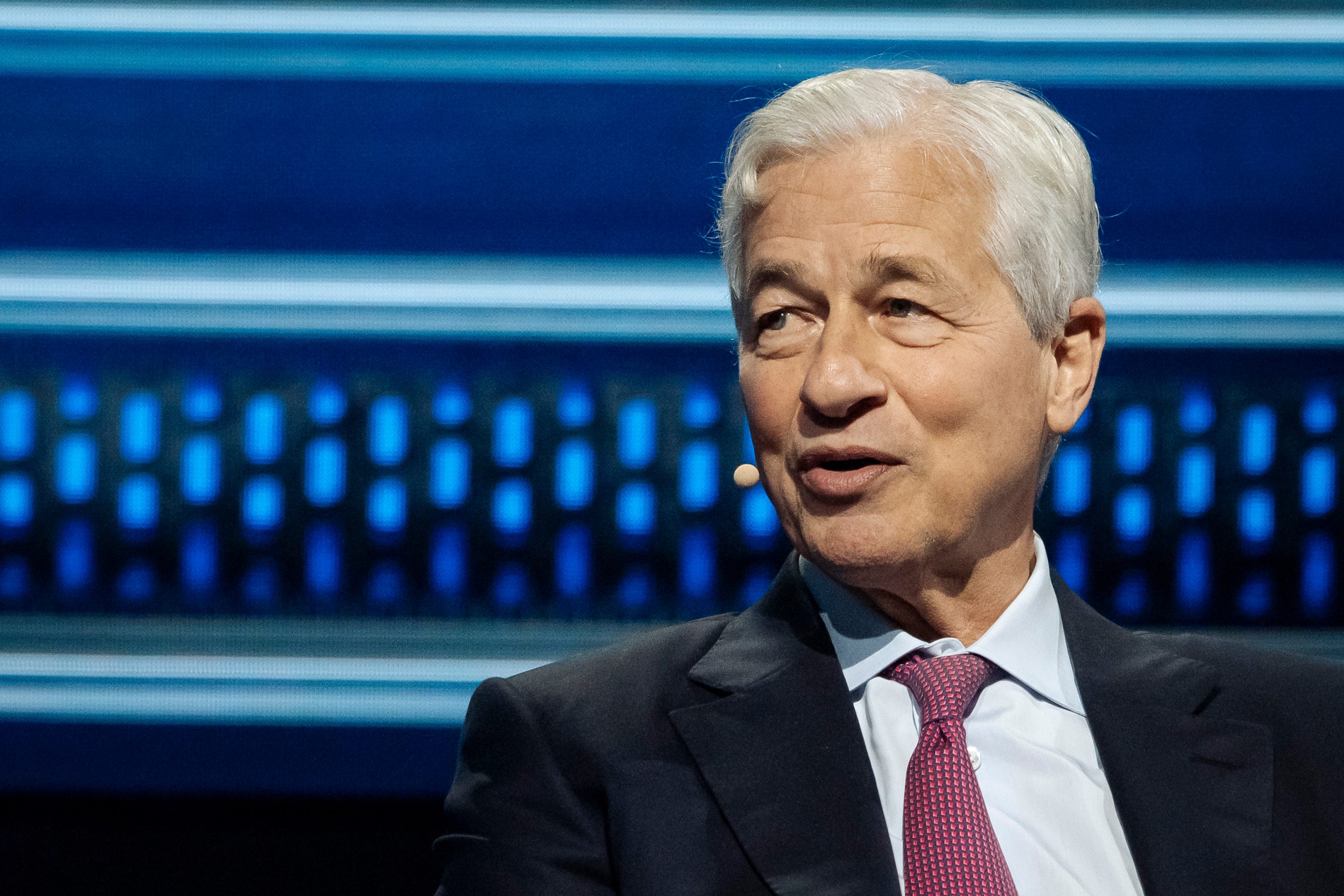
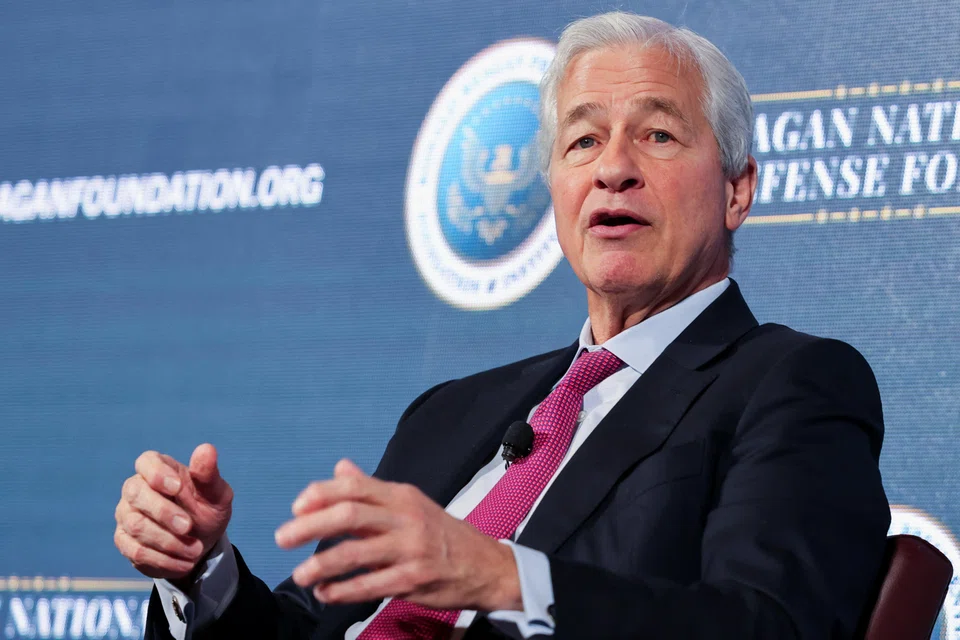
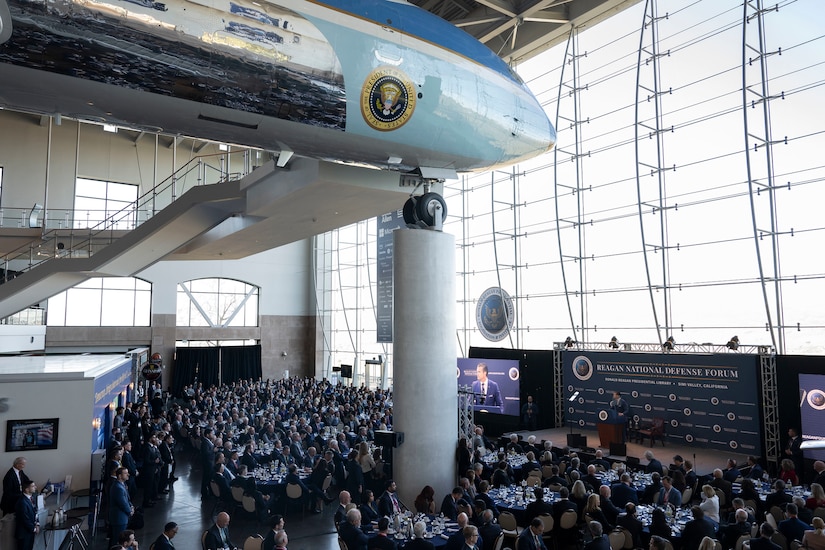
- “Europe has a real problem,” Dimon said Saturday at the Reagan National Defense Forum.
- “They do some wonderful things on their safety nets. But they’ve driven business out, they’ve driven investment out, they’ve driven innovation out. It’s kind of coming back.”
While he praised some European leaders who he said were aware of the issues, he cautioned politics is “really hard.”
- On Saturday, he praised the creation of the euro and Europe’s push for peace. But he warned that a reduction in military efforts and challenges trying to reach agreement within the European Union are threatening the continent.
The administration of President Donald Trump issued a new national security strategy that directed US interests toward the Western Hemisphere and protection of the homeland while dismissing Europe as a continent headed toward “civilizational erasure.”
JPMorgan has been ramping up its push to spur more investments in the national defense sector. In October, the bank announced that it would funnel $1.5 trillion into industries that bolster US economic security and resiliency over the next 10 years — as much as $500 billion more than what it would’ve provided anyway.
Dimon said in the statement that it’s “painfully clear that the United States has allowed itself to become too reliant on unreliable sources of critical minerals, products and manufacturing.”
- supply chain and advanced manufacturing;
- defense and aerospace;
- energy independence and resilience; and
- frontier and strategic technologies.
The bank will also invest as much as $10 billion of its own capital to help certain companies expand, innovate or accelerate strategic manufacturing.
Separately on Saturday, Dimon praised Trump for finding ways to roll back bureaucracy in the government.
“There is no question that this administration is trying to bring an axe to some of the bureaucracy that held back America,” Dimon said. “That is a good thing and we can do it and still keep the world safe, for safe food and safe banks and all the stuff like that.”




Hegseth Outlines New National Defense Strategy During Speech at Reagan Library
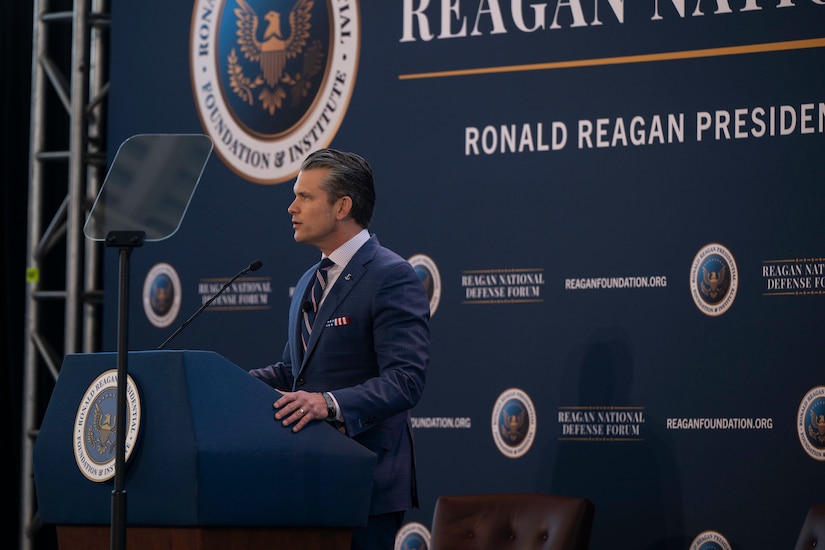
During a keynote speech that one Pentagon official speaking on background said represented a preview of the War Department's forthcoming National Defense Strategy, Secretary of War Pete Hegseth today outlined four distinct lines of effort for the department to take, so as to guarantee peace through strength for the U.S. and its allies in the coming years.
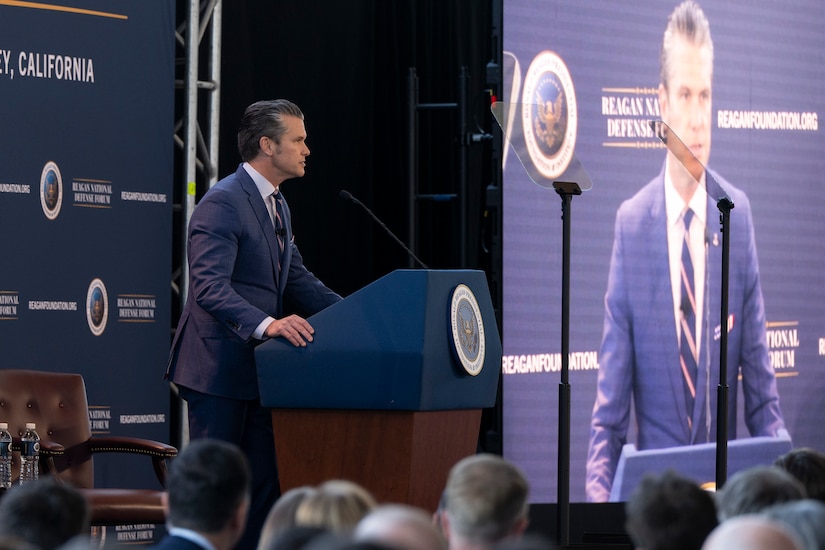
While delivering his remarks at the Ronald Reagan National Library's annual defense forum in Simi Valley, California, Hegseth underscored numerous parallels that he believes exist between the military strategies and policies of presidents Reagan and Donald J. Trump, while also emphasizing his view on the current president's commitment to strengthening the U.S. military.
"Make no mistake about it: President Trump is hellbent on maintaining and accelerating the most powerful military the world has ever seen; the most powerful, the most lethal and American-made … the Arsenal of Freedom," Hegseth said.
He added that the War Department is also working to get back to basics on the topics of restoring the warrior ethos, readiness, accountability, standards, discipline and lethality.
Hegseth also said that the Trump administration and the War Department are committed to putting America first and avoiding getting into seemingly unending foreign entanglements, as well as prioritizing the nation's security, freedom and prosperity of its citizens.
"We're doing it in a way that leaves not only our nation better off, but the world. Out with utopian idealism, and in with hard-nosed realism," he said.
To achieve those goals, Hegseth said it's necessary to prioritize the aforementioned "four key lines of effort" at the War Department: defending the U.S. homeland and its hemisphere; deterring China through strength rather than force; increasing burden sharing between the U.S. and its allies and partners; and supercharging America's defense industrial base.
Speaking on the first topic of defending the U.S. homeland and its citizens, Hegseth said that since Jan. 20 and under Trump's direction, the War Department has made increasing security at the southern border and gaining 100% operational control a top priority.
"We did so by surging forces, where our troops partner with [the Department of Homeland Security] and [U.S Customs and Border Protection] to seal the border," Hegseth said, adding that the number of illegal border crossings today is at virtually zero.
He added that the War Department is proud to support law enforcement in the deportation of dangerous criminals here illegally and that the War Department and its interagency partners are leaning on the U.S. Mexican counterparts to do their part to combat illegal immigration and drug trafficking.
- "These narco-terrorists are the al-Qaida of our hemisphere, and we are hunting them with the same sophistication and precision that we hunted al-Qaida," Hegseth said, adding that our allies in the region are also aiding in combating narco-terrorism.
On the issue of China, Hegseth said that, thanks to the leadership of President Trump, relations between the U.S. and China are stronger than they have been in many years.
"President Trump and this administration seek a stable peace, fair trade and respectful relations," Hegseth said, adding that the War Department is committed to opening a wider range of military-to-military communications with China's People's Liberation Army aimed at de-confliction and de-escalation.
"This line of effort is based on flexible realism … an approach aimed not at domination, but rather a balance of power ... that will enable all of us, all countries, to enjoy a decent peace in the Indo-Pacific, where trade flows openly and fairly, where we can all prosper and all interests are respected," Hegseth said.
"That's the world that we see in the Indo-Pacific, and that is what our approach is designed to produce," he added.
- On increasing burden sharing with U.S. allies around the world, Hegseth said that many who have shaped U.S. foreign policy have "lost the plot" when it comes to treating our allies as if they are incapable of helping themselves.
- Noting that NATO countries have recently agreed to spend 5% of their gross domestic product on their defense, Hegseth said the Trump administration now hopes to apply that template to U.S. allies all around the globe.
"In a few years, thanks to President Trump's visionary leadership, we will have our allies — which include some of the wealthiest and most productive countries in the world — once again fielding combat credible militaries and more state-revived defense industrial industries," Hegseth said.
Along the fourth line of effort — defense industrial buildup — which he believes may be the the most important, Hegseth said that "supercharging" America's defense industrial base underwrites all other lines of effort.
"Our objective is simple, if monumental: transform the entire acquisition system to rapidly accelerate the fielding of capabilities and focus on results," he said.
Hegseth said the key to that objective is moving away from the current, prime contractor-dominated, low-competition defense industrial base to "a future powered by dynamic vendor space that accelerates production by combining investment at a commercial pace, with the uniquely American ability to scale and scale quickly."
"We owe safety, freedom and prosperity to the American people; and we will deliver."


No comments:
Post a Comment