
MOST READ

Books
The Real Leaf Readers
For almost 100 years, American tea lovers were protected by an elite group of tasters who controlled the quality of imports. Then they were summarily tossed out. Why—and what happened after—is a bitter brew indeed.
Sign up for the Slatest to get the most insightful analysis, criticism, and advice out there, delivered to your inbox daily.
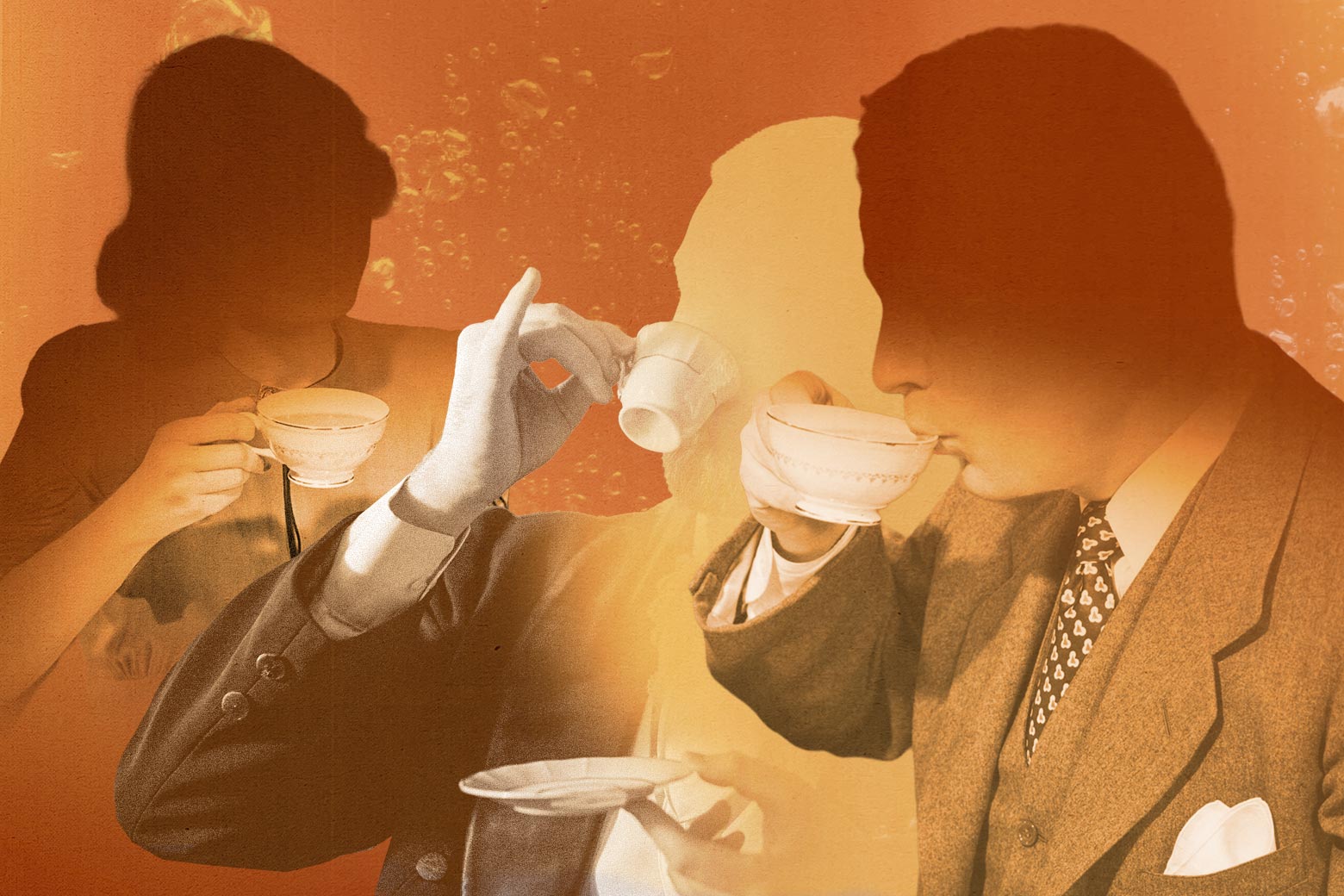
On a winter morning in early 1995, three women and five men sat nearly elbow-to-elbow at a round wooden table in an office on the Brooklyn waterfront as rain battered the windows. In front of them were canisters, spoons, spittoons, and myriad teacups. A kettle steamed nearby. Tea soon began to flow, and the group got to work.
These assembled were the Board of Tea Experts: a cohort of tea industry professionals who were summoned once a year by the United States Food and Drug Administration to meet in New York and choose the teas that would serve as standards by which all other imported tea would be judged. The standard for each tea category was chosen based on leaf size, stem count, color, taste, and other criteria. Over the course of a few hours, the board tasted dozens of teas—rolling each sip on their tongues and then spitting it out to avoid overcaffeination—and deliberated until they could unanimously agree on one benchmark product for each category. Specialty tea hadn’t taken off yet with American consumers, so the categories were broad: “formosa oolong,” “all green teas,” “all scented black teas,” and not many others.
But that day, as the board members worked and enjoyed the camaraderie of colleagues they only got to see once a year, they did not know it would be the last time. Soon, the chair of the board, Supervisory Tea Examiner Bob Dick, would be forced by an act of Congress to vacate this office, where he had taste-tested thousands of teas over more than 40 years. After a 99-year run rife with controversy, the FDA’s tea program would be defunded and cease to operate. The consequences of that decision still linger today, dictating how tea is imported and ultimately affecting how it is experienced by the Americans who drink it—and not necessarily for the better.
In the 19th century, much of the tea coming to the U.S. was the low-quality leftovers that British tea sellers did not want, or it was compromised for the sake of profit. Imported teas were often mixed with spent and redried leaves, colored with toxic dyes, mixed with lead filings to weigh them down, or otherwise altered to imitate higher grades. This was a public health concern, and it threatened the reputation of legitimate importers. The Tea Importation Act of 1897 arose as a governmental effort to protect consumers, but it was also strongly supported—and in part shaped—by those in the U.S. tea trade, who saw it as a way to protect themselves from unfair competition by those selling cheap or adulterated teas.
The act prohibited the importation of teas unfit for consumption, defined the Board of Tea Experts, and established the relationship between the board and the tea examiners, who at that time were U.S. Customs officials. The program became more sophisticated after the FDA was established and oversight of the tea examination passed from Customs to the FDA.
Bob Dick started his work with the FDA in 1937 as a seafood inspector in New Orleans, but because that was only a seasonal role, he was assigned to the New York office for the other half of the year to inspect tea samples. A tea examiner was stationed at each of the major port cities—New York, Boston, New Orleans, and San Francisco. The inspectors would go onto a ship, use a special tool to bore into the wooden tea chests, take out a sample from each chest, put the samples in bags and label them, then plug the holes in the chests with corks. They hauled the samples back to their labs in “suitcase-type sample carriers,” as Dick described them in a 1984 interview produced by the FDA, and inspected them by comparing their quality and taste with those of the standard teas that had been chosen for that year. Depending on how they measured up, they would either be deemed acceptable for import or rejected and sent back to their place of origin.
After more than a decade of inspecting various products for the FDA, Dick was promoted to Supervisory Tea Examiner in 1953, making him the third—and, unbeknownst to him at the time, final—head of the tea program. He relocated permanently to New York.
You might think that tea tasting would be a relaxing, if somewhat stimulating, profession, and it might have been at times. But the program was also a source of tension throughout the 20th century. In 1940, Congress tried to repeal the act as a money-saving move. Then tea industry lobbyists appeared before a congressional committee and vowed to subsidize the program in order to save it. The act protected them, so it was well worth whatever they would have to pay. Congress agreed, and the subsidies began.
Then in 1970, the Nixon administration proposed budget cuts in several areas. Nixon publicly stated that cutting the tea program would save $1 million, which made it a popular idea, but he was incorrect: The program’s actual cost was only $60,000 at that time, and the tea industry subsidies covered it. The administration also was unaware that the program was protected by a congressional act, and therefore only Congress could repeal it. Tea industry leaders once again lobbied to keep the act in place, and their efforts were successful.
The cycle continued: “The same thing happened again later on during the Carter administration,” Dick said. “They found out too, the same thing—that Congress must act.”
In the following decade, members of Congress called the program “nonsense” and “unnecessary.” Former Sen. Harry Reid, a Democrat from Nevada, was particularly vocal about his position in several speeches on the Senate floor throughout the early ’90s. “I also, Mr. President, want everyone to know here that I think that the Tea Board that was established in 1897 is one of the biggest wastes that I could have imagined in government,” he said during a 1993 speech addressing Bill Clinton on the Senate floor. “What we need, I think, is a congressional tea party, and we should dump the whole Board of Tea Experts overboard. It seems inappropriate, Mr. President, and I think morally inappropriate to expend taxpayer money for such a program.”
Opponents of the program finally succeeded in 1996. Bob Dick packed up the tea and paraphernalia from his office. He died a few months later at age 82.
As president of a tea importing company called G.S. Haly, Mike Spillane was among the final board members in 1995. When the Tea Act was repealed, he had mixed feelings.
“It was like a watchdog of the industry. I was for that,” he says. “But I also did not mind that once it was gone, I could save four or five days of delay on my shipments because it wasn’t held up by the tea examiner anymore.”
But things got complicated. In the absence of the Tea Act, tea was now subjected to the same inspections as any other imported food products. There were at least two big problems: Many of the tea importers didn’t understand the new rules they had to operate under, and Maximum Residue Limits of various agrochemicals had never been set for tea products before. Because of the lack of clarity, a lot of tea was rejected on arrival and sent back to its origin.
Peter Goggi, a former president of the Tea Association of the USA who retired only earlier this month, served multiple terms on the Board of Tea Experts in its active years. When the Tea Act was repealed, he was working with Lipton. For more than a decade following the repeal, only three chemicals were allowed, while Goggi and others advocated for the need to expand the list. Then in 2008, after 40 shipping containers of tea were rejected, the Tea Association started working with the U.S. Department of Agriculture and the Environmental Protection Agency to identify safe levels of common agrochemicals specifically applicable to tea. Since then, the FDA has updated their list to allow more than 50, which has solved the over-rejection issue.
Goggi says this system is mostly sufficient, though it’s still missing a key element that the Tea Act used to sanction: the taste test. Now imported teas might check all of the boxes for purity and safety, but still taste bad. There is no check for whether the tea’s aroma has dissipated, or maybe was never there at all; no judgment of whether it has a taste that properly represents the way it is labeled. Perhaps the import of poor-tasting tea is one of the reasons so many modern Americans say tea is bitter or bland.
The demise of the Tea Act was an instance of men in power deeming a program unnecessary without adequately taking into account the complexity of the consequences. As we see today in examples like the U.S. Agency for International Development, the National Science Foundation, the Centers for Disease Control, and many other agencies, slashing funding while experts on the ground sound the alarm about detrimental effects has been the norm since Donald Trump’s administration took office last year. Though cuts to these programs have been more severe and the subsequent implications for people’s health and well-being are more serious than anything related to the Tea Act, their demise was brought on by similar forces, leaving those closest to the work to pick up the pieces themselves.
“It’s one thing to sit on high and say, ‘What could this possibly do? Let’s cut it down,’ ” Goggi says. “But nobody is aware of the knock-on effects. We had a process that was in place for 100 years and worked very well. We ended up with a much more cumbersome kind of process.”
That, and quite possibly a worse cup of tea."





















No comments:
Post a Comment