Saturday, October 02, 2021
THE DIGITAL DIVIDE: We're not even beginning to ask the right questions, much less acknowledge the real origins of the problem
The 'Digital Divide' Didn't Just Show Up One Day. It's The Direct Result Of Telecom Monopolization
from the can't-fix-what-you-don't-acknowledge dept

But notice when regulators, politicians, and many news outlets discuss the problem, it's usually framed in this nebulous, causation free way. About 90% of the time, the problem is dubbed the "digital divide." But the cause of this broadband divide is always left utterly nebulous and causation free. It's almost pathological.
Seriously, look at any news story about the "digital divide" in the last three months and try to find one that clearly points out that the direct cause of the problem is regional telecom monopolies and the corruption that protects them. You won't find it.
This phenomenon again showed up this week in a CNET interview with Jessica Rosenworcel, who appears to be the top candidate in the Biden Administration's glacial pursuit of a permanent FCC boss. In the article, CNET talks repeatedly about the U.S. broadband problem without once mentioning that telecom monopolies exist, and are the primary reason U.S. broadband is painfully mediocre:
"According to a study last year by the New America Foundation's Open Technology Institute, the US has the highest average monthly internet prices when compared to other countries in North America, Europe and Asia. On average, the monthly bill in the US is $84.37, which includes $68.38 for internet service and $15.99 for equipment rental fees.
"What's become clear is that affordability is a really big issue in the digital divide," she said. "And we're going to need programs like the EBB to help solve it."
> Again, please notice how expensive, shitty broadband is just this thing that exists for some nebulous reason. That Comcast, Charter, Verizon, and AT&T have lobbied for thirty years to create a favorable policy environment that harms competition and prioritizes their bloated revenues doesn't even get a sentence. It's just this bizarre act of omission driven by, you'd have to imagine, a fear of upsetting sources and advertisers. Or in the case of politicians and regulators, powerful telecom lobbyists that can make or break your career.
 Please notice the word "competition" isn't even used once in an interview with a top U.S. telecom regulator about the state of U.S. broadband, where the primary issue remains a lack of competition. The article almost acknowledges the U.S. telecom monopoly problem when it discusses "digital redlining," or the documented tendency of regional telecom monopolies like AT&T to refuse to upgrade low income or minority neighborhoods (while simultaneously lobbying for laws preventing them from building their own broadband networks).
 But even here the problem is addressed in this causation-free, nebulous way:
I think the fact that we're having a conversation about digital redlining is a good thing. We've got communities in this country that for too long have been overserved or underserved and overlooked. We've got to figure out how to address that.
Clearly and accurately calling out regional telecom monopolies is just viewed as...impolite in DC and much of the "he said, she said," access-motivated U.S. press.
But you can't fix a problem you refuse to even acknowledge. And when it comes to regional telecom monopolization and the corruption that protects it, we're not even beginning to ask the right questions, much less acknowledge the real origins of the problem.
____________________________________________________________________________
BLOGGER INSERT RELATED CONTENT
This map shows where the broadband problem is worst — the areas where the difficulty of reliably connecting to the internet has gotten bad enough to become a drag on everyday life. Specifically, the colored-in areas show US counties where less than 15 percent of households are using the internet at broadband speed, defined as 25Mbps download speed. (That’s already a pretty low threshold for calling something “high-speed internet,” but since it’s the Federal Communications Commission’s standard, we’ll stick with it.)
Maps like this are important because, for much of the past decade, the scale of the problem has been maddeningly difficult to pin down. Most large-scale assessments of American broadband access rely on FCC data, a notoriously inaccurate survey drawn from ISPs’ own descriptions of the areas they serve. Even as the commission tries to close the broadband gap, its maps have been misleading policymakers about how wide the gap really is.
Instead of the FCC’s data, we drew on an anonymized dataset collected by Microsoft through its cloud services network, published in increments by the company over the past 18 months. If the FCC monitors the connections that providers say they’re offering, this measures what they’re actually getting. You can roll over specific counties to see the exact percentage of households connected at broadband speed, and the data is publicly available on GitHub if you want to check our work or drill down further. It’s not a perfect dataset, since device speeds can also be affected by bad routers or slow processors that have nothing to do with the underlying connection. But for better or worse, these are the speeds users actually experience, which puts the dataset worlds ahead of what you’d get from the FCC.

Thank you for reading this Techdirt post. With so many things competing for everyone’s attention these days, we really appreciate you giving us your time. We work hard every day to put quality content out there for our community.
Techdirt is one of the few remaining truly independent media outlets. We do not have a giant corporation behind us, and we rely heavily on our community to support us, in an age when advertisers are increasingly uninterested in sponsoring small, independent sites — especially a site like ours that is unwilling to pull punches in its reporting and analysis.
While other websites have resorted to paywalls, registration requirements, and increasingly annoying/intrusive advertising, we have always kept Techdirt open and available to anyone. But in order to continue doing so, we need your support. We offer a variety of ways for our readers to support us, from direct donations to special subscriptions and cool merchandise — and every little bit helps. Thank you.
–The Techdirt Team
Knocking-The-Hustle In Southeast Mesa/District 6: City Manager Chris Brady Wants To Speed-Up Fast-Tracking for A Water-Guzzling 'Sports Complex'

Out in the open and an Exclusive that skims-the-surface and pours-on all the Hype & Hoopla that can heaped on a public relations gambit
 Holy Bullshit again, Batman!
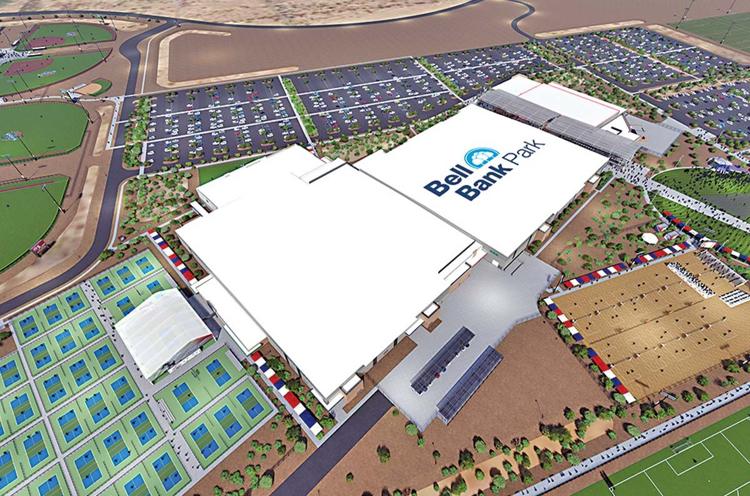
  Before a single softball is pitched or volleyball served on the under-construction park, the company – partnering with Oak View Group Facilities – already is making back some of its money.
  “The 320-acre complex will be called Bell Bank Park, designed to host youth and amateur sports teams and individual and team training, family fun via events, concerts, youth sports tournaments, and fitness opportunities,” the announcement last week stated. “It will be the largest of its kind in North America.”
  You name it in the sports world, they got it. Indoor and outdoor facilities will host soccer, baseball, softball, football, lacrosse, basketball, volleyball, pickleball, gymnastics, cheer, dance, obstacle course racing – plus eSports and high-level fitness training.
(OK. and don't forget gambling and betting on the new industry of e-Sports)
“One of the things we pride ourselves on is it’s not just a sports complex but a true entertainment district. There’s going to be something for everyone from 5 to 95, whether you play sports or just want to go out and walk around and hear music,” Legacy CEO Chad Miller told the Tribune in mid-March.
 Even before receiving official zoning approval, and even before Mesa officially annexed the former “county island,” Miller’s bulldozers were moving dirt near East Pecos and South Ellsworth roads.
The Mesa City Council gave Miller and company the green light, fast-tracking the construction project.
“As a family-owned company, it’s been especially meaningful to us to connect with the Miller family at Legacy Sports USA,” Bell Bank CEO Michael Solberg said.
Founded in 1966 in Fargo, N.D., Bell Bank now has locations in Arizona, North Dakota and Minnesota and more than $10 billion in assets. Bell Bank also has a “pay it forward” program, giving every full-time employee $1,000 and every part-time employee $500 each year to give as they choose to individuals, families and organizations in need.
“Bell Bank Park will be a special place to compete and train, and gather with family and friends to enjoy sports and live entertainment,” Miller promised. And, OVG Chairman Peter Luukko chimed in, “Bell Bank Park will be the premier destination for aspiring athletes, sports enthusiasts. It will be the ultimate place to train, play and enjoy live events.”
> Miller and Luukko already booked tournaments from pickleball to softball, planning to hit the turf running in 2022.

They expect 5 million visitors every year for the area just south of the Eastmark and Cadence communities."
___________________________________________________________________________
>> BLOGGER NOTE THERE WAS A LIQUOR LICENSE APPLICATION BACK IN AUGUST 2021
Including :Item *3-d Legacy Sports USA
File #: 21-0853
Type: Liquor License Application Status: Agenda Ready
In control: City Council
On agenda: 8/23/2021
Title: Legacy Sports USA A sports complex is requesting a new Series 06 Bar License for Legacy Sports USA LLC, 6321 South Ellsworth Road; Andrea Dahlman Lewkowitz, agent. There is no existing license at this location. (District 6)
Attachments: 1. Background,
2. Calls For Service,
3. Map
_____________________________________________________________________________
RELATED CONTENT ON THIS BLOG 10 MARCH 2021

PLEASE NOTE: Besides the Legacy Sports Park, OVG was recently selected to manage the $115 million multipurpose arena that Arizona State University is building in Tempe for the school’s hockey program, as well as other sporting competitions and events.
THERE'S A LOT OF INFORMATION TO PROCESS > TRY THIS ONE ON
Massive multisport facility under construction in Mesa gets first general manager, new events

| File #: | 21-0296 |
| Type: | Presentation | Status: | Agenda Ready |
| In control: | City Council Study Session |
| On agenda: | 3/11/2021 |
| Title: | Hear a presentation and discuss a proposed development project known as “Legacy Sports Park”, generally located at the southeast corner of South Ellsworth Road and East Williams Field Road, and related pre-annexation development agreement. |
| Attachments: | 1. Presentation |
=======================================================================
HOW ABOUT THIS:
"Though many are familiar with this as a party game to be played with the hand not holding a beer, cornhole has become a serious sport.
Indeed, there’s a professional cornhole league – and it’s headed to Mesa. . .And a pro league is headed to one of the biggest sports facilities planned for the East Valley.
This week, Legacy Sports USA announced a partnership with the American Cornhole League to host an ACL Pro event at Legacy Sports Park every June for the next five years. . .“We are stoked to be heading to Legacy Sports Park over the next five years. The facility is an ultimate sports destination that will be a perfect fit for cornhole players and athletes,” said ACL Chief Marketing Officer Trey Ryder.
. . .The league is also focused on continuing to grow the sport “for any age and any skill level.”
11 July 2021
=========================================================================
A RIPPLE FROM THE PAST
11 April 2019
Friday, October 01, 2021
Arizona's Off-Center Senator Sinema Tilting To An Extreme Democrat of A Different Shade of Red
Appetizer from Jon Tilton
September 27, 2021
The extremists
Gage Skidmore photo
Will Rogers quipped, "I am not a member of any organized political party. I am a Democrat." This was during the 1930s, when FDR's New Deal was made possible by an uneasy coalition of northern and midwestern big-city party bosses, unions, farmers, and Southern segregationists. Somehow it worked and the nation was saved.
Now, at another moment of national peril, the Democrats are not merely disorganized but deeply divided and nobody's laughing. Their time to make constructive moves on historic public investments in infrastructure, improve living standards, and return to progressive taxation is running down. If they fail and we get a Republican-controlled Congress next year and Donald Trump’s second term in 2024, we'll know who to blame.
In the past I've been willing to cut Sen. Kyrsten Sinema a break, tacking right sometimes to be viable in a red-purple state. It's in the "pinto" tradition of Arizona Democrats such as Carl Hayden. But in the Biden years, she's hardened into an extremist, deliberately blocking the president’s agenda when Democrats have momentary control of both houses of Congress. Like West Virginia Sen. Joe Manchin, she's no "centrist." She's a destructive force who might as well be a Republican. And, like Manchin, she stands to profit from industries that oppose the Biden budget.
And they aren't the only ones.

-
 Flash News: Ukraine Intercepts Russian Kh-59 Cruise Missile Using US VAMPIRE Air Defense System Mounted on Boat. Ukrainian forces have made ...

