Tuesday, May 23, 2023

Russian troops smash Ukrainian terrorists in Belgorod Region | Tass + other news agencies

 We have to make clear that there is a very hot information war being fought on all sides. Because of the fluid nature of the situation we can only convey the state of play as proclaimed by those involved and their surrogates and via open source information.

23 May, 07:08
tass.com

Russian troops smash Ukrainian terrorists in Belgorod Region 

TASS
4 - 6 minutes

"The Russian military blocked and wiped out Ukrainian nationalist formations in the Belgorod Region during a counterterror operation

MOSCOW, May 23. /TASS/. As part of a counterterror operation, the Russian military wiped out the Ukrainian nationalist formations that infiltrated the Grayvoronsky District in the Belgorod Region on Monday, Russian Defense Ministry Spokesman Lieutenant General Igor Konashenkov said on Tuesday. Some 70 Ukrainian terrorists have been eliminated. According to the latest data, no civilians have been killed as a result of the sabotage group’s actions and 12 people were injured. An elderly woman died during evacuation.

TASS has put together the latest information about the situation in the Belgorod Region.

Elimination of Ukrainian saboteurs

- The Russian military blocked and wiped out Ukrainian nationalist formations in the Belgorod Region during a counterterror operation. The terrorists infiltrated Russian territory on May 22 after shelling the Kozinka border checkpoint and a number of other civilian facilities, the Russian Defense Ministry specified.

- The nationalist formations were blocked and eliminated by air strikes, artillery fire and active actions from the state border security units of the Western Military District. Over 70 Ukrainian terrorists have been wiped out. The Russian military pushed the remnants of the sabotage group back to Ukraine where they continued to fire on them until they were completely eliminated.

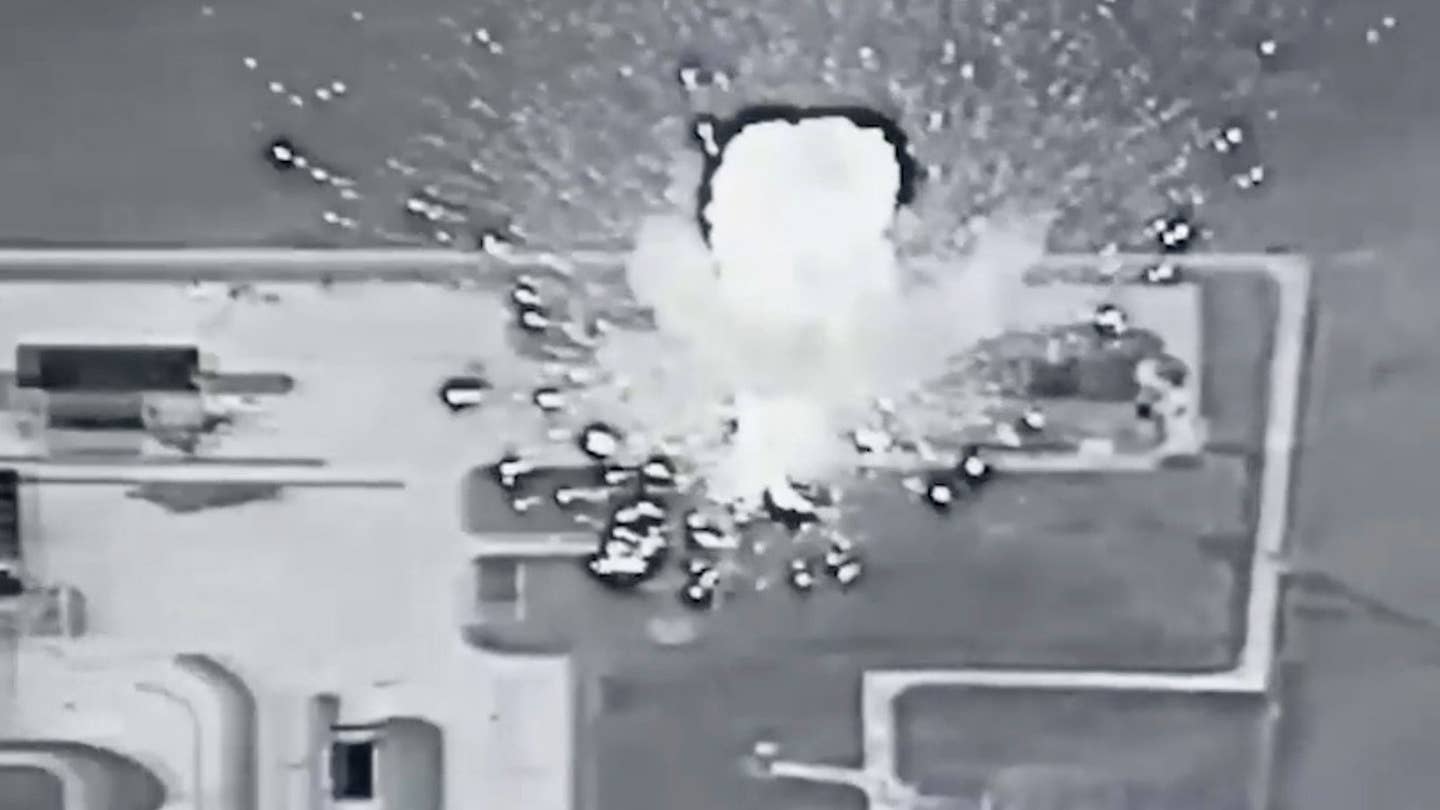
- Russian troops also destroyed four armored combat vehicles and five pickup trucks.

Situation in region

-Over the past 24 hours, Ukrainian troops shelled about 20 communities in the Belgorod Region, regional Governor Vyacheslav Gladkov said. They used a multiple-launch rocket system and dropped explosive devices on residential buildings and people using drones.

- Some 29 residential buildings and three vehicles have been damaged. Power outages have been registered in 14 populated localities. It will be possible to begin restoring service as soon as the situation allows, the governor clarified.

- Ukraine has launched an unprecedented information attack on the region’s inhabitants, spreading rumors that tanks are entering the region and that a nuclear catastrophe looms. Ukraine’s goal is to intimidate people and spread panic in the region, the governor said, urging that only official information be trusted.

Evacuation of residents

- The inhabitants of nine communities have been evacuated due to the infiltration by Ukrainian saboteurs. They are Grayvoron, Novostroyevka, Gorkovsky, Bezymeno, Mokraya Orlovka, Glotovo, Gora Podol, Zamostye and Spodaryusheno.

- The regional governor does not recommend the residents of the Grayvoronsky District return home. According to him, the authorities will let people know when it is safe to do so.

- Residents who were evacuated earlier are staying at temporary accommodation centers in Stary Oskol and the Yakovlevsky and Ivnyansky districts.

Number of casualties

- According to Gladkov, 12 people have been wounded in bombardments by Ukrainian troops. On Monday, he reported that eight people had been injured as a result of Ukrainian saboteurs infiltrating the Grayvoronsky District.

- No civilians have been killed as a result of the actions of the Ukrainian saboteurs.

- Two wounded civilians who had been in the populated localities infiltrated by the enemy where Russian forces had been unable to reach them immediately, were hospitalized.

- A woman born in 1941 died while being evacuated. She was on a bus with her son and daughter-in-law. The cause of her death is being established.

Reaction by authorities

- Russia’s Investigative Committee opened a criminal case on charges of terrorism, attempts on the lives of members of law enforcement, attempted murder, premeditated property damage and illegal arms and explosives trafficking.

- Investigators are establishing the attackers’ identities.

- The incursion by Ukrainian saboteurs caused deep concern in the Kremlin, Putin’s press secretary Dmitry Peskov said. There are no plans to hold a special session of the Russian Security Council over these events. A regular meeting will be held later this week.

Ukraine’s actions

- The authorities of the Sumy Region in Ukraine announced the evacuation of residents from a number of localities in the Akhtyrsky District close to the Belgorod Region’s border." 

RELATED CONTENT 

5 hours ago · Combat aircraft, artillery and Russian troops destroyed over 70 Ukrainian saboteurs in the Belgorod Region in the counter-terror operation, ...
Russian troops smash Ukrainian terrorists in Belgorod Region: TASS News Agency. 16 mins ago May 23, 2023.
11 hours ago · Moscow has claimed to have repelled an attack led by Ukraine-aligned militias that led to a series of chaotic battles on Russian territory ...
Russian troops smash Ukrainian terrorists in Belgorod Region, Russian Defense Ministry Spokesman Lieutenant General Igor Konashenkov said: ...
6 hours ago · Russian troops smash Ukrainian terrorists in Belgorod Region. Mirror African TV. Mirror African TV. 4.73K subscribers. Join. Subscribe.
22 hours ago · The governor of Russia's Belgorod region said on Monday that a Ukrainian "sabotage group" had entered Russian territory in the Graivoron ...
Missing: smash | Must include:smash
4 hours ago · TALLINN, Estonia (AP) — Russia alleges that dozens of Ukrainian militants crossed into one of its border towns in its Belgorod region, ...
Russian troops smash Ukrainian terrorists in Belgorod Region from english.alarabiya.net
1 day ago · Russia's authorities introduced on Monday an “anti-terror regime” in the Belgorod region after Moscow accused a Ukrainian “sabotage” group ... 

www.news4jax.com

Russia claims it repelled one of war's most serious cross-border attacks

Associated Press
7 - 8 minutes

"KYIV – Russia's military said Tuesday it quashed what appeared to be one of the most serious cross-border attacks from Ukraine since the war began, claiming to have killed more than 70 attackers in a battle that lasted around 24 hours.

Moscow blamed the raid that began Monday on Ukrainian military saboteurs. Kyiv portrayed it as an uprising against the Kremlin by Russian partisans. It was impossible to reconcile the two versions, to say with certainty who was behind the attack or to ascertain its aims.

The battle — which took place in southwest Russia's Belgorod region, about 80 kilometers (45 miles) north of the city of Kharkiv, in eastern Ukraine — was a fresh reminder of how Russia itself remains vulnerable to attack, along with Russian-occupied regions of Ukraine.

The region is a Russian military hub holding fuel and ammunition depots and was included in Russian President Vladimir Putin's order last year to increase the state of readiness for attacks and improve defenses.

Kremlin spokesman Dmitry Peskov refused to say how many attackers were involved in the assault or comment on why efforts to put down the attackers took so long.

Such cross-border attacks embarrass the Kremlin and highlight the struggles it faces in its bogged-down invasion of Ukraine.

The Belgorod region, like the neighboring Bryansk region and other border areas, has witnessed sporadic spillover from the war, which Russia started by invading Ukraine in February 2022.

Far from the 1,500-kilometer (932-mile) front line in southern and eastern Ukraine, Russian border towns and villages regularly come under shelling and drone attacks, but this week's attack is the second in recent months that also appears to have involved an incursion by ground forces. Another difference from earlier cross-border attacks is that Russia's effort to repel it continued into a second day for the first time.

Russian Defense Ministry spokesman Igor Konashenkov claimed local troops, air strikes and artillery routed the attackers.

“The remnants of the nationalists were driven back to the territory of Ukraine, where they continued to be hit by fire until they were completely eliminated,” Konashenkov said, without providing evidence. He did not mention any Russian casualties.

Russian forces destroyed four armored combat vehicles and five pickup trucks the attackers used, he said. Local officials alleged the invaders also used drones and artillery.

The governor of the Belgorod region, Vyacheslav Gladkov, said the raid targeted the rural area around Graivoron, a town about 5 kilometers (3 miles) from the border. Twelve civilians were wounded in the attack, he said, and an older woman died during an evacuation.

The Russian news portal RBK, quoting unidentified sources in the regional interior ministry and territorial police, said Graivoron came under heavy shelling that lasted about five hours early Monday. After that, tanks fired at the Graivoron border checkpoint while the adjacent village of Kozinka came under mortar and rocket fire, RBK said, citing the same sources. Gladkov later reported that a Koznika villager had been killed.

The attacking force was made up of 10 armored vehicles and an unspecified number of troops, RBK said.

Earlier Tuesday, the regional governor urged residents who had evacuated not to return home until they received official instructions to do so. He said a “counterterrorism operation” was completed by early Tuesday evening.

Gladkov also said fire from the Ukrainian side of the border on Tuesday hit the Borisovka area, about 20 kilometers (20 miles) northeast of Graivoron. No casualties were reported, he said without elaborating on the incident.

The regional governor complained in a video late Tuesday that federal authorities' claims for the past year that “everything is under control” do not ring true in light of this attack and prior assaults. He appealed again to the Kremlin to strengthen defenses.

Since the war began, drones, explosions and missiles have hit fuel and ammunition depots, railroad equipment, bridges and air bases on Russian territory and Russia-occupied areas of Ukraine. Assassinations of Russian-appointed government officials and other public figures have also taken place in those areas.

Ukraine said Russian citizens belonging to murky groups called the Russian Volunteer Corps and the Freedom of Russia Legion were behind the assault.

Ukrainian Deputy Defense Minister Hanna Maliar said the attackers were Russian dissidents unhappy about Putin’s policies.

“These are Russian patriots, as we understand it. People who actually rebelled against the Putin regime,” she said.

The Freedom of Russia Legion said on Telegram the goal was to “liberate” the region.

The Russian Volunteer Corps implied on Telegram that the attack was over, adding: “One day, we’ll come to stay.” The post went up at around the same time as the Russian Defense Ministry claimed to have quashed the assault.

The U.K. Defense Ministry said it was “highly likely” that Russian security forces were fighting partisans in at least three locations in Belgorod.

Russia is facing an increasingly serious multi-domain security threat in its border regions, with losses of combat aircraft, improvised explosive device attacks on rail lines and now direct partisan action,” it said Tuesday.

Russia’s Investigative Committee, its top law enforcement agency, announced an investigation into alleged terrorism and attempted murder in connection with the raid.

Belgorod officials earlier this year said they had spent nearly 10 billion rubles ($125 million; 116 million euros) on fortifications to protect the region.

Peskov, the Kremlin spokesman, said the raid “elicits deep concerns” and that a "bigger effort” was required to prevent future attacks.

The Russian Volunteer Corps claimed to have breached the border in early March. The shadowy group describes itself as “a volunteer formation fighting on Ukraine’s side.” It's not clear if it — or the Freedom of Russia Legion — has any ties with the Ukrainian military.

Elsewhere, Ukrainian forces made minor progress against Russian forces on the edge of Bakhmut, the eastern Ukrainian city that Moscow claims to have captured, according to Maliar, the Ukrainian deputy defense minister.

She said Tuesday that Ukrainian troops still controlled the southwestern outskirts of the city and that fighting was continuing in the suburbs, on Russia’s flanks.

Ukrainian military leaders say the fight in Bakhmut isn't over."

___

Follow AP’s coverage of the war in Ukraine at https://apnews.com/hub/russia-ukraine 

May 23, 2023


Russian Border Incursion Fight Raged On Into Second Day

Moscow claims it stopped the cross-border incursion but there are indications the fight inside Russia isn’t over yet.

Recent PEAR Research: Presidential economic approval rating and the cross-section of stock returns," examined the performance of individual stocks over a 40-year period.

Finance researcher Zhi Da wanted to understand more about how presidential politics affects the performance of individual stocks, especially those that could benefit from a president's policies—or be hurt by them.  

31 minutes ago

phys.org

Investors overvalue companies that align with presidential policies; their mistakes 'leave money on the table'

Science X 
8 - 9 minutes

Credit: Pixabay/CC0 Public Domain

"Republican politicians typically favor low taxes and less regulation, which seems like a recipe for corporate profits and stock market success. In reality, however, this is not what happens.

Stock markets deliver higher returns during Democratic presidencies than they do during Republican ones, and that has held true for many decades. It's a counterintuitive finding known as the "presidential puzzle," but the observation applies to the market as a whole. . .

"Presidential politics affect markets, and any time there is a Democratic president, returns are going to be hot going forward," said Da, the Howard J. and Geraldine F. Korth Professor of Finance at the University of Notre Dame's Mendoza College of Business. Da's recent research, "Presidential economic approval rating and the cross-section of stock returns," examined the performance of individual stocks over a 40-year period.

Every president has a policy agenda, and some companies will be more aligned with it than others. Da wanted to understand how this affected a stock's price and eventual returns. He found that companies aligned with a sitting president's policy agenda did have an initial price bump, but it didn't last.

When investors observe that a company is aligned with a president's policies, they buy its stock, pushing its price higher. Yet over a one-year horizon, Da found that companies not aligned with presidential policies actually delivered better returns. He argues that this is because investors overvalue the benefits of policy alignment, and push prices higher than the company's actual value. But eventually, investors come to terms with their mistakes, and prices come back to earth.

✓ The study, published in the Journal of Financial Economics, was co-authored by Zilin Chen of the Southwestern University of Finance and Economics, Dashan Huang of Singapore Management University and Liyao Wang of Hong Kong Baptist University. 

✓ The researchers built an index of the public approval ratings of the president's handling of the economy between 1981 and 2019. This drew from more than 2,100 polls on economic approval conducted by multiple polling agents, including Gallup, The New York Times and NBC News/The Wall Street Journal. They called it the presidential economic approval rating index, or PEAR for short.

✓ To measure the performance of individual stocks against the index, Da adapted the financial concept of a stock's beta. When markets move, not all stocks increase or decrease by the same amount. A stock's beta quantifies its volatility relative to the overall market. It is a statistical calculation that gives the overall market a value of 1.0. A stock with a beta greater than 1.0 is expected to move more than the overall market; a stock with a beta less than 1.0 is expected to move less.

For this research, Da created the measure of PEAR beta, which adapts the concept to measure relative to a president's economic approval rating. A stock with a high PEAR beta goes up more than the overall market when a president's economic approval rating is high. A stock with a low PEAR beta goes up less.

Consider the case of two energy companies during a time of transition. Renewable Energy Group is a biodiesel firm and New Concept Energy is a traditional energy firm in the oil and gas sector.

[   ]

"We found analysts are too optimistic about high PEAR beta firms. Sometimes people get too excited, and there are not enough rational investors in the market to correct the overpricing. Investors need to face the reality of an earnings report before they admit their mistake. Eventually, they face reality and revise their expectations, but it takes up to a year."

For low PEAR beta firms, it's the opposite story...

The effect could also be observed in major economies with strong trading ties to the United States, including Canada, Germany, Japan and the United Kingdom. Da argues that these findings reveal a market inefficiency that could be leveraged by portfolio managers.

"Taking a practical point of view, we can identify a group of stocks with less risk, that outperform and have higher returns," said Da.

"You are systematically taking advantage of money left on the table by whose decisions are mostly driven by politics. They are essentially leaving money on the table, and you could pick it up."

More information: Zilin Chen et al, Presidential economic approval rating and the cross-section of stock returns, Journal of Financial Economics (2022). DOI: 10.1016/j.jfineco.2022.10.004

Journal information: Journal of Financial Economics


X

Ars Technica: Here’s how long it takes new BrutePrint attack to unlock 10 different smartphones

The attack exploits vulnerabilities and weaknesses in the device SFA (smartphone fingerprint authentication

arstechnica.com

Here’s how long it takes new BrutePrint attack to unlock 10 different smartphones

by Dan Goodin - May 22, 2023 10:31 pm UTC
4 - 5 minutes

BrutePrint requires just $15 of equipment and a little amount of time with a phone.

Getty Images


Researchers have devised a low-cost smartphone attack that cracks the authentication fingerprint used to unlock the screen and perform other sensitive actions on a range of Android devices in as little as 45 minutes.

Dubbed BrutePrint by its creators, the attack requires an adversary to have physical control of a device when it is lost, stolen, temporarily surrendered, or unattended, for instance, while the owner is asleep. The objective: to gain the ability to perform a brute-force attack that tries huge numbers of fingerprint guesses until one is found that will unlock the device. The attack exploits vulnerabilities and weaknesses in the device SFA (smartphone fingerprint authentication).

BrutePrint overview

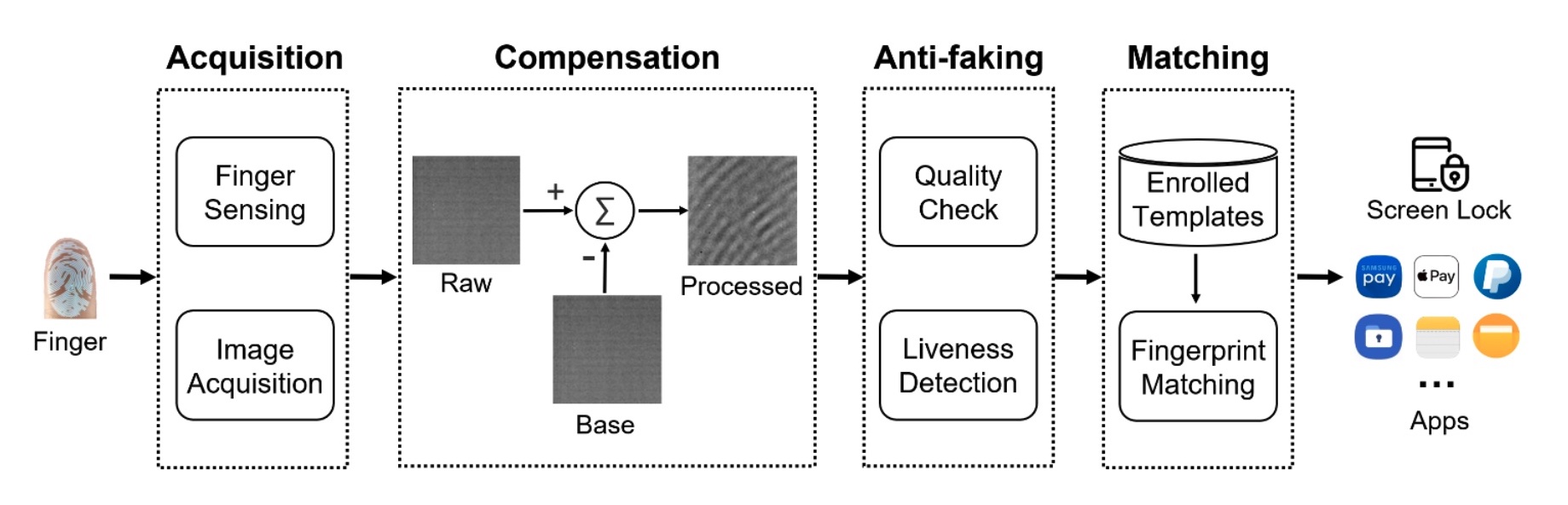
BrutePrint is an inexpensive attack that allows people to unlock devices by exploiting various vulnerabilities and weaknesses in smartphone fingerprint authentication systems. Here's the workflow of these systems, which are typically abbreviated as SFAs.

The workflow of a smartphone fingerprint authentication system.

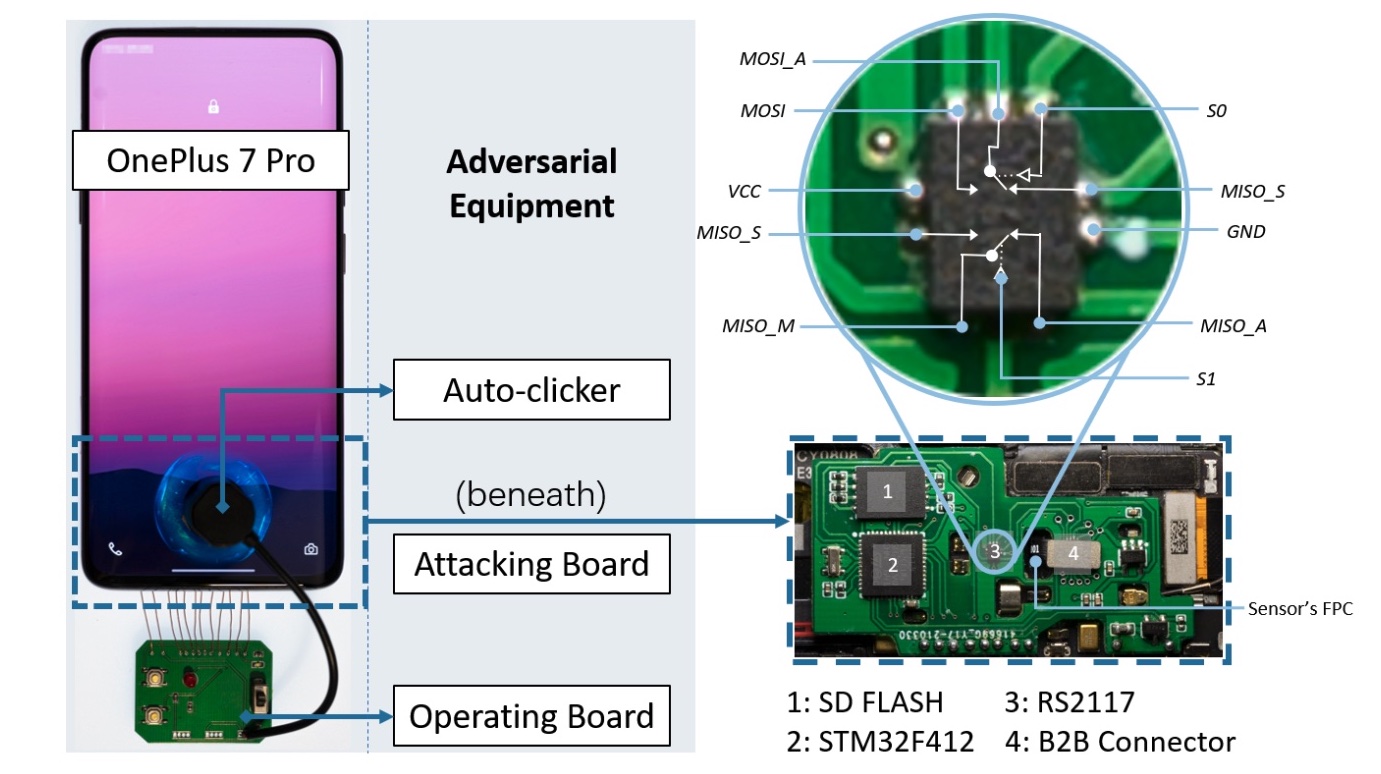
The core of the equipment required for BrutePrint is a $15 circuit board that contains (1) an STM32F412 microcontroller from STMicroelectronics, (2) a bidirectional, dual-channel analog switch known as an RS2117, (3) an SD flash card with 8GB of memory, and (4) a board-to-board connector that connects the phone motherboard to the flexible printed circuit of the fingerprint sensor.

The adversary device that forms the core of the BrutePrint attack.

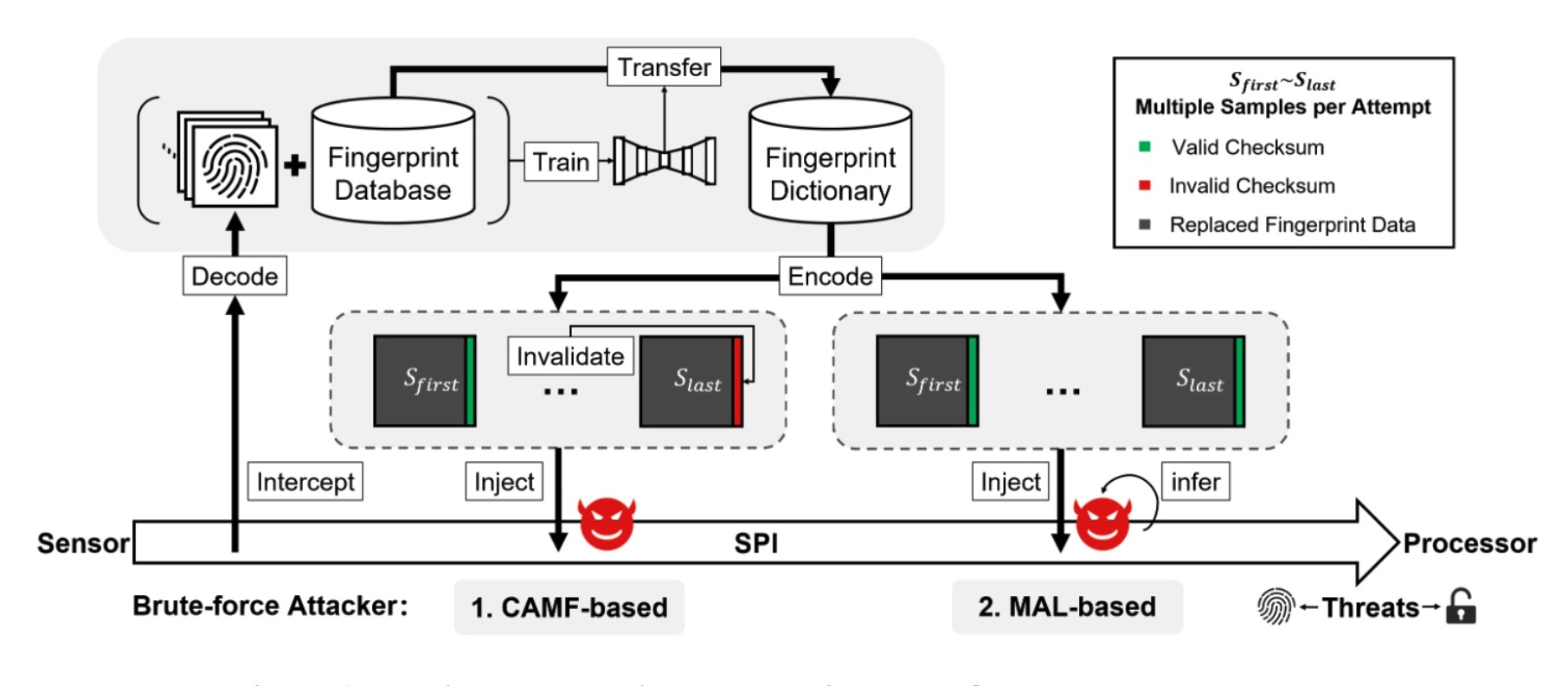
Additionally, the attack requires a database of fingerprints, similar to those used in research or leaked in real-world breaches such as these.

An overview of the BrutePrint attack.

Not all smartphones are created equal

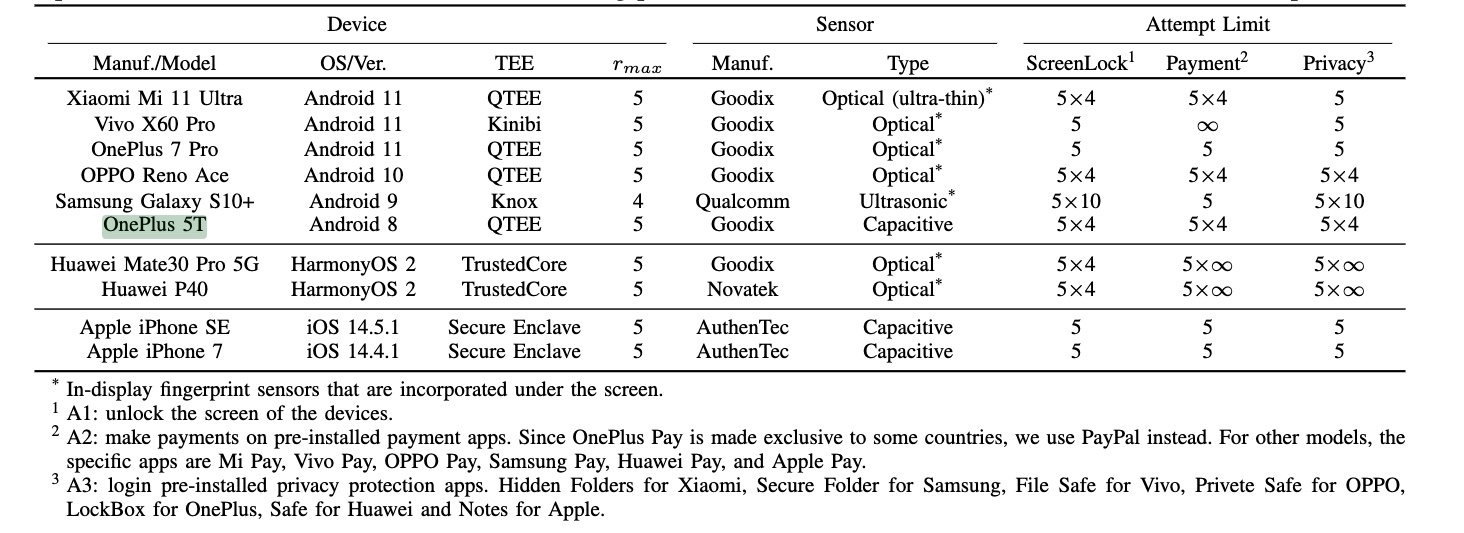
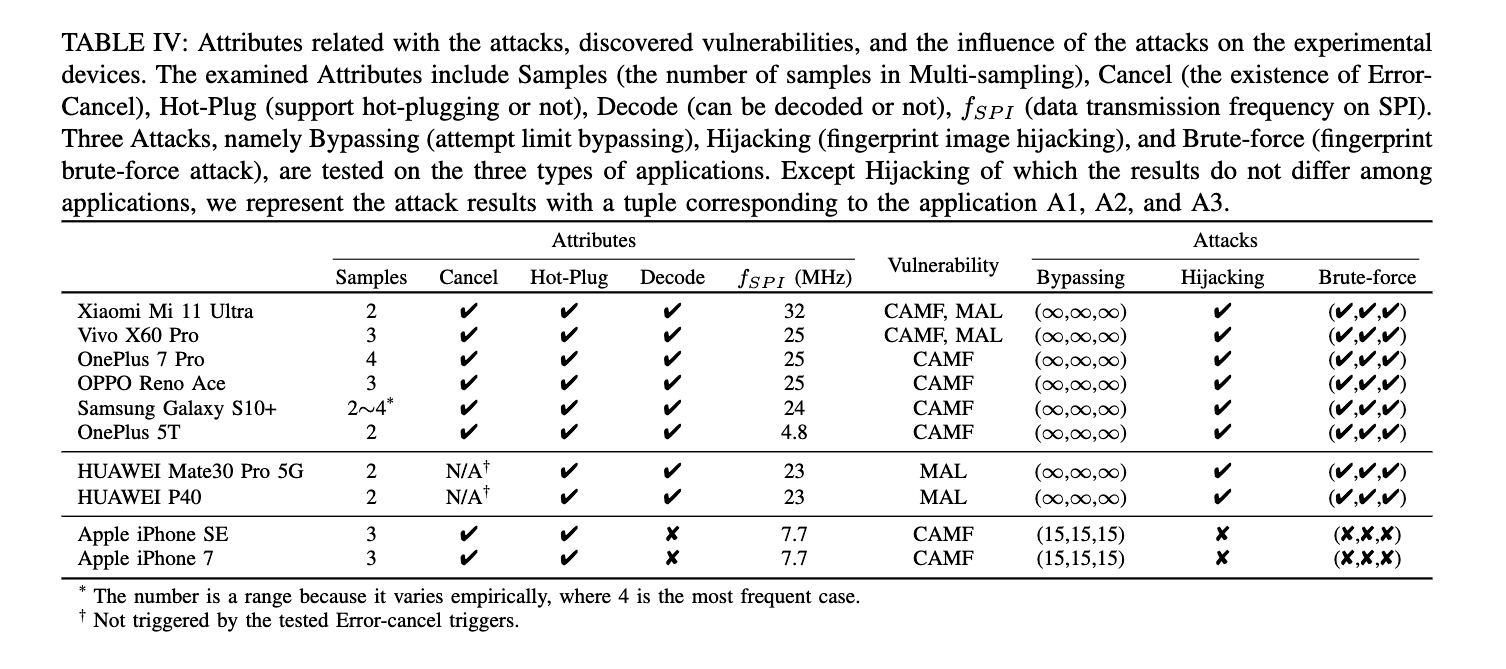
More on how BrutePrint works later. First, a breakdown of how various phone models fared. In all, the researchers tested 10 models: Xiaomi Mi 11 Ultra, Vivo X60 Pro, OnePlus 7 Pro, OPPO Reno Ace, Samsung Galaxy S10+, OnePlus 5T, Huawei Mate30 Pro 5G, Huawei P40, Apple iPhone SE, Apple iPhone 7.

A list of the devices tested along with various attributes of the devices.

The researchers tested each for vulnerabilities, weaknesses, or susceptibility to various attack techniques. Examined attributes included the number of samples in multi-sampling, the existence of error-cancel, support for hot-plugging, whether data could be decoded, and data transmission frequency on SPI. Additionally, the researchers tested three attacks: attempted limit bypassing, hijacking of fingerprint images, and fingerprint brute-forcing.

Results of various attacks on the different devices tested.

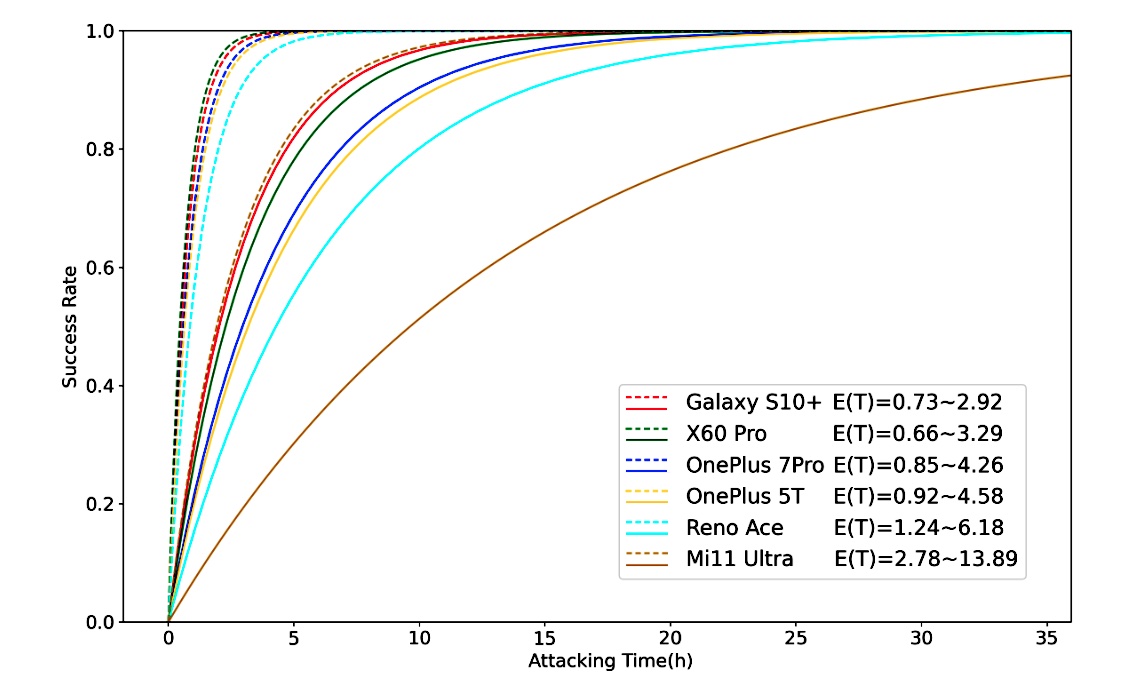
Last, the researchers provided results showing the time it took for various phones to have their fingerprints brute-forced. Because the amount of time depends on the number of prints authorized, the researchers set each to a single print.

The success rate of various devices tested, with the Galaxy S10+ taking the least amount of time (0.73 to 2.9 hours) and the Mi11 taking the longest (2.78 to 13.89 hours).

Although specifics varied, the result is that BrutePrint can attempt an unlimited number of authentication fingerprints on all eight of the Android models tested. Depending on various factors, including the fingerprint authentication framework of a specific phone and the number of fingerprints stored for authentication, it takes anywhere from about 40 minutes to 14 hours.

Dan Goodin / Dan Goodin is Senior Security Editor at Ars Technica, where he oversees coverage of malware, computer espionage, botnets, hardware hacking, encryption, and passwords. In his spare time, he enjoys gardening, cooking, and following the independent music scene.


X

KSI Meet My Cat | 2.2M views #8 TRENDING May 22, 2023

Puriteens, Anti-Fans, and The Culture War’s Most Bonkers Battleground. . .How did the internet become so puritanical? | Vox

". . .The downside is that the wider crackdown on sexual expression, especially in the United States, is only getting worse. That bodes ill for the internet and all its citizens, especially since media literacy as a whole is also on the decline. As purity culture spreads, the idea of depicting fictional harm as equivalent to real-world harm grows and spreads along with it.

Then again, if anyone can creatively respond to a culture of increasingly absurd attacks on ingenuity and imagination, it’s an army of passionate deviants who’ve historically been vanguards of the weird, the queer, and the subversive. They’re sexual rebels and literary freedom fighters.

If fans can’t kick that nonsense to the curb, who can?"

Puritanism took over online fandom — and then came for the rest of the internet

Puriteens, anti-fans, and the culture war’s most bonkers battleground.

Cartoon of a Gen Z teenager wearing a pilgrim hat and collar as they type on a laptop with a Tumblr logo on it.Ohni Lisle for Vox

How did the internet become so puritanical? On social media, outspoken anti-sex advocates increasingly cry “gross” at everything from R-rated rom-coms to fictional characters and queer people having sex to consenting adults with slight age gaps to dating short people

  • They see oversexualization in just about everything. 
  • They often accuse the things they dislike of being coded fronts for pedophilia, and the people who enjoy those things of being sexual predators. 
  • These social media users frequently form enclaves that turn as nightmarish and troubling as the things they’re ostensibly trying to police.

This dovetails with what we’re being told right now about Gen Z and sex: They’re having less casual sex, they hate dating, they’re more reserved about relationships in general. It’s easy to pigeonhole online anti-sex police as being teens and young adults, a.k.a. “puriteens.” Because so much of this comes down to carnal horror, you might assume that everyone who’s horrified is a teen who just hasn’t arrived at a mature view of sex and other adult activity. 

. . .Such anti-sex zeal increasingly forces sex-positive communities back into the internet’s underground. It also aids and abets the larger cultural shift toward regressive attitudes and censorship of sexual minorities and sex-positive content.

Yet overwhelmingly, the common thread among this new generation of “antis” — a broad label for people who are opposed to sexual content in media — isn’t that they are minors who are scared of sex. It’s that none of them distinguish between fictional harm and real-world harm. That is, regardless of their ages, they believe fiction not only can have a real-world impact, but that it always has a real-world impact. . ."

Read more > Vox

X

Warthog Defense: ALARMING - UKRAINIAN-BACKED REBELS CAPTURED RUSSIAN MILITARY BASE WITH TACTICAL NUCLEAR WEAPONS 1,652 views May 23, 2023

Super Typhoon, Coronal Hole, Heinrich Layers | S0 News May.23.2023