



Photo Illustration by Eric Faison/The Daily Beast/Getty Images




President Trump suggested that federal investigators would coerce reporters to tell the government who leaked the “low confidence” preliminary Defense Intelligence Agency (DIA) assessment that his strikes on Iran may only set the regime’s nuclear program back by a few months.
Trump repeated his demand that the leaker be prosecuted and speculated that Democrats may have been behind the report going public.
“They could find out easily. And you go up and tell the reporter, ‘National security, who gave it?’ You have to do that. And, I suspect will be doing things like that,” Trump told Fox News’ “Sunday Morning Futures” in a pre-taped interview.

CNN was the first to report on the DIA assessment, followed by the New York Times. Fox News also reported on the leaked intel.
The extent of the damage done to Iran’s nuclear program remains somewhat murky. CIA Director John Ratcliffe has echoed Trump’s claims, saying that it “has been severely damaged by the recent, targeted strikes.”
Director of National Intelligence Tulsi Gabbard has similarly back up Trump’s claim.

The Trump administration has also pointed to the Israel Atomic Energy Commission, which found that the bombing of the Fordow facility “destroyed the site’s critical infrastructure and rendered the enrichment facility inoperable.”
Meanwhile, prominent Democrats left those briefings unconvinced about the president’s use of the word “obliterated.”
“Right now, we have no final battle damage assessment that would enable us to be comfortable or complacent about what has been done,” Sen. Richard Blumenthal (D-Conn.) said afterward the Senate briefing Thursday.

His colleague, Sen. Chris Murphy (D-Conn.), more directly criticized Trump’s use of the word “obliterated.”
International Atomic Energy Commission (IAEC) director general Rafael Mariano Grossi suggested that Iran could get its nuclear program back up in running within months.
“They can have, you know, in a matter of months, I would say, a few cascades of centrifuges spinning and producing enriched uranium, or less than that,” Grossi told CBS’ “Face the Nation” in a pre-taped interview that aired Sunday.
Iranian Supreme Leader Ayatollah Ali Khamenei’s social media account rejected Trump’s characterization of the damage done as well.
“The President of the United States, in describing what happened, exaggerated unusually, which turned out to be necessary for that exaggeration,” Khamenei’s account wrote on X.
“Anyone who heard those words understood that beneath their surface, another truth existed. They couldn’t do anything and exaggerated to cover up and conceal th

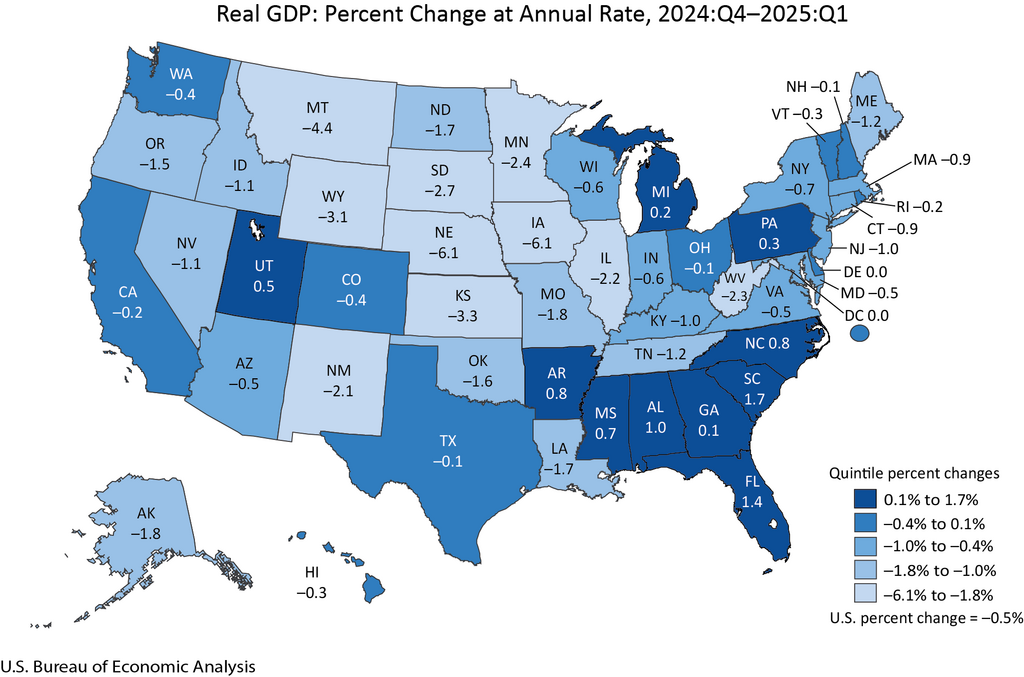
SPOILER ALERT: Real gross domestic product decreased in 39 states in the first quarter of 2025, with the percent change ranging from 1.7 percent at an annual rate in South Carolina to –6.1 percent in Iowa and Nebraska, according to statistics released today by the U.S. Bureau of Economic Analysis (table 1).
|
|
EMBARGOED UNTIL RELEASE AT 10:00 a.m. EDT, Friday, June 27, 2025
Real gross domestic product decreased in 39 states in the first quarter of 2025, with the percent change ranging from 1.7 percent at an annual rate in South Carolina to –6.1 percent in Iowa and Nebraska, according to statistics released today by the U.S. Bureau of Economic Analysis (table 1).
Current-dollar gross domestic product (GDP) increased in 47 states and the District of Columbia, with the percent change ranging from 8.7 percent at an annual rate in North Dakota to –2.7 percent in Iowa.
Personal income, in current dollars, increased in all 50 states and the District of Columbia in the first quarter of 2025, with the percent change ranging from 12.7 percent at an annual rate in North Dakota to 3.2 percent in Washington state (table 3).
In the first quarter of 2025, real GDP for the nation decreased at an annual rate of 0.5 percent. Real GDP decreased in 16 of the 23 industry groups for which BEA prepares quarterly state estimates. Finance and insurance; agriculture, forestry, fishing and hunting; and wholesale trade were the leading contributors to the decrease in real GDP nationally (table 2).
In the first quarter of 2025, current-dollar personal income increased $407.3 billion, or 6.7 percent at an annual rate (table 3). Nationally, increases in earnings, transfer receipts, and property income (dividends, interest, and rent) contributed to the increase in personal income (chart 1).
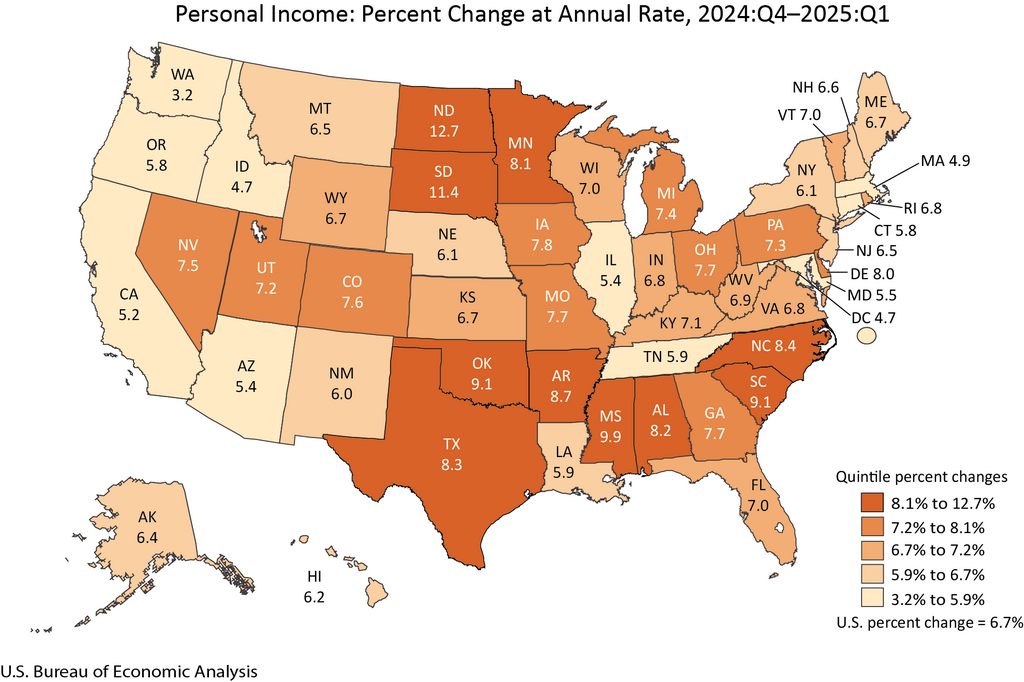
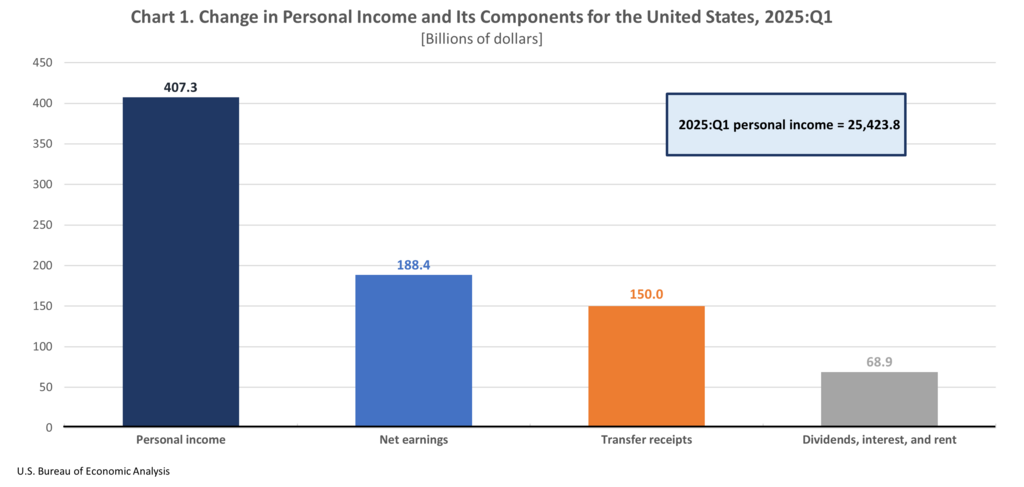
Earnings increased in all 50 states and the District of Columbia, while growing 5.0 percent nationally (table 4). The percent change in earnings ranged from 13.5 percent in North Dakota to 0.1 percent in Washington state. Earnings increased in 22 of the 24 industries for which BEA prepares quarterly state estimates and was the largest contributor to growth in personal income in 28 states (table 5).
Transfer receipts increased in all 50 states and the District of Columbia, while growing 13.6 percent nationally. The percent change in transfer receipts ranged from 21.2 percent in Nevada to 9.1 percent in Florida (table 4). The increase in transfer receipts was due in part to an increase in Affordable Care Act premium tax credits and an annual cost-of-living adjustment for Social Security benefits.
Property income increased in all 50 states and the District of Columbia, while growing 5.6 percent nationally. The percent change ranged from 7.8 percent in Idaho to 3.8 percent in Alaska (table 4).
Today, BEA also released revised quarterly estimates of personal income by state for the first through fourth quarters of 2024. This update incorporates new and revised source data that are more complete and more detailed than previously available and aligns the states with the national estimates from the National Income and Product Accounts released on June 26, 2025.
On September 26, 2025, BEA will publish quarterly GDP and personal income by state along with annual personal consumption expenditures by state in a single news release.
This combined release will provide a fuller picture of the economies of all states and the District of Columbia and will replace the publication of two separate releases issued on different days.
BEA will release revised annual state GDP and personal income estimates for 2020 to 2024, along with revised quarterly estimates for the first quarter of 2020 through the first quarter of 2025 and preliminary estimates for the second quarter of 2025.
An upcoming article in the Survey of Current Business will describe the results.
The Survey of Current Business (SCB) has served as the journal of record for the U.S. Bureau of Economic Analysis (BEA) since 1921. The SCB offers a variety of economic content, including detailed presentations of recent data releases, explanations of annual and benchmark updates, summaries of key methodologies, updates about in-development data sets, research by BEA economists, briefings on key issues, and ongoing statistical and related innovations. Tables, charts, and links to interactive data sets—with charting and mapping functions—accompany nearly every article.
For the many corporate, government, and academic users of BEA data, the SCB is essential reading. A Google Scholar query about the SCB shows that SCB articles have long been widely cited by economists and other authors. Our articles may be used without specific permission; however, we ask authors to cite our articles when appropriate (see guidelines for citing the SCB).
The SCB is published on a rolling basis on the BEA website, with content organized by date and content organized by subject. Articles are provided in interactive HTML format as well as in PDF format. In addition, every print issue going back to 1921 is available on the site in searchable format. To receive automatic email notifications when new SCB articles are published, sign up for BEA's Email Subscription Service.
We welcome your comments, questions, and suggestions about the SCB. Please contact us at scb@bea.gov.
Danielle Helta, Managing Editor
Peter Fisk, Editor
Sallie Pisch, Editor
Colby Johnson, Graphic Designer
Kristina Maze, Contributor
In 2021, the SCB turned 100! For over a century, BEA and its predecessor agencies have reported timely, relevant, and accurate statistics on the U.S. economy. We spent our centennial year looking back at highlights from each decade of the SCB's history with reprints from the BEA archives, profiles of top influencers, original articles, downloadable posters, and other historical content.
Data previously published as tables within the quarterly and annual news releases on GDP, personal income, and PCE by state will continue to be updated and available simultaneously with the release in BEA’s online Interactive Data Tables.
Next release: September 26, 2025, at 10:00 a.m. EDT




