14 MARCH 2024
Art During Wartime
Can it really be that to call for sympathy with victims of murder and kidnapping is necessarily to demand violence in return?
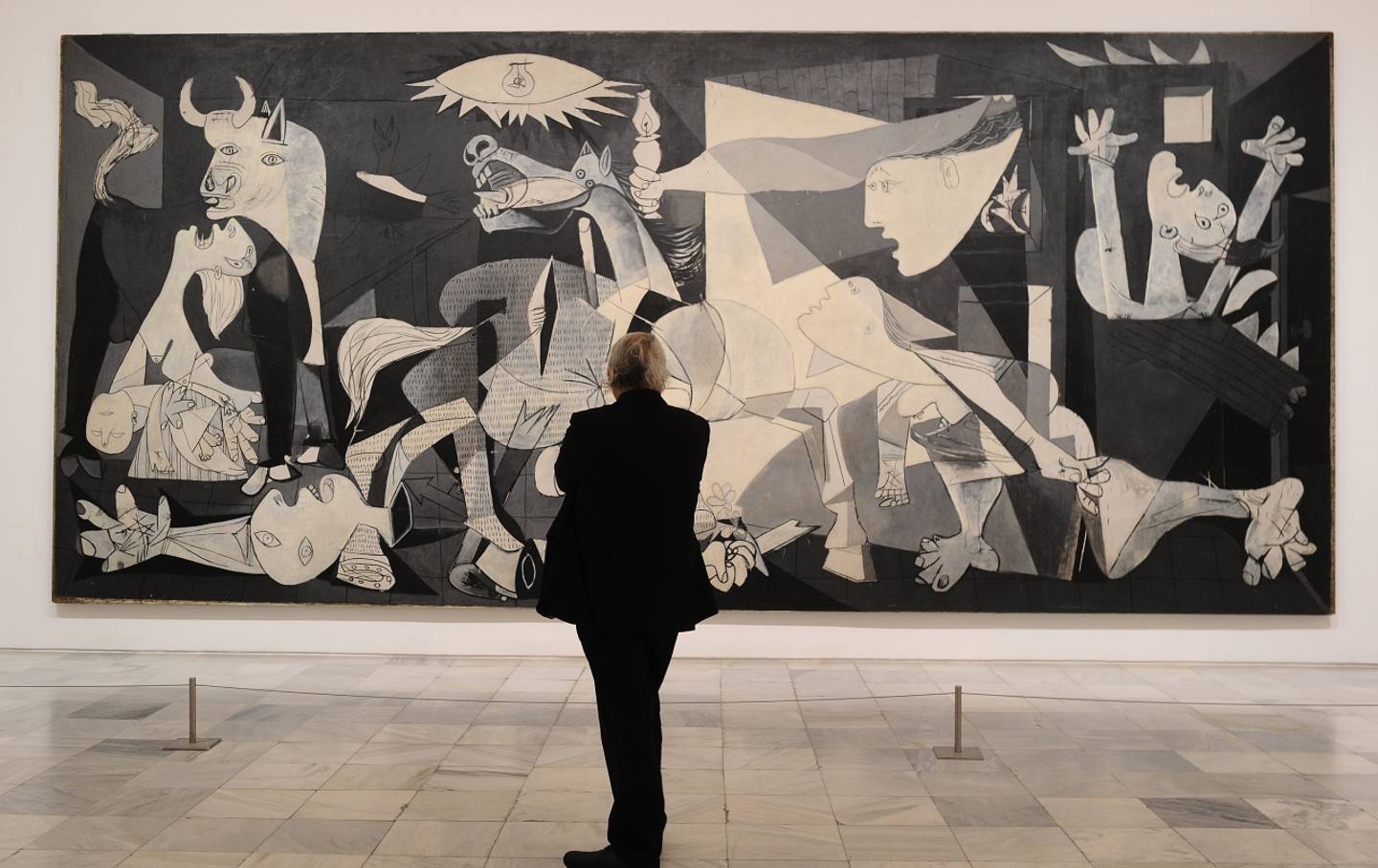
- The exception that proves the rule is obviously Picasso’s Guernica, but even that harrowing masterpiece, which rubbed the world’s face in the enormity of what had transpired in the massacre of innocents in the hitherto-obscure Basque town, also registered a kind of detachment from the violence it depicted, through its grisaille palette, which—as Peter Schjeldahl, shrewdly observed—“by evoking the look of a newspaper, factored in the modern experience of comprehending catastrophe (and of inflicting it) at a distance.”
- “I have not painted the war,” he said, “because I am not the kind of painter who goes out like a photographer for something to depict.”
- When he finally produced his allegory of war in The Charnel House, 1944–45, it revived the black-and-white of Guernica, but to less effect.
But the question of whether and how the horror of war can be portrayed in painting goes back much further than the 20th century, though perhaps it became more fraught then. I think of Peter Weiss’s great, still not completely translated, symphonic novel The Aesthetics of Resistance: its anonymous narrator, a young German Communist trying to spiritually and physically survive the 1930s as history takes him from the underground in Nazi Berlin to the Spanish Civil War and then exile in Sweden, where he falls into the orbit of fellow refugee Bertolt Brecht.
In doing so, he continually wrestles with the political meaning of artworks such as the Pergamon Altarpiece and Géricault’s Raft of the Medusa.
- But in Bruegel’s fantastical vision, he feels, “[t]he combination of the spawns of madness with the gestures and movements of startled, agonized individuals, created a situation that approximated that derangement and clairvoyance we had sometimes felt, if only for a few seconds” in battle in Spain. “In those moments, staring at sand dunes and piles of stones, faces would emerge from furrows and holes, roots, charred beams would transform into bodies laying in wait, dust-gray shrubs on the edge of paths turned into the raised limbs of guns, and from this threshold between flash-like impressions and delusions other apparitions proliferated, characterized by the disgust that was never far from fear.”
- She wants to evoke empathy with the victims—naturally enough. But in trying to do so she wallows in kitsch.
- One example, a work showing several generations of a family taking refuge in a safe room, shows why:
- They all gaze out with big sad eyes, as if they already saw themselves as constituting a tableau composed for no other reason than to solicit a viewer’s emotion, rather than expressing any organic relationship among themselves, let alone agency.
It seems that we have lost some of our ability to empathize: Horrors compete with horrors, and we only feel for some of the victims at the expense of the others.
At a public conversation at the museum in February, demonstrators denounced the exhibition as “a pro-war show…trying to stir up revenge and retaliation” and “imperial propaganda”—an unlikely construal of the intentions of an artist who, according to The New York Times, has previously depicted Israeli oppression of Palestinians.
But these days, arbitrary imputations of intent seem de rigueur.
- Everyone is supposed to have the right to determine what everyone else means when they use slogans like “from the river to the sea” or “bring them home” (and whatever you do, never ask anyone what they mean, because the answer might deprive you of the pleasure of denouncing them). Maybe that’s the trouble with slogans. Can it really be that to call for sympathy with victims of murder and kidnapping is necessarily to demand violence in return?
Those who believe this need to examine their own consciences. Let’s not become so morally degraded. Despite everything, it should still be possible to feel the suffering of fellow human beings, whether they are Israeli Jews or Palestinian Muslims. Instead, we find an effort to erase the memory of one group or another.
How to do art in times of war, destruction, violence, anger, hate, resentment?
What kind of art should be done in moments of darkness and desperation?…
How to continue working—as an artist—and in doing so, avoid falling into the traps of facts, journalism, and comments?
The Dubious Ethics of “the World’s Most Ethical Companies”
Ethisphere has a proprietary metric for assessing how morally correct companies are. This year, it gave an award to Israel’s largest weapons manufacturer.


.jpg)
.jpg)
No comments:
Post a Comment