Lava-Lit Lenticular Cloud Crowns Volcano in Spectacular Photo
These bizarre-looking clouds form in stable atmospheric eddies
Francisco Negroni
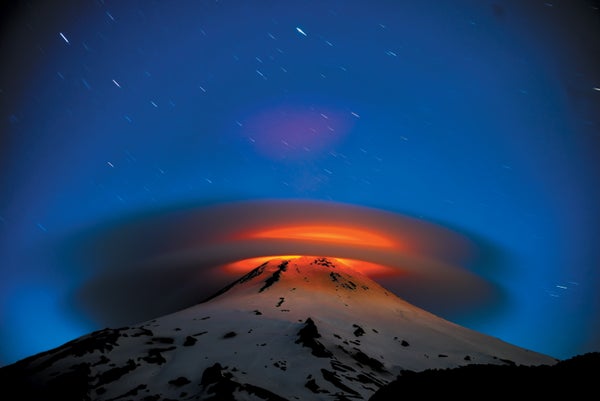
". . .Luckily for photographer Francisco Negroni, a lenticular cloud materialized over Villarrica when it was at its most dramatic for this award-winning shot.
After the volcano entered a period of activity, Negroni camped at its snowy base for 10 days as he waited for the right moment. He then set up his camera and opened the lens for a full four minutes to capture enough light. That was enough time to track Earth’s rotation, which makes stars appear as streaks of light even as the volcano’s lenticular crown stays put.
For Negroni, the shot was more than worth the effort. Photographing volcanoes “is my life,” he says. . .
A Perfect Cloud by Francisco Negroni
WINNER, Standard Chartered Weather Photographer of the Year
Nope. That’s not a photo of Mount Doom. This is a gigantic lenticular cloud surrounding the crater of the Villarrica volcano, while the lava illuminates the cloud from within. Francisco Negroni camped out at the volcano—one of Chile's most active—for ten days to capture this special moment, during a period of intense volcanic activity.
“I think it is one of my most beautiful photographs.”
Lenticular clouds form when air flowing over the ground encounters an obstacle—like a volcano. This causes the air to rise and cool, which can allow moisture to condense and form clouds. For these particularly striking lenticular clouds to form, the atmosphere needs to be stable, which means that the air forced up over the high ground readily sinks back down again beyond, sometimes causing continuous rise and fall downstream or ripples in the air. Due to their unusual shape, they’re often compared to flying saucers—and we think this photo is a great example of why.
To capture this shot, Francisco exposed his camera for over four minutes to gather enough light. And this lengthy snap also captured the rotation of the Earth: the stars are stretched out into streaks, since their position in the sky shifts during the course of the exposure.
Photo location: Pucón, Chile
Photographer based: Chile
Camera: Nikon D610, 105mm 2.8


No comments:
Post a Comment