Policies for Reporting Sightings
Here are some points and policies to note about the posting of reports on our migration maps:
|

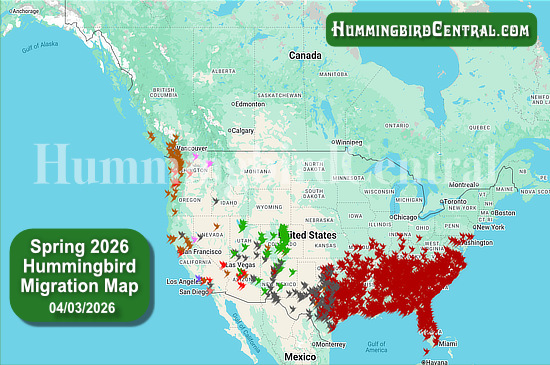
Highlights of 2026 Spring Migration Activity
We began posting to the 2026 Hummingbird Spring Migraton Map in late January of 2026.
2026 Hummingbird Spring Migration Map
|
|
More About the Spring Hummingbird Migration
During migration, a hummingbird's heart beats up to 1,260 times a minute, and its wings flap 15 to 80 times a second. To support this high energy level, a hummingbird will typically gain 25-40% of their body weight before they start migration in order to make the long trek over land, and water. They fly alone, often on the same path they have flown earlier in their life. Young hummingbirds must navigate without parental guidance. Hummingbirds fly by day when nectar sources such as flowers are more abundant. Flying low allows the birds to see, and stop at, food supplies along the way. They are also experts at using tail winds to help reach their destination faster and by consuming less energy and body fat. Research indicates a hummingbird can travel as much as 23 miles in one day. Strong cold fronts moving south over the Gulf make flying difficult as the birds deal with headwinds and heavy rain, over long distances with no shelter. Food is non-existent over the open waters. |
|
|
 below to see a list of sightings for 2026
 Ruby-throated
  Rufous
  Black-chinned
  Anna's
  Allen's
 Costa's
  Calliope
  Blue-throated
  Broad-billed
  Broad-tailed
 Buff-bellied
  Rivoli's
  Other/Unknown
When hummingbirds arrive by region
Timing varies quite a bit depending on where you live and which of the four main flyways runs through your area: the Pacific, Central, Mississippi, and Atlantic.
Along the Gulf Coast and Southeast
“In places like Florida, Louisiana, and the Gulf Coast, Ruby-throated Hummingbirds can start appearing as early as around March 1st,” says Sean Graesser, a biologist and director of Wild Bird Research Group. In 2026, birds are running slightly ahead of schedule, so getting a feeder up before you think you need it is a smart move.
From there, the migration moves steadily north. South Carolina typically sees its first birds by late March, the South Carolina-North Carolina border around April 1, and Virginia and Maryland throughout April.
The Mid-Atlantic and Northeast
“Here in the Mid-Atlantic, including New Jersey, the first few individuals typically show up toward the end of April, with numbers increasing quickly,” Graesser says. By late April into May, hummingbirds are widespread across the Northeast, with the northernmost stretches of New England and Maine seeing arrivals around mid-May.
“If you picture it on a map, the Ruby-throated Hummingbird migration moves steadily up the eastern US coast from early March through mid-May, following the progression of spring and blooming plants,” he adds.
East of the Mississippi, you’re mainly watching for one species. “The Ruby-throated Hummingbird is the only regular breeding species and the expected hummingbird in spring and summer,” says Chad Witko, Specialist in Avian Biology at the National Audubon Society. “Most winter in Mexico and Central America, though a growing number now remain along the Gulf Coast.”
The Southwest, where diversity peaks
“The Southwest supports the highest diversity of hummingbirds in the US, up to roughly a dozen and a half species in places such as Arizona, including breeders, migrants, and occasional vagrants from Mexico,” Witko explains.
“Winter distributions are shifting as milder conditions and expanded plantings of nectar sources allow some hummingbirds to persist farther north and east,” Witko says, with Black-chinned, Rufous, and Broad-tailed hummingbirds now being spotted in Louisiana and Florida with increasing regularity.
How to attract hummingbirds to your garden
Get feeders up before the blooms open
Native nectar flowers are the long game, but most haven’t bloomed yet when the first wave of migrants arrives. A feeder bridges that gap nicely.
The nectar recipe is straightforward: one part refined white sugar to four parts water. A quarter cup of sugar to one cup of water. Bring it to a boil, let it cool fully, and pour it in. Skip the substitutions, honey, corn syrup, powdered sugar, and raw sugar – all of which ferment faster and can harm the birds. No food dye, either.
“You can make a larger batch and refrigerate the extra solution,” says Jen McGuinness, author of Bird-Friendly Gardening. “Although, discard any if it appears the sugar water has turned, which means the sugar solution is looking cloudy.”
Keep feeders clean and placed strategically
This part matters more than people realize. “Moldy sugar water can be harmful and even fatal for hummingbirds,” McGuinness says. In cool weather, clean feeders once a week. In the heat, at least twice, or every time the feeder empties. Hot water or a diluted vinegar solution works well. Dish soap leaves residue, so skip it.
Placement is worth thinking through, too. Hummingbirds are territorial and will guard a feeder aggressively, so hanging several out of sight of each other spreads the food supply around. And be thoughtful about windows. Witko recommends positioning feeders “at least a short distance from windows, generally under three feet, to reduce collision risk.”


No comments:
Post a Comment