Saturday, October 02, 2021
NEW STUDY FROM DAVID ABBOTT: Resolution Copper Mine Has Become A Symbol of The Fight over Economic Development, Dwindling Water Supplies, Preservation of Native American Heritage and Publicly Owned Open-Spaces
New study: Resolution Copper mine will use 250 billion gallons of water as drought ravages Arizona


Pinal Partnership campaigns for copper mine ahead
of vote in Congress

(Disclosure: Rose Law Group represents Resolution Copper.)
(Disclosure: Rose Law Group represents Resolution Copper.)
by Aaron Dorman
Aaron Dorman is the Casa Grande reporter at PinalCentral, covering government, schools, business and more. He can be reached at adorman@pinalcentral.com.
CASA GRANDE — Once again, the proposed Resolution Copper mine has come into the crosshairs of federal action.
The potential to overturn a 2014 land transfer agreement has increased lobbying and public opinion efforts by both critics and supporters of the project.
Earlier this month, the Pinal Partnership group began a targeted public relations campaign on behalf of Resolution Copper, including urging members to write letters to several key members of the Arizona congressional delegation —Sens. Mark Kelly and Kyrsten Sinema, as well as Reps. Tom O’Halleran, Greg Stanton and Ann Kirkpatrick.
The letter says that bill H.R. 1884, which is part of the $3.5 trillion reconciliation package, “would prevent mining from ever happening” and would “prevent the creation of thousands of American jobs, and billions in revenue to the Arizona economy.”
Representatives for Resolution Copper also released their own statement affirming an economic boost to the region and claiming that the project has been years in the making through public engagement and government review.
“We have strong support from local community leaders to build a responsible copper mine that would support more than 3,700 jobs, add $1 billion a year to Arizona’s economy and supply up to one quarter of the nation’s copper demand,” the statement reads. “Mining has co-existed with outdoor recreation, ranching and cultural activities in the Copper Triangle region for over a century, and we are committed to preserving the area’s unique heritage.”
At the same time, the Center for Biological Diversity released a statewide poll showing 74% of Arizonans oppose the Resolution Copper proposal. According to the poll, although the opposition trended toward both Democratic and urban residents, a majority of Republicans polled — 56% — were also against the mine.
Resolution Copper officials say they are planning to release their own polling numbers from August suggesting that “most Arizona voters were unfamiliar with Resolution Copper but after learning more, including what critics say, support for the project grew.”
The proposed copper mine, located near the town of Superior in northern Pinal County, would use a block-cave process to drill the copper ore over several decades. As a result of land subsidence, the area known as Oak Flat would become a crater several miles wide and 1,000 feet deep.
Critics of the mine say that the 2014 land transfer that was passed was snuck into a “must pass” bill at the last minute, after being repeatedly struck down in prior legislative sessions.
While little about the debate over the mine has changed, the past year has seen a dramatic back-and-forth over its future status, with the possible reconciliation bill just the latest in a struggle between strongly entrenched viewpoints.
A 3,000-page Environmental Impact Statement from the U.S. Forest Service, due out at the end of 2020, was instead released at the beginning of the year, just before President Donald Trump left office. The document was quickly rescinded in March by the incoming Biden administration. However, in June, the Justice Department threw out a lawsuit by the Apache Stronghold organization opposing the copper mine, claiming in a brief that the land transfer did not violate existing treaties.
At the same time, the Center for Biological Diversity released a statewide poll showing 74% of Arizonans oppose the Resolution Copper proposal. According to the poll, although the opposition trended toward both Democratic and urban residents, a majority of Republicans polled — 56% — were also against the mine.
Resolution Copper officials say they are planning to release their own polling numbers from August suggesting that “most Arizona voters were unfamiliar with Resolution Copper but after learning more, including what critics say, support for the project grew.”
Resolution resolve
In the wake of the administration’s hold on the Oak Flat land swap, officials from the Town of Superior, as well as a group of stakeholders calling itself the Pinal Partnership, began advocating for the project and standing firm against SOFA.
> Superior Mayor Mila Besich has been working on the Resolution Copper project for many years — too long, she says — and sees it as one of the few economic opportunities for a community her family has been a part of for generations. . .
In a recent letter urging members of her community to reach out to their representatives, Besich said SOFA is a “poison pill” that would “cripple all of the mining operations in our region.”
“As residents of Arizona’s Copper Corridor, we understand our role in the world,” she wrote. “We mine and produce the copper that runs this world. Right now, our role in the global economy is at risk. . .
Resolution Copper says the project could ultimately directly employ somewhere in the neighborhood of 1,500 people — most living in the East Valley and Phoenix Metro area — and inject $20 billion into Arizona’s economy. It could supply the United States with one-quarter of its copper for the next 40-60 years, although there is no guarantee the copper would make it into U.S. manufacturing, given the volatility of the copper market.
A 2019 study commissioned by the Arizona Department of Transportation concluded that the majority of copper extracted from the Rosemont mine would be shipped outside of the U.S. because there isn’t capacity at American smelters to process the ore.
The Pinal Partnership, a nonprofit founded in Pinal County in 2005 that “unites the (county’s) vision for responsible economic development,” according to the organization’s president Tony Smith, has also advocated for Resolution Copper, touting the economic benefits of the project, using its influence in the region to further garner support for the project.
. . .The proposed mine would be the largest underground mine in the U.S., plunging to depths of more than 7,000 feet below the surface, where temperatures reach 180 degrees Fahrenheit. Large quantities of water for cooling and other aspects of mining, from dust control to remediation of mine waste, would be required for its operation.. . ."
_________________________________________________________________________
From WHOWHATWHY: Must-Reads for October 1, 2021 ...Podcast + A Full Transcript / Peter Thiel Setting The Stage For His Own Rise

Donald Trump, Peter Thiel, and Charles Koch.
Photo credit: Adapted by WhoWhatWhy from U.S. Department of State / Flickr , Heisenberg Media / Flickr (CC BY 2.0), Gavin Peters / Wikimedia (CC BY-SA 3.0), and Patrick Pascal Schauß / Pixabay .
"For almost 50 years, the Koch brothers have been the bête noir of the left. Their influence over conservative politics and policies has been significant, even if not to the levels they are given credit for by their opponents. But the Koch family, as a political brand, are aging out. One brother is gone, and the other seems more interested in philanthropy than in Trumpism. But there is a new kid on that block to fill the void: tech billionaire Peter Thiel
In this week’s WhoWhatWhy podcast, we talk with Bloomberg editor, reporter, and Thiel biographer Max Chafkin. He explains that from Thiel’s time at Stanford, as the creator of an early alt-right publication, to his mentoring of Mark Zuckerberg in the techniques of disruption and libertarianism, to his support for Donald Trump, he has been setting the stage for his own rise as a political Midas.
One of the first Silicon Valley executives to support Trump, he was the leader, years ago, of what has been called the PayPal Mafia: a group of his Silicon Valley disciples who have tentacles into everything from MAGA to Facebook, from Tesla to LinkedIn to dozens of other technology companies.
Chafkin draws a Venn diagram in which Thiel is linked with vast wealth, Silicon Valley power brokers, and a growing right-wing ecosystem.
According to Chafkin, Thiel found Trump appealing not only for his political views, but also because his anti-establishment attitude was right in line with how Thiel sees the world.
The man who took down Gawker and drove both the publication and its owner into bankruptcy is picking up where the Kochs left off. Except that Thiel is even further to the right — and a lot meaner in how he does it.
Full Text Transcript: JUST ENOUGH TO GET READERS OF THIS BLOG STARTED TO DIG DEEPER INTO WHAT CHALKIN IS SAYING
(As a service to our readers, we provide transcripts with our podcasts. We try to ensure that these transcripts do not include errors. However, due to a constraint of resources, we are not always able to proofread them as closely as we would like and hope that you will excuse any errors that slipped through.)
Jeff Schechtman: Welcome to the WhoWhatWhy podcast. I’m your host, Jeff Schechtman. When most of you think about who have been the key players in financing the rise of the right in America, the Koch brothers in their efforts to buoy the right and push all sorts of buttons on the left are front and center. But the fact is that the Koch brothers are aging out. One is gone, the other seems to be unsure of where he currently stands. The Koch family in many ways represented an old-school view of the world, just as their money was from an old industrial model economy, things like paper, plastic, pipelines, and textiles.
So as the Kochs fade away, who will carry the mantle? Who will represent funding for the modern right in the postindustrial economy? More and more the answer to this seems to be Peter Thiel. A legend in Silicon Valley, the man who took down Gawker, and one of the Valley’s most important venture capitalists, with tentacles into everything from MAGA to Facebook to the military-industrial complex.
Peter Thiel is already shaping elections in 2022 and 2024, even as he continues to move forward in Silicon Valley. But who is Peter Thiel, and why should we care?
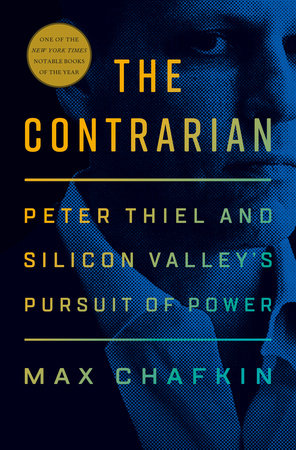
The answer lies in the pages of a new book by my guest Max Chafkin entitled The Contrarian.
Max Chafkin is a features editor and tech reporter at Bloomberg Businessweek. His work has appeared in Fast Company, Vanity Fair, and The New York Times, and it is my pleasure to welcome Max Chafkin here to the WhoWhatWhy podcast to talk about Peter Thiel, and his new book about Peter Thiel, The Contrarian. Max Chafkin, thanks so much for joining us.
Max Chafkin: Yes, thanks. Thanks for that intro, Jeff.
Jeff: Certainly, Silicon Valley is filled with iconoclasts, a lot of strange people that we’ve watched come and go over the years. Why is Peter Thiel different? Why should we care?
Max: Well, I think the framing that you just set up, the comparison with the Koch brothers, is a really smart one. Thiel has had this incredible impact on Silicon Valley. If you look around and say how did Silicon Valley go from being an economic sideshow, a curiosity, something that people were interested in, to being the economic focal point for the world? Where the world’s largest and most powerful companies are located. Where the global culture, to an increasing extent, is being created. Where even politically there’s an increasing amount of engagement. I think you would say Peter Thiel is one of those guys, along with a very small handful.
What’s really interesting about Thiel, who co-founded the company PayPal, he co-founded Palantir, this surveillance company and military contractor, and was an early investor in Facebook, is that he also created what I think of as the dominant Silicon Valley ideology, and that is the ideology of disruption. It’s what says companies, tech companies in particular, tech billionaires, are this privileged class of people that in order to make the future happen should be trying to grow as quickly as they possibly can, scaling their companies with no regard for the consequences, and should be willing to break the rules.
That breaking the rules, “disrupting the status quo,” isn’t just something that happens by accident that you’re allowed to get away with. It’s something that you actually should do. And so all of those things make him a really interesting figure in the world of tech. But as you said in the intro, he’s not just playing in tech. What he’s doing is trying to create this new political movement and to play kind of a patron role to the far right; the Trump movement as it were. So he was in 2016 one of the first executive types to come out and support Donald Trump, he was a major donor to Trump, and post-2020 has really emerged as one of the key financial backers of far-right candidates.
Jeff: To your point about disruption and move fast and break things, and we’ll come back to that and talk about Thiel and Zuckerberg, it’s interesting in reading your book that PayPal at the time — and we forget about this — was viewed, at least Thiel viewed it, as something akin to the way we view crypto today.
Max: Yes, absolutely. And PayPal in so many ways had this huge influence that’s partly a credit to Thiel’s personality and the force of his ideas, but also to just the impact of this company. So, when Thiel was promoting PayPal in the late 1990s, he was talking about it not just as, “Oh, this is going to be a way for you to buy stuff on the internet,” which is of course what it is and how people understand it, but this idea of having digital money as a way to free people to get out under the thumb of government. Thiel talked about that this would help destabilize nation-states. That it would be the equivalent of a Swiss bank account in your pocket.
It’s like libertarian sort of philosophy that I think now people are really used to hearing about crypto. But it actually began during those PayPal years, and the company never really got there but those ideas were influential. And they continued and Thiel continued to develop them. And the idea is basically just that rich people should have a way to shield their assets and to shield their lives from the regulations as they see it can help overly aggressive regulations of the US government. Which obviously can take you to some very out-there places when you take it to its logical extreme.
Jeff: Talk about PayPal in terms of the PayPal Mafia, the people that were involved with Thiel and that company, and the tentacles that they have today, the influence they have today, in Silicon Valley, and in turn in all of our lives.
Max: The PayPal Mafia, it’s not literal mafia, but it is this influence network where a bunch of early executives of PayPal, these are mostly people who were close friends of Peter Thiel at Stanford and who were ideologically aligned with him, although there are some exceptions to that, have now proliferated in Silicon Valley, and have invested in each other’s companies, have moved money around, and also moved talent around. So, it’s really common for people who work for one PayPal Mafia company to jump to another within this network. Loyalty is a huge thing. Loyalty both to Peter Thiel but also to these companies.
And these people have in general, again, worked together to promote each other’s interests. And the universe, the number of companies they’ve touched, is just enormous. Elon Musk is attached to the PayPal Mafia, even though he and Thiel disagree on a lot of things. He’s the founder of Tesla and SpaceX, Thiel’s a major investor in SpaceX. Reid Hoffman, close friend of Thiel’s from Stanford, started LinkedIn. You got the YouTube guys. You have the guys who started Yelp, the rating site. And then you have a bunch of lesser figures who have ended up putting money into pretty much almost every Silicon Valley company that anyone’s heard of. So Thiel has his hooks in a whole lot.
Jeff: And of course, his hooks are also in Facebook as one of the first outside investors, and also was a longtime mentor to Zuckerberg.
Max: Yes, absolutely. So Thiel was the first outside investor in Facebook. Reid Hoffman is a close friend of his. Another PayPal Mafia member was involved in that, Thiel as well. And Thiel was really the first person, not just the first investor, but really the first person to see promise in Mark Zuckerberg. To realize that this little piddling company started by this guy from Harvard, who had gotten a lot of attention for basically hacking an aspect of the college’s software system, actually had something special. That he was going to be this force of nature. That somebody’s going to run a really successful business.
Thiel is the one who sets up Mark Zuckerberg in the role that he’s currently in. So, Mark Zuckerberg right now controls Facebook but does not own more than 50 percent of Facebook. But because of the structure that was set in part by Peter Thiel, controls the company. He’s essentially the absolute dictator of this media platform that is bigger than any media company in human history. Three billion users, just an enormous amount of reach and influence. And that’s Thiel; that’s Thiel’s work. And then Thiel became this mentor to Mark Zuckerberg, both as a business mentor.
And you can see the PayPal ethos and the Thiel ethos in the way that Facebook expanded, in the way that Facebook was willing to “disrupt things” and sometimes take a lot of flak for, say, not being careful enough with users’ data or whatever. And you also see it in the politics of it, which came out much later. But Zuckerberg seems to have absorbed at least some of Thiel’s libertarian values. And those, I think, we saw coming from Facebook, especially during the 2016 and 2020 election.
Jeff: What seems unique about Thiel? And you talked about this at the outset. About the libertarian streak that certainly has long been part of Silicon Valley. And Thiel to a large extent embodies that, and as you write about, has driven it. But there’s also a cultural side to Thiel’s conservatism that is out of place and different from the Valley. Talk about that.
Max: So, Thiel is a cultural conservative, and somebody who has spent a lot of his career really focused on the problem as he sees it of “political correctness.” And by that what he means is the extent to which institutions have bent over backwards to cater to the needs and feelings of women and minorities primarily. So, Thiel wrote a book in the mid- ‘90s called The Diversity Myth, basically railing against Stanford’s efforts to be more inclusive. And he has seen “political correctness” as this scourge. If you were to rank the biggest problems in the world that would be one of them.
And that seems really, as you said, out of step with the values of Northern California and the tech industry, which in general these companies are very inclusive and they include a lot of immigrants. But on the other hand, you can see why that might have happened. So, one thing is Thiel loves these troublemakers and this need to disrupt, and you could see “political correctness” again as being opposed to that.
And I think it also helps explain why did Peter Thiel back Donald Trump. There were a lot of questions asked in 2016 like, “Why does this gay immigrant with two Stanford degrees, who’s all about technology, embrace a nativist New Yorker who wears his crassness as a credential, who brags about not using technology, and who’s putting forward a reactionary platform?” And I think the reason is Trump was one of these people who was willing to say the unsayable.
Thiel has been getting close to and doing so himself, making these statements and promoting these statements that go right up to the line of what is considered racist or sexist, or many times cross that line. And Trump is the same thing. A key part of his appeal was he was the one who’s going to stick it to the liberal establishment, say the unsayable things. Trump would rail against political correctness. So, I think that was a place where they connected, and that’s ultimately why Thiel supported Trump, is because of that fact.
Jeff: Why didn’t Thiel play a bigger role with Trump ultimately?
Max: Well, that’s a really good question. So Thiel, because of the speech he gave at the Republican National Convention. Then he makes a donation in mid-October 2016, not long after the leak of the Access Hollywood tape where Trump was caught on tape seeming to endorse sexual assault. That support, which came at a really crucial moment for Trump, puts Thiel on the inner circle. He’s on the transition team, he has a huge portfolio during the early days of the presidential transition and has a lot of influence in the White House early on.
Now, what did he do with that influence? Well, he pushed for a lot of very far-right and were just really out there figures. I talked to Steve Bannon for the book, and Bannon said, “If you thought we were crazy you should’ve seen what Thiel was doing.” He was putting forward people who were really too far out there even for Donald Trump. And it’s easy to say, “Okay. Well, that looks like a huge mistake, right?” He totally screwed up. He wasn’t able to maximize his influence.
On the other hand, despite not having a huge influence on the Trump administration, he did manage to get quite a lot of access, and access not just for him but for people in his inner circle. So there was this meeting in December 2016 where Thiel brings in the founders, CEOs of the biggest tech companies in the world. And it’s all the big names, all the companies you’ve heard of. And then one that you maybe haven’t heard of, which is Palantir, which was tiny compared to the other ones. But the Palantir CEO, good friend of Peter Thiel’s, Alex Karp, gets in the meeting and is able to pitch his services to Donald Trump.
And from there you can’t draw a straight line. We don’t know exactly what procurement decisions were made and why, but Palantir gets a huge series of government contracts, more than a billion dollars in government contracts, over the next few years. And that really propelled the company into a new class where its valuation soared, it goes public, Thiel’s net worth goes way up.
So, there’s an extent to which yes, Thiel failed maybe politically, but he didn’t fail in terms of business; his net worth went up. And I would even argue that what looks like a political failure may not be clearly so. And I say that because of course, the Trump administration didn’t end super well for Donald Trump or for many of his allies, but Thiel, because he had sort of lost his juice in the White House a couple of years earlier, doesn’t end up taking responsibility for any of that.
So, he’s able to keep his credibility as this hard right, Steve Bannon-esque ideologue without taking any of the blame for the obvious failures of the Trump presidency, including the impeachment, the slow response to COVID-19, and then the January 6th failed insurrection. None of that stink really gets on Peter Thiel, and instead, he comes out of this as this very ideologically pure money man who is now promoting this new generation of candidates, spending more money than he’s ever spent before.
And there’s a real chance that Thiel could have four people. He’s got two candidates in Senate races right now, and then there are two candidates who he’s done a lot to support who are already in the Senate: Ted Cruz and Josh Hawley. But he could be close to four Republicans in a Republican-controlled Senate after 2022. And I think if that happens, you’re not going to say, “Oh, it was a total failure,” you would say, “Well, he was setting himself up for this higher level of influence.”
Jeff: What’s more important to Thiel, the money side of it or the political side of it?
Max: I really liked that introduction about the Koch brothers. When I was working on this book I read this book Kochland, which I recommend. It’s a profile of Koch Industries, and it describes the way that Koch Industries, the business project was inseparable from the political project. These two things were working together. And I think that’s absolutely how you should look at Thiel.
So, it’s not like, “Oh, he’s an idealogue who also does tech investing,” or, “He’s a tech investor who happens to just have some of these crazy right-wing ideas.” These things are all connected. And his ideological standpoint, this hard libertarianism, the idea that tech billionaires are this privileged class, that ends up both feeding into the tech companies and supporting them. I think those two things are inseparable. Thiel is doing work in politics because it helps his business. He’s also doing business because it helps fulfill his ideological project.
Jeff: In many ways because of the libertarian side of it, because of the disruptive side, the one thing that doesn’t always seem to fit neatly into the package is what he did vis-à-vis Gawker. Talk about that. . ."
|
NEWS RELEASE BUREAU OF ECONOMIC ANALYSIS: Gross Dometic Product by State Q2 2021
BEA News: Gross Domestic Product by State, 2nd Quarter 2021
The U.S. Bureau of Economic Analysis (BEA) has issued the following news release today:
__________________________________________________________________
TONIGHT 8-11PM: Live Music Angel Robles
ANGEL ROBLES is k nown for an eclectic set list that spans multiple genres, . . He utilizes loop pedals, acoustic guitars, and backing...

-
 Flash News: Ukraine Intercepts Russian Kh-59 Cruise Missile Using US VAMPIRE Air Defense System Mounted on Boat. Ukrainian forces have made ...
 -
A nor’easter is about to hit the Northeast in May. That’s very unusual.

