Monday, May 22, 2023

IT'S NOT OVER UNTIL IT'S OVER: US states agree breakthrough deal to prevent Colorado River from drying up???

The agreement was the result of months of negotiation, the according to the governors of California, Nevada and Arizona...the state leaders acknowledged in a joint press release that the work isn't over with this agreement and the threats to the Colorado River will continue past 2026.

Graph of historical and projected water use and demand along the Colorado River. Figure 18. Historical and projected water use and demand along the Colorado River.
Source: U.S. Bureau of Reclamation Colorado River Factsheet.

  • The vast amount of water conservation will take place in exchange for about $1 billion in federal funding.
  • The Interior Department has pledged $281 million for 21 water recycling projects, up to $233 million in water conservation funding for the Gila River Indian Community, more than $73 million for infrastructure repairs on water delivery systems, $71 million for 32 drought resiliency projects to expand access to water through groundwater storage, rainwater harvesting, aquifer recharge and water treatment and $20 million in new small surface and groundwater storage investments.

US states agree breakthrough deal to prevent Colorado River from drying up

California, Arizona and Nevada strike deal with US government to take about 13% less water from drought-stricken river

"A deal has been struck by Joe Biden’s administration for California, Arizona and Nevada to take less water from the drought-stricken Colorado River, in a bid to prevent the river dwindling further and imperiling the water supplies for millions of people and vast swaths of agricultural land in the US west.

The agreement, announced on Monday, will involve the three states, water districts, Native American tribes and farm operators cutting about 13% of the total water use in the lower Colorado basin, a historic reduction that will probably trigger significant water restrictions on the region’s residents and farmland. . .The agreement averts, for now, the prospect of the Biden administration imposing unilateral water cuts upon the seven states – California, Arizona, Nevada, Colorado, New Mexico, Utah and Wyoming – that rely upon the river, a prospect that has loomed since last summer when the waterway’s two main reservoirs, Lake Mead and Lake Powell, hit perilously low levels.

“Today’s announcement is a testament to the Biden-Harris administration’s commitment to working with states, tribes and communities throughout the west to find consensus solutions in the face of climate change and sustained drought,” said Deb Haaland, the US interior secretary.

Harnessing the might of the Colorado river, which rises in the Rocky mountains and flows all the way to Mexico, has enabled cities such as Los Angeles, Phoenix and Las Vegas to flourish, as well as allowing millions of acres of agricultural land to be cultivated in otherwise harsh desert environments. More than 40m people rely upon the water the 1,450-mile river provides.

But the enormous extraction of water, mainly for farming, coupled with the climate crisis, which has increased the evaporation of water and reduced the snowpack that feeds the river, has caused a crisis point for the river and US west. The region is experiencing its worst drought in 1,200 years, with this year’s bumper rain and snowfall not expected to fully release the grip of a two-decade “megadrought”. 

. . .Any further drop – Lake Mead is only about a third full and is at its lowest ebb since the construction of the Hoover Dam, which created it – could see the drying up of the Colorado river south of the reservoir, which feeds the lower basin states – Nevada, California and Arizona."

LINK: The Guardian 

RELATED 

Sizing up Colorado River Water Fight

Arizona Farms' Crop Choices at Center of Colorado River Basin Water Dispute
Todd Neeley
By  Todd Neeley , DTN Staff Reporter
Connect with Todd:
Farmers in the Colorado River basin are at the center of efforts to reduce water use in the basin where drought persists. (Photo courtesy of University of Arizona Geological Survey)

LINCOLN, Neb. (DTN) -- With Arizona facing a 21% cut in Colorado River water allocations from the U.S. Bureau of Reclamation this year, an expert in water policy at Arizona State University said April 25 she's hopeful farmers won't be expected to alter their operations as the region grapples with declining water levels.

On April 24, the bureau opened bypass tubes at Glen Canyon Dam to allow three days of high-water flow from Lake Powell through the Grand Canyon. Arizona is in the middle of its longest drought in about 1,200 years.

Sarah Porter, director of the Kyl Center for Water Policy at Arizona State University's Morrison Institute for Public Policy, said during a Farm Foundation seminar on water rights this week that Arizona farmers are facing increasing pressure to cut usage.

Agriculture accounts for nearly three-fourths of consumptive water use in the basin and that puts farmers squarely in the spotlight.

This has sparked public debate and discussion about a perceived need for farmers to move away from crops that require a lot of water.

The current cut in water to Arizona comes on top of an 18% reduction in 2022 with farmers feeling the brunt of those cuts.

"There's a very heated conversation currently in the state of Arizona about the use of groundwater for farming and particularly the use of groundwater for growing alfalfa," Porter said.

"Alfalfa is really being demonized here in Arizona. The reason is that the choice of growing alfalfa by a farmer is a rational choice based on a farmer's water rights and water availability based on a healthy market. The conversation is very misplaced. It would be worrisome if someone other than the grower -- who's the expert on the crop choice -- was making a call about what to grow. If we have a problem with the amount of water that's allocated to farmers, then let's work on that problem but not focus on crop choices."

HEIGHTENED CONTROVERSY

Agriculture water use in Arizona has seen heightened controversy in recent months.

It was learned Saudi Arabia-owned alfalfa farms were pumping high volumes of groundwater in La Paz County and sending alfalfa to Saudi Arabia to feed dairy cows. That part of the state receives, on average, about 4 to 5 inches of rain annually. The state revoked the farms' well permits this week.

The debate on how to manage water in the Colorado River basin is coming down to be between cities -- lower-priority users -- and higher-priority users in agriculture, Porter said.

There are arguments being made that farmers should be compelled to leave water in the system because hydrologic systems need to have water, she said.

"And so, there's a theory that the Bureau of Reclamation has kind of an emergency authority to keep water running in the system, even if that water would be delivered to lower-priority users," Porter said.

"There's an argument that there's health and safety sort of theory that the Bureau of Reclamation could deliver water to users if their health and safety depended on it, even if those deliveries would not be consistent with priority. And finally, and I think maybe more interesting in this conversation is an argument that some agricultural uses of water are wasting water, in the legal term, (and) don't qualify as beneficial use."

The Colorado River Compact

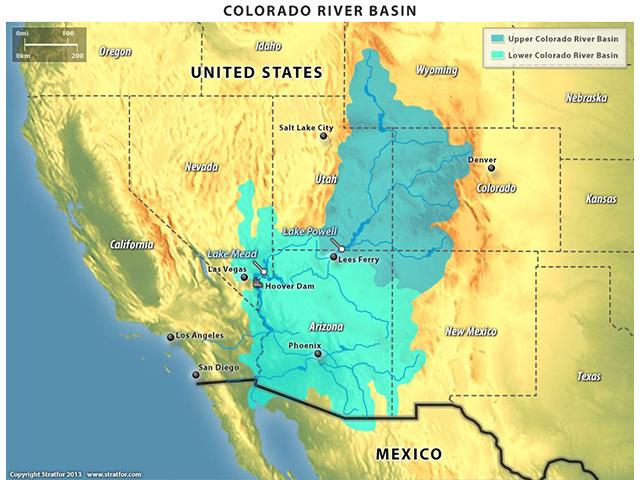
The Colorado River flows almost 1500 km from its headwaters in Wyoming, Colorado, Utah and New Mexico, through Nevada, Arizona, and California, before crossing the border to Mexico and flowing to the Gulf of California. It is the lifeblood of the American Southwest, serving almost 30 million people and enabling cities, industry, and irrigation-based agriculture to thrive in one of the direst climates on Earth (see Figure 1 in Module 8.2). The river also provides hydroelectric power that spurred much of the 20th century development of the Southwestern U.S.

In 1922, these seven western states and the federal government negotiated an agreement, the Colorado River Compact (Figure 15) to allocate water rights on the river. First and foremost the compact partitioned water between Utah, New Mexico, Wyoming, and Colorado (the Upper Basin States) where most of its discharge originates as snowmelt); and Arizona, Nevada, and California (the Lower Basin States), where population growth and water demand were increasing rapidly (Figure 16).

LINK: Materials

X

True GRIT: Debt ceiling drama is sure to heighten questions about the enormous financial power of the United States and the dollar

The repercussions of a first-ever default on the federal debt would quickly reverberate around the world.

Illustration: Natalie Peeples/Axios

What it would mean for the global economy if the US defaults on its debt

11 minutes ago 


WASHINGTON (AP) — If the debt crisis roiling Washington were eventually to send the United States crashing into recession, America’s economy would hardly sink alone.

The repercussions of a first-ever default on the federal debt would quickly reverberate around the world. Orders for Chinese factories that sell electronics to the United States could dry up. Swiss investors who own U.S. Treasurys would suffer losses. Sri Lankan companies could no longer deploy dollars as an alternative to their own dodgy currency.

“No corner of the global economy will be spared” if the U.S. government defaulted and the crisis weren’t resolved quickly, said Mark Zandi, chief economist at Moody’s Analytics.

Zandi and two colleagues at Moody’s have concluded that even if the debt limit were breached for no more than week, the U.S. economy would weaken so much, so fast, as to wipe out roughly1.5 million jobs. . .Of course, it might not come to that. The White House and House Republicans, seeking a breakthrough, concluded a round of debt-limit negotiations Sunday, with plans to resume talks Monday. The Republicans have threatened to let the government default on its debts by refusing to raise the statutory limit on what it can borrow unless President Joe Biden and the Democrats accept sharp spending cuts and other concessions.

US DEBT, LONG VIEWED AS ULTRA-SAFE

‘SHOCKWAVES THROUGH THE SYSTEM’

“If the trustworthiness of (Treasurys) would become impaired for any reason, it would send shockwaves through the system ... and have immense consequences for global growth,” said Maurice Obstfeld, senior fellow at the Peterson Institute for International Economics and former chief economist at the International Monetary Fund. , ,

CENTRAL BANKS’ STOCKPILES OF DOLLARS

Of all the foreign exchange reserves held by the world’s central banks, U.S. dollars account for 58%. No. 2 is the euro: 20%. China’s yuan makes up under 3%, according to the IMF. . .

THE GO-TO HAVEN FOR INVESTORS

Even when a crisis originates in the United States, the dollar is invariably the go-to haven for investors. That’s what happened in late 2008, when the collapse of the U.S. real estate market toppled hundreds of banks and financial firms, including once-mighty Lehman Brothers: The dollar’s value shot up.

“Even though we were the problem — we, the United States — there was still a flight to quality,” said Clay Lowery, who oversees research at the Institute of International Finance, a banking trade group. “The dollar is king.’’ . .

GOVERNMENT’S STRATEGY IF DEBT CAP IS BREACHED...A rising dollar can trigger crises abroad by drawing investment out of other countries and raising their cost of repaying dollar-denominated loans. The United States’ eagerness to use the dollar’s clout to impose financial sanctions against rivals and adversaries is also viewed uneasily by some other countries...

RELATED

Sending A Probe Around The Sun | Universe Explorers | BBC Earth Lab

The Rolling Stones - You Can't Always Get What You Want (Live) - OFFICIAL 11,784,554 views

The Rolling Stones - You Can’t Always Get What You Want (Official Video)... 20,994,830 views

Forbes Report 04.20.2022: President Zelensky Is Not A Billionaire. So How Much Is He Worth? } Matt Durot Forbes Staff

 The Russian invasion has hit Ukraine’s billionaires hard. According to Forbes’ 36th annual World’s Billionaires List, there are only seven left in the country and Zelensky is not one of them (nor is former president and chocolate magnate Petro Poroshenko, who dropped from the rankings this year).

But unlike his predecessor, Zelensky never was a billionaire. He’s currently worth roughly $20 million, based on reporting by Forbes Ukraine. Additional reporting by Forbes US puts that number at less than $30 million.

President Zelensky Is Not A Billionaire. So How Much Is He Worth?

. . .His main asset: an estimated 25% stake in Kvartal 95, a group of companies that produce humorous shows, which he transferred to his partners after being elected president, though he’ll likely regain his shares after leaving office. 

  • Kvartal 95 produced and owns the Servant of the People series, a popular political comedy starring Zelensky as a Ukrainian high school teacher who is elected president. 
  • Netflix, which previously streamed the show between 2017 and 2021, snapped up the rights again in March. With estimated revenues of $30 million annually, Forbes Ukraine values Zelensky’s stake at $11 million.

While he does own a flat in one of Ukraine’s most expensive apartment buildings in the center of Kyiv, it’s relatively modest by Western standards. 

  • Forbes estimates Zelensky’s entire real estate portfolio is worth $4 million, including two more wholly owned apartments, two that he co-owns, a single commercial property and five parking spaces. 
  • Zelensky did own a $4.6 million villa in Forte dei Marmi, Italy as of December 2019, according to the most recent filing by his holding company. He apparently sold it during 2020 (it had shown up in his declarations for 2018 and 2019 but not 2020) along with a small plot of land and 5 hotel rooms in Georgia (popular upper-middle-class investments in Ukraine). 
  • The cash from these sales was declared and is included in Forbes’ estimate, but because the sum is less than the estimated value of the real estate, it is possible Zelensky remains a de facto beneficiary or the cash is invested elsewhere. 
  • We estimate he and his wife Olena Zelenska share a bank account that holds roughly $2 million in cash and government bonds. Their other assets, consisting of two cars and some jewelry, are worth no more than $1 million. . ."

RELATED CONTENT ON THIS BLOG FROM 2020 

ANOTHER REAL-LIFE POLITICIAN MADE ON TELEVISION: From Lewd Comedy to Ukrainian President

Intro: There is an ironic parallel with the real-life viral videos coming out of Ukraine at the moment, , ,But the journey from lewd comedy to president would not have happened without one telly success: Servant of the People.
The Kvartal 95 team owns this show, which ran for three seasons between 2015 and 2019, with Zelenskiy as creator, producer and star. The last of the 51 episodes aired on 28 March 2019; Zelenskiy won the election on 21 April 2019.
A year earlier, Kvartal 95 had registered Servant of the People as the name of a new political party.

A rehearsal for war: Volodymyr Zelenskiy’s path from comic to symbol of courage

Volodymyr Zelenskiy in March 2019, weeks before becoming Ukraine’s president.

Volodymyr Zelenskiy in March 2019, weeks before becoming Ukraine’s president. 

Photograph: Bloomberg/Getty

Last modified on Wed 2 Mar 2022 04.10 EST

As the president of Ukraine, his defiance has made him a hero across the world. 

Could his success as a politician lie in his years as an entertainer? . . .But there is plenty about Zelenskiy’s showbiz career that has been underestimated. When Zelenskiy was elected in April 2019, at the age of 41, the Russian commentator Sergey Parkhomenko said: “He is weak, he does not have a religion, he does not have a nationality.” It was meant as a criticism, even though all these reasons were precisely why people had voted for Zelenskiy. He is not intimidating. He does not come from a political background. He is a Russian speaker from the centre of the country. But, most of all, to Ukrainians, he was recognisable and he was funny. That nice guy off that TV show Servant of the People. You know, the one where the geeky history teacher becomes the president overnight. The Paddington voice guy.

Outside the Russian-speaking world, you wouldn’t have known any of this. You probably wouldn’t even have heard of the TV show, even though it was eventually snapped up by Netflix. (It is now available on YouTube with English subtitles.) Beyond Ukraine, until last week, he was simply referred to as “a comedian who became president”. Initial coverage of his landslide victory – in which he won 73.2% of the vote – was derisory. What were the Ukrainians thinking? Who is this guy anyway? He is hardly Ronald Reagan. What a joke. . .

  • . . .He started out in 1995, as a teenager, as an improviser in KVN competitions in his area. KVN (Klub Vesyolykh i Nakhodchivykh, or Club of the Funny and Inventive) is a beloved institution known throughout the former Soviet Union, which went on to become one of the longest-running shows on Russian television. (Its social media feeds have been inactive since 27 February.) It grew out of the 60s TV show Vecher Vesleykh Voprosov (An Evening of Funny Questions), in which performers would compete to come up with the funniest answers, in the style of Whose Line Is It Anyway?. Taken off air in the early 70s after it fell foul of the censors, it was revived in 1986 during the era of glasnost and perestroika.
  • Zelenskiy was a keen competitive improviser and became part of Ukraine’s Kvartal 95 team of about 10 players, touring the then recently dissolved USSR, winning KVN competitions and honing their Russian-language sketches. It was only much later that they started to do more sketches in Ukrainian: Zelenskiy’s story represents the fluidity and divides between Russian and Ukrainian cultural audiences. He is and isn’t “one of ours”. . 
  • In 2003, Kvartal 95 was established as an independent production company, making TV shows and films for Ukrainian and Russian-speaking audiences. The project got a boost when Zelenskiy won Ukraine’s Dancing With the Stars in 2006, performing with his professional partner, Alena Shoptenko. She is still one of the 196 people he follows on Instagram. (He has 13.4 million followers.) 
  • Highlights included a jive to Blue Suede Shoes, with Zelenskiy giving it the full pink-satin-jumpsuited Elvis, a pencil moustache for a tango to Big Spender, a blindfolded rumba to Sting’s The Shape of My Heart and a quirky American smooth dressed as Charlie Chaplin. His performances were energetic and all-in – and he was super-fit. 
  • This was – and is – clearly important to him: until he became president, he would regularly post videos on social media from the gym, or swimming, or jogging in New York.

  • His screen work grew. In 2008, he played Igor, a Russian dentist living in New York, in Love in the Big City. Igor is one of three friends suddenly struck impotent, who must then find the path to true love in order to regain their virility. (It is easy to react disparagingly to this, but the film made $9m at the box office and it is fair to say that Steve Carell’s The 40-Year-Old Virgin is not too dissimilar in tone.)

  • Two sequels followed. In Office Romance: Our Time (2011), he played Anatoly, a financial analyst with a difficult boss.

ZeroHedge Today: Yes 'Something Else Is Cooking' In Ukraine...but No mention of The Corruption??


Seymour Hersh: 'Something Else Is Cooking' In Ukraine

Tyler Durden's Photo
BY TYLER DURDEN
MONDAY, MAY 22, 2023 - 01:15 AM

Authored by Seymour Hersh, via Scheerpost,

This story is a follow up to Seymour Hersh’s original report on the Nord Stream pipeline sabotage.

Sign up at seymourhersh.substack.com so you can support Sy Hersh’s work

Last Saturday the Washington Post published an exposé of classified American intelligence documents showing that Ukrainian President Volodymyr Zelensky, working behind the back of the Biden White House, pushed hard earlier this year for an expanded series of missile attacks inside Russia. The documents were part of a large cache of classified materials posted online by an Air Force enlisted man now in custody. A senior official of the Biden administration, asked by the Post for comment on the newly revealed intelligence, said that Zelensky has never violated his pledge never to use American weapons to strike inside Russia. In the view of the White House, Zelensky can do no wrong. 

Zelensky’s desire to take the war to Russia may not be clear to the president and senior foreign policy aides in the White House, but it is to those in the American intelligence community who have found it difficult to get their intelligence and their assessments a hearing in the Oval Office. Meanwhile, the slaughter in the city of Bakhmut continues. It is similar in idiocy, if not in numbers, to the slaughter in Verdun and the Somme during World War I. The men in charge of today’s war—in Moscow, Kiev, and Washington—have shown no interest even in temporary ceasefire talks that could serve as a prelude to something permanent. The talk now is only about the possibilities of a late spring or summer offensive by either party.

But something else is cooking, as some in the American intelligence community know and have reported in secret, at the instigation of government officials at various levels in Poland, Hungary, Lithuania, Estonia, Czechoslovakia, and Latvia. These countries are all allies of Ukraine and declared enemies of Vladimir Putin.

This group is led by Poland, whose leadership no longer fears the Russian army because its performance in Ukraine has left the glow of its success at Stalingrad during the Second World War in tatters. It has been quietly urging Zelensky to find a way to end the war—even by resigning himself, if necessary—and to allow the process of rebuilding his nation to get under way. Zelenskyy is not budging, according to intercepts and other data known inside the Central Intelligence Agency, but he is beginning to lose the private support of his neighbors.

One of the driving forces for the quiet European talks with Zelensky has been the more than five million Ukrainians fleeing from the war who have crossed the country’s borders and have registered with its neighbors under an EU agreement for temporary protection that includes residency rights, access to the labor market, housing, social welfare assistance, and medical care. An assessment published by the UN High Commissioner for Refugees reports that the estimate excludes roughly 3 million Ukrainian refugees who escaped from the war zone without a visa into any of the 27 European nations that have abolished border control between each other under the Schengen agreement. Ukraine, though not in the EU, now enjoys all the benefits of the Schengen pact. A few nations, exhausted by the 15-month war, have reintroduced some forms of border control, but the regional refugee crisis will not be resolved until there is a formal peace agreement.

The UNHRC reports that free travel from Ukraine into the Baltic states and EU states in Western Europe “makes it particularly difficult to determine exactly how many Ukrainians have reached the EU in the last few months, and where they are now.” The report says the “vast majority” of the Ukrainian refugees are women and children, and one third of them are under the age of eighteen. Seventy-three per cent of the refugees of working age are women, many with children.

A February analysis of the European refugee issue by the Council on Foreign Relations found that “tens of billions of dollars” in humanitarian aid were poured into Ukraine’s neighbors during the war’s first year.

“As the conflict enters its second year with no end in sight,” the report says, “experts worry that host countries are growing fatigued.”

Weeks ago I learned that the American intelligence community was aware that some officials in Western Europe and the Baltic states want the war between Ukraine and Russia to end. These officials have concluded that it is time for Zelensky to “come around” and seek a settlement. A knowledgeable American official told me that some in the leadership in Hungary and Poland were among those working together to get Ukraine involved in serious talks with Moscow. “Hungary is a big player in this and so are Poland and Germany, and they are working to get Zelensky to come around,” the American official said. The European leaders have made it clear that “Zelensky can keep what he’s got”—a villa in Italy and interests in offshore bank accounts—“if he works up a peace deal even if he’s got to be paid off, if it’s the only way to get a deal.” 

So far, the official said, Zelensky has rejected such advice and ignored offers of large sums of money to ease his retreat to an estate he owns in Italy. There is no support in the Biden Administration for any settlement that involves Zelensky’s departure, and the leadership in France and England “are too beholden” to Biden to contemplate such a scenario. There is a reality that some elements in the American intelligence community can’t ignore, the official said, even if the White House is ignoring it: “Ukraine is running out of money and it is known that the next four or months are critical. And Eastern Europeans are talking about a deal.” The issue for them, the official told me, “is how to get the United States to stop supporting Zelensky,” The White House support goes beyond the needs of the war: “We are paying all of the retirement funds—the 401k’s—for Ukraine.”

And Zelensky wants more, the official said.

“Zelensky is telling us that if you want to win the war you’ve got to give me more money and more stuff. He tells us, ‘I’ve got to pay off the generals.’ He’s telling us”—if he is forced out of office—“he’s going to the highest bidder. He’d rather go to Italy than stay and possibly get killed by his own people.” 

“All of this talk is being reported and is now flying around inside the American intelligence community, but, as usual,” the official said, “it’s not clear to the intelligence community what the president and his foreign policy aides in the White House know of the reality” of the European discussion about finding a way to end the war.

“We are still training Ukrainians how to fly our F-16s that will be shot down by Russia as soon as they get into the war zone. The mainstream press is dedicated to Biden and the war and Biden is still talking about the Great Satan in Moscow while the Russian economy is doing great. Putin can stay where he is”—in power—“despite his failure to wipe Ukraine off the map as an independent state. And he thought he would win the war with just one airborne division”—a sardonic reference to Russia’s failed effort in the first days of the war to seize a vital airport by parachuting in an attack force.

“Europe’s problem,” the official said, in terms of getting a quick settlement to the war, “is that the White House wants Zelensky to survive while there are others”—in Russia and in some European capitals—“who say Zelensky has got to go, no matter what,”

It’s not clear that this understanding has gotten to the Oval Office. I have been told that some of the better intelligence about the war does not reach the president, through no fault of those who prepare the often contrary assessments. Biden is said to rely on briefings and other materials prepared by Avril Haines, director of National Intelligence, since the Biden Administration came into office. She has spent much of her career working for Secretary of State Anthony Blinken, whose ties to Biden and agreement with him on matters pertaining to Russia and China go back decades. 

The one saving grace for some in the community, I have been told, has been CIA Director William Burns.

Burns was ambassador to Russia and deputy secretary of State and is seen as someone “who has come around” in opposition to some of the White House’s foreign policy follies. “He doesn’t want to be a rat on a sinking ship,” the official told me.

On the other hand, I have been told, it’s not clear to those in the CIA who prepare the President’s Daily Brief that Joe Biden is a regular reader of their intelligence summary. The document is usually three pages. Decades ago I was told—by someone who begged me not to write about it at the time—that Ronald Reagan rarely read the PDB until Colin Powell, then in the White House, began reading it to a video recorder. The tape would then be played for the president. It’s unclear who, if anyone, might take the initiative as Biden’s Colin Powell.

*  *  *

Sign up at seymourhersh.substack.com so you can support Sy Hersh’s work

140,742433

Could this be the ICONIC image for #47 ?? | Illustration by Erik Carter

      SOURCE:  Trump’s Profiteering Hits $4 Billion   Saturday, January 31, 2026   David D. Kirkpatrick Staff writer ...