Though US efforts to cooperate with Asian and Pacific countries have recently produced good results, many countries in the region don’t see cooperation with the US as being in their interest. And any positive movement in those relationships may have as much to do with Beijing’s aggression or mismanagement of relationships as it does with what the US has to offer.



The US’s multiple Indo-Pacific strategies, explained
A Papua New Guinea pact reveals the complexity of creating partnerships in the region.
"The US has accelerated its security and cooperation agreements in the Indo-Pacific region in recent months, renewing strong ties to the Philippines, enhancing cooperation with Australia, and negotiating wide-ranging defense and cooperation agreements with Papua New Guinea. But even as the US courts the region, Asian and Pacific countries must weigh the costs and benefits of their alignments in a complex security, economic, and environmental interests.
While there are no official details about the agreements, they include targeted economic support, efforts to fight climate change, disaster relief assistance, as well as an expanded US military presence over the next 10 years and support in policing illicit activity like illegal fishing in the country’s immediate vicinity.
Papua New Guinea, like many countries in the broader region, has a strong trade relationship with China but values its non-aligned status and commitment to its own domestic priorities above “great power” competition.
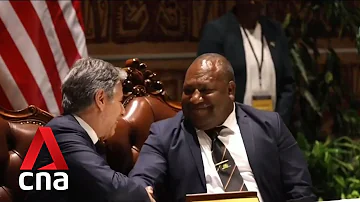
Papua New Guinea President James Marape insists that the defense agreement is just an update of a previous defense pact and that his country will not be used as a US base in a conflict between the US and China. “We have a healthy relationship with the Chinese government and they are an important trading partner,” Marape said during a joint press conference with Secretary of State Antony Blinken in the capital, Port Moresby, last week.
The leaders of 14 Pacific Island nations were in Port Moresby last week as part of a regional partnership with the US, aimed at deepening economic and security ties to help fend off what President Joe Biden called China’s “economic coercion” in the region at a White House summit last year.
- Efforts to court nations in the Pacific Islands also comes on the heels of renewed defense cooperation with the Philippines. That partnership withered under former Philippines President Rodrigo Duterte, but the Enhanced Defense Cooperation Agreement (ECDA), has been reinstated under President Ferdinand Marcos Jr. and allows the US to base troops at specific military installations in the Philippines.
- Japan and South Korea have also agreed to invest more in their militaries, and cooperation between the two nations has increased under new leadership and with increased threats both from China and North Korea.
- And the Quad — the defense, economic, and policy cooperation group made up of the US, Australia, Japan, and India — is at its strongest yet. . .
There can’t really be just one Indo-Pacific strategy
The US has many challenges to its relationships in the Asia-Pacific region; horrific wars, outright colonialism, environmental destruction, and covert meddling in politics are just a few of the reasons Asian and Pacific nations have to distrust or reject a relationship with the US. . .
- “Japan-South Korea has been the incredibly weak link, the weak leg of this trilateral triangle for years, to great frustration of US objectives and US strategists,” Brian Harding, senior expert for Southeast Asia at the US Institute for Peace told Vox. “There are a lot of reasons why there are problems in that relationship, but strategically it’s been a real problem for the United States, so a closer trilateral US-Japan-South Korea relationship is a major new development” particularly when it comes to dealing with the military and nuclear threat coming from North Korea.. .
- Japan in particular has committed to increasing its military might, eschewing its decades-long pacifist position to counter threats from both North Korea and China. “The threat is [...] a military conflict over the Taiwan Strait and because of Japan’s geographic proximity, because of the US-Japan alliance, and because US military assets in Japan are seen as critical for any kind of viable US military intervention in the Taiwan crisis — because of that, if there is any kind of Taiwan conflict, there is a high probability that China would attack Japanese territory,” Mike Mochizuki, associate professor of political science and international affairs at George Washington University, told Vox in a January interview. . .
- The US’s relationship with the Philippines is less straightforward and more challenging; to start, the relationship between the two nations is built on colonialism, which actually caused the Philippines to kick US forces out of the country for more than two decades. And although Marcos has become close to the US during his short tenure, his predecessor was “the most pro-China president in Philippines history,” Derek Grossman, senior defense analyst at the RAND corporation, told Vox.
Still a greater challenge for the US in terms of cooperation is Southeast Asia. Though the US has military cooperation agreements with both Thailand and Singapore — which hosts more US troops than the Philippines — non-alignment remains a strong priority for Southeast Asian nations.
- Non-alignment is still a potent force, particularly in the Global South, according to Blake Herzinger, a research fellow at the United States Studies Centre in Sydney. “While non-alignment has maybe gone out of vogue, we don’t talk a lot about the non-aligned movement anymore unless you’re quite involved in Southeast Asia and the Global South, it is still a vital national interest of most countries — they would still cling to that non-alignment and they see it in their best interest.”
- As Vox previously reported, the non-alignment movement began during the Cold War and drew in countries that didn’t care to get caught up in Great Power competition.
Cooperation with China is a necessity for most in the region
Outside of its relationships with Japan and South Korea, and to an extent the Philippines, the US has to contend with the fact that many of the countries in the region — and with which it is seeking relationships — don’t have militaries, Harding said. “In terms of US defense policy and engagement in the Pacific Islands region, it’s actually a little bit of a tough challenge for US statecraft,” he said. “There are only three militaries in the Pacific Islands region — Papua New Guinea, Fiji, and Tonga. So while there’s a huge interest at the Pentagon, at INDOPACOM, about how to be more focused on the Pacific, there are not a lot of partners.”
- . . .It’s possible that US policy makers have gotten more comfortable with the fact that countries in the region will also cooperate with China because they have to to further their own interests.
- And no amount of coordination, regional dialogue, or military and economic cooperation can change the fact that the US-China relationship is at its lowest point in decades, with little opportunity for conversation between government officials at the highest levels.
. . .However, offering investment, attention, and diplomacy to these countries may be the only tool available."
LINK: VOX
Ellen Ioanes covers breaking and general assignment news as the weekend reporter at Vox. She previously worked at Business Insider covering the military and global conflicts.


RELATED


THE LATEST
/cdn.vox-cdn.com/uploads/chorus_image/image/72318031/killers1.0.jpg)
By


