
The domino theory is a geopolitical theory which posits that increases or decreases in democracy in one country tend to spread to neighboring countries in a domino effect.[1] It was prominent in the United States from the 1950s to the 1980s in the context of the Cold War, suggesting that if one country in a region came under the influence of communism, then the surrounding countries would follow. It was used by successive United States administrations during the Cold War as justification for American intervention around the world. Former U.S. President Dwight D. Eisenhower described the theory during a news conference on 7 April 1954, when referring to communism in Indochina as follows:
Moreover, Eisenhower’s deep belief in the domino theory in Asia heightened the “perceived costs for the United States of pursuing multilateralism"[3] because of multifaceted events including the “1949 victory of the Chinese Communist Party, the June 1950 North Korean invasion, the 1954 Quemoy offshore island crisis, and the conflict in Indochina constituted a broad-based challenge not only for one or two countries, but for the entire Asian continent and Pacific."[3] This connotes a strong magnetic force to give in to communist control, and aligns with the comment by General Douglas MacArthur that “victory is a strong magnet in the East."[4]
Other applications[edit]

- During the Iran–Iraq War the United States and other western nations supported Ba'athist Iraq, fearing the spread of Iran’s radical theocracy throughout the region.
- In the 2003 invasion of Iraq, some neoconservatives argued that when a democratic government is implemented, it would then help spread democracy and liberalism across the Middle East.
- This has been referred to as a “reverse domino theory,"[42] or a “democratic domino theory,"[43] so called because its effects are considered positive, not negative, by Western democratic states.

A Fresh Order of Domino Theory — COLUMBIA POLITICAL REVIEW

The Domino Theory

Domino Theory: Definition, Cold War & Vietnam War - HISTORY


We Are Living Through the Worst Eighties Reboot
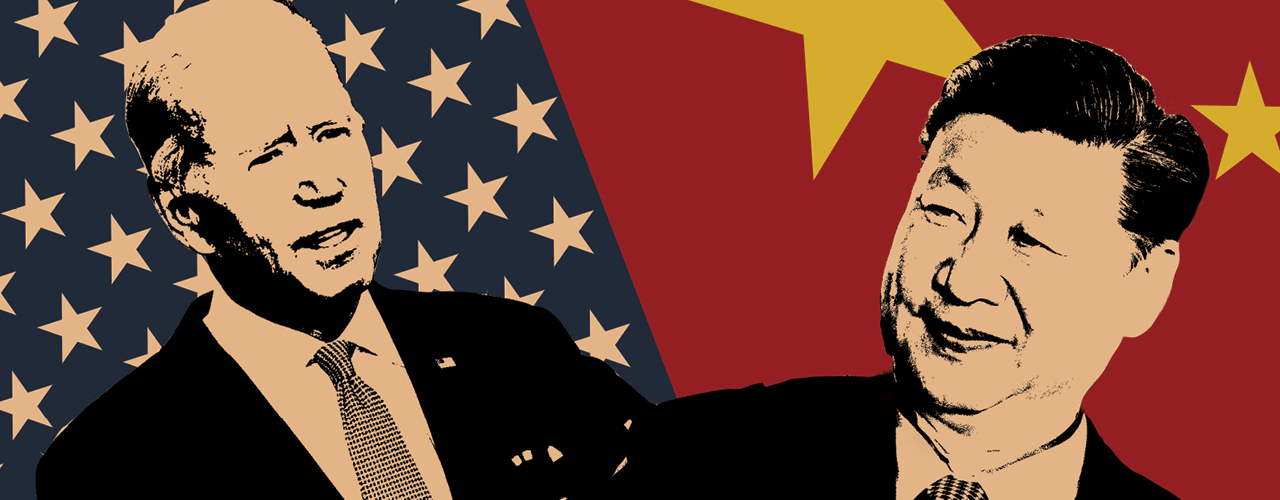
Cold War II | Miller Center
History[edit]
During 1945, the Soviet Union brought most of the countries of eastern Europe and Central Europe into its influence as part of the post-World War II new settlement,[5] prompting Winston Churchill to declare in a speech in 1946 at Westminster College in Fulton, Missouri that:
Following the Iran crisis of 1946, Harry S. Truman declared what became known as the Truman Doctrine in 1947,[7] promising to contribute financial aid to the Greek government during its Civil War and to Turkey following World War II, in the hope that this would impede the advancement of Communism into Western Europe.[8] Later that year, diplomat George Kennan wrote an article in Foreign Affairs magazine that became known as the “X Article", which first articulated the policy of containment,[9] arguing that the further spread of Communism to countries outside a “buffer zone” around the USSR, even if it happened via democratic elections, was unacceptable and a threat to U.S. national security.[10] Kennan was also involved, along with others in the Truman administration, in creating the Marshall Plan,[11] which also began in 1947, to give aid to the countries of Western Europe (along with Greece and Turkey),[12] in large part with the hope of keeping them from falling under Soviet domination.[13]
In 1949, a Communist-backed government, led by Mao Zedong, was instated in China (officially becoming the People’s Republic of China).[14] The installation of the new government was established after the People’s Liberation Army defeated the Nationalist Republican Government of China in the aftermath of the Chinese Civil War (1927-1949).[15] Two Chinas were formed – mainland “Communist China” (People’s Republic of China) and 'Nationalist China' Taiwan (Republic of China). The takeover by Communists of the world’s most populous nation was seen in the West as a great strategic loss, prompting the popular question at the time, “Who lost China?"[16] The United States subsequently ended diplomatic relations with the newly-founded People’s Republic of China in response to the communist takeover in 1949.[15]
Korea had also partially fallen under Soviet domination at the end of World War II, split from the south of the 38th parallel where U.S. forces subsequently moved into. By 1948, as a result of the Cold War between the Soviet Union and the U.S., Korea was split into two regions, with separate governments, each claiming to be the legitimate government of Korea, and neither side accepting the border as permanent. In 1950 fighting broke out between Communists and Republicans that soon involved troops from China (on the Communists’ side), and the United States and 15 allied countries (on the Republicans’ side). Though the Korean conflict has not officially ended, the Korean War ended in 1953 with an armistice that left Korea divided into two nations, North Korea and South Korea. Mao Zedong’s decision to take on the U.S. in the Korean War was a direct attempt to confront what the Communist bloc viewed as the strongest anti-Communist power in the world, undertaken at a time when the Chinese Communist regime was still consolidating its own power after winning the Chinese Civil War.


No comments:
Post a Comment