
NASA starts reassessment of Mars Sample Return architecture
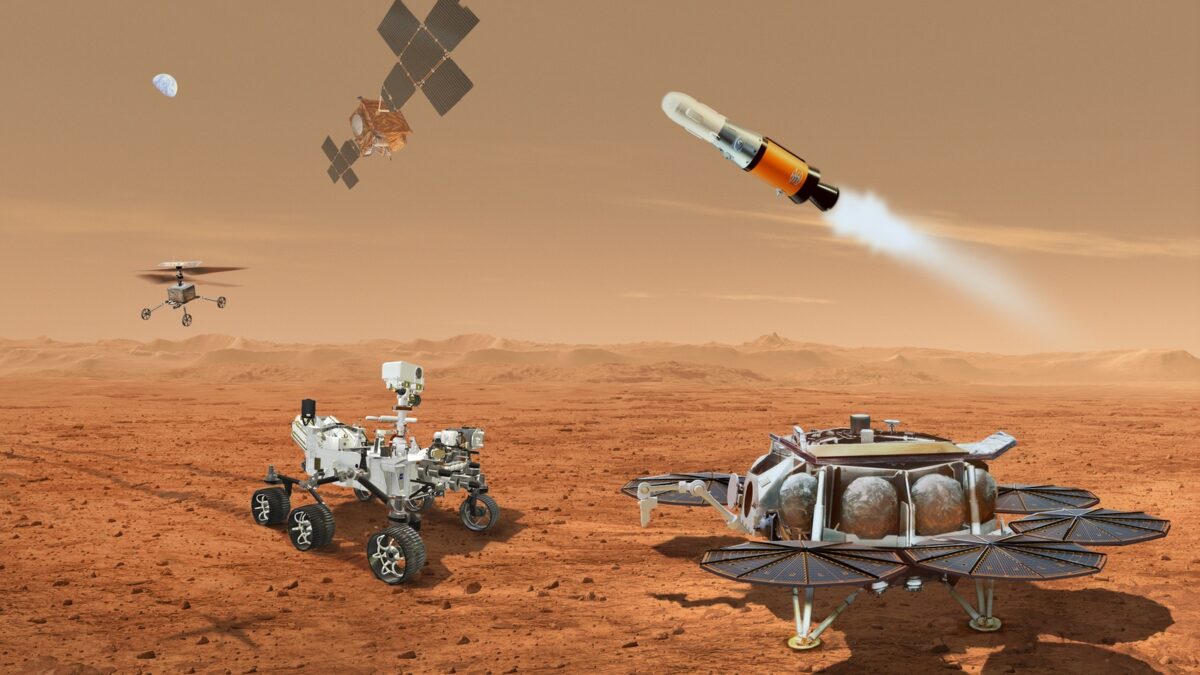
PASADENA, Calif. — NASA has started work to revise its approach to returning samples from Mars after an independent review concluded the current Mars Sample Return (MSR) architecture has an “unrealistic” budget and schedule. Sandra Connelly, NASA deputy associate administrator for science, said at an Oct. 20 meeting of the Mars Exploration Program Analysis Group (MEPAG), an advisory committee, that the agency has convened a team to address the recommendations made by an independent review board (IRB) in September.
That independent review found a “near zero” probability that the next major elements of MSR, a sample retrieval lander and Earth return orbiter, would be ready for launch as currently planned in 2027 and 2028.
- It also estimated MSR costs to be in the range of $8 billion to $11 billion, far higher than previous NASA projections.
- “We want to make sure that we’re taking into consideration the findings and recommendations so that we can structure this program to be successful and do so within a balanced budget,” Connelly said.
- She is leading a group called the MSR IRB Response Team, or MIRT, that will develop a revised Mars Sample Return architecture. That team, which held a kickoff meeting Oct. 19, includes five subcommittees focused on various technical, science, programmatic and budgetary issues associated with the program.
- The MIRT will complete its work by the end of March, she said, offering a revised architecture for MSR. Some of that work started even before the team’s kickoff: Jeff Gramling, MSR director at NASA Headquarters, said one group has been reviewing architectures for the last three to four weeks.
- The plan he outlined called for selecting two or three alternative architectures this fall for further study, which may include independent cost estimates.
- One the agency selects a new architecture, he said the goal is to get through a confirmation review by late 2024 where NASA makes formal cost and schedule commitments for the program. NASA had previously planned to hold a confirmation review for MSR this fall.
One additional challenge for the effort is uncertainty about how much funding will be available for MSR in fiscal years 2024 and 2025 during this effort, part of broader debates about agency funding.
- “We don’t know yet what’s going to be appropriated for ’24, so we’re going to have to be skinnying down a bit to fit within ’24 while we pause and step back,” he said.
- He didn’t elaborate on the alternative approaches to MSR under consideration. The IRB report listed several that would push back launches of the lander and orbiter into the 2030s, while incorporating flight-proven technologies like the “skycrane” landing approach and a rover based on the Mars Exploration Rover that would retrieve samples cached by the Perseverance rover.
The review of alternative architectures will focus on several figures of merit, including total and per-year costs, technical issues and the science value of the revised mission.
- One example he gave is looking at reducing the number of samples returned, allowing for a smaller Orbiting Sample (OS), the container that would house them. A smaller OS, he noted, could reduce cost and complexity for the overall architecture.
- Earlier in the meeting, Orlando Figueroa, who chaired the IRB, identified a lack of maturity of the design of the OS as a key problem for MSR.
- The OS would be launched by a Mars Ascent Vehicle rocket into orbit and be captured by the Earth Return Orbiter, thus impacting the design of both.
- “It is an item that interconnects all of the components of the architecture,” he said.
- NASA officials said they would work with the European Space Agency, which is responsible for the Earth Return Orbiter and a robotic arm for transferring samples.
- “Our ESA partners are tightly coupled into all of this and are also bringing their thoughts and ideas to the table,” Gramling said.
- Daniel Neuenschwander, ESA’s director of human and robotic exploration, said at an Oct. 19 briefing after an ESA Council meeting that ESA was proceeding with its contributions to MSR.
- “We are assessing all options” for MSR, he said, citing an upcoming meeting he had with NASA officials on the program.
Both NASA officials and others at the MEPAG meeting said NASA should remain committed to Mars Sample Return despite its current problems.
- “MSR is clearly, logically the next step in our leadership on Mars,” said Connelly.
- “It does remain a NASA priority."
- Philip Christensen of Arizona State University, a co-chair of the steering committee that led development of the planetary science decadal survey published in 2022, noted that the report endorsed MSR as its highest scientific priority, while offering recommendations to ensure that it did not become too large a part of NASA’s planetary science portfolio.
- This is something that we should take very seriously,” he said of that recommendation. “It took a year and a half of discussion and debate to come to this recommendation. It was not achieved lightly, and it really does represent the view of the broad planetary science community of the importance of this project.”


No comments:
Post a Comment