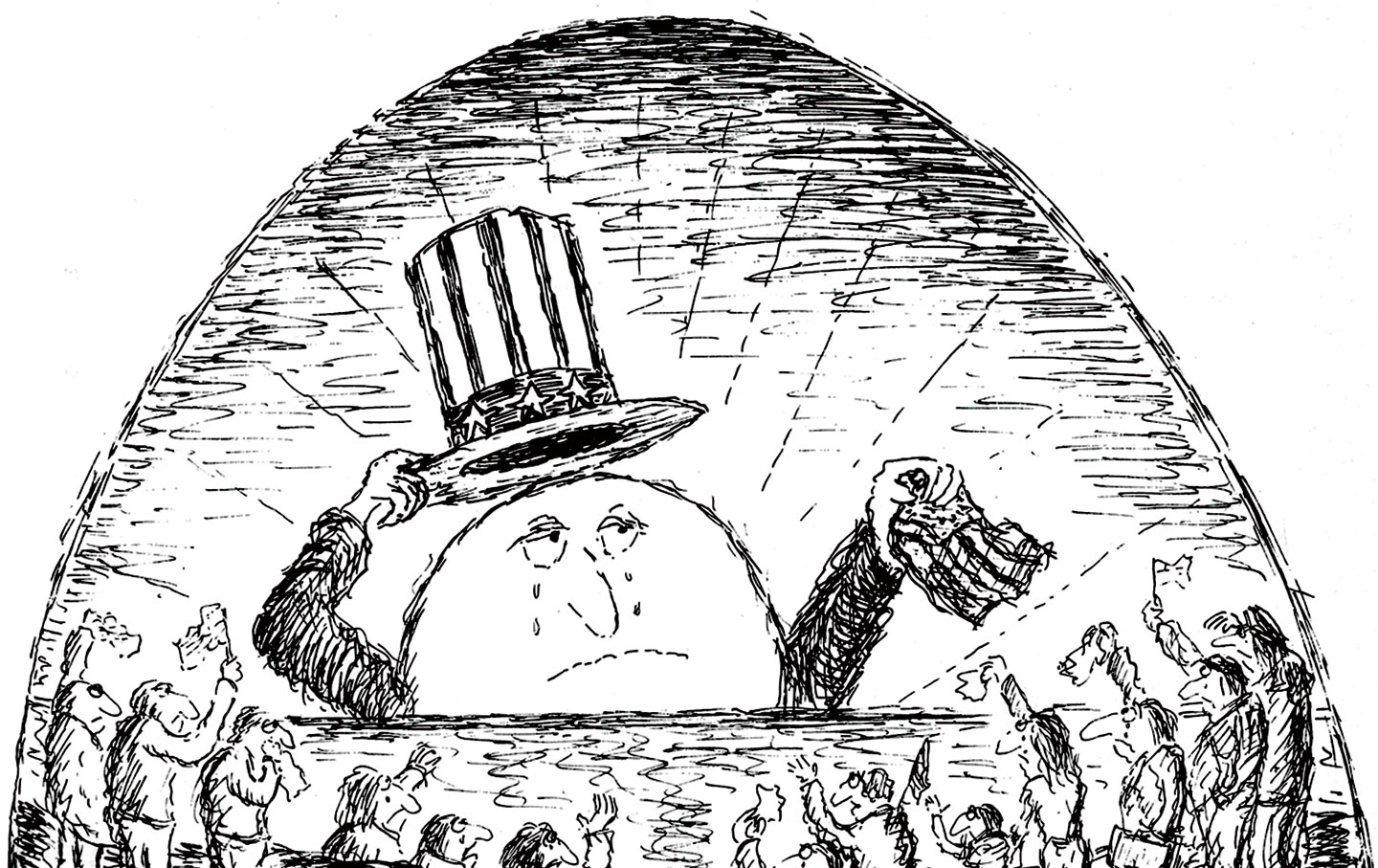
Getting Rome Right
and America Wrong
A new history of empire is far too British.

In Why Empires Fall: Rome, America, and the Future of the West, Peter Heather and John Rapley set themselves to an all-too-familiar task, drawing lessons from the fall of the Roman Empire to apply to the ever-imminent and somehow never-yet-arriving collapse of the U.S.-led global order. Indeed, comparison between the United States and Rome, particularly its decline, is a well-worn and time-tested genre.

Why Empires Fall: Rome, America, and the Future of the West, Peter Heather and John Rapley, Yale University Press, 200 pp., $27, September 2023
Yet the book has a distinctly British perspective. That’s unsurprising given that the authors write from King’s College London and the University of Cambridge, respectively, but it is an uncomfortable fit for a Western global order in which the Pacific is every bit as important at the Atlantic. As a result, while Heather and Rapley provide a masterful vision of the whole of the late Roman Empire, they write on the apparent decline of the modern Western “empire” from a perspective on its periphery.
Much of the United States’ global world is missing from the narrative. While the European Union, Brexit, and NATO come up frequently, much of the Pacific economic and diplomatic infrastructure barely appears: The Trans-Pacific Partnership, Quadrilateral Security Dialogue, and Association of Southeast Asian Nations are all absent from the volume. The U.K. National Health Service has an index entry, but the United States-Mexico-Canada Agreement, née NAFTA, does not. It is the fall of Rome but as it might have been written from Roman Greece or, indeed, Roman Britain, shaped more by British declinism than U.S. realities.
- This, too, is a well-worn comparison; worries that the British Empire might overextend and then decline like the Roman Empire had go back at least to the late 1800s, to British Prime Minister William Gladstone and Rudyard Kipling. As a history of Rome, the book is fascinating, but as a lesson for our times, it is shaky.


No comments:
Post a Comment