“Explosive potential” in Korean Peninsula geopolitics – GlobalData
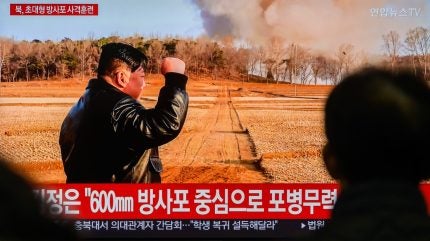
On Tuesday (19 March), North Korean leader Kim Jong Un oversaw the successful test of the intermediate-range hypersonic missile at the Sohae Satellite Launching Ground, the state-run Korean Central News Agency reported.
- The day before, North Korea had reportedly fired three short-range ballistic missiles into the Sea of Japan while US Secretary of State Antony Blinken visited Seoul, which South Korea condemned as a “clear provocation”.
The launch followed one of the US and South Korea’s joint major annual military exercises, which Kim called an invasion rehearsal.
“Nuclear risk” in Korean Peninsula --- Over the next four years, the risk of conflict escalation between North and South Korea is “high – with nuclear risk”, according to GlobalData analysts’
Geopolitics – Executive Briefing.
See Also:

While the briefing says the direct threat of ongoing conflicts in Ukraine and Gaza is severe, the ripple effect of escalating tensions in East Asia has the largest relative risk based on likelihood and global impact.
Within the East Asia theatre, the briefing designates Taiwan, the South China Sea and the Korean Peninsula as the major risks.
“So high are the stakes in the US-China confrontation that the economic and business risks stemming from the present Russia-Ukraine and Middle East wars would pale beside any possible conflicts in East Asia,” the briefing states.
“[There is] explosive potential also on the Korean Peninsula and in the South China Sea”.
This analysis of fraught geopolitical relations on the Korean Peninsula correlates with the latest intensification in rhetoric and military activity.
The missile tested on 19 March used a solid-fuel engine, which lasts longer than liquid-propelled missiles – and makes launches trickier to detect.
Given its proximity to the border with North Korea and the Korean Demilitarized Zone (DMZ), Seoul is also much more susceptible to a surprise attack than Pyongyang.
In a hypothetical trading of cross-border missiles, South Korea’s aerial defense protocol would have considerably less time to react than North Korea, especially if Pyongyang launched solid-fuel, tricky-to-detect missiles.
Nuclear warhead stockpiling
- In 2006, North Korea became the ninth country to demonstrate nuclear weapon capabilities, joining the US, Russia, UK, France, China, India, Pakistan and Israel.
- Ever since, Pyongyang has forged closer military ties with Moscow.
- North Korea has assembled an estimated thirty active nuclear warheads, according to Our World in Data.


No comments:
Post a Comment