It can work with whoever governs Iran, because it would be in the net interest of Iran as well as its gulf neighbors, not to mention the Asian economies that depend most on the strait. It is designed to be done with Iran rather than to it.

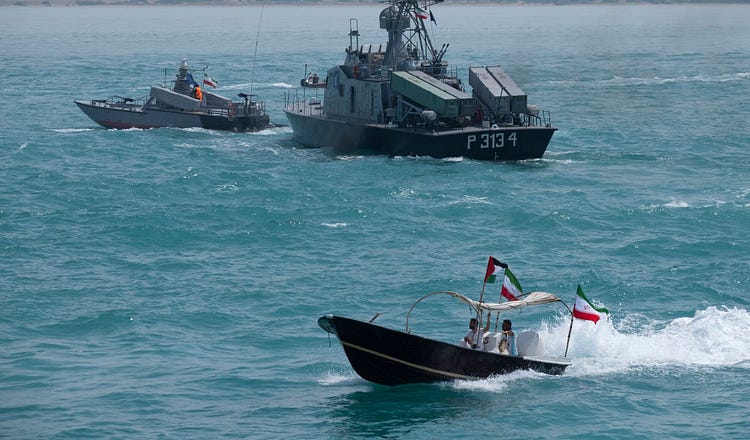
This Saturday, delegations from the United States and Iran are slated to head to Pakistan to try to negotiate a lasting end to the war between them. Among the bones of contention will be the Strait of Hormuz: the crucial waterway through which one-fifth of the world’s oil and liquefied gas normally passes. Iran’s closure of the strait since the conflict began has sent a massive shockwave through the global economy, driving up key commodity prices and risking global stagflation.
Conflicts over strategic and commercial waterways—especially straits and canals—are nothing new. Back in 1507, the Portuguese decided to set up a fortress to control the Strait of Hormuz. It taxed commerce for a century before Persia and Britain joined forces to evict them. Today, Iran is attempting to claim the toll-keeper role that Portugal once played, demanding that any permanent peace deal recognize its right to impose fees on ships passing through the strait. The theocratic tyranny that has ruled in Tehran for 47 years wants to determine who can trade through one of the world’s great choke points—and what they must pay for the privilege.
This cannot stand. The Iranian regime must not be allowed to turn the seven other states that border the Persian Gulf, most of them good friends of the United States, into its vassals. Nor should the rest of the world submit to Iran’s extortions.
The United States and its allies have dealt with Iranian threats to traffic in the strait before. The last major disruption was during the Iran-Iraq War, which led in 1987-88 to an international effort to provide naval escorts for convoys of oil tankers. This time, too, Iran must fail in its bid to become the master of Hormuz, with the power to tax or block a fifth of the world’s supply of crude oil and liquefied natural gas, to say nothing of urea, sulfur, and other crucial commodities.
Even China—which has done so much to arm the Iranian regime with missiles and other weaponry—will lose heavily if the current, contested situation is allowed to persist. As is already clear after 48 hours of the two-week ceasefire agreed on Tuesday, volumes of shipping through the strait will not rebound to their prewar levels anytime soon.
We cannot turn the clock back to the antebellum status quo. There has been a complete breakdown of trust among all the countries involved in the current war. It is unlikely that it will be restored in or after a 14-day time frame.
The United States must therefore prepare to reopen the strait on terms Iran does not set—ideally at the head of an international coalition. But more than armed force will be needed. The U.S. and those who support the effort to reopen the strait must offer a positive vision for how commerce through the strait will be regulated in future—with incentives for all, including Iran, to keep it open. History offers examples of what might work.

The status quo ante was admittedly a flimsy thing. The United Nations Convention on the Law of the Sea, adopted in 1982 and implemented in 1994, regulates “transit passage” through straits in general and prohibits coastal states from blocking or suspending the passage of ships through international channels. But while Oman has ratified it, Iran has not—nor has the United States.
Instead, Iran has long claimed the right to determine what is and isn’t “innocent passage” through the strait under the earlier Convention on the Territorial Sea and the Contiguous Zone of 1958. The current war has given Tehran the opportunity to exercise that right, which it hopes to continue to do after the war is over. Its 10-point peace plan envisages that Iran will not only regulate but also tax all future shipping in the strait, sharing the proceeds with Oman, on the other side of the strait. Such an outcome would be a major strategic victory for Iran, more than offsetting the severe damage that has been inflicted on its armed forces since February 28.
The U.S. response should be in three steps:
Step one: Iran should be in no doubt about our readiness to force safe transit through the strait on our terms. The U.S. and its allies have been preparing a campaign involving insurance and compensation schemes, some military escorts, extensive deployments of defenses including new counter-drone interceptors now flooding into the region with Ukrainian help, and various combined U.S.-Israeli efforts to control parts of the coast and suppress Iranian fire. Another option would be to impose a blockade in the Gulf of Oman. Whatever the military undertaking, it must be recognized that for a time, transits from our allies may be limited and hazardous. But Iran would get none. This would flip the narrative: The strait should be open to all or closed to all.
In such civil-military readiness there will be important roles for Arab, Asian, and European partners. It will be easier, especially for the European states, to act in direct support of Arab friends and the international shippers and carriers, without having to align themselves with ongoing Israeli or U.S. military action inside Iran.
Step two: A back-channel understanding might then be negotiated, based on immediate mutual interest, that allows transits for both Iranian and Persian Gulf merchant shipping while conversations proceed toward a formal public agreement. If the Iranians face a credible threat of a blockade of their oil exports, they will agree to this. Such an understanding need not depend on a political settlement that resolves all the differences between Iran, Israel, and the United States. For instance, even as the war in Ukraine continues, there are now more or less safe Black Sea corridors that each side uses for civilian exports of grain, with the tacit consent of the other.
Step three: All countries that support open commerce in the Strait of Hormuz and the Persian Gulf more generally can call for a new Hormuz Convention. This does not need to be invented from scratch. It can combine ideas from the 1936 Montreux Convention, which to this day governs the Black Sea straits, and the international agreement that has governed the Suez Canal since 1888.
The Montreux Convention offered a solution to the longstanding problem that the Black Sea straits are in Turkish territory but are crucial for all the states with Black Sea commerce. To this day, the signatories “recognize and affirm the principle of freedom of transit and navigation by sea in the straits.”
As for the Suez Canal, even though Egypt nationalized the company operating the waterway in 1956, the Egyptian government has always pledged to abide by the 1888 agreement, article 1 of which states that the canal “shall always be free and open, in time of war as in time of peace, to every vessel of commerce or of war, without distinction of flag.” Extending that protection to Israeli shipping was part of the 1979 peace treaty between Egypt and Israel.
Iran must fail in its bid to become the master of Hormuz.
President Donald Trump has said he is open to some kind of “joint venture” to manage the strait. Here is how it could work. Under a new convention, the Strait of Hormuz would be declared a permanently neutral waterway for all commercial traffic under the control of a new Strait of Hormuz Company (SOHCO). The signatories of the convention would be the eight coastal states, including Iran, and at least five outside maritime powers: the United States, China, India, Japan, and South Korea, reflecting the key naval role of the U.S. in the region and the heavy reliance of the Asian economies on trade through the strait. The UK and European Union may also wish to sign.
- The company could assume obligations for assuring safe passage and shouldering relevant costs. The principal shareholders in the company should be the eight coastal states, including Iran, plus the United States. The shareholders can work out their voting rights on the principle of majority rule.
- The company could administer a regulated fee system for passage through the Strait of Hormuz. These funds would be held in a SOHCO trust to pay for collective goods such as mine clearance and navigational infrastructure (deploying land-based positioning beacons to counter the widespread GPS jamming currently affecting the region). Such services could be provided by regional navies, including the U.S. 5th Fleet.
- The company could establish a Code for Unplanned Encounters at Sea (CUES) specifically tailored for the gulf.
- A direct hotline could be established between U.S. Naval Forces Central Command (NAVCENT), the Iranian navy, and other naval forces in the region.
- In case of conflict, there could be Neutral Escort Corridors, based on the concept of neutral convoys from the widely accepted San Remo Manual on International Law Applicable to Armed Conflicts at Sea. Warships from nonbelligerent states would escort merchant fleets through dedicated Blue Zones, which combatant forces would commit not to target.
Any violation of the Hormuz Convention could lead to exclusion of the offending country from use of the strait, on the basis of a two-thirds majority vote by SOHCO shareholders. Enforcement would be entrusted to appropriate regional naval forces.
This three-step strategy to restore and govern open commerce through Hormuz does not depend on overthrowing the governing regime in Iran. It can work with whoever governs Iran, because it would be in the net interest of Iran as well as its gulf neighbors, not to mention the Asian economies that depend most on the strait. It is designed to be done with Iran rather than to it.
An effective resolution on Hormuz may open new choices for Iran’s new leaders. They can then decide whether to build on this positive momentum and look beyond the war. The crucial thing is that they cannot dictate the terms of peace.
As for the U.S. and its friends, since there is no good way to minimize the economic costs of the war, they may as well develop a strategy that charts a new course through the storm—and envisions a safer and more stable harbor on the other side.



No comments:
Post a Comment