Monday, February 28, 2022

NIALL FERGUSON: Wars & Empires & Finance Revolutions

Intro: Always so much more to stories and narratives

Defi is a “Bona Fide Financial Revolution” Says Niall Ferguson

Niall Ferguson at the Ascent of Money

"Niall Ferguson, one of the most prominent living historian of finance, has called decentralized finance (defi) a genuine revolution.

“DeFi looks like a bona fide financial revolution, taking advantage of new technological possibilities to reduce transaction costs in exciting ways,” Ferguson said. . .

[. ] His point seemingly being that finance is more than just currency in as far as a dollar or gold, it is also instruments that facilitate the movement of that currency or its attribution.

“DeFi defies the skeptics to unleash a financial revolution as transformative as the e-commerce revolution of Web 2.0,” Ferguson said without providing much detail on how exactly he expects it to do so.

His primary aim so seemingly being to provide a counter-voice to the crypto sceptic doom shoutings of Paul Krugman or Nouriel Roubini. Stating:

“Economists have generally been unreceptive to cryptocurrency, if not downright hostile to it. I suspect this is because their discipline implicitly prefers the structures of financial intermediation to remain static, to avoid overcomplicating the mathematical models they are so fond of. Financial history, by contrast, enables one to discern both long-term trends in prices and revolutionary changes in markets.”

Markets. His argument being that one has to look at both substance and form, that while gold is ‘money,’ IoUs are money too, just a different sort. And thus while eth or bitcoin might not necessarily be ‘money’ for coffee, they are a financial instrument for the market.

He calls bitcoin an option on gold, but ethereum seems to excite him more, stating that “ethereum offer something different: the possibility of re-engineering the financial system on the basis of ‘smart contracts.'”

Re-engineering. So bringing us back to his example where the increased availability of cheap paper led to a new method of representing value that greatly benefited commerce.

The invention of code, and code based money, which has significant advantages over paper, will likewise revolutionize finance, Ferguson says, with one potential key area being the peer to peer lending and borrowing of value with automatic and autonomous interest rates which fluctuate by the second based on the increase or decrease in demand on borrowing or lending.

The establishment of money pools or liquidity pools in Uniswap further allows for the direct exchange of different assets which gradually may extend to other areas outside of crypto to lubricate general commerce.

Thus while some economists speak of a crypto winter, Ferguson sees something more fundamental and say:

“Applying financial history to the future, I expect this crypto winter soon to pass. It will be followed by a spring.”

Related posts

You may use these HTML tags and attributes: <a href="" title=""> <abbr title=""> <acronym title=""> <b> <blockquote cite=""> <cite> <code> <del datetime=""> <em> <i> <q cite=""> <s> <strike> <strong>

1

Joe Biden Has Only Days to Avoid Becoming Jimmy Carter

Rampant inflation, foreign policy fiascoes and failed sanctions — is America back in a national malaise?

It is just over a year since some eminent historians were comparing Joe Biden to Franklin Roosevelt or Lyndon Johnson and hailing the advent of a “transformative” presidency. My response at the time was that it was more likely to be a reprise of Jimmy Carter’s. This is starting to look as good a prediction as my Jan. 2 call that war was coming to Ukraine.

He had a bad year.&nbsp;

It was on July 15, 1979, that Jimmy Carter delivered what came to be known as his “malaise” address to the nation — though the word did not appear in the text. Intended as a bold, broad-brush speech about “about national concerns, the energy crisis, reorganizing the government, our nation’s economy, and issues of war and especially peace,” it has gone down in history as a political suicide note. . ."

Putin’s Ukrainian War Is About Making Vladimir Great Again

Current conditions are ideal for a Russian invasion, but the historical inspiration is more tsarist than Soviet.
Bigger than life.

Niall Ferguson is the Milbank Family Senior Fellow at the Hoover Institution at Stanford University and a Bloomberg Opinion columnist. He was previously a professor of history at Harvard, New York University and Oxford. He is the founder and managing director of Greenmantle LLC, a New York-based advisory firm.
His latest book is "Doom: The Politics of Catastrophe."

====================================================================

INSERT (2)

1 day ago · After 9/11, we became laser-focused on a threat from an ideology not from a great power. We 'went to war against terror'. We succeeded and failed writes...
2 days ago · When they sat down over coffee for the new Daily Wire series, “The Search,” podcaster Ben Shapiro and renowned historian Niall Ferguson couldn't have known...

====================================================================

2

Putin is looking to rebuild Russia’s empire

Peter the Great is his hero, much more than Stalin

“War,” in Prussian military theorist Carl von Clausewitz’s most famous dictum, “is nothing but a continuation of politics with the admixture of other means.” A generation of Democrats — the American variety, but also European Christian and Social Democrats — have sought to ignore that truth. Appalled by the violence of war, they have vainly searched for alternatives to waging it. When Vladimir Putin ordered the annexation of Crimea in 2014, Barack Obama responded with economic sanctions. When Putin intervened in the Syrian civil war, they tried indignant speeches.

When it became clear that Putin intended a further and larger military incursion into Ukraine, Joe Biden and his national security team opted for sanctions once again. If Putin invaded Ukraine, they said, Russia would face “crippling” or “devastating” economic and financial penalties. When these threats did not deter Putin, they tried a new tactic, publishing intelligence on the likely timing and nature of the Russian assault. Cheerleaders for the administration thought this brilliant and original. It was, in reality, a species of magical thinking, as if stating publicly when Putin was going to invade would make him less likely to do so.

Those who dread war approach diplomacy the wrong way, as if it is an alternative to war. This gives rise to the delusion that, so long as talks are continuing, war is being averted. But unless you are prepared ultimately to resort to force yourself, negotiations are merely a postponement of the other side’s aggression. They will avert war only if you concede peacefully what the aggressor is prepared to take by force.

Putin decided on war against Ukraine some time ago, probably in July when he published a lengthy essay, “On the Historical Unity of the Russians and Ukrainians,” in which he argued tendentiously that Ukrainian independence was an unsustainable historical anomaly. This made it perfectly clear that he was contemplating a takeover of the country. Even before Putin’s essay appeared, Russia had deployed around 100,000 troops close to Ukraine’s northern, eastern and southern borders. The response of the United States and the European Union was to make clear that Ukraine was a very long way indeed from either NATO or EU membership, confirming to Putin that no one would fight on Ukraine’s side if he went ahead with his planned war of subjugation.

Over the past few months, Putin has used diplomacy in the classical fashion, seeking to gain his objectives at the lowest possible cost while at the same time carefully preparing for an invasion. Western leaders have achieved nothing more than to remain united in saying they will impose sanctions if he invades. But a Russian invasion of Ukraine beyond the Donbas will create an entirely new situation. Politicians on both sides of the Atlantic may express a common outrage, but it will not take long for their unity to be eroded by the altered reality and their fundamentally divergent interests. The US does not need Russia’s natural gas. At least in the short run, Europe does. . .

[  ] True, Russia’s economy may be smaller than South Korea’s, and just a fifth of America’s. But using the same method to estimate defense spending — allowing for the fact that Russian soldiers and hardware are significantly cheaper than their western equivalents — reveals that Russia is, in the words of a 2019 study, ‘The world’s fourth largest military spender, behind the United States, China, and India… The Russian General Staff gets a lot more capability out of its military expenditure than many other higher-cost militaries” — including those of Britain and France.

Russia under Putin has become a great power once again. That is precisely why he has been able to fight and win wars in Georgia, Ukraine and Syria. That is why he is in a position for a full-scale invasion of Ukraine today.

It has long been clear that Putin aspires to much more than the independence of the Donetsk and Luhansk “People’s Republics,” entities that he himself summoned into existence in 2014. The “separatists” in those cities have been Kremlin proxies all along. So anyone who thought this is the limit of Putin’s ambitions was delusional. Recognizing their independence was the prelude to a much larger military incursion — the first step of which came almost immediately, with the deployment of Russian regular forces to the Donbas, supposedly to defend the locals against Ukrainian attacks.

Already the Kremlin has announced that it is recognizing the independence of not just the parts controlled by separatists but the entirety of the Donetsk and Luhansk administrative areas — a much larger expanse. It also evacuated its embassy in Kyiv and issued an ultimatum to Ukraine that amounts to a demand for surrender: the country should be neutral and demilitarized; it should accept the annexation of Crimea and renounce its constitutional aspiration to join NATO. No doubt there will be further desperate, diplomatic Hail Marys by western leaders, but Putin’s televised national security council meeting on February 21 confirmed that he is set on war. He even mocked the US with his ironical allusions to the 2003 invasion of Iraq. . .

The Russian president’s most likely strategy is a blitzkrieg designed to inflict maximum damage on Ukraine’s armed forces and other military assets, followed by a regime change that replaces Volodymyr Zelensky with someone more in the style of Viktor Yanukovych, the corrupt satrap overthrown exactly eight years ago in the “Euromaidan” revolution. . .

Read more >> This article was originally published in The Spectator 

https://spectatorworld.com/topic/vlad-invader-putin-rebuild-russia-empire/
 
 
3

Sunday, February 27, 2022

Vladimir Putin puts Russia’s nuclear deterrence forces on high alert

Vladimir Putin puts Russia’s nuclear deterrence forces on high alert

Russian president says order taken in response to ‘aggressive statements’ by Nato over Ukraine

Vladimir Putin has ordered his military to put Russia’s nuclear deterrence forces on high alert in response to “aggressive statements” by Nato countries.

The order came at a meeting between the president, the defence minister, Sergei Shoigu, and the chief of the general staff of the armed forces of Russia, Valery Gerasimov.

“Senior officials of the leading Nato countries also allow aggressive statements against our country, therefore I order the minister of Defense and the chief of the general staff [of the Russian armed forces] to transfer the deterrence forces of the Russian army to a special mode of combat duty,” Putin said in televised comments.

“Western countries aren’t only taking unfriendly actions against our country in the economic sphere, but top officials from leading Nato members made aggressive statements regarding our country.

It is not immediately clear what the “special mode of combat duty” entails. Pavel Podvig, a Geneva-based analyst and head of the Russian Nuclear Forces project, said it was “hard to tell” what the order meant but that it may be a “preliminary command.” It “makes a retaliatory strike possible,” he told the Guardian. “But does not mean preparation for a first strike.”

It does not appear to be the highest level of readiness, including bombers being loaded with weapons and taking off. “It is an action that makes the command and control able to react if necessary,” said Podvig. “But it’s a pretty high level.”

Putin has warned foreign countries not to interfere in his invasion of Ukraine, saying it could lead to “consequences they have never seen”. He has positioned anti-air missiles and other advanced missile systems in Belarus and deployed his fleet to the Black Sea in an effort to prevent a western intervention in Ukraine.

The US ambassador to the United Nations responded to the news from Moscow while appearing on CBS. “President Putin is continuing to escalate this war in a manner that is totally unacceptable,” Ambassador Linda Thomas-Greenfield said. “And we have to continue to condemn his actions in the most strong, strongest possible way.”

. . .

Russian forces also blew up a gas pipeline in the city, the Ukrainian state service of special communications said, prompting the government to warn of a potential “environmental catastrophe” and to urge people to protect themselves from the smoke by covering their windows.

Air raid sirens sounded in Kyiv early on Sunday, hours after the US, Britain and European countries announced tougher sanctions targeting Russian banks, including barring some from the Swift international payments system."


The Future of Europe with Niall Ferguson | L'Echo New Year's Event

FINDING ALTERNATIVE WAYS TO TRANSACT: Ukrainians are Fund-Raising in Cryptocurrencies | The Verge

How Ukrainians are fundraising in cryptocurrency

More than $9.9 million has been donated so far

than $9.9 million in cryptocurrency has been donated to Ukrainian groups since Russia attacked the country on February 24th, according to research firm Elliptic. Decentralized autonomous organizations (DAOs) have formed to support Ukrainians. NFTs have been sold to raise money for the Ukrainian people and military. The country’s official Twitter account has said it accepts Bitcoin, Ether, and Tether.

Donations like these are ordinarily made the old-fashioned way: through banks. In tech-savvy Ukraine, crypto has emerged as a quick and easy way to handle this money. It’s not just money flowing into the country, either — stablecoin Tether is supposed to be pegged to the US dollar. But demand in Ukraine is so high that it’s broken its peg, and is trading above the dollar — at $1.10, as of this writing.

“Coming from Ukraine, it’s totally normal to have stacks of dollars in physical proximity,” says Illia Polosukhin, a Ukrainian cofounder of NEAR Protocol, a competitor to Ethereum. He has family in Kharkiv, which was being bombarded as we spoke. “You don’t trust the local currency and on top of that, you don’t trust banks.” That makes Ukraine a natural place for cryptocurrency adoption.

Ukraine is known for its tech talent, with more than 200,000 tech workers, and its IT export business did $6.8 billion in volume last year. It also officially legitimized Bitcoin and other cryptocurrencies last year, in a law regulating digital financial assets and providing fraud protection for Ukrainians. (Previously, crypto existed in a gray area where people could transact but companies and exchanges doing so attracted law enforcement attention.)

The country ranked fourth on Chainalysis’ Global Crypto Adoption Index, behind only Vietnam, India and Pakistan, and about $8 billion of cryptocurrency passes through the country annually. “The big idea is to become one of the top jurisdictions in the world for crypto companies,” Alexander Bornyakov, the deputy minister at Ukraine’s Ministry of Digital Transformation, told The New York Times last year.

When Polosukhin was in Ukraine last year, he was surprised to see that crypto had proliferated widely, even among people who aren’t working on crypto projects. He noted that Tether is particularly popular, partly because so many Ukrainians were used to working with the dollar as a reserve currency. There was another factor: the relative paucity of investment options. Besides the real estate market, “the only other opportunity to invest is actually crypto.”

That may explain why so many cryptocurrency and Web3 proponents have rallied around the country since the February 24th invasion. Though there are concerns that Russian companies may also use cryptocurrency to evade sanctions, the Bank of Russia has been pushing for a ban on cryptocurrencies. (Instead, it favors the digital ruble.) So when Ukraine’s central bank suspended digital cash transfers and limited cash withdrawals, crypto — alongside the dollar, gold, and silver — became a viable option for making transactions.

Broadly, the international crypto community has reacted with messages of support for Ukraine. Vitalik Buterin, the creator of Ethereum, tweeted that the invasion was “a crime” against Ukrainian and Russian people, adding “Glory to Ukraine.” Later, Buterin retweeted an announcement from Unchain.fund, aimed at humanitarian relief. Nine people have to sign off on the funds being dispersed; NEAR’s Polosukhin is one of the signers. After we spoke, Polosukhin sent me a document with ways to donate.

It’s not just Polosukhin. A member of Russian performance art group Pussy Riot created UkraineDAO, to use “the power of web3 tech and community to raise funds.”

There’s also RELI3F, “a humanitarian aid initiative founded by NFT/web3 artists collaborating to support the people of Ukraine.”

On Twitter, the CEO of the cryptocurrency exchange FTX announced that the company “just gave $25 to each Ukrainian on FTX. Do what you gotta do.”

Yev Muchnik, a Ukrainian-born lawyer who’s lived in the US since 1988, has been working on Ukraine United DAO with developers from PieFi. “Everyone’s kind of banding together to figure out ways they can help,” she told me. “It really restores your faith in how people and community and technology can do so much.” Among the DAO’s goals: creating peer-to-peer mesh networks to preserve internet connectivity, even if centralized internet service providers go down.

“The missing link is trying to figure out what people on the ground need,” Muchnik says. She thinks that blockchain technology will make it easier to make sure that funds that are raised for Ukrainians actually go where they’re supposed to. Her understanding now from people on the ground in Ukraine is that people are withdrawing money from their bank accounts and trying to find alternative ways to transact.

The collective coordination effort demonstrates how crypto can be used as a public good, Muchnik says. She’s coordinating with people in Ukraine and Poland to verify and authenticate the organizations that spring up. The blockchain also means that the flow of funds is traceable; anything unused can be returned.

Oleksii Stoiko runs a popular Telegram channel in Ukraine about cryptocurrency, which he created after being inspired by Bankless, a media organization focused on crypto. It exploded in popularity about a year and a half ago, he told me from his home in the western part of the country. It doesn’t surprise him that Ukrainians have taken to crypto. “Ukrainians are natural when it comes to coordination,” he says. . .

[.  ] Polosukhin’s focus right now is on making sure that those in need are taken care of — whether that’s in cryptocurrency or not. It’s easy to send crypto, he notes, but it’s not necessarily easy for people to receive it if the internet or power is cut off. When we spoke, the only thing working in Kharkiv were mobile providers, and Polosukhin wasn’t sure when they’d fail too. For those who had it, cash was still the best strategy."

Reference >> https://www.theverge.com/2022/2/26/22952357/ukraine-bitcoin-ethereum-donation-vitalik-buterin

The Universe, Stellar Flares, 1863 | S0 News Feb.26.2022

IN AN ORLANDO STATE-OF-MIND: Where The Big Lie Lives On Another Day ...What a cast of characters!!

Intro: "Welcome to the the grassroots CPAC summit, where conservatives see themselves not as dismantlers of democracy, but as saviors. . ."

The strange Republican world where the big lie lives on and Trump is fighting to save democracy

Attendees at CPAC in Orlando this week. Trump is due to be the headline speaker at CPAC on Saturday night. Photograph: Joe Raedle/Getty Images
in Orlando, Florida

Last modified on Sun 27 Feb 2022 05.18 EST

 ____________________________________________________________________________

RELATED CONTENTS

46 mins ago · In an earlier speech, Missouri's Sen Josh Hawley slammed the Biden administration, claiming it “emboldened” Putin to invade Ukraine by not...
2 hours ago · In their appearances in Orlando, Trump's potential 2024 rivals — or successors — were careful to read the mood of the conference.

____________________________________________________________________________

"On stage in a hotel ballroom glowing red, white and blue, Ron DeSantis was recalling his days in Congress and a book he wrote about America’s troubles. It was “read by about a dozen people,” the Florida governor said with rare self-deprecation.

DeSantis then told a gathering of grassroots conservatives on Thursday: “I look back at that time, it almost seems a little quaint to me because the threats we face to freedom, the threats we face to a just society, are much more pervasive than they were just 10 years ago.”

Many Americans across the political spectrum would agree that something has gone terribly wrong over the past decade. Liberals might point to deepening inequality, a rise of white nationalism and an existential threat to democracy from the authoritarian right.

But DeSantis and fellow travellers at this week’s Conservative Political Action Conference (CPAC) in Orlando, Florida, see themselves not as dismantlers of democracy but its saviours. In their worldview, the true danger comes not from former president Donald Trump’s “big lie” of a stolen election but a radical left minority imposing socialism, cancel culture and “woke” ideology on the majority.

Welcome to a parallel universe where it is common cause that Trump was spied on by rival Hillary Clinton, the January 6 insurrection was a heroic stand by patriots, and names such as Anthony Fauci, Justin Trudeau and Black Lives Matter are guaranteed to elicit loud boos.

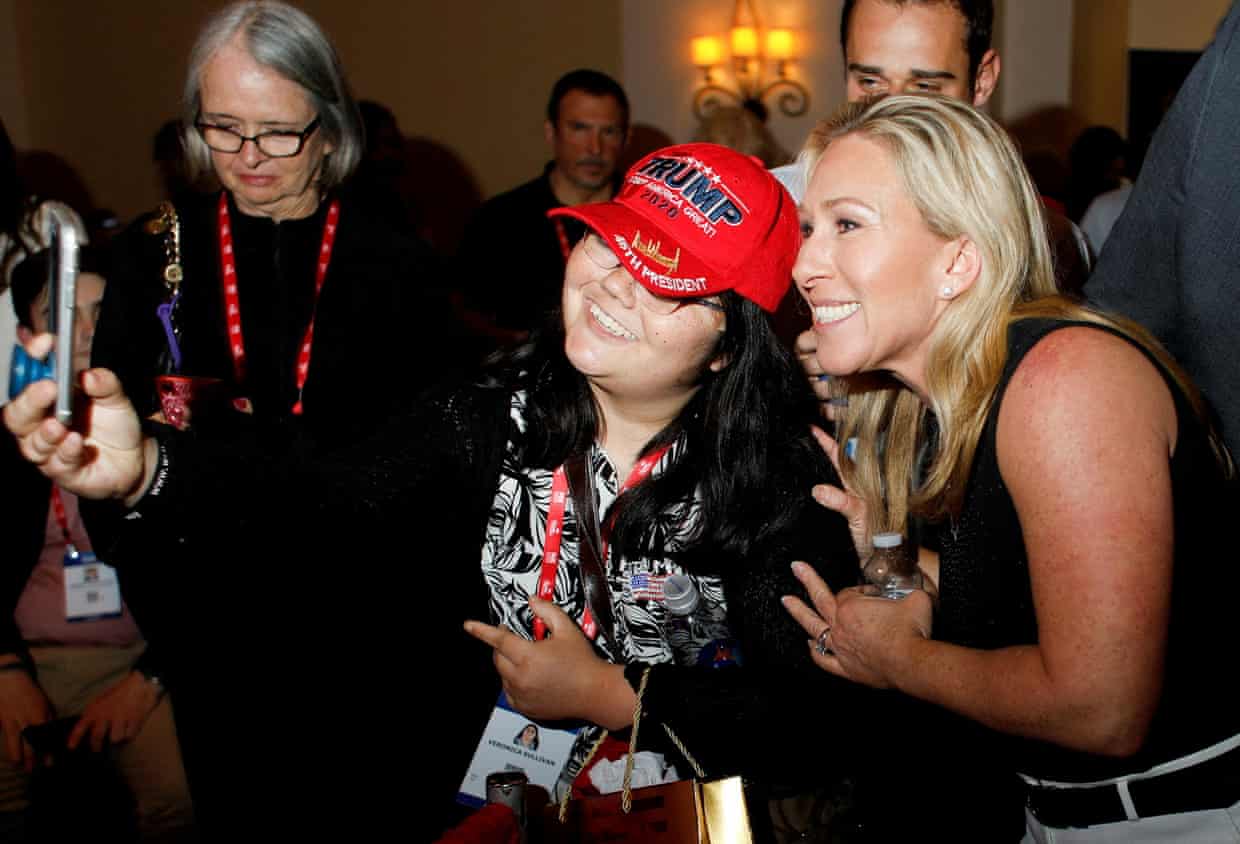
US congresswoman Marjorie Taylor Greene with a Trump supporter.
US congresswoman Marjorie Taylor Greene with a Trump supporter. Photograph: Octavio Jones/Reuters

It is a universe where Wayne LaPierre of the National Rifle Association, an organisation accused of illegally diverting tens of millions of dollars for lavish personal trips, and which tried and failed to file for bankruptcy, can still be feted when he boasts of a record 5.4 million first-time gun buyers last year.

And it is universe where Trump still reigns supreme, his face emblazoned on toy money and Superman images, his name stitched into souvenir badges, hats, hammocks and T-shirts that proclaim “Trump 2024”. Bids for a 5x5in painting by Michael Shellis depicting the former president kissing the Stars and Stripes opened at $3,000.

The big lie lives on

Trump is due to be the headline speaker at CPAC on Saturday night. A familiar line at his recent campaign rallies has been, “I am not the one trying to undermine American democracy. I’m the one who is trying to save it.” It is an argument that many at CPAC seem to sincerely believe, based on three justifications.

First, they amplify Trump’s baseless claim of widespread election rigging.

Interviews with CPAC attendees found it is taken as gospel. For example, Tom Freeman, 66, a retailer from Jupiter, Florida, insisted: “The fraud in 2020 is real, it’s huge, it’s millions of fraudulent votes. Democracy in the United States is under assault due to illegal immigration and voter fraud and manipulation that’s done on a systemic level.”

The assertion, rejected by election officials and courts, is used to justify sweeping voter suppression laws in Republican-led states.

People pick out stickers on a table.
People pick out stickers on a table. Photograph: Joe Raedle/Getty Images

Josh Mandel, an aggressively pro-Trump candidate for the US Senate in Ohio, won cheers when he told the CPAC audience: “We have Democrats who think it’s OK to cheat in elections, and I would submit to you that one of the most important fights of our day is to stop the cheating from the left... I want to say it very clearly and very directly. I believe this election was stolen from Donald J Trump.”

Mandel described Liz Cheney and Adam Kinzinger, Republican members of a House of Representative select committee investigating the January 6 riot, as “traitors”, adding: “We should abolish the January commission and replace it with a November 3 commission” – a reference to the date of the 2020 election.

A parallel view of the Capitol attack

Rewriting the history of the insurrection is the second component of this inverted universe.

At a CPAC session on Friday entitled, “The Truth about January 6th”, Julie Kelly, author of a book on the subject, accused the government of persecuting innocent demonstrators and hiding 14,000 hours of surveillance video. “We deserve to know how many FBI undercover agents and informants were involved,” she said, airing another bogus conspiracy theory.

Kelly added that if Republicans gain control of the House, they should “turn the January 6 committee 180 degrees” to investigate how Democrats and the justice department “have abused their power to punish Trump supporters to criminalise political dissent because that’s not what this country is about”.

The comments earned enthusiastic applause at CPAC, where few attendees share the conventional view of January 6 as a seditious assault on democracy. They are more likely to say it was morally justified, or that a few protesters went too far, or that it was a false flag operation by the FBI intended to discredit Trump supporters.

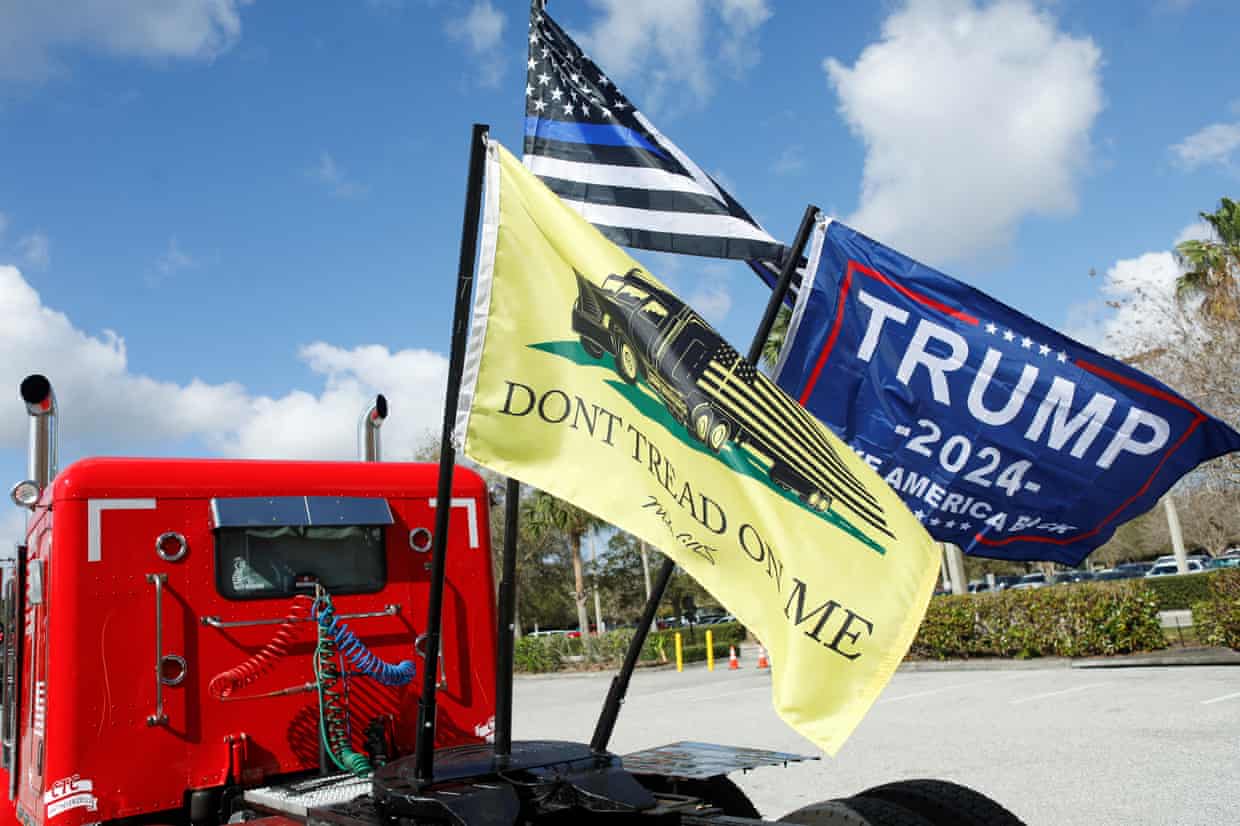
A semi-trailer truck with a message for Trump.
A semi-trailer truck with a message for Trump. Photograph: Octavio Jones/Reuters

Lisa Forsyth, 54, from Tampa, Florida, said she was in Washington that day but did not go inside the Capitol building. “To see the amount of bad press for just being there is out of line. Some of us didn’t do anything wrong but we’re lumped in with the infiltrators. There’s video footage of these people changing into Trump gear from their black stuff. There’s video footage out there but it’s a total denial.”

Asked if she feels democracy is under threat, Forsyth, who is retired from a family pharmaceutical company, replied: “No, I wouldn’t use that phrase, I’m sorry, but that’s a line that I hear the liberals use all the time and I’m obviously not one of them. Our freedom is definitely under threat.”

But standing nearby, Rachel Sheley, a chief information security officer from northern Kentucky, disagreed. “Democracy is under threat because they’re trying to infiltrate us with communism,” the 53-year-old said. “First amendment, second amendment – they want to strip them all away. If they are successful in doing so one at time all undercover, they’re stealing away the rights of our democracy.”

Defending America from ‘wokeness’

Third, the movement goes on the offensive by accusing Democrats of being the true anti-democratic party. This narrative holds that an unelected, leftist minority controls schools and universities, the mainstream media and the big tech giants of Silicon Valley, pushing politically correct “wokeness” on transgender, race and other cultural issues.

It therefore follows that the conservative rank and file is fighting a righteous cause in defence of the “real America”. Senator Ted Cruz of Texas told CPAC: “We are taking this country back from the lunatic socialist left that is trying to destroy our freedom.”

Warning that major institutions have become infected with the “woke virus”, DeSantis urged courage. “We have an opportunity to make 2020 to the year that America fought back. We’re going to lead the charge here in Florida but we need people all over the country to be willing to put on that full armour of God, to stand firm against the left’s schemes.”

Audience members listen on Friday.
Audience members listen on Friday. Photograph: Joe Raedle/Getty Images

Mike Pompeo, the former secretary of state, added: “There is no threat greater to the United States than that which emanates inside our republic, emanates inside our school system. If we do not teach our children, the next generation, that we are not a racist nation, then surely the bad guys will come to be right about an America in decline.”

Such speeches cast the struggle in heroic terms so that criticism is only likely to harden the siege mentality and resolve of the foot soldiers. Those wandering the corridors of CPAC seemed to share Joe Biden’s view that a struggle for the soul of America is under way – but were convinced that the president is on the wrong side.

Lauren Lamp, 22, who works in corporate bankruptcy in New York, said: “Clearly, we can see from the past year Biden is a larger threat than Trump ever was. Trump was trying to restore the American dream. Biden: nobody knows what he’s doing because he does not address the American people. We don’t even know if it’s him working behind the scenes.”

Sam Leiter, 56, insisted that democracy is under threat from cancel culture. “You can’t say what you want. There’s no free speech. If you don’t agree with the radical left you lose your job, you can get tarred and feathered, smeared. They’ll go after you and destroy you.”

But what does Leiter make of the argument that Trump’s increasingly authoritarian Republican party is the threat to democracy? “It’s a classic case in psychology of projection,” said the speech therapist from Baltimore, Maryland. “Project on your spouse or some other person or people what you’re doing yourself.

“It’s always been around in human relationships but in American political circles Bill Clinton was a master at that and it’s gotten worse, It’s now been proven that it was a complete hoax and yet for years they were accusing Trump of Russia collusion. And it was it was Hillary that was colluding with the Russians. She literally was.”

Trump’s 2016 election campaign had dozens of contacts with Russia. There is no evidence that Hillary Clinton colluded with Russia – literally or otherwise."

Reference >> https://www.theguardian.com/us-news/2022/feb/26/cpac-republicans-democrats-america-trump-biden

BEA News: Gross Domestic Product by State and Personal Income by State, 3rd Quarter 2025

  BEA News: Gross Domestic Product by State and Personal Income by S...