EURONEWS: 2025 Copernicus Report said: “Over the past decade, emissions of sulphur oxides and nitrogen oxides have fallen by approximately three-to-five per cent per year across the European Union. The most significant reductions have been achieved in industry and road transport. Since 2015, industrial emissions of sulphur oxides have fallen by 59 per cent, while nitrogen oxide emissions from industry have declined by 39 per cent. Road transport emissions have also fallen substantially, with reductions of 40 per cent for nitrogen oxides and 34 per cent for fine particulate matter (PM2.5).”
Improving public transport, implementing low or zero emission zones for traffic, switching from fossil fuels to clean energy sources and consuming less meat are seen as some of the most successful ways to reduce air pollutants.
But, Atmosphere Watch says, “ozone shows no clear downward trend and remains an issue.”
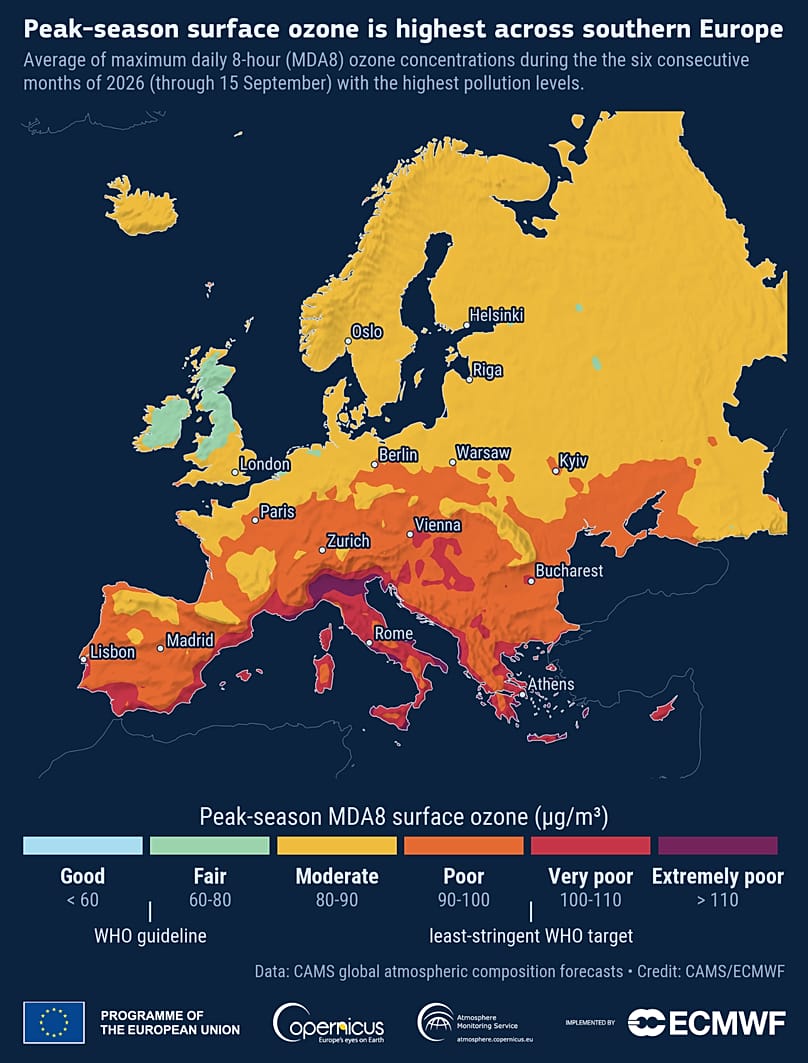
Under the EU Ambient Air Quality Directive, the maximum eight-hour daily average ozone concentration should not exceed 120 μg/ m3 more than 18 days per year, with a long-term objective of 100 μg/m3 compliant with the WHO guidelines. The map above shows how much of Europe exceeded these levels during 2026 so far. It shows how levels get worse the further south you go on the continent – the areas where heatwaves were the hottest and most prolonged.
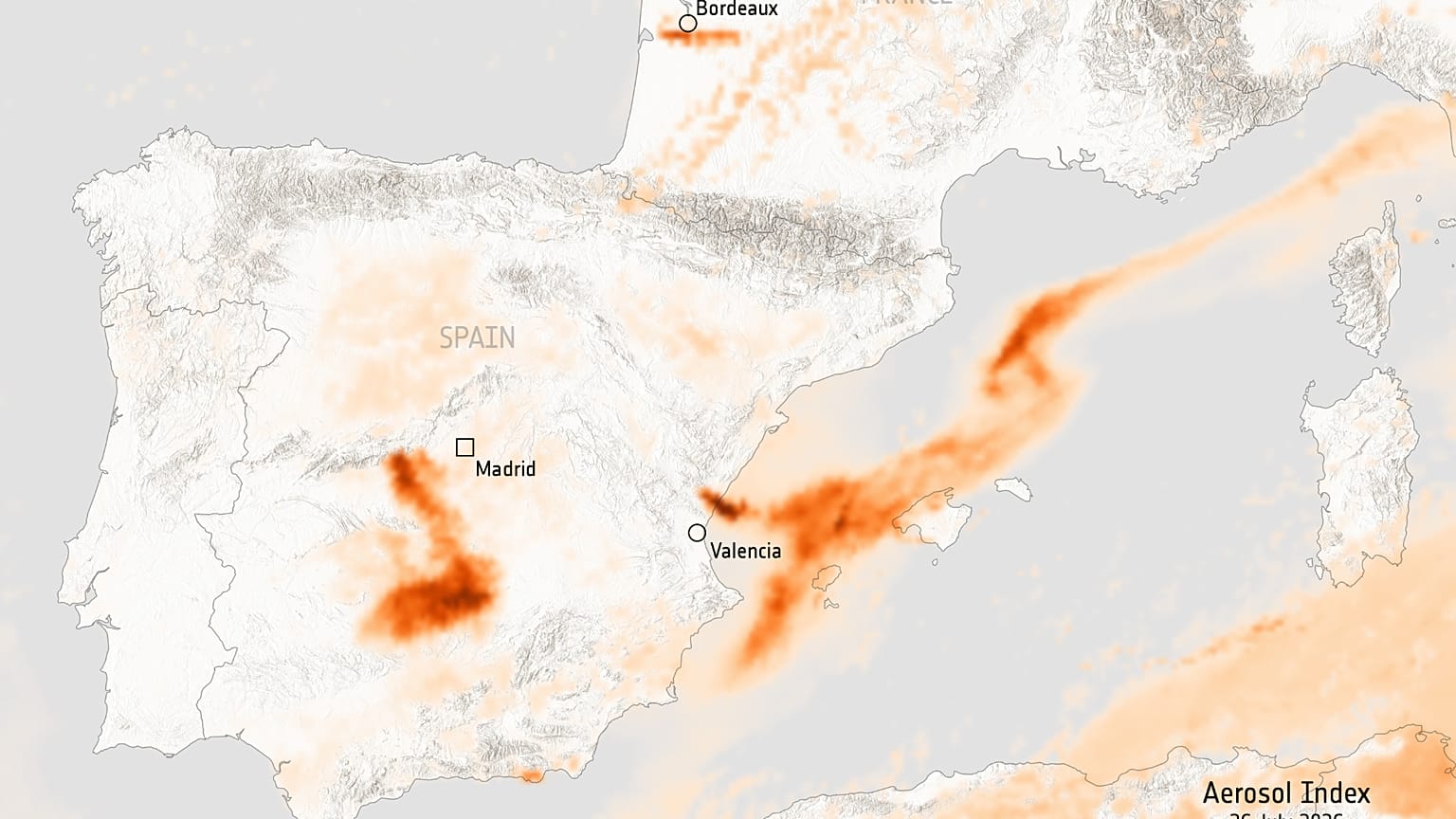
The extreme weather and unprecedented wildfires led to worse air pollution across the whole continent, not just in directly affected areas.
People who suffer from asthma are the most at risk.
Half of Europeans were exposed to a little-known greenhouse gas during this summer’s record breaking heatwaves and wildfires.
Ground-level ozone is an air pollutant that can “penetrate deep into the respiratory system and enter the bloodstream, allowing it to reach almost all organs within the body.” People who suffer from asthma are the most at risk.
Ozone forms from thousands of chemical reactions, triggered by sunlight and high temperatures. So the record-breaking heatwaves that gripped Europe from June to August this year led to ozone levels dangerous to human health. During this period, 50 per cent of Europe’s population was exposed to poor, very poor or extremely poor ozone levels, according to the European Commission’s Copernicus Atmosphere Monitoring Service (CAMS).
“Ozone pollution is a stark reminder of how interconnected our atmosphere, climate, health, and livelihoods really are, with pollution and our changing climate impacting the chemistry of the air we breathe, determining the health of our ecosystems, and even governing our ability to grow food,” says Laurence Rouil, Director of CAMS.. .
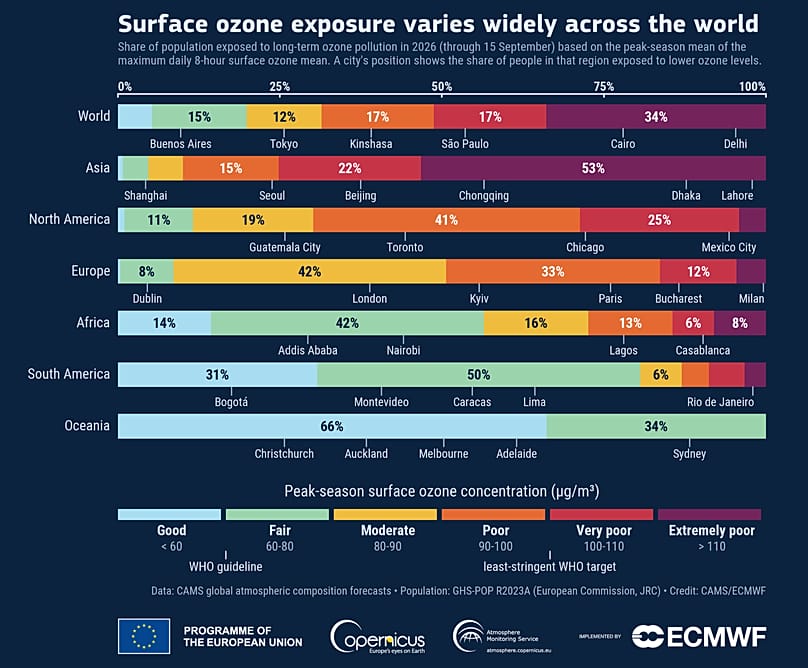
[. . .] Roughly 50 per cent of the global population was exposed to very or extremely poor air quality due to ozone concentrations in 2026. Milan, Rio de Janeiro, Mexico City, Delhi and Cairo are the cities with some of the highest exposures. Only five per cent of the global population was exposed to ‘good’ long-term ozone levels and 15 per cent to ‘fair’ levels during 2026, according to the analysis.
“Ozone concentrations in all continents are likely to be affected by climate change: ground-level, and more generally, tropospheric ozone formation, is triggered by warm temperatures and sunlight. Therefore, in areas experiencing more heatwaves, local ozone concentrations will increase, partly offsetting the benefits of the mitigation strategies designed to reduce precursor pollutant emissions.”
How can ozone levels be reduced?
Ultimately responsibility for and power over ozone levels rests with governments. Experts recommend much better monitoring and reporting of ozone levels, as is done for other air pollutants. At the moment in the EU, only Croatia, France and Spain have developed or implemented air quality plans explicitly focused on ozone.
Countries and cities that are doing the best on limiting ozone are focused on improving forecasting for ozone concentration and understanding how ozone forms and its main sources, according to the European Environment Agency. . . ."
Go to source > https://www.euronews.com/2026/09/30/a-little-known-greenhouse-gas-is-quietly-harming-half-of-europeans-this-italian-city-is-hi
ARIZONA RELATED -- PHOENIX/MESA METRO AREA WAS RATED #4 MOST POLLUTED CITY IN UNITED STATES

- 4th Worst Nationwide: The American Lung Association's 2025 State of the Air report ranked the Phoenix metro area as the fourth-most polluted city in the United States for ozone, trailing only behind three cities in California. [1, 2]
- Failing Grades: Maricopa County received an "F" grade for air quality, averaging 54.8 unhealthy ozone days annually. The intense Arizona heat and sun provide a "perfect recipe" for emissions from vehicles, gas equipment, and industrial processes to react chemically into ground-level ozone. [1, 2, 3]



No comments:
Post a Comment