Wednesday, May 24, 2023

Earthquakes Today: latest quakes worldwide in the past 24 hours on Thursday, May 25, 2023 - list, stats and map


LATEST QUAKES

Earthquakes Today: latest quakes worldwide in the past 24 hours on Thursday, May 25, 2023 - list, stats and map

Updated: May 25, 2023 04:43 GMT - 8 minutes ago refresh
Felt a quake? Report it! 
Show quakes near me!
See quake list

QUAKES IN THE PAST 24 HOURS:

  • 2 quakes above magnitude 6
  • 5 quakes between magnitude 5 and 6
  • 40 quakes between magnitude 4 and 5
  • 116 quakes between magnitude 3 and 4
  • 261 quakes between magnitude 2 and 3
  • 535 quakes below magnitude 2 that people normally don't feel.
In the past 24 hours, there were 2 quakes of magnitude 6.0 or above, 5 quakes between 5.0 and 6.0, 40 quakes between 4.0 and 5.0, 116 quakes between 3.0 and 4.0, and 261 quakes between 2.0 and 3.0. There were also 535 quakes below magnitude 2.0 which people don't normally feel.
major magnitude 6.6 earthquake hit Caribbean SeaColombia, 1 hour and 38 minutes ago.

Latest quake: Mag. 4.6 | West Sulawesi, 82 km SW of PaluCentral SulawesiIndonesia - 20 minutes ago

Strongest quake today: Mag. 6.6 | Caribbean Sea, 99 km NW of TurboAntioquiaColombia - 1 hour 46 minutes ago 

Recent quakes above magnitude 3.0 worldwide (updated 8 minutes ago)

Past 24 hours163 quakes116 quakes M3+40 quakes M4+5 quakes M5+2 quakes M6+
Past 7 days1,211 quakes830 quakes M3+304 quakes M4+69 quakes M5+6 quakes M6+2 quakes M7+
Past 30 days4,887 quakes3,583 quakes M3+1,121 quakes M4+169 quakes M5+11 quakes M6+3 quakes M7+
Past 90 days14,887 quakes11,040 quakes M3+3,382 quakes M4+423 quakes M5+37 quakes M6+5 quakes M7+
Past 365 days64,608 quakes47,590 quakes M3+15,206 quakes M4+1,670 quakes M5+123 quakes M6+19 quakes M7+
Filter by magnitude:

all
 
2.0+
 
3.0+
 
4.0+
 
5.0+
 
6.0+
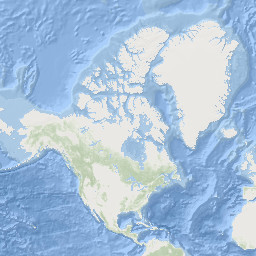
5000 km
3000 mi
 Leaflet | © Esri / arcgisonline.com
[smaller] [bigger]


Showing most recent quakes and quakes magnitude 3.6 or higher (101 out of 959 quakes, show more):
Date and timeMag
Depth
LocationDetailsMap
Thursday, May 25, 2023 GMT (19 quakes)
May 25, 2023 04:32 GMT
May 25, 2023 12:32 pm (GMT +8)
20 minutes ago
4.6

10 km
 West Sulawesi, 82 km southwest of PaluCentral SulawesiIndonesia
I FELT IT
More
May 25, 2023 04:27 GMT
May 25, 2023 4:27 pm (GMT +12)
25 minutes ago
3.8

248 km
 South Pacific OceanNew Zealand
I FELT IT
More
May 25, 2023 04:17 GMT
May 25, 2023 1:17 pm (GMT +9)
35 minutes ago
4.3

11 km
 Ceram Sea, 286 km east of Ambon CityMalukuIndonesia
I FELT IT
More
May 25, 2023 04:16 GMT
May 25, 2023 12:16 am (GMT -4)
35 minutes ago
2.5

18 km
 19 km west of PonceSegundo BarrioPoncePuerto RicoMore
May 25, 2023 04:10 GMT
May 24, 2023 11:10 pm (GMT -5)
42 minutes ago
3.1

5.9 km
 Caribbean Sea, 65 km northwest of NecocliAntioquiaColombia
I FELT IT
More
May 25, 2023 03:56 GMT
May 24, 2023 10:56 pm (GMT -5)
55 minutes ago
3.1

5.2 km
 Caribbean Sea, 95 km northwest of TurboAntioquiaColombia
I FELT IT
More
May 25, 2023 03:52 GMT
May 25, 2023 6:52 am (GMT +3)
59 minutes ago
2.9

10 km
 Aegean Sea, 10.3 km west of KusadasiAydınTurkey 2 reportsMore
May 25, 2023 03:47 GMT
May 24, 2023 11:47 pm (GMT -4)
1 hour 4 minutes ago
3.3

69 km
 24 km north of OvalleProvincia de LimariCoquimbo RegionChile
I FELT IT - 4 reports
More
May 25, 2023 03:23 GMT
May 24, 2023 10:23 pm (GMT -5)
1 hour 29 minutes ago
3.6

4.5 km
 Caribbean Sea, 95 km northwest of TurboAntioquiaColombia
I FELT IT - 4 reports
More
May 25, 2023 03:14 GMT
May 24, 2023 10:14 pm (GMT -5)
1 hour 37 minutes ago
4.9

10 km
 Caribbean SeaPanama, 99 km northwest of TurboAntioquiaColombia
I FELT IT - 27 reports
More
May 25, 2023 03:05 GMT
May 24, 2023 10:05 pm (GMT -5)
1 hour 47 minutes ago
6.6

10 km
 Caribbean Sea, 99 km northwest of TurboAntioquiaColombia
I FELT IT - 374 reports
More
May 25, 2023 02:56 GMT
May 25, 2023 2:56 pm (GMT +12)
1 hour 55 minutes ago
5.0

604 km
 South Pacific OceanFiji
I FELT IT
More
May 25, 2023 02:22 GMT
May 24, 2023 10:22 pm (GMT -4)
2 hours 30 minutes ago
4.0

10 km
 113 km northeast of IquiqueTarapacaChile
I FELT IT
More
May 25, 2023 02:02 GMT
May 24, 2023 11:02 pm (GMT -3)
2 hours 49 minutes ago
4.1

296 km
 206 km southeast of CalamaProvincia de El LoaAntofagastaChile
I FELT IT
More
May 25, 2023 00:59 GMT
May 24, 2023 8:59 pm (GMT -4)
3 hours 52 minutes ago
3.8

118 km
 70 km northeast of CalamaProvincia de El LoaAntofagastaChile
I FELT IT
More
May 25, 2023 00:35 GMT
May 24, 2023 8:35 pm (GMT -4)
4 hours ago
4.6

108 km
 Caribbean Sea, 84 km northeast of CarupanoMunicipio BermudezSucreVenezuela
I FELT IT - 9 reports
More
May 25, 2023 00:15 GMT
May 25, 2023 9:15 am (GMT +9)
5 hours ago
4.5

69 km
 North Pacific Ocean, 34 km southeast of Shizunai-furukawachōJapan
I FELT IT
More
May 25, 2023 00:08 GMT
May 25, 2023 9:08 am (GMT +9)
5 hours ago
4.6

10 km
 Molucca Sea, 115 km northwest of TernateNorth MalukuIndonesia
I FELT IT
More
May 25, 2023 00:03 GMT
May 24, 2023 9:03 pm (GMT -3)
5 hours ago
4.3

207 km
 204 km west of SaltaDepartamento CapitalSaltaArgentina
I FELT IT
More
Wednesday, May 24, 2023 GMT (82 quakes)
May 24, 2023 23:55 GMT
May 25, 2023 7:55 am (GMT +8)
5 hours ago
4.5

10 km
 Philippine Sea, 60 km east of Tuguegarao CityCagayanPhilippines
I FELT IT
More
May 24, 2023 23:32 GMT
May 25, 2023 11:32 am (GMT +12)
5 hours ago
3.6

33 km
 South Pacific Ocean, 191 km northeast of GisborneNew Zealand
I FELT IT
More
Show more


Strong mag. 5.5 earthquake - South Pacific Ocean on Wednesday, May 24, 2023 at 1:33 am (GMT -9) - 18 hours ago

Updated: May 25, 2023 03:08 GMT - 1 hour 40 minutes ago refresh
I felt this quake
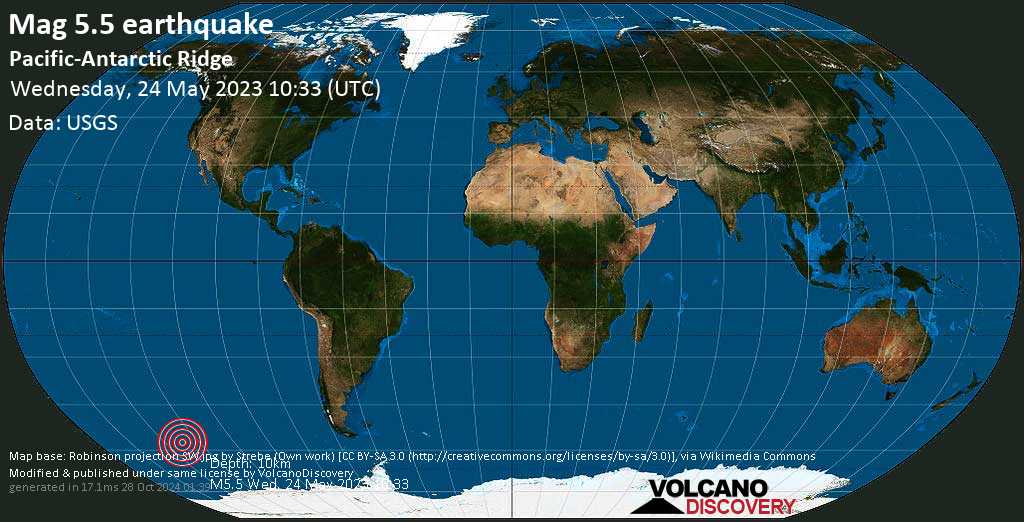
Strong mag. 5.5 earthquake - South Pacific Ocean on Wednesday, May 24, 2023 at 1:33 am (GMT -9)

Strong magnitude 5.5 earthquake at 10 km depth

24 May 10:44 UTCFirst to report: GFZ after 11 minutes.
24 May 10:46: Epicenter location corrected by 8 km (5 mi) towards WNW.
24 May 10:51: Now using data updates from USGS
24 May 16:38: Epicenter location corrected by 1.6 km (1 mi) towards S.

x

2CELLOS - LIVE at Sydney Opera House [FULL CONCERT] 6,561,690 views Premiered Mar 18, 2022

In the Future More People Will Die from Air Pollution

Even more people will die prematurely from particulate air pollution in the future according to model calculations performed by Ulas Im, Department of Environmental Science at Aarhus University, in collaboration with NASA.

"We hope that our calculations will lead to politicians around the world taking the problem even more seriously. We hope that they will use the figures to make decisions about limiting air pollution even further; both in the countryside and in the cities."


MAY 24, 2023

Danish Researcher and NASA predict how many people will die from air pollution in the future

Jeppe Kyhne Knudsen
8 - 10 minutes

Credit: Pixabay/CC0 Public Domain

"They come from factory stacks, car exhaust pipes and cruise liner engines. They are tiny particles and they are all around us. When we breathe in air, these particles settle in the small vessels of our lungs, and they make us sick.

For many years now, we have known that is bad for our health. For example, American researchers have found that you have a 20% higher risk of dying prematurely if you live next to a big road.

In recent years, many countries—especially Western countries—have spent time and efforts to come up with solutions to reduce air pollution. Particle filters and phasing out use of the most polluting energy sources have helped. In Denmark, emissions of fine particles have been reduced by 48% since 1990.

But despite this progress, even more people will die prematurely from particulate air pollution in the future according to model calculations performed by Ulas Im, Department of Environmental Science at Aarhus University, in collaboration with NASA.

> The study is published in the journal Environmental Research.

Together, Im and NASA have developed a global model for air pollution that includes , particle emission reduction measures and changes in population composition. The model depicts a bleak future, especially for the countries in Asia.

"Even if they reduce air pollution significantly in Asia, the mortality rate will still be high. This is because their populations are aging. And you become more vulnerable to pollution with age," Ulas Im says.

Extremely complicated calculations

Ulas Im from Aarhus University and NASA have come together in this project because both institutions have unique technology that—if combined—offer entirely new possibilities and perspectives.

The NASA Goddard Institute for Space Studies in New York has one of the most advanced climate models in the world, and Aarhus University has one of the best computer models for how air pollution affects human health.

By creating a hybrid of the two models and running the new model through Aarhus University's supercomputer, Ulas Im and his partners from NASA could create three scenarios for how air pollution will affect human health in the future.

"We fed the model with three different scenarios: 

  • one in which most of the world continues to regulate and try to limit air pollution; 
  •  one in which we do even more than we do today; and finally, 
  • one in which we do less," he says.

But even in the most optimistic of the three scenarios, the result turned out to be bleak, especially for Asia.

"Although China has done much to reduce air pollution in recent decades, air pollution will have a dire impact in the future. Even if they step up their efforts. This is because of their aging population. A greater share of the population will simply be more vulnerable," he says.

This map predicts how the air pollution with fine particles will be in the future - according to Ulas Im's computer simulation. The blue colored areas show where the pollution are worst. Green is a little better and yellow means almost no pollution. Credit: Journal for Environmental Research

Fine particles and hazardous chemical compounds

The particles that Ulas Im and NASA include in their model are among the most harmful anthropogenic pollutants. However, the model does not include all forms of air pollution, he emphasizes.

"We have studied the effect of fine particles, which are also referred to as PM2.5, and the effect of ozone, which is formed in the atmosphere when NOx gases and other molecules that we humans emit, react with the air," he says.

Both fine particles and ozone are harmful to our lungs.

The fine particles penetrate deep into the lungs and end up in the alveoli, in the tiniest air spaces of the lungs, where they settle and do damage because they make it more difficult to breathe. The consequences of this can be severe. Some people may develop asthma, others blood clots, hardening of the arteries, or even cancer.

Ozone has the same effect. The tiny gas molecules can cause damage to the lungs, which can cause chest pain and breathing difficulties.

The damage has already been done

In the most optimistic of Ulas Im's scenarios, we manage to do a lot more to reduce air pollution at global level. But the scenario still predicts an annual death rate of four million people.

"Because of an aging population in Asia, it's difficult to prevent these deaths. Even if they were to do everything they could, they would still not be able to prevent the high death rate," he says.

This is because air pollution is a slow killer. The seeds of future illness and death have already been planted in many people. In other words, the damage has already been done. Therefore, the numbers will not be reduced, even if we cut our emissions of harmful particles drastically.

"Even if we electrify our cars, replace coal-powered and gas-powered power plants with and solar PV, and cut down on aviation, we won't be able to rectify the damage already done to our lungs," he says. "But having said that, the particles disappear from the air quickly when we limit our emissions. It's not like with , which stays in the atmosphere for hundreds of years."

Air pollution in the countryside as well

Cities are responsible for a substantial share of air pollution. This is where there are most cars, factories and ; and this is where aircraft land and cruise liners dock. But this does not necessarily mean that the air is clean once you get to the countryside.

"There are more fine particles in the air in the cities. But there is less ozone. In the countryside, it's the other way around. Here, there are fewer and more ozone. This is because, in the cities, ozone decomposes because of emissions from factories, while it thrives in the countryside," says Ulas Im.

So, we are affected by air pollution both in the countryside and in cities. Even if the air feels nice and clean, it may be filled with ozone, which is also harmful to our lungs.

"So it's false to think that rural areas are free of air pollution, although it's still healthier to live in the countryside," he says. "We hope that our calculations will lead to politicians around the world taking the problem even more seriously. We hope that they will use the figures to make decisions about limiting air pollution even further; both in the countryside and in the cities."

More information: Ulas Im et al, Present-day and future PM2.5 and O3-related global and regional premature mortality in the EVAv6.0 health impact assessment model, Environmental Research (2022). DOI: 10.1016/j.envres.2022.114702

Journal information: Environmental Research

BARRON'S: Debt Ceiling Increase Delay gets real ‘Credit Watch Negative.’

Fitch Puts U.S. Debt on ‘Credit Watch Negative.’ The Debt Ceiling Debate Turns Real.


After months of debate over the debt ceiling, Fitch Ratings has issued a warning about U.S. debt, putting the country’s top-rated bonds on “Rating Watch Negative.”

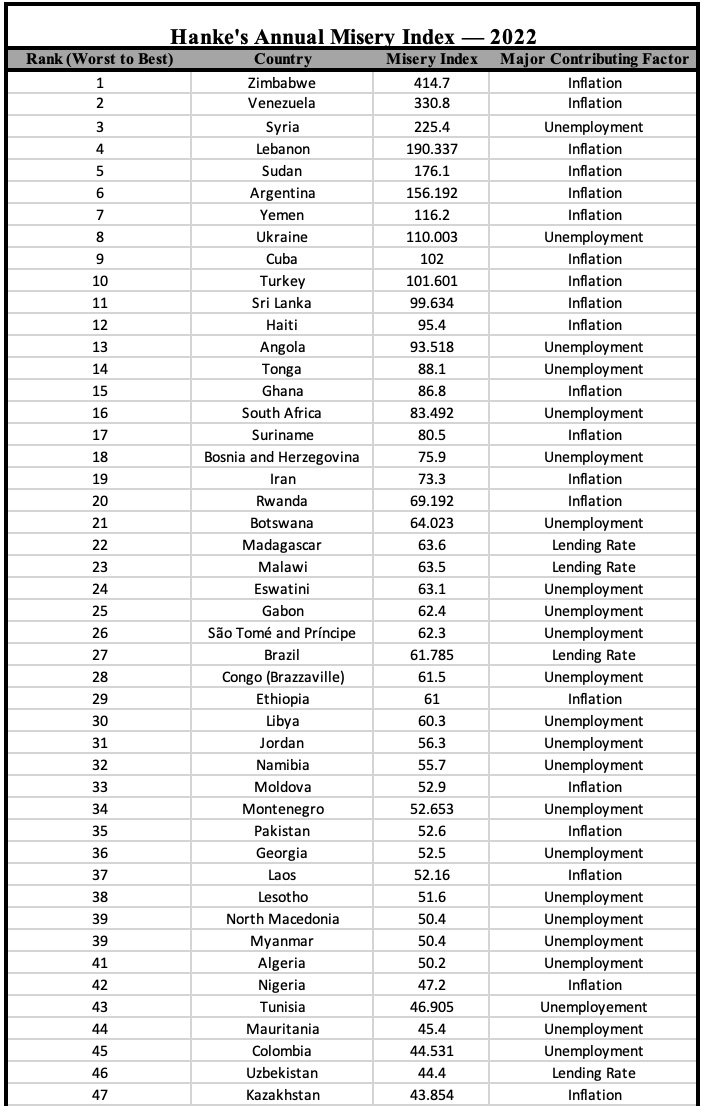
Hanke’s Annual Misery Index (HAMI)

While the list of the top-ten might surprise some, good numbers are good numbers, at least for now.

www.independent.org

Hanke's 2022 Misery Index--Who's Miserable and Who's Happy? | Steve H. Hanke

May 22, 2023 By Steve H. Hanke
7 - 9 minutes

"The human condition lies on a vast spectrum between “miserable” and “happy.” In the economic sphere, misery tends to flow from high inflation, steep borrowing costs, and unemployment. The surefire way to mitigate that misery is through economic growth. Comparing countries’ metrics can tell us a lot about where in the world people are sad or happy.

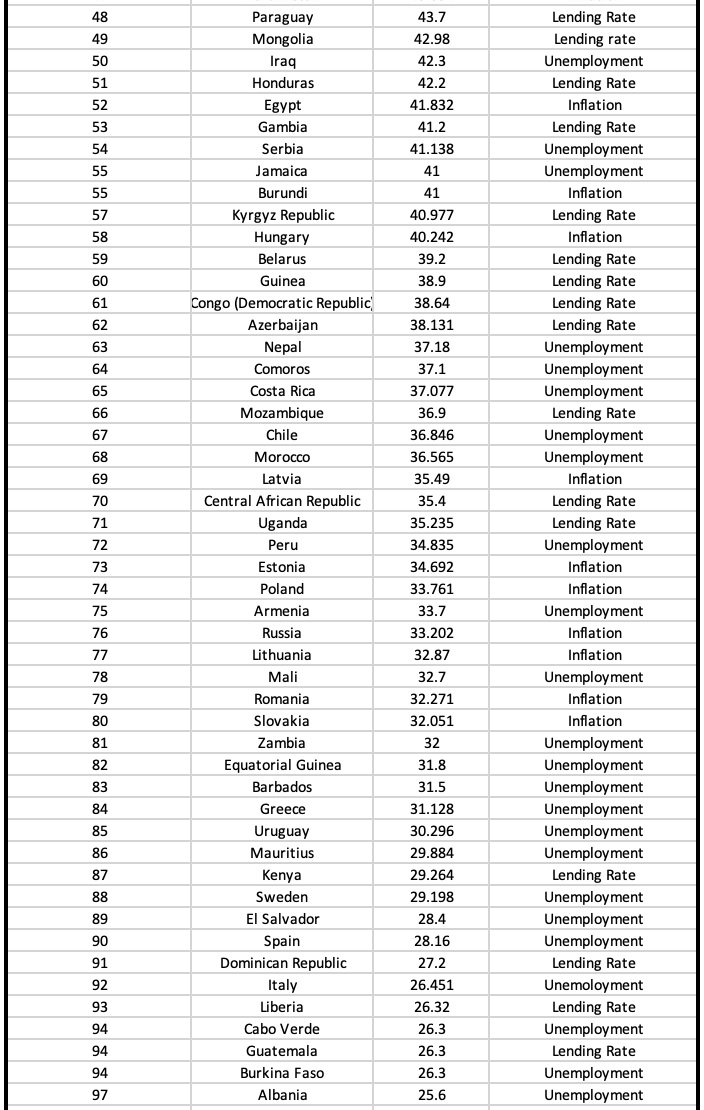
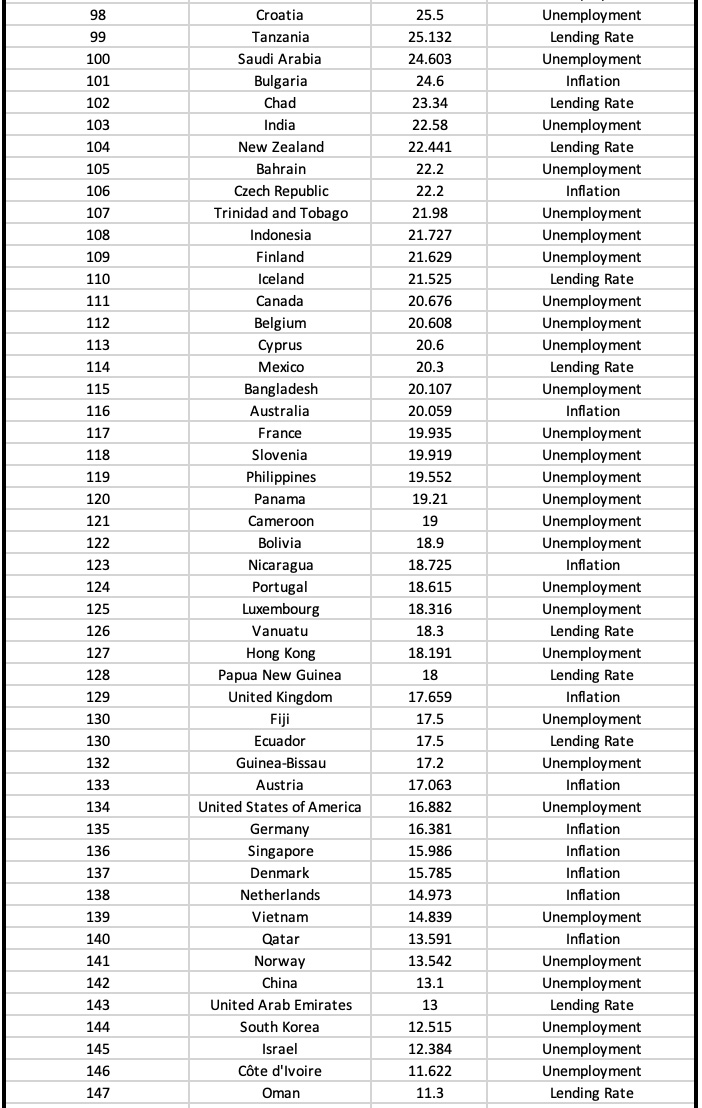
Hanke’s Annual Misery Index (HAMI) gives us the answers. My version of the misery index is the sum of the year-end unemployment (multiplied by two), inflation, and bank-lending rates, minus the annual percentage change in real GDP per capita. Higher readings on the first three elements are “bad” and make people more miserable. These “bads” are offset by a “good” (real GDP per capita growth), which is subtracted from the sum of the bads to yield a HAMI score. For more on this index, please see here. . .

This year’s HAMI includes 157 countries (see the accompanying table).

Zimbabwe, Venezuela, Syria, Lebanon, Sudan, Argentina, Yemen, Ukraine, Cuba, Turkey, Sri Lanka, Haiti, Angola, Tonga, and Ghana comprise the 15 most miserable countries in the world.

. . .

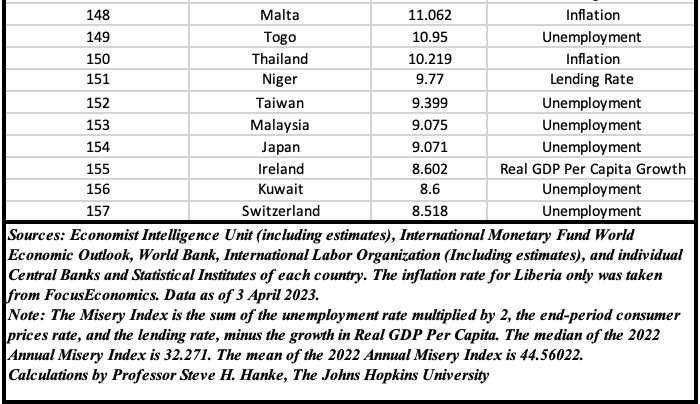
Now, let’s turn to a happier page and take a look at the least miserable countries in the world.

Switzerland has the lowest HAMI score in the world.  reason for that is the Swiss debt brake. The debt brake has worked like a charm. Unlike most countries, Switzerland’s debt-to-GDP ratio has been on a downward trend in the last two decades, since it enshrined its debt brake into its constitution in a 2002 national referendum. In 2002, central-government debt stood at 29.7 percent of GDP, and by 2018 had been reduced to 18.7 percent. It’s hard to beat a democracy in which most major decisions can, if enough of the electorate insists, be put to a popular vote.

HAMI = [(Unemployment (2.166%) * 2) + Inflation (2.84%) + Bank‐Lending Rate (2.646%)] − Real GDP Growth (1.3%) = 8.518

Kuwait, even with squabbling amongst politicians, put in a solid performance across the board in 2022. As the arithmetic below shows, the “bads” were minimized, and the “good,” was, well, pretty good (4.5 percent per year real GDP growth).

HAMI = [(Unemployment (2.9%) * 2) + Inflation (3.1%) + Bank‐Lending Rate (4.2%)] − Real GDP Growth (4.5%) = 8.6

Ireland, even with a strong performance in 2022, faces threats; namely, the OECD International Tax Agreement. Ireland signed up to the OECD International Tax Agreement in 2021, and, being a well-known tax haven, this might take some wind out of Ireland’s sails after the agreement comes into force in 2024. For now, things look good.

HAMI = [(Unemployment (4.5%) * 2) + Inflation (8.302%) + Bank‐Lending Rate (2.7%)] − Real GDP Growth (11.4%) = 8.602

Thanks to strong economic performances, Switzerland, Kuwait, Ireland, Japan, Malaysia, Taiwan, Niger, Thailand, Togo, and Malta were the top-ten “happiest” countries in 2022. While the list of the top-ten might surprise some, good numbers are good numbers, at least for now."

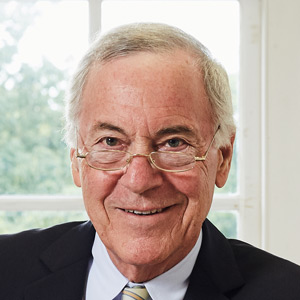
Steve H. Hanke is a Senior Fellow at the Independent Institute and Professor of Applied Economics and Founder and Co-Director of the Institute for Applied Economics, Global Health, and the Study of Business Enterprise at Johns Hopkins University.

2 CELLOS - Highway To Hell [Live at Sydney Opera House]