

- “SoundThinking is the perfect name for a company that has mentored us to change the way we think about responding to gun violence,” said Melron Kelly, Deputy Chief of the Columbia, South Carolina Police Department. “We used to prioritize our response to gunfire to solely make arrests, but with the tools and counsel of SoundThinking, our response is more comprehensive and now focuses on saving lives and increasing community trust in our agency.”
- “SoundThinking’s SafetySmart platform is a game-changer in terms of the success of our mission,” said John Bush, director of Savannah, Georgia’s Office of Neighborhood Safety and Engagement. “It’s not just about law enforcement anymore. SafetySmart brings law enforcement and community organizations together to effectively prevent violence and save lives.”

- It includes the leading law enforcement search engine, CrimeTracer™, the comprehensive investigation management system, CaseBuilder™, and patrol management and analysis software, ResourceRouter™.
- ShotSpotter is an acoustic gunshot detection system that alerts police to virtually all gunfire within a coverage area in less than 60 seconds, helping reduce police response times to gun crimes and save lives.
- CrimeTracer is a law enforcement search engine that enables investigators to search through more than 1 billion criminal justice records from across jurisdictions to generate tactical leads and quickly make intelligent connections.
- CaseBuilder is a one-stop investigative management system for tracking, reporting, and collaborating on cases. It produces a single electronic courtroom-ready document to help prosecutors clear cases and take offenders off the streets.
- ResourceRouter is software that directs the deployment of patrol and community anti-violence resources in an objective way to help maximize the impact of limited resources and improve community safety.
In conjunction with the brand update, SoundThinking has also launched a new official company website. To learn more and explore the new site, visit www.soundthinking.com.
About SoundThinking
Media Relations:
SoundThinking, Inc.
Jerome Filip
510-203-0934
jfilip@soundthinking.com
Investor Relations:
Matt Glover
Gateway Investor Relations
+1 (949) 574-3860
ssti@gatewayir.com
Why Dayton quit ShotSpotter, a surveillance tool many cities still embrace
Police across the country face increased pressure to drop the controversial technology as researchers and activists question its effectiveness.
The DPD statement announcing the end of the ShotSpotter contract also noted a new law that came into effect in June 2022 legalizing the permitless carry of concealed guns as another reason for discontinuing it; the law makes it more difficult for police to confiscate guns. ShotSpotter’s efficacy was also complicated by the fact that Ohio law does not make it illegal for people to discharge many types of firearms on their own property as long as doing so causes no harm or interference to others.

(Facebook.com/DaytonPoliceandFire)
This article originally appeared in Bolts Magazine.
Julio Mateo and other activists in Dayton, Ohio, tried for years to get police to ditch one of the most controversial trends in law enforcement surveillance technology.
In 2019, the Dayton City Commission approved an initial $205,000 contract with ShotSpotter, a California-based company, to deploy microphones that listen for gunshots across a three-square-mile area of west Dayton, the heart of the city’s Black community, which has a long history of economic segregation and redlining. When the contract came up for an extension in late 2020, Mateo and other Dayton activists circulated a petition that gathered hundreds of signatures demanding the city drop the technology. But the commission approved the extension, nearly tripling the city’s overall spending on ShotSpotter.
So Mateo was a little incredulous, if not pleasantly surprised, when the Dayton Police Department (DPD) announced late last year that it would not seek to extend the ShotSpotter contract beyond December 2022, when it was set to run out. While DPD defended the system, saying it had helped locate shooting victims and get illegal guns off the streets, the police statement announcing the end of ShotSpotter in Dayton partly echoed a broader point that activists had long raised—with police admitting it was “challenging” to prove the effectiveness of the technology.
“It definitely felt like a relief,” says Mateo. “And it definitely felt like our efforts played a role in them making this decision.”
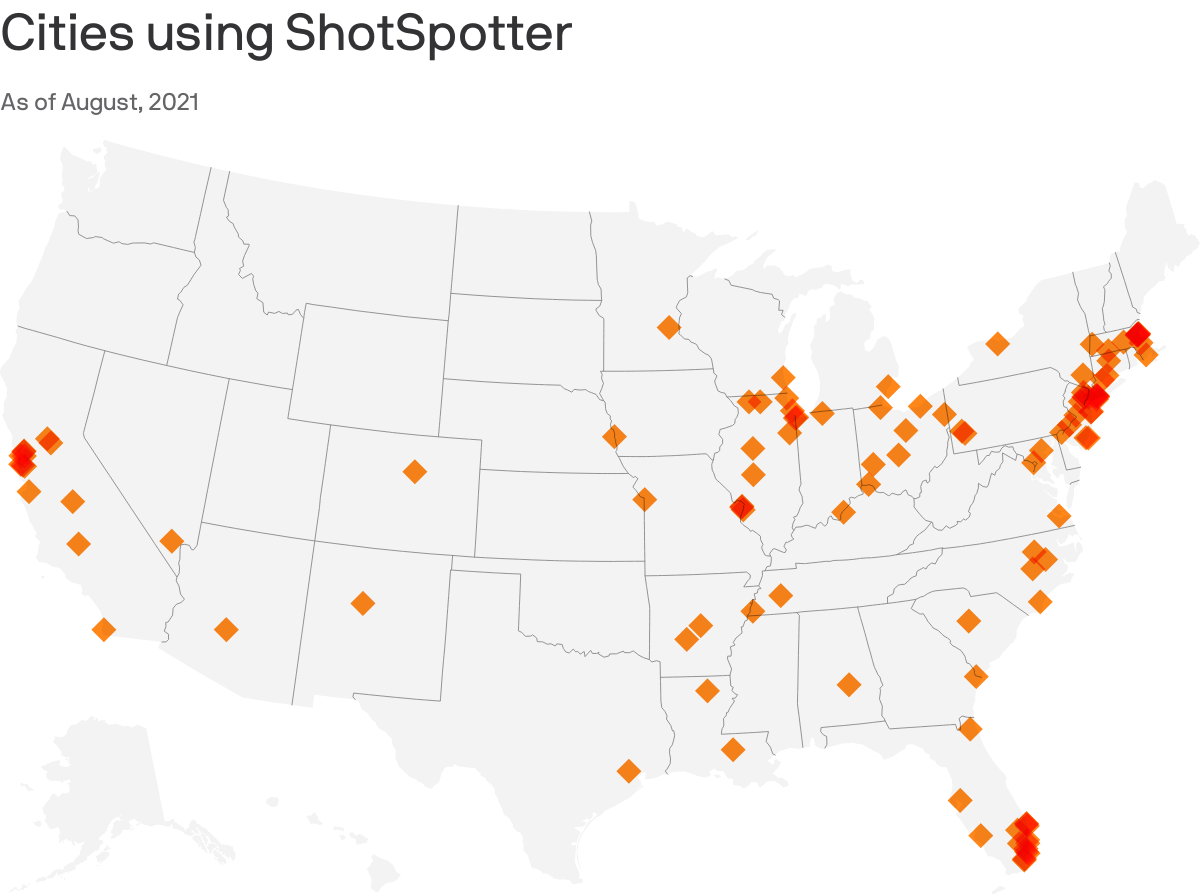
The end of ShotSpotter in Dayton marked a rare victory for activists who have fought against the company’s rapid expansion in Ohio and across the rest of the country in recent years, drawing the attention of groups elsewhere who have been fighting for cities to drop the surveillance technology. Rebranded in April as SoundThinking, the company has rolled out microphones in over 150 cities, feeding sound to proprietary software that the company says identifies gunshots and alerts staffers, who in turn notify local cops. The company, founded in 1996, is now worth around $260 million and has been championed by mayors and police departments across the country, who call it an essential crime-fighting tool and advocate for its lucrative contracts.
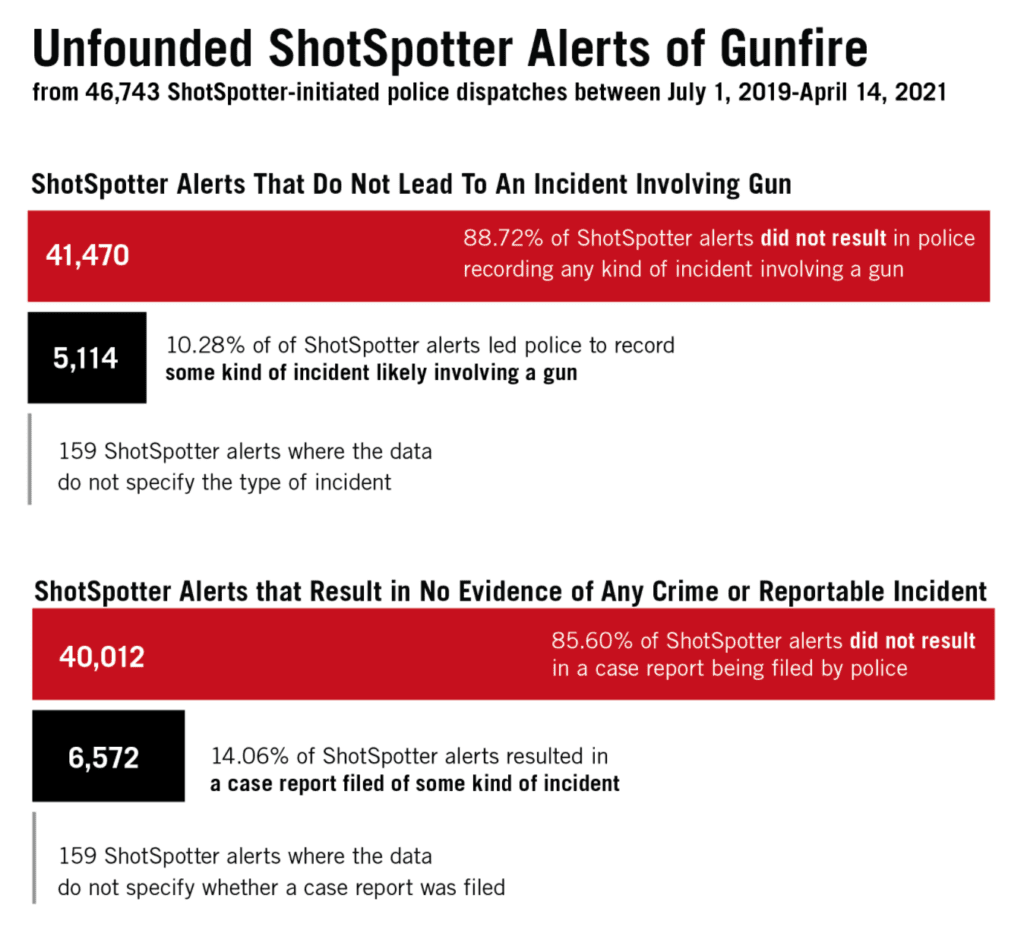
SoundThinking claims its system is nearly flawless, but researchers and defense lawyers have challenged its effectiveness as well as the increasing use of the company’s technology as evidence in court. An Associated Press investigation last year found that the company’s microphones can miss gunfire that happens right under them, misclassify fireworks or sounds from cars as gunshots, and that company employees can, and often do, alter evidence gathered by the technology;

>
___________________________________________________________________________________

ShotSpotter is a Failure. What's Next? - MacArthur Justice

How Tech Like ShotSpotter Thrives Despite Public Pushback | The Marshall Project
Another City Ditches ShotSpotter, Says It Can’t Show The System Helped Reduce Violent Crime

from the city-will-have-to-find-new-way-to-misspend-$200k dept
ShotSpotter has routinely claimed its system of mics and location info is crucial to reducing gun crime. The theory is that if you can hear it, you can respond to it, even if officers can’t physically hear these gunshots themselves.
The problem with this assertion is that there’s a margin of error. The system can’t be perfect, so it’s always going to generate false positives and negatives. The tech is backstopped by human analysts, but records show these analysts don’t receive any specified training, aren’t actually acoustic experts, and, if needed, will alter reports at the request of law enforcement.
Then there’s the real world application of this tech. It’s relatively inexpensive as far as law enforcement tech goes, which means cities are often willing to throw money at ShotSpotter just in case. But PDs that are under fire for, specifically, not reducing the amount of times the “protected and served” find themselves under (gun)fire have chosen to ditch the tech, rather than continue pretending the tech has even a negligible impact on violent crime.
When ditching the tech, law enforcement agencies tend to highlight the false positives generated by ShotSpotter. Others have simply pointed out the money spent hasn’t resulted in any positive gains on the crime-fighting front.
Whatever the reason, ShotSpotter has shown it is not a solution. And, in recent years, its efforts to control the narrative (either through public statements or court testimony) have only served to undermine its own marketing materials. This confluence of events explains why ShotSpotter has chosen to rebrand as “SoundThinking,” apparently hoping PDs and their oversight won’t link its past failures with its brand-washed moniker by doing a basic Google search.
Dayton, Ohio is the latest city to kick ShotSpotter to the curb, as Stephen Starr reports for Bolts, a criminal justice-focused site that has long examined issues such as unproven tech masquerading as “smarter” policing.
Julio Mateo and other activists in Dayton, Ohio, tried for years to get police to ditch one of the most controversial trends in law enforcement surveillance technology.
In 2019, the Dayton City Commission approved an initial $205,000 contract with ShotSpotter, a California-based company, to deploy microphones that listen for gunshots across a three-square-mile area of west Dayton, the heart of the city’s Black community, which has a long history of economic segregation and redlining. When the contract came up for an extension in late 2020, Mateo and other Dayton activists circulated a petition that gathered hundreds of signatures demanding the city drop the technology. But the commission approved the extension, nearly tripling the city’s overall spending on ShotSpotter.
So Mateo was a little incredulous, if not pleasantly surprised, when the Dayton Police Department (DPD) announced late last year that it would not seek to extend the ShotSpotter contract beyond December 2022, when it was set to run out. While DPD defended the system, saying it had helped locate shooting victims and get illegal guns off the streets, the police statement announcing the end of ShotSpotter in Dayton partly echoed a broader point that activists had long raised—with police admitting it was “challenging” to prove the effectiveness of the technology.
While the statement released shows local law enforcement still felt there might be some worth in deploying acoustic tech to detect gunshots, the full statement [PDF] makes it clear ShotSpotter doesn’t change the crime-fighting matrix much and definitely isn’t a (as cops like to call these things) “force multiplier.”
The language of the statement might be muted, but the message is clear: ShotSpotter isn’t worth paying for.
Due to the amount of work invested in the ShotSpotter area to reduce violent crime, it is challenging to develop statistics showing how effective ShotSpotter would be on its own. While the ShotSpotter area shows a more considerable decrease in violent crimes, this cannot be solely attributed to ShotSpotter’s effectiveness, as it was only one of the many tools used to combat violent crime in this area during this timeframe.
This statement is far more honest than most, even if it tries to protect ShotSpotter’s feelings. What it says is that there’s no real way to judge ShotSpotter on its own, because even the most irresponsible PDs in the nation would never allow the tech to do their work for them. It will always be part of a combination of crime-fighting efforts. It will never stand on its own.
The problem is that it’s part of the ShotSpotter pitch. It implies deploying the tech will free up law enforcement resources. The reality is never this simple. It may be added to enforcement efforts to make them (theoretically) more efficient. But it can’t really replace officers. And when it’s wrong, it reroutes cops to areas where nothing happened. Even when it’s right, it’s only telling cops a crime took place. It can’t provide assistance in solving the crime (other than showing a gunshot might have happened somewhere in the area) and it certainly can’t contribute much to an investigation.
So, cops get scrambled to places where loud noises were detected. Sometimes they might get an arrest. Other times, they just go back to their patrol areas with no investigation instigated. ShotSpotter doesn’t do anything more than a concerned citizen might — report a gunshot. This minimal contribution routinely costs more than $100,000/year, money that might better be spent on just hiring another officer or two.
In Dayton’s case, the cost was projected to be more than $200,000 a year. And its inability to clearly demonstrate its value — as well as changes to local gun possession laws — means it’s definitely not worth the money being spent on it. Going forward, the Dayton PD plans to hire more officers, deploy more officers in gun violence affected communities, and (at least according to its press release) focus on building a relationship with the residents of those areas. And, if the PD is serious about rebuilding trust and interacting with potential crime victims (rather than just alleged criminals), these efforts will do more to reduce crime than a handful of microphones that don’t contribute anything at all to community-based police work.
Filed Under: dayton, gunshot detection, ohio, police, surveillance
Companies: shotspotter, soundthinking


No comments:
Post a Comment