


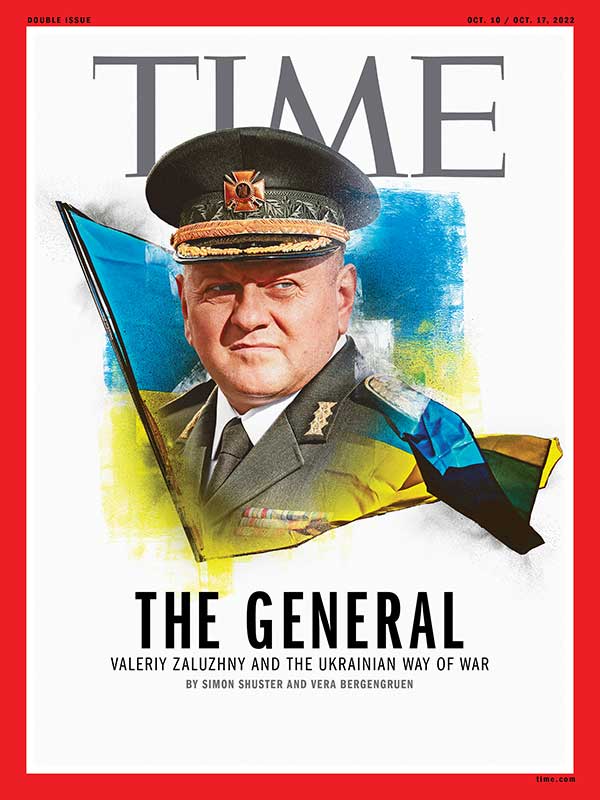
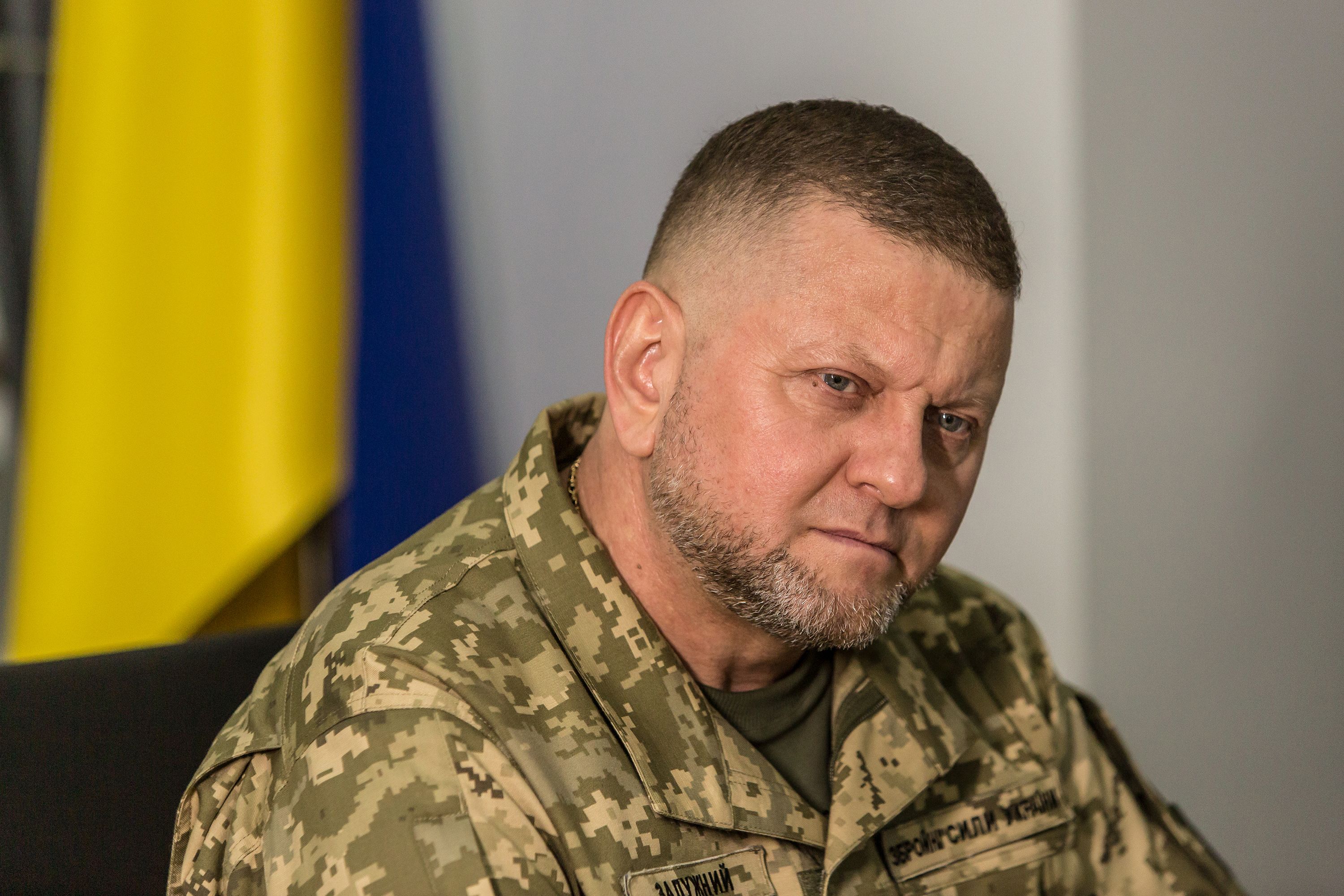
Why is Western media treating Ukraine’s failing top general like a movie star?


- Indeed, Zaluzhny has consistently received the movie-star treatment: softball questions and shameless PR write-ups masquerading as journalism. And yet, propagandistic as it is, The Economist’s fluff piece still merits attention, if read against the grain.
- “His leadership enabled the Ukrainian armed forces to adapt quickly with battlefield initiative against the Russians.”
That initiative has now taken a key turn in Ukraine’s favor. .
- After the predictable failure of Ukraine’s summer counteroffensive has finally been acknowledged, a note – if not the substance – of realism is now discernible.
- Zaluzhny gets to “admit” (The Economist’s word) that the war is “at a stalemate.”
- While this is still too optimistic when Ukraine and its Western backers are, in reality, losing, it is a departure from the past.
- Serious independent analysts, such as Brian Berletic, were already explaining why this was a gross mischaracterization: Ukrainian forces had re-taken territory in northeastern Ukraine, but at a damaging cost in personnel and materiel. Russia had retreated, but not suffered a strategic setback. It may have looked impressive on a map, and it rattled some Russian commentators, but, in reality, it was a PR stunt Ukraine could not afford.
- It was precisely not the “counterstrike that turned the tide of the war,” as Time put it back then, in another piece fawning over Zaluzhny.
- Now, a year later, there are not even such empty territorial gains to show for the lost lives of the counteroffensive.
- That, too, flew in the face of professional expertise: armies, even units inside armies, cannot be transformed at that speed.
- It is a snake-oil-level silly or dishonest belief. Thanks to it, though, many Ukrainians are dead, wounded, or, if lucky, POWs.
- Others have long openly admitted that they had to revert to tactics not taught by NATO to stand a chance at survival. Ukraine’s Western 'supporters' (would 'users' not be the better, more honest word?), meanwhile, accused their proxies of being “casualty-averse.”

If it had not wasted so many lives, Zaluzhny’s frank naivete would be touching. It only took him seeing his troops being bogged down in those minefields everyone knew about in advance, while Western miracle weapons turned out to be as susceptible to enemy fire as was easily predictable, to have a remarkable epiphany: This sort of thing is not unprecedented! That’s when he told “his staff to dig out a book he once saw as a student.” Published in 1941 by Soviet general Pavel Smirnov thinking through the experiences of World War I, 'Breaching Fortified Defense Lines' turned out relevant, unlike those NATO 'textbooks' Zaluzhny was following.
But there is no happy ending here. Zaluzhny has only replaced one set of illusions for another one:
- Now he believes that Ukraine’s – and very much his own – failure in the counteroffensive is due to a stalemate akin to what made World War I last so long.
- With contemporary defenders too powerful, thanks to satellites, drones, and other technologies, attackers end up wasting their men and weapons in fruitless or exorbitantly costly attempts to storm almost un-stormable positions.
- He draws two conclusions:
- First, Russia has essentially the same problem; and
- Second, the only way to break the stalemate is to introduce more new technology to re-empower the attackers over the defenders.
- In effect, the man who was surprised that Western arms that already exist are no miracle weapons, now puts his faith in yet more miracle weapons – those still to be developed.
Both of Zaluzhny’s conclusions are bad cases of wishful thinking. Indeed, they are so obviously wrong that one cannot help but recall that this is the man openly admitting he believed NATO 'textbooks' and 'math' until he saw his soldiers dying in droves.
Here’s why he’s got it wrong again.
- While it is true that Russia also suffers substantial losses when it launches relatively large, concentrated offensive operations, that does not change the fact that this is a war of attrition, as both Zaluzhny and The Economist have admitted.
- And it is ongoing: Attrition is constantly working for the (much) stronger country, here Russia, against the (much) weaker country, here Ukraine.
- Even Zaluzhny admits that any technological breakthrough magically re-empowering Ukraine’s attackers is, at best, far off and, therefore, the war is bound to be long.
- Yet since there is a limit to the attrition an army can absorb before having to give up or fall apart, Ukraine does not, actually, have the time to wait for Zaluzhny’s new dream of the miracle weapons of the future to come true (if it ever will).

- And unlike Ukraine, Russia has the economy to provide it with what it needs to implement its plans.
- It also has allies because, whether Ukraine’s commander-in-chief has noticed or not, the West’s attempt to isolate Moscow and bring it down through economic warfare have fared no better than Ukraine’s counteroffensive.
- At this point, Russian forces keep most of the line of contact busy with comparatively small-scale operations. Those do not yield any sudden breakthroughs, but they steadily erode Ukrainian positions and improve those of the Russians.
- In the future, some of the ground thus gained may also serve as launch pads for a big-arrow-style large-scale attack, big enough to overload Ukraine’s weakened, exhausted defenses in more than one place.
- Does Zaluzhny really believe that his unforgivably late insights into the nature of World War I and the ill-conceived analogies he builds on them will help much in that case?
The statements, views and opinions expressed in this column are solely those of the author and do not necessarily represent those of RT.
___________________________________________________________________________________
Ukraine facing ‘worst winter ever’ – FM

- In an interview with the German daily Die Welt on Monday, Kuleba revealed that he had bought “dozens of candles” and his father had bought a truck of firewood in anticipation of Russian attacks.
Germany has been reluctant to provide Kiev with long-range weapons. Chancellor Olaf Scholz explained that he does not want to see these missiles used against targets in Russia. Commenting on the issue in September, German Foreign Minister Annalena Baerbock described this weaponry as extremely sophisticated, adding that “when we deliver something, it has to work in the field.”

The view that Ukraine is about to face a difficult winter was shared by National Security Council chief Aleksey Danilov, who said in September that top Ukrainian officials had discussed the issue on numerous occasions, adding that it is also up to local communities to provide people with electricity.
Earlier in July, he estimated that Russian attacks had damaged about 50% of all power-generating facilities, with some of them beyond repair.
Russia first started launching large-scale strikes on Ukrainian energy infrastructure in October 2022, in response to what it described as a “terrorist attack” on the strategic Crimean Bridge. While Ukrainian officials initially denied involvement, this summer, Vasily Malyuk, the head of Ukraine’s Security Service (SBU), claimed responsibility for the attack.




No comments:
Post a Comment