
Scientists turn huge cave in southwest China into lunar research facility
Researchers want to know if volcanic lava tubes could support a moon base and they are looking for answers deep below ground on Earth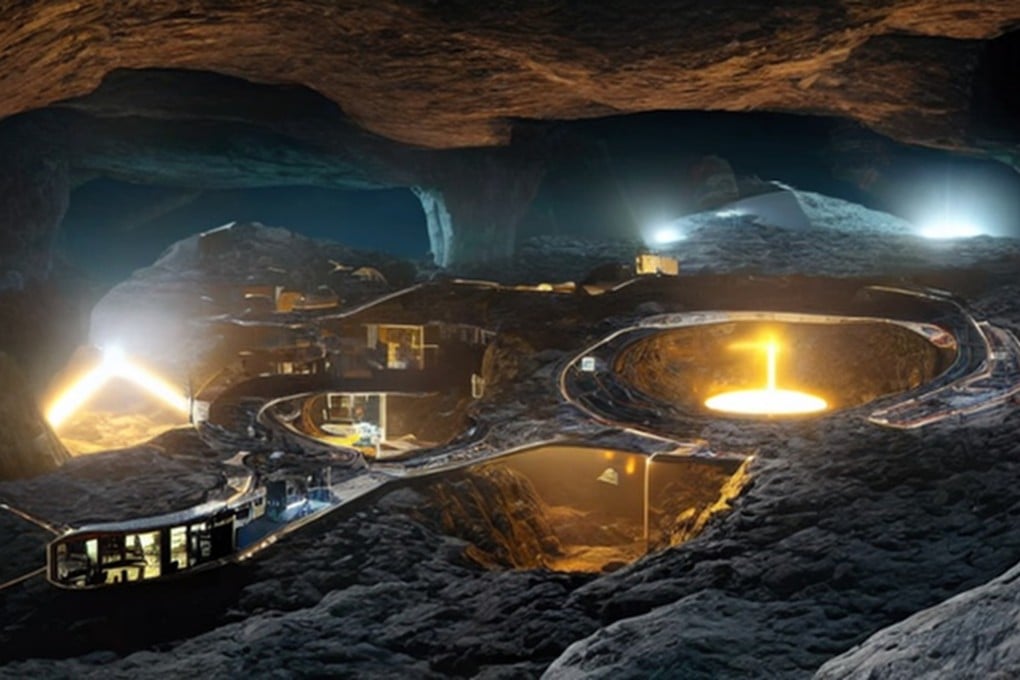
Xie Gengxin, from the Centre of Space Exploration at Chongqing University in southwestern China, organized the visit to Youyang Base, where large-scale closed cave ecosystem validation research is under way. . .
Bases on the moon and Mars will be essential components of future deep space exploration, but their extreme environments present significant challenges – including temperature fluctuations, intense radiation and frequent meteorite impacts.
- In contrast, the recently discovered lava tubes on the moon can withstand meteorites and radiation, while maintaining relatively stable internal temperatures.
- And if the ceilings are thick enough, the tubes could be pressurized to standard atmospheric levels, making them a promising site for future lunar bases, according to the scientists. . .
The team’s plan for an extraterrestrial, cave-based habitat involves three phases,
- starting with identifying and modifying a suitable lava tube, then
- establishing a cave farm for plants and livestock, and finally
- habitat construction.
According to the researchers, a production area will be reserved in the planned moon base layout, where lunar regolith will be transformed from loose dust and broken rocks into building materials or planting medium.

- the farming zone focusing on plant cultivation and animal incubation.
- An equipment area will incorporate local resources and human waste to establish resource cycles, converting some organic matter into nutrient solutions.
- Finally, a backyard will serve as a transitional space for plants adapted to lowlight conditions.
The habitat construction phase will focus on optimizing energy systems and residential areas to ensure the long-term survival of humans.
An energy system will use solar power and thermoelectric generation from the moon’s surface to generate electricity, providing stable power supply for system operations, heating, and environmental regulation.
The residential area will balance comfort and functionality, providing living, exercise, and research spaces for the crew, according to the researchers.
“As deep space exploration advances rapidly, using lunar and Martian caves to build habitats will become a crucial starting point for humanity’s exploration of the cosmos and expansion of living space, ushering in a new era of extraterrestrial civilization,” Xie said.






No comments:
Post a Comment