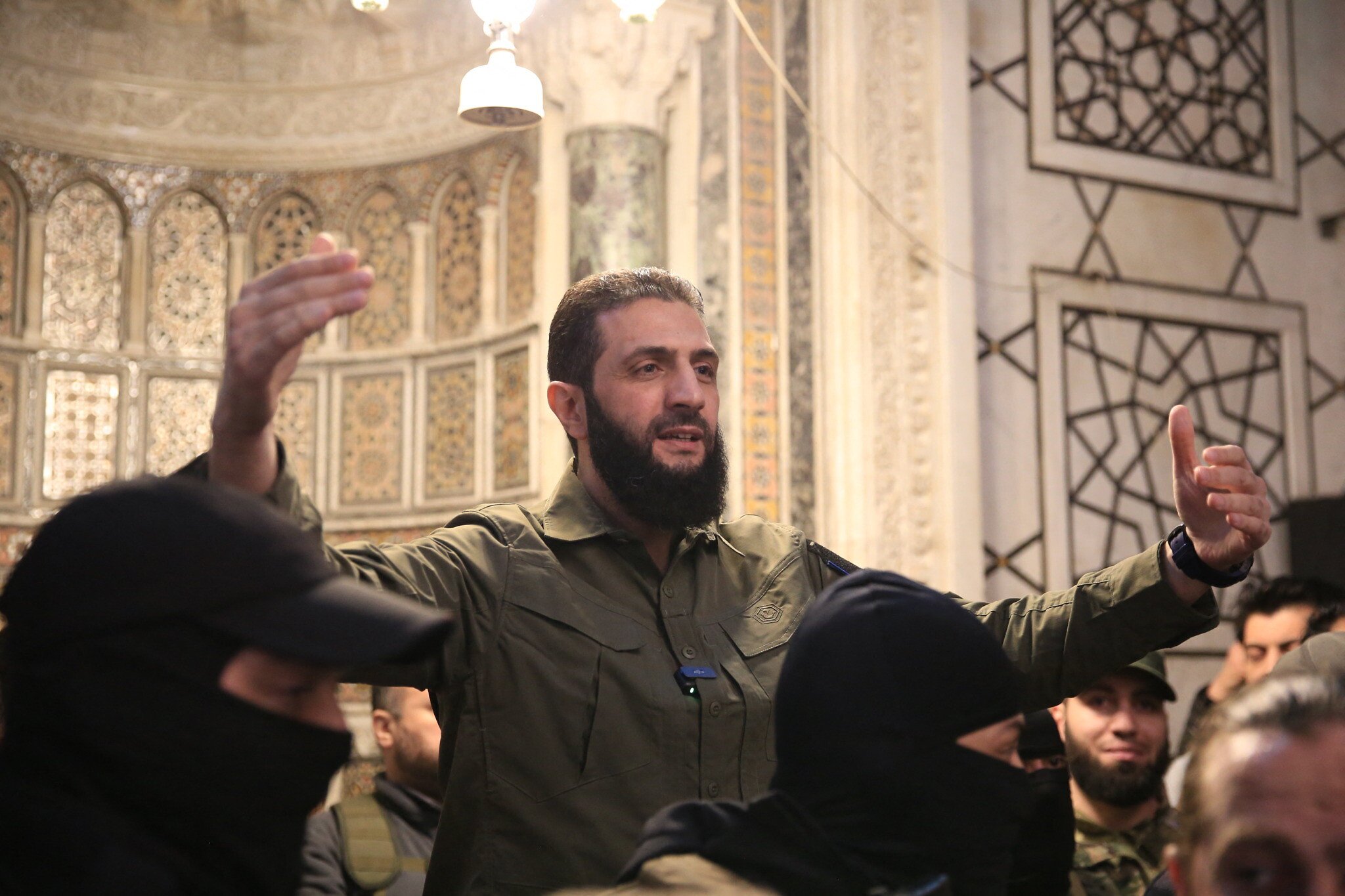
- Hayat Tahrir al Sham (HTS) is establishing a transitional government and reconciling with former Syrian regime and Syrian Arab Army (SAA) members.
- HTS likely attempting to improve its image among the Syrian people and international community by framing itself as an organization that is devoted to building a pluralist Syrian state.

Iraq and Iran in Syria: The fall of the Assad regime has exposed fissures between Iran and Iraq. Iranian Foreign Affairs Minister Abbas Araghchi was “surprised” during his visit to Baghdad on December 6 that the Iraqi federal government refused to send forces to Syria to defend the Assad regime.

8 hours ago
Iran Update, December 9, 2024
Annika Ganzeveld, Ria Reddy, Siddhant Kishore, Andie Parry, Carolyn Moorman, Katherine Wells and Brian CarterInformation Cutoff: 2:00 pm ET
Click here to see CTP and ISW’s interactive map of Israeli ground operations, and here to see CTP and ISW’s interactive map of the ongoing opposition offensive in Syria. These maps are updated daily alongside the static maps present in this report.
We do not report in detail on war crimes because these activities are well-covered in Western media and do not directly affect the military operations we are assessing and forecasting. We utterly condemn violations of the laws of armed conflict and the Geneva Conventions and crimes against humanity even though we do not describe them in these reports.
- HTS appointed HTS-led Syrian Salvation Government Prime Minister Mohammad al Bashir to lead the transitional government on December 9.[ii]
- HTS established the Salvation Government in northwestern Syria in 2017.[iii]
- Bashir met with HTS leader Abu Mohammed al Jolani and former Assad Regime Prime Minister Mohammed al Jalali on December 9 to discuss the transfer of power from the Assad regime to HTS.[iv]
- Jalali stated on December 8 that he and HTS agreed on “the importance of preserving government institutions and trying to return 400,000 employees to their jobs.”[v]
- HTS-led Salvation Government Justice Minister Shadi al Waisi separately met with former Assad Regime Justice Minister Ahmed al Sayeh on December 9 to discuss “an efficient handover.”[vi]
- HTS has rapidly rolled out its own governance apparatus in areas of Syria it has liberated from the Assad Regime in the past.[vii]
- HTS likely correctly recognizes that it cannot rely upon its own much smaller and Idlib-focused government apparatus to govern all of Syria it has recently captured and will need to rely upon Syrian government institutions in the interim.
ty and security during the post-conflict transition period.[xi]HTS announced on December 9 a general amnesty for all Syrian regime military personnel whom the regime conscripted under compulsory service.[viii] HTS emphasized that these individuals’ lives “are safe” and that “no assault on them is permitted.”[ix] HTS has similarly sought to integrate Syrian regime military and security personnel into civilian life in Aleppo City since it seized that city on November 30.[x] CTP-ISW previously noted that integrating former combatants into civilian life could ensure stabili
8 hours ago
Iran Update, December 9, 2024
Information Cutoff: 2:00 pm ET
The Critical Threats Project (CTP) at the American Enterprise Institute and the Institute for the Study of War (ISW) publish the Iran Update, which provides insights into Iranian and Iranian-sponsored activities that undermine regional stability and threaten US forces and interests.
Click here to see CTP and ISW’s interactive map of Israeli ground operations, and here to see CTP and ISW’s interactive map of the ongoing opposition offensive in Syria. These maps are updated daily alongside the static maps present in this report.
We do not report in detail on war crimes because these activities are well-covered in Western media and do not directly affect the military operations we are assessing and forecasting. We utterly condemn violations of the laws of armed conflict and the Geneva Conventions and crimes against humanity even though we do not describe them in these reports.
Hayat Tahrir al Sham (HTS) is establishing a transitional government and reconciling with former Syrian regime and Syrian Arab Army (SAA) members. HTS is attempting to ensure continuity of governance to prevent widespread anarchy in Syria, which is consistent with HTS’ longstanding approach to “liberated areas.”[i] HTS appointed HTS-led Syrian Salvation Government Prime Minister Mohammad al Bashir to lead the transitional government on December 9.[ii] HTS established the Salvation Government in northwestern Syria in 2017.[iii] Bashir met with HTS leader Abu Mohammed al Jolani and former Assad Regime Prime Minister Mohammed al Jalali on December 9 to discuss the transfer of power from the Assad regime to HTS.[iv] Jalali stated on December 8 that he and HTS agreed on “the importance of preserving government institutions and trying to return 400,000 employees to their jobs.”[v] HTS-led Salvation Government Justice Minister Shadi al Waisi separately met with former Assad Regime Justice Minister Ahmed al Sayeh on December 9 to discuss “an efficient handover.”[vi] HTS has rapidly rolled out its own governance apparatus in areas of Syria it has liberated from the Assad Regime in the past.[vii] HTS likely correctly recognizes that it cannot rely upon its own much smaller and Idlib-focused government apparatus to govern all of Syria it has recently captured and will need to rely upon Syrian government institutions in the interim.
HTS announced on December 9 a general amnesty for all Syrian regime military personnel whom the regime conscripted under compulsory service.[viii] HTS emphasized that these individuals’ lives “are safe” and that “no assault on them is permitted.”[ix] HTS has similarly sought to integrate Syrian regime military and security personnel into civilian life in Aleppo City since it seized that city on November 30.[x] CTP-ISW previously noted that integrating former combatants into civilian life could ensure stability and security during the post-conflict transition period.[xi]
HTS likely attempting to improve its image among the Syrian people and international community by framing itself as an organization that is devoted to building a pluralist Syrian state. HTS announced on December 9 that it is “strictly forbidden” to interfere in women’s choice of clothing or to demand that women dress modestly.[xii] HTS emphasized that “respect[ing] the rights of individuals is the basis for building a civilized nation.”[xiii] HTS separately announced on December 9 that it is “strictly forbidden” to attack or threaten journalists and reporters.[xiv] It is unclear whether HTS will indefinitely protect the rights of women and journalists. HTS’s “morality police,” called Markaz al Falah, has previously arrested women for dressing “inappropriately.”[xv] HTS has also imprisoned journalists who criticized its rule in northwestern Syria.[xvi]
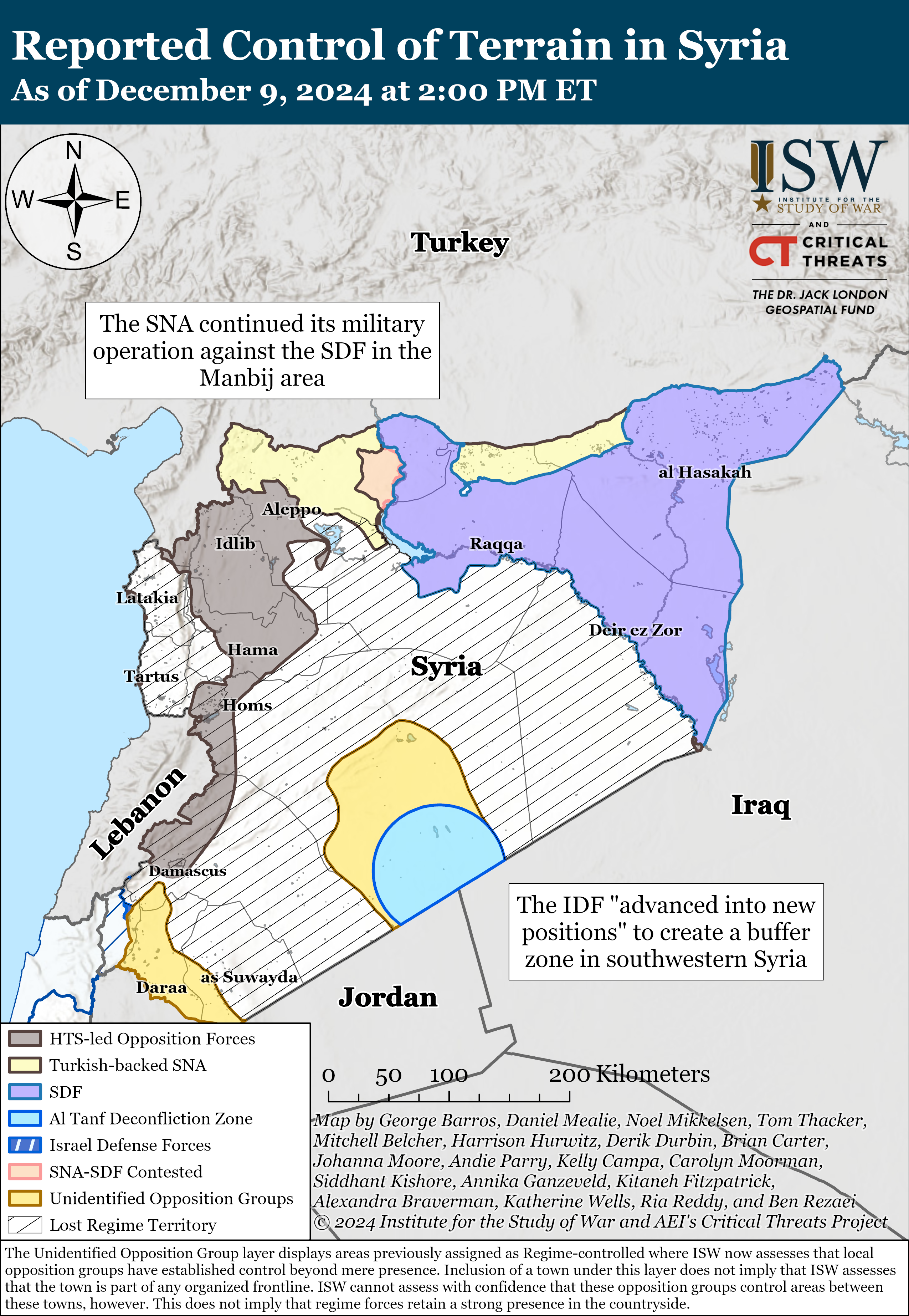
The Kurdish-controlled, US-backed Syrian Democratic Forces (SDF) may face increased challenges governing Arab areas in northeastern Syria due to the emergence of the HTS-led transitional government as a viable alternative to the SDF. Local opposition to SDF rule has broken out in several cities and villages in Raqqa Province since the fall of the Assad regime.[xvii] Arab sources reported that locals seized SDF military checkpoints and headquarters in Karamah and Tabqa on December 8.[xviii] The SDF deployed reinforcements to Karamah on December 9 and conducted a large arrest campaign in several villages involved in opposition activities the day before.[xix] Armed local resistance in these towns does not appear to be organized or well-equipped enough to force the SDF out of these areas. The emergence of the transitional government is liable to pose a serious problem for the SDF, which has a difficult relationship with local Arab residents. The existence of the regime—and the risk that Arab areas in northeastern Syria could fall back under regime control—acted as a dampener against large-scale uprisings against the SDF. Several Arab-majority areas in Deir ez Zor Province began an armed uprising and participated in demonstrations against the SDF in the autumn of 2023, demonstrating the existing discontent in the region, however.[xx] SDF Commander Mazloum Abdi called Assad’s fall ”an opportunity to build a new Syria based on democracy and justice“ on December 8, but did not elaborate further on the SDF’s willingness to join the transitional government.[xxi]
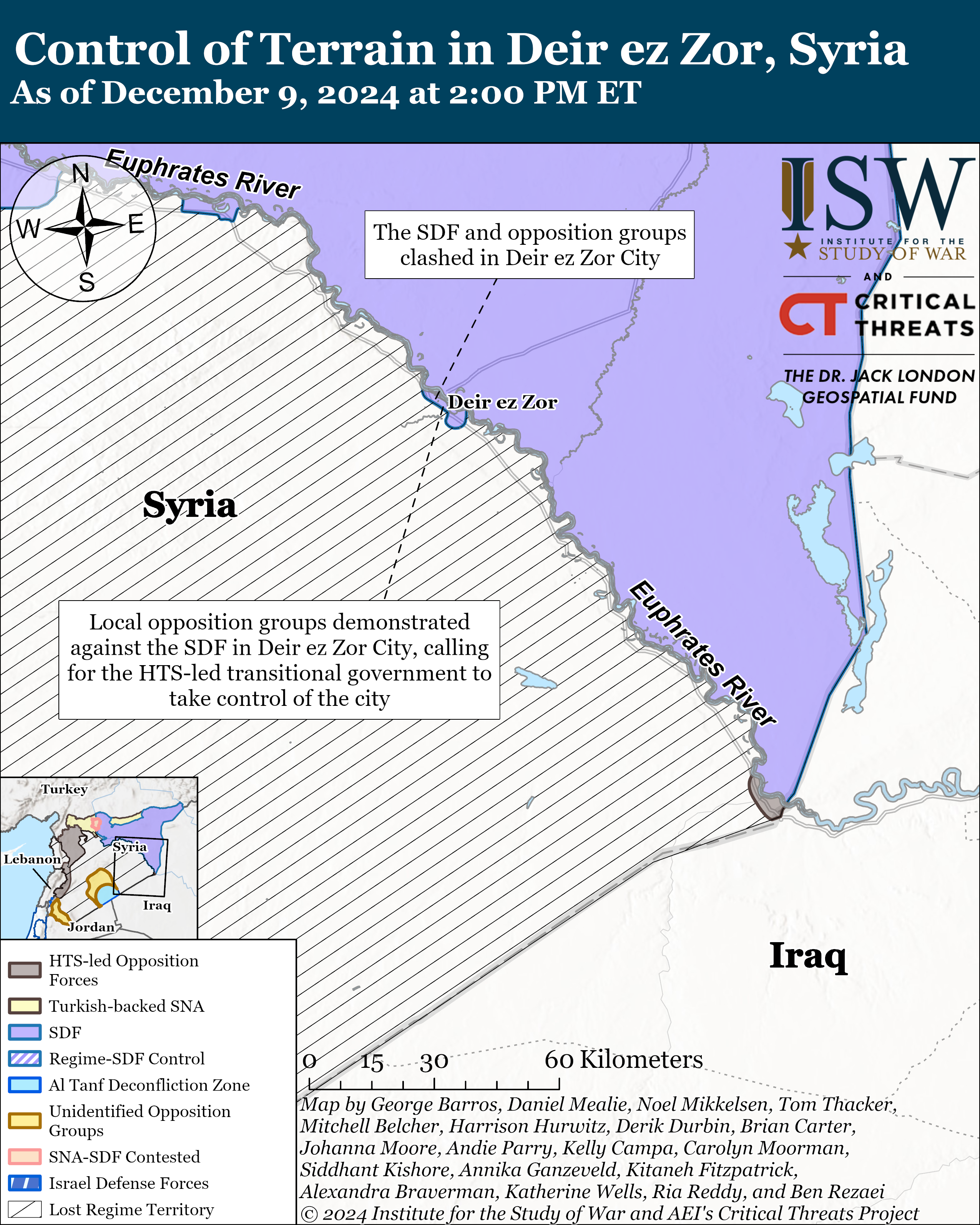
The SDF is also facing local dissent in the areas of Deir ez Zor Province that it seized from the Syrian regime on December 6.[xxii] Local opposition groups demonstrated in Deir ez Zor City on December 9, calling for the HTS-led transitional government to take control of the city.[xxiii] Local media reported that the SDF opened fire on the demonstrators and killed several of them.[xxiv] The HTS-affiliated Fateh Mubin operations room confirmed that its forces were operating in Deir ez Zor City on December 7 shortly before Assad fled the country.[xxv] Local media has since reported that convoys affiliated with Fateh Mubin are operating between Deir ez Zor and Albu Kamal, but few reliable sources are reporting direct clashes between the SDF and HTS-affiliated forces.[xxvi] Engagements between the SDF and local opposition demonstrate that HTS-affiliated forces have not established full security control over the Deir ez Zor corridor.[xxvii]
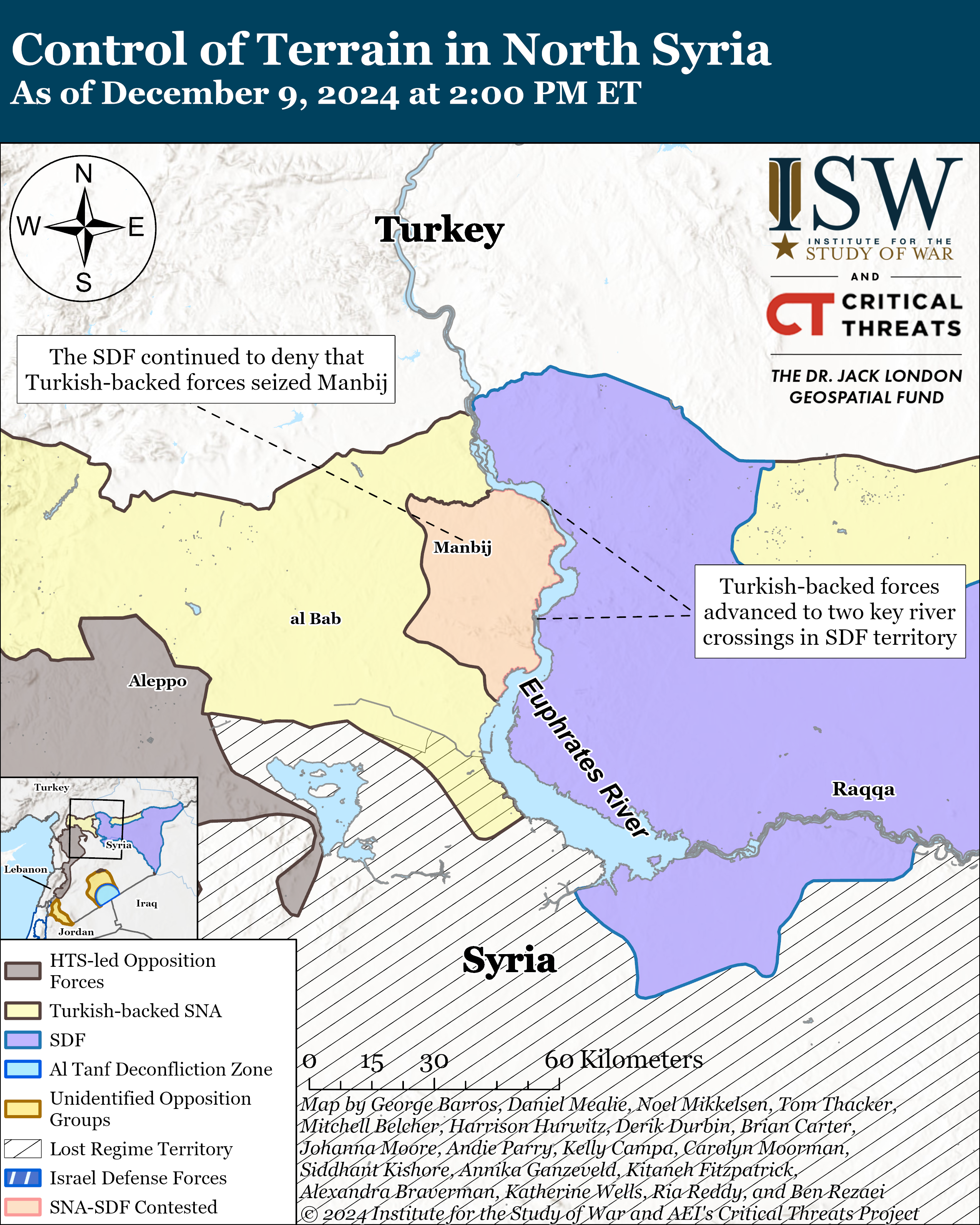
The Turkish-backed Syrian National Army (SNA) is also attacking the SDF as the SDF contends with internal dissent. SNA forces advanced east of Manbij to Qara Qozak Bridge and Tishrin Dam, which are two key river crossings in SDF territory.[xxviii] The SDF confirmed that its forces engaged SNA fighters at both sites and did not acknowledge that its forces lost control over the river crossings.[xxix] Opposition media claimed that the SNA took control of the Qara Qozak Bridge and posted a video from the site, however.[xxx] The SDF continued to dispute that SNA forces seized full control of Manbij on December 9.[xxxi] The SNA claimed that it seized Manbij on December 8.[xxxii]
The Israel Defense Forces (IDF) continued to establish a buffer zone in Syria along the Golan Heights on December 9. Israeli Foreign Affairs Minister Gideon Saar stated on December 9 that the IDF “advanced into new positions” in the disengagement zone between Syria and the Israeli-controlled Golan Heights.[xxxiii] An Israeli Army Radio correspondent reported on December 9 that the IDF had advanced several kilometers into the disengagement zone.[xxxiv] Geolocated imagery posted on December 8 showed Israeli forces near a UN Disengagement Observer Force (UNDOF) position on Mount Hermon.[xxxv] Israeli forces captured an SAA position at the top of Mount Hermon on December 8.[xxxvi] Geolocated imagery posted on December 9 also showed Israeli tanks entering the disengagement zone from Majdal Shams in the Golan Heights and Israeli forces operating west of the town of Hader in Quneitra Province.[xxxvii] The IDF operated in Quneitra and al Hamidiyah cities on December 9 after issuing warnings to residents in these cities on December 8 to stay inside.[xxxviii]
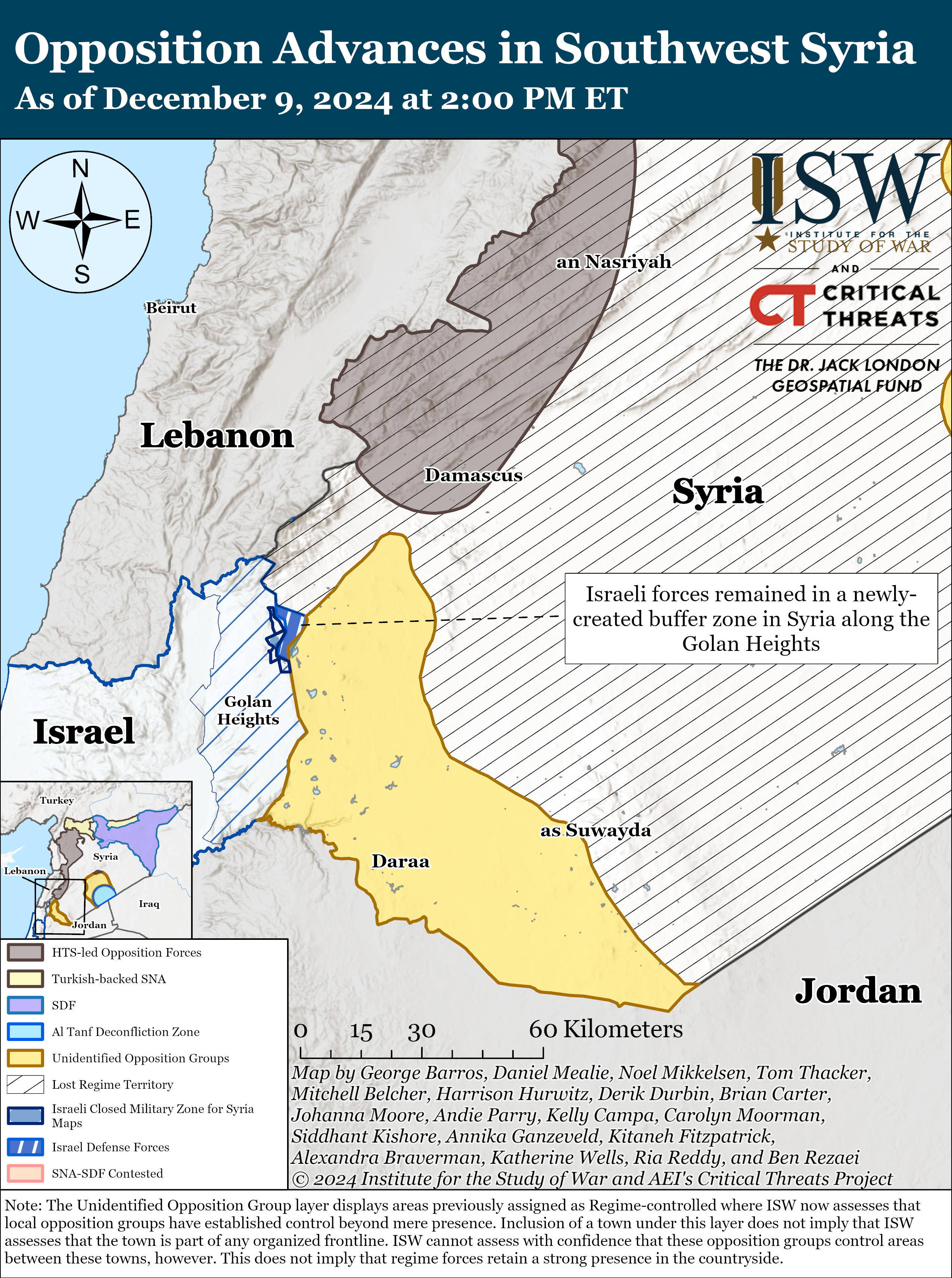
The IDF Air Force continued conducting airstrikes targeting former SAA and Lebanese Hezbollah sites in Syria on December 9. An Israeli Army Radio correspondent reported on December 9 that the IAF conducted airstrikes targeting over 100 SAA targets in the past day.[xxxix] The IAF targeted the SAA 9th Division, 112th Brigade, and 12th Brigade bases in Daraa Province.[xl] The IAF also targeted SAA military sites, barracks, and missile warehouses, as well as unspecified Hezbollah sites in the Qalamoun area north of Damascus.[xli] Israeli officials told Axios on December 9 that the IAF has targeted facilities that were part of the Syrian regime’s chemical weapons and ballistic missile programs to ”make sure strategic weapon systems don’t fall into the wrong hands.”[xlii]
The fall of the Assad regime has exposed fissures between Iran and Iraq. Iranian Foreign Affairs Minister Abbas Araghchi was “surprised” during his visit to Baghdad on December 6 that the Iraqi federal government refused to send forces to Syria to defend the Assad regime, according to an unspecified Iraqi official speaking to the Washington Post on December 9.[xliii] The official stated that Araghchi assumed that the Iraqi federal government would support Assad as it had previously done in the Syrian Civil War.[xliv] Senior Iraqi security officials, including Popular Mobilization Committee Chairman Faleh al Fayyadh, emphasized in recent days that the conflict in Syria is an “internal matter.”[xlv] Some Iranian-backed Iraqi militia leaders, including Badr Organization Secretary General Hadi al Ameri, seemed to oppose the stance of the Iraqi government and called on fighters to bolster the SAA and not wait for ”Baghdad to escalate” against opposition forces.[xlvi]
Iran is attempting to reframe its role in the Syrian Civil War in order to reestablish influence within the new Syrian government. A senior Iranian official told Reuters on December 9 that Iran opened direct communication with unspecified Syrian rebels to "prevent a hostile trajectory" between the two countries.[xlvii] Another official stated that Iran aims to build ties with "those within Syria's new ruling groups whose views are closer to [Iranian views], though the specific opposition groups are unclear. Iran's "main concern" is that Assad's successor may shift Syria away from Iranian influence, demonstrating that Iranian officials remain concerned about the requirement to reestablish Iranian influence in Syria. Key Iranian officials, including the foreign affairs minister and parliament speaker, have recently tried to reframe the role Iran held in the war. The Iranian foreign affairs minister claimed that Iran has always advocated for “dialogue” with opposition forces, but it is highly unlikely that Iran would have supported talks that would have given Assad or a pliant pro-Iran actor a subordinate role to any opposition organization.[xlviii] Iran‘s parliament speaker falsely claimed that Iran had only intervened to counter ISIS, not rebel groups.[xlix] Iran launched a concerted effort to keep Assad in power and maintained its forces in Syria since shortly after the start of the Syrian civil war in 2011.[l] This effort required Iran to fight ISIS, but Iran also fought all threats to Assad’s rule, including the opposition.
This Iranian effort is unlikely to succeed, at least in the near term. HTS leader Abu Mohammed al Jolani stated on December 9 that the victory of Syrian opposition forces would end Syria's role as a "playground for Iranian ambitions, spreading sectarianism, and stirring corruption", reflecting deep resentment toward Iranian influence in Syria.[li]
Members of Iran’s armed forces and Iranian policymakers are increasingly disillusioned with Iran’s handling of the collapse of the Assad Regime. Iran observers have noted that Islamic Revolutionary Guard Corps (IRGC) and Basij members are critical of Iran's failure to intervene more decisively in Syria to support Assad against the opposition's surprise offensive, citing IRGC communication channels and interviews with IRGC members.[lii] An IRGC member stated that Syria was ”crucial” for the Axis of Resistance, and "abandoning" Assad was a "betrayal" that would have serious consequences for Iran.[liii] Another member stated that the "[IRGC youth] will not forget the cowardice of the decision-makers."[liv] Iranian Parliamentarian Mohammad Manan Raisi stated that "after sacrificing six thousand martyrs and spending billions of tomans, we handed Syria over [in just one week]."[lv] These statements reveal dissatisfaction within Iran over its failure to support the Syrian regime, raising concerns about Iran's ability to sustain its influence via the Axis of Resistance. These frustrations—if they become wildly held among the security services and key Iranian leaders—could lead to the removal of top Iranian military commanders, including in the IRGC.
Key Takeaways: Syrian Transitional Government Formation:
Iranian Reactions to Assad’s Collapse: Members of Iran’s armed forces and Iranian policymakers are increasingly disillusioned with Iran’s handling of the collapse of the Assad Regime.
.png)
- Source: Institute for the Study of War and AEI's Critical Threats Project;
.png)

The Economist: Who will rule Syria now Assad regime toppled?




No comments:
Post a Comment