Two years ago, a Canadian writer named Cory Doctorow coined the phrase "enshittification" to describe the decay of online platforms. The word immediately set the Internet ablaze, as it captured the growing malaise regarding how almost everything about the web seemed to be getting worse.
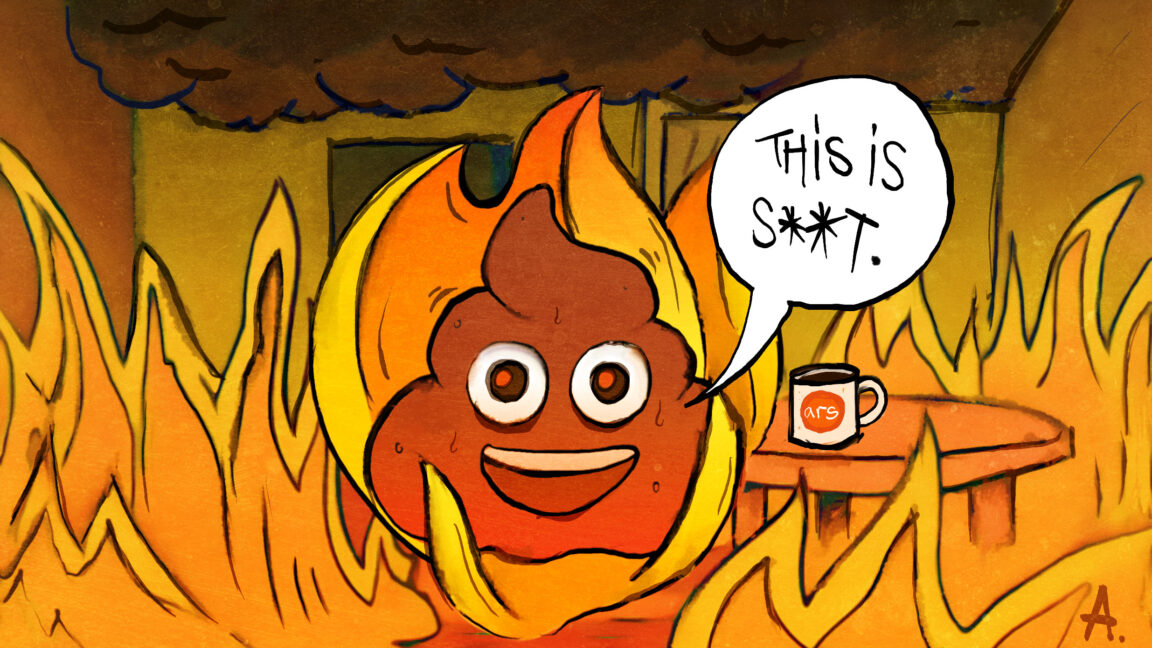
Two years ago, a Canadian writer named Cory Doctorow coined the phrase "enshittification" to describe the decay of online platforms. The word immediately set the Internet ablaze, as it captured the growing malaise regarding how almost everything about the web seemed to be getting worse.
EFA : Electronic Frontiers Australia - “Enshittification” was Macquarie Dictionary's Word of the Year for 2024, and also won the People's Choice"
- Doctorow explained in a follow-up article. "We’re all living through a great enshittening, in which the services that matter to us, that we rely on, are turning into giant piles of shit. It’s frustrating. It’s demoralizing. It’s even terrifying."
Doctorow believes there are four basic forces that might constrain companies from getting worse:
- competition,
- regulation,
- self-help, and
- Tech workers.
- With another competitor tossed aside, Amazon was then free to sell diapers at its price from wherever it wanted to source them.
Anyway, we at Ars have covered a lot of things that have been enshittified. Here are some of the worst examples we've come across. Hopefully, you'll share some of your own experiences in the comments. We might even do a follow-up story based on those. . . .


Feds putting the kibosh on national EV charging program
DOT orders states to halt plans to build federally funded EV stations.
The US Department of Transportation has ordered states to kill their implementation plans related to the National Electric Vehicle Infrastructure program, according to a memo obtained by WIRED that was later made public. The decision appears to halt in its tracks a $5 billion program designed to fund state projects to install electric vehicle charging stations across the United States.
Officials at the Federal Highway Administration (FHWA), which manages the program, ordered state transportation directors to “decertify” the plans that all 50 states have used to outline where and how they will build their charging stations, and with what companies they’ll contract to do so. States have followed those plans to build more than 30 charging stations across the US, with hundreds more on the way.
Surveys show prospective car buyers cite the country’s lagging electric vehicle charging infrastructure as a major reason they won’t buy electric. The NEVI program, established by 2021’s Infrastructure Law, was the government’s answer to those concerns. It attempts to build chargers along thousands of miles of federal highway, with a focus on places that might not otherwise be able to financially support a charger.

National Institutes of Health radically cuts support to universities
Sudden and drastic change will make it hard for researchers to keep the lights on.
Grants paid by the federal government have two components. One covers the direct costs of performing the research, paying for salaries, equipment, and consumables like chemicals or enzymes. But the government also pays what are called indirect costs. These go to the universities and research institutes, covering the costs of providing and maintaining the lab space, heat and electricity, administrative and HR functions, and more.
These indirect costs are negotiated with each research institution and average close to 30 percent of the amount awarded for the research. Some institutions see indirect rates as high as half the value of the grant.
On Friday, the National Institutes of Health (NIH) announced that negotiated rates were ending. Every existing grant, and all those funded in the future, will see the indirect cost rate set to just 15 percent. With no warning and no time to adjust to the change in policy, this will prove catastrophic for the budget of nearly every biomedical research institution.

The Sims re-release shows what’s wrong with big publishers and single-player games
Opinion: EA might be done with single-player games—but we're not.
It's the year 2000 all over again, because I've just spent the past week playing The Sims, a game that could have had a resurgent zeitgeist moment if only EA, the infamous game publisher, had put enough effort in.
A few days ago, EA re-released two of its most legendary games: The Sims and The Sims 2. Dubbed the "The Legacy Collection," these could not even be called remasters. EA just put the original games on Steam with some minor patches to make them a little more likely to work on some modern machines.
The emphasis of that sentence should be on the word "some." Forums and Reddit threads were flooded with players saying the game either wouldn't launch at all, crashed shortly after launch, or had debilitating graphical issues. (Patches have been happening, but there's work to be done yet.)



No comments:
Post a Comment