
New AI tool can detect three deadly heart conditions in just 15 SECONDS (and it's more accurate than a doctor!)
The stethoscope is used to listen to sounds within the body and has been a vital part of a doctor’s toolkit since it was invented in 1816.
But an AI version can do much more, including analysing tiny differences in heartbeat and blood flow and recording electrical signals in the heart at the same time.
A trial involving 205 NHS GP surgeries with 1.5million patients found it increases detection of heart failure at the early stage when someone first goes to their family doctor with symptoms.
Those examined using an AI stethoscope were twice as likely to be diagnosed with heart failure in the next 12 months, compared to similar patients who were not examined using the technology.
They were also 3.5 times more likely to be diagnosed with atrial fibrillation—an abnormal heart rhythm which can increase the risk of having a stroke.
- A trial involving 205 NHS GP surgeries with 1.5million patients found it increases detection of heart failure at the early stage when someone first goes to their family doctor with symptoms.
- Those examined using an AI stethoscope were twice as likely to be diagnosed with heart failure in the next 12 months, compared to similar patients who were not examined using the technology.
- They were also 3.5 times more likely to be diagnosed with atrial fibrillation—an abnormal heart rhythm which can increase the risk of having a stroke.
Dr Sonya Babu-Narayan, clinical director at the British Heart Foundation and consultant cardiologist, said:
‘Given an earlier diagnosis, people can access the treatment they need to help them live well for longer.’
‘This is an elegant example of how the humble stethoscope, invented more than 200 years ago, can be upgraded for the 21st century.‘We need innovations like these, providing early detection of heart failure, because so often this condition is only diagnosed at an advanced stage when patients attend hospital as an emergency.
However, 70 per cent of GP surgeries given smart stethoscopes in the study stopped using them, or used them infrequently, after 12 months and two-thirds of people identified by the AI stethoscope as having suspected heart failure did not in fact have it, when given a further blood test or heart scan.
The researchers say efforts to integrate the technology into GPs’ existing routines would be needed to roll the technology out more widely and highlight the device is picking up cases that would otherwise be missed.

They stress that the AI-stethoscope should be used for patients with symptoms of suspected heart problems and not for routine checks in healthy people.
The study, called TRICORDER, was funded by the National Institute for Health and Care Research (NIHR), British Heart Foundation and Imperial Health Charity.
Researchers supplied GP practices with an AI stethoscope manufactured by Californian company Eko Health.
They next plan to roll out the technology to GP practices in Wales, South London and Sussex.
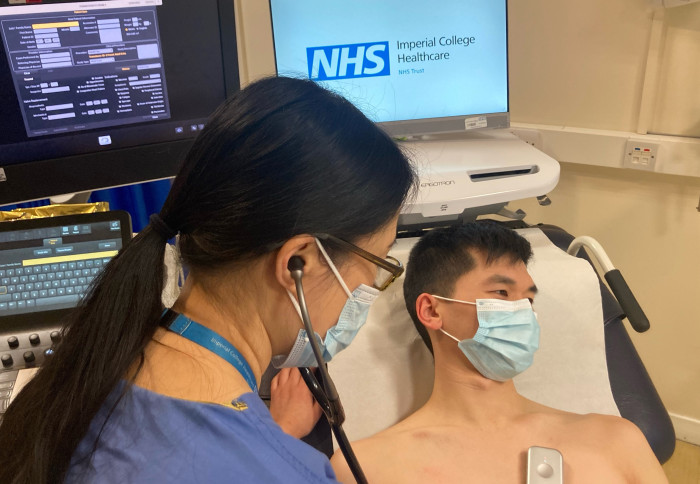
Professor Nicholas Peters, senior investigator from Imperial College London and consultant cardiologist at Imperial College Healthcare NHS Trust, said: ‘Our study shows that three heart conditions can now be identified in one sitting.
‘Importantly, this technology is already available to some patients and being widely used in GP surgeries.’

AI-powered stethoscope promises heart disease detection in seconds
Three serious heart conditions detected in just 15 seconds, while the results appear on a phone.
The Apple Watch is on the wrist of millions of users across the world. Over the years, Apple has developed algorithms that collect data from the integrated PPG sensor to sense irregular heart rhythms and warn users about risks such as Atrial Fibrillation. Now, a similar approach has been deployed to develop an AI-powered stethoscope that is claimed to detect three serious heart conditions within a matter of seconds.
The device, which is roughly the size of a playing card and looks more like a power bank, has already been deployed by Imperial College London and Imperial College Healthcare NHS Trust as part of a nationwide study called TRICORDER. The smart stethoscope can detect Heart failure (HF), atrial fibrillation (AF), and valvular heart disease (VHD).
How does it work?
At the heart of the AI stethoscope is a single-lead ECG sensor and a mic array that records phonocardiogram (PCG) waveforms, while algorithms make sense of these heart activity and blood flow readings to detect any abnormalities. The device, which connects to a smartphone app via Bluetooth and sends data to the cloud over Wi-Fi or cellular network, can reportedly detect the aforementioned heart issues in just 15 seconds.

This AI-driven stethoscope is classified as a Class IIa medical device, which means it is already authorized for regular use in healthcare. As such, doctors and healthcare professionals won’t need a written or signed consent from patients for using it either. The most notable aspect is that the trials have produced reliable results.
The device, which has been provided as a replacement stethoscope for routine patient clinical examination to general practitioners (GP) across the country, takes a 15-second recording after placing it over the upper left sternal border area on the chest. The real magic happens courtesy of the algorithms, which are governed by the UK Medicines and Healthcare Products Regulatory Agency (MHRA) and have shown promising results.

According to the British Heart Foundation, which partly funded the studies, patients who got themselves examined by the AI-powered stethoscope were roughly 3.5 times more likely to be diagnosed with atrial fibrillation. “They were almost twice as likely to receive a diagnosis of heart valve disease, which is where one or more heart valves do not work properly,” the institution adds.
A bright future
- Heart failure, which affects as many as a million patients in the UK alone, is detected in 70 percent of cases only after an individual is rushed in for emergency care.
- As for the device itself, it is manufactured by a California-based company named Eko Health.
- It notes that over three million patients have already been enrolled as part of the TRICORDER trial program, and down the road, it could potentially enable healthcare savings worth over a hundred million pounds to the government.


=============


No comments:
Post a Comment