

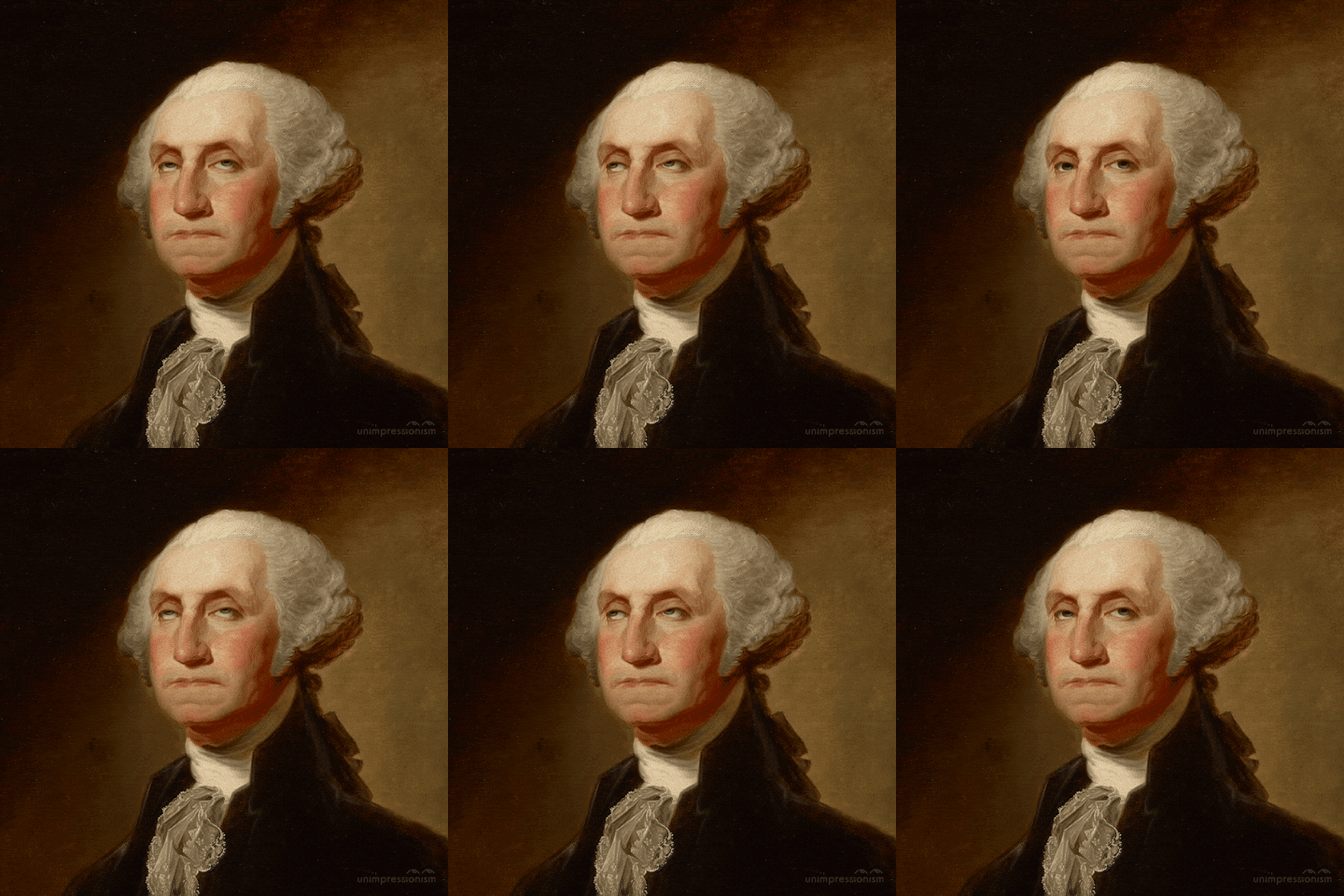
George Washington’s Worries Are Coming True
from the the-people-are-the-problem dept
The United States will celebrate the 250th anniversary of the Declaration of Independence, the country’s founding document, in 2026. Twenty years later, America will celebrate the 250th anniversary of President George Washington’s Farewell Address, which was published on Sept. 19, 1796.
The two documents are the bookends of the American Revolution. That revolution began with the inspirational language of Thomas Jefferson, who wrote much of the Declaration of Independence; it ended with somber warnings from Washington, the nation’s first president.
After chairing the Constitutional Convention in Philadelphia and serving eight years as president, Washington announced in a newspaper essay that he would not seek another term and would return to his home in Mount Vernon. The essay was later known as the “Farewell Address.”
Washington began his essay by observing that “choice and prudence invite me to quit the political scene” while “patriotism does not forbid it.” The new nation would be fine without his continued service.
But Washington’s confidence in the general health of the union was tempered by his worries about dangers that lay ahead – worries that seem startlingly contemporary and relevant 229 years later.

Focus on the domestic
Washington’s Farewell Address is famous for the admonitions “to steer clear of permanent alliances” and to resist the temptation to “entangle our peace and prosperity in the toils of European ambition.”
Important as those warnings are, they are not the main topic of Washington’s message.
During the four decades that I have taught the Farewell Address in classes on American government, I have urged my students to set aside the familiar issues of foreign policy and isolationism and to read the address for what it says about the domestic challenges confronting America.
Those challenges included partisanship, parochialism, excessive public debt, ambitious leaders who could come to power playing off our differences, and a poorly informed public who might sacrifice their own liberties to find relief from divisive politics.
Washington’s address lacks Jefferson’s idealism about equality and inalienable rights. Instead, it offers the realistic assessment that Americans are sometimes foolish and make costly political mistakes.
Rule by ‘ambitious, and unprincipled men’
Partisanship is the primary problem for the American republic, according to Washington.
“It serves always to distract the public councils and enfeeble the public administration,” he wrote. Partisanship “agitates the community with ill founded jealousies and false alarms, kindles the animosity of one part against another, foments occasionally riot and insurrection” and can open “the door to foreign influence and corruption.”
Though political parties, Washington observes, “may now and then answer popular ends,” they can also become “potent engines by which cunning, ambitious, and unprincipled men will be enabled to subvert the power of the people and to usurp for themselves the reins of government, destroying afterwards the very engines which have lifted them to unjust dominion.”
Washington’s fear that partisanship could lead to destruction of the Constitution and to the rule of “ambitious, and unprincipled men” was so important to him that he felt compelled to repeat the warning more than once in the Farewell Address.
Politicians’ ‘elevation on the ruins of public liberty’
The second time Washington takes it up, he says that “the disorders and miseries” of partisanship may “gradually incline the minds of men to seek security and repose in the absolute power of an individual.”
Sooner or later, he writes, “the chief of some prevailing faction, more able or more fortunate than his competitors, turns this disposition to the purposes of his own elevation on the ruins of public liberty.”
So why not outlaw parties and rein in the dangers of partisanship?
Washington observes that this is not possible. The spirit of party “is inseparable from our nature, having its root in the strongest passions of the human mind.”
Americans naturally collect themselves into groups, factions, interests and parties because that’s what human beings do. It’s easier to be connected to local communities, states or regions of the country than to a large and diverse nation; even though that large and diverse nation is, by Washington’s assessment, essential to the security and success of all.
The central problem in American politics is not a matter of devious leaders, foreign intrigue or sectional rivalries — things that will always exist.
The problem, Washington warned, lies with the people.
Excesses of partisanship
By their nature, people divide themselves into groups and then, if not careful, find those divisions used and abused by individual leaders, foreign interests and “artful and enterprising” minorities.
Political parties are dangerous, but can’t be eliminated. According to some people, Washington observes, the competition between parties might serve as a check on the powers of government.
“Within certain limits,” Washington acknowledges, “this is probably true.” But even if the battles between political parties sometimes have a useful purpose, Washington worried about the excesses of partisanship.
Partisanship is like “a fire not to be quenched, it demands a uniform vigilance to prevent its bursting into a flame, lest instead of warming it should consume.”
Where is America today? Warmed by the fires of partisanship or consumed by the bursting of flames? George Washington suggested that provocative question more than two centuries ago on Sept. 19, 1796. It’s still worth asking.
Robert A. Strong is Emeritus Professor of Politics at Washington and Lee University and Senior Fellow, Miller Center at the University of Virginia. This article is republished from The Conversation under a Creative Commons license. Read the original article.
Filed Under: farewell address, george washington, partisanship, people, political parties

Senator Cassidy Takes To ExTwitter, Radio To Rail Against RFK Jr., Whom He Voted To Confirm

from the you-did-this dept
I’ll start with this: I am certainly not fully politically aligned with Senator Bill Cassidy, but I have typically found him to be genuine and intelligent. Points of disagreement aside, he doesn’t strike me as a grifter or psychopath, which is unfortunately quite rare amongst government these days. He is a doctor, specifically a gastroenterologist, and typically pretty good on medical issues.
But come on, man: do something.
Cassidy was a key vote in confirming our own national embarrassment, RFK Jr., as head of HHS. Kennedy’s chaotic activity during these first nine months is well documented in that link above, but I’m going to reiterate what I said in a post about how polling is demonstrating that the American people are done with Kennedy’s bullshit.
But the context around this is that plenty of GOP members of Congress are looking ahead to the midterms and some percentage of those same people are in districts that are either swing districts or not solidly safe GOP districts. And every bit of chaos that comes out of this administration, and HHS has produced a ton of that chaos, makes the reelection chances of those House and Senate members that much worse.
Cassidy is one of those that are campaigning for reelection at the midterms. He last won in 2020 with 59% of the vote, which wouldn’t strike you as a particularly risky place to be, except he’s getting attacked from both the right and the left. His fellow senators have made it quite clear that they look to his guidance on matters of healthcare, and specifically on how he views and handles RFK Jr. During Kennedy’s most recent congressional hearing, he said many strong and tough things directly to and about Kennedy.
But come on, man: do something.
All we have gotten is words. There has been no public whipping of support to pushback on Kennedy and the disastrous things he’s done for nine months. No public followups from the hearing. No real oversight of any kind. I know this, because Kennedy and Trump recently came out and made the scientifically illiterate claim that pregnant mothers ingesting Tylenol is responsible for the uptick in rates of autism.
And Bill Cassidy has responded with more words, first on ExTwitter, and later on a radio program.
Cassidy first addressed the president’s words on X, saying studies don’t back up the claims he made at a clunky press conference on Monday.
“The preponderance of evidence shows that this is not the case,” Cassidy wrote. “The concern is that women will be left with no options to manage pain in pregnancy. We must be compassionate to this problem.” He added that HHS, helmed by vocal health conspiracy theorist Robert F. Kennedy Jr., “should release the new data that it has to support this claim.”
We already know there is no “new data.” The studies cited by Kennedy and Trump were old studies. The new study that they used to push this unfounded claim didn’t do any new research itself, but rather analyzed a bunch of existing research instead. Oh, and that study’s own authors disagreed with the conclusions Kennedy and Trump drew from it. The data isn’t new, so Cassidy’s request is moot.
Cassidy expanded on all of this on local radio.
The “best” study on Tylenol usage during pregnancy and autism doesn’t back up Trump, he told Talk 107.3 host Brian Haldane.
“There is an article out of Sweden ― two million people followed ― and what they did is they looked at someone who had autism and they compared them to a sibling who did not have autism, and they found no association, effectively, between taking Tylenol or not,” Cassidy pointed out, calling it the “highest quality” and “best controlled” study on the subject.
The findings Trump was referencing Monday appeared to be from “a study which found an association,” he said. “Now that’s the key thing: an association. That doesn’t mean it causes it; it just means that it’s associated.”
Yes, exactly right! Kennedy and the Mad King are going to harm mothers and the unborn with this nonsense. Cassidy is correct that the advice coming from HHS and the goddamned President is not trustworthy, nor based in good science.
But come on, man: do something.
Do something more than words. Back the folks in the House that are seeking to impeach Kennedy. Break with him publicly. Demand more accountability. Haul him before Congress as often as it takes to expose the very real harm that is being done to the health of the American people.
Do no harm, Senator. That’s an oath you once took, before you entered the pretzel-twisted world of federal politics. Your inaction is doing harm.
Filed Under: autism, bill cassidy, do your job, health and human services, rfk jr., tylenol, vaccines
Stanford Study: ‘AI’ Generated ‘Workslop’ Actually Making Productivity Worse

from the I'm-sorry-I-can't-do-that,-Dave dept
Automation undeniably has some useful applications. But the folks hyping modern “AI” have not only dramatically overstated its capabilities, many of them generally view these tools as a way to lazily cut corners or undermine labor. There’s also a weird innovation cult that has arisen around managers and LLM use, resulting in the mandatory use of tools that may not be helping anybody — just because.
The result is often a hot mess, as we’ve seen in journalism. The AI hype simply doesn’t match the reality, and a lot of the underlying financial numbers being tossed around aren’t based in reality; something that’s very likely going to result in a massive bubble deflation as the reality and the hype cycles collide (Gartner calls this the “trough of disillusionment,” and expects it to arrive next year).
One recent study out of MIT Media Lab found that 95% of organizations see no measurable return on their investment in AI (yet). One of many reasons for this, as noted in a different recent Stanford survey (hat tip: 404 Media), is because the mass influx of AI “workslop” requires colleagues to spend additional time trying to decipher genuine meaning and intent buried in a sharp spike in lazy, automated garbage.
The survey defines workslop as “AI generated work content that masquerades as good work, but lacks the substance to meaningfully advance a given task.” Somewhat reflective of America’s obsession with artifice. And it found that as use of ChatGPT and other tools have risen in the workplace, it’s created a lot of garbage that requires time to decipher:
“When coworkers receive workslop, they are often required to take on the burden of decoding the content, inferring missed or false context. A cascade of effortful and complex decision-making processes may follow, including rework and uncomfortable exchanges with colleagues.”
Confusing or inaccurate emails that require time to decipher. Lazy or incorrect research that requires endless additional meetings to correct. Writing full of errors that requires supervisors to edit or correct themselves:
“A director in retail said: “I had to waste more time following up on the information and checking it with my own research. I then had to waste even more time setting up meetings with other supervisors to address the issue. Then I continued to waste my own time having to redo the work myself.”
In this way, a technology deemed a massive time saver winds up creating all manner of additional downstream productivity costs. This is made worse by the fact that a lot of these technologies are being rushed into mass adoption in business and academia before they’re fully cooked. And by the fact the real-world capabilities of the products are being wildly overstated by both companies and a lazy media.
This isn’t inherently the fault of the AI, it’s the fault of the reckless, greedy, and often incompetent people high in the extraction class dictating the technology’s implementation. And the people so desperate to be innovation-smacked, they’re simply not thinking things through. “AI” will get better; though any claim of HAL-9000 type sentience will remain mythology for the foreseeable future.
Obviously measuring the impact of this workplace workslop is an imprecise science, but the researchers at the Stanford Social Media Lab try:
“Each incidence of workslop carries real costs for companies. Employees reported spending an average of one hour and 56 minutes dealing with each instance of workslop. Based on participants’ estimates of time spent, as well as on their self-reported salary, we find that these workslop incidents carry an invisible tax of $186 per month. For an organization of 10,000 workers, given the estimated prevalence of workslop (41%), this yields over $9 million per year in lost productivity.”
The workplace isn’t the only place the rushed application of a broadly misrepresented and painfully under-cooked technology is making unproductive waves. When media outlets rushed to adopt AI for journalism and headlines (like at CNET), they, too, found that the human editorial costs to correct and fix all the problems, plagiarism, false claims, and errors really didn’t make the value equation worth their time. Apple found that LLMs couldn’t even do basic headlines with any accuracy.
Elsewhere in media you have folks building giant (badly) automated aggregation and bullshit machines, devoid of any ethical guardrails, in a bid to hoover up ad engagement. That’s not only repurposing the work of real journalists, it’s redirecting an already dwindling pool of ad revenue away from their work. And it’s undermining any sort of ethical quest for real, informed consensus in the authoritarian age.
This is all before you even get to the environmental and energy costs of AI slop.
Some of this are the ordinary growing pains of new technology. But a ton of it is the direct result of poor management, bad institutional leadership, irresponsible tech journalism, and intentional product misrepresentation. And next year is going to likely be a major reckoning and inflection point as markets (and people in the real world) finally begin to separate fact from fiction.
Filed Under: ai, automation, bubbles, hype, llms, productivity, workslop
UK Can’t Help Itself: Back To Demanding Apple Break Encryption After “Backing Down” Just Months Ago

from the security-theater dept
Well, that didn’t last long. Remember back in August when we reported that the UK had supposedly “backed down” from its dangerous demand that Apple create encryption backdoors? Remember how the Trump administration (mainly Tulsi Gabbard and JD Vance) went around patting themselves on the back for tough-arming the UK into acquiescence?
At the time, we highlighted that getting the UK to back down was undoubtedly a good thing, but the reporting on it mentioned a “secret deal” which raised a lot of new questions. Apparently, we were right to be concerned. It appears that Gabbard and Vance negotiated a hollow victory that allowed them to get fawning press coverage, while the UK government could still demand encryption backdoors.
It turns out that “backing down” was more like a tactical retreat, because according to a new Financial Times report, British officials are right back at it — this time with an only slightly tweaked but still terrible demand.
The UK government has ordered Apple to allow access to encrypted cloud backups of British users, after a previous attempt to issue a broader demand that included US customers drew a furious backlash from the Trump administration.
The UK Home Office demanded in early September that Apple create a backdoor into users’ cloud storage service, but stipulated that the order applied only to British citizens’ data, according to people briefed on the matter.
A previous technical capability notice (TCN) issued in January sought global access to encrypted user data. That move sparked a diplomatic clash between the UK and US governments and threatened to derail the two nations’ efforts to secure a trade agreement.
In February, Apple withdrew its most secure cloud storage service, iCloud Advanced Data Protection, from the UK.
So let’s recap this insanity: Earlier this year, the UK demanded Apple break encryption globally. Apple shut down its Advanced Data Protection service in the UK rather than comply. There was massive pushback, including from the Trump administration. The UK then supposedly “backed down” in what was described as a “mutually beneficial agreement” between the US and UK. Now, just weeks later, they’re back with basically the same demand, just geographically limited.
Which raises the obvious question: what exactly was that “mutually beneficial” deal? Because it’s starting to look suspiciously like the US told the UK “fine, spy on your own people all you want, just leave ours alone.”
And here we are again. Apple is still unable to offer its most secure cloud storage to UK users, and now the UK government is doubling down on making its own citizens less safe. The company’s response remains appropriately defiant:
“Apple is still unable to offer Advanced Data Protection in the United Kingdom to new users,” Apple said on Wednesday. “We are gravely disappointed that the protections provided by ADP are not available to our customers in the UK given the continuing rise of data breaches and other threats to customer privacy.”
It added: “As we have said many times before, we have never built a back door or master key to any of our products or services and we never will.”
As for all that pressure from Trump administration officials like Tulsi Gabbard and JD Vance that supposedly convinced the UK to back down? Well, according to the FT report, that pressure seems to have evaporated:
Members of the US delegation raised the issue of the request to Apple around the time of Trump’s visit, according to two people briefed on the matter. However, two senior British government figures said the US administration was no longer leaning on the UK government to rescind the order.
Translation: The US got what it wanted and is now perfectly happy to let the UK spy on British citizens. So much for standing on principle.
Once again, it appears that the Trump administration is happy to sign short-sighted, limited deals that sell out principles in favor of getting headlines that pump up their own efforts misleadingly.
This whole saga perfectly illustrates the fundamental problem with trying to create “limited” backdoors. You can’t create a vulnerability that only works for the “good guys”—any backdoor becomes a vulnerability for everyone. And you certainly can’t create geographically limited encryption weaknesses:
Caroline Wilson Palow, legal director of the campaign group Privacy International, said the new order might be “just as big a threat to worldwide security and privacy” as the old one.
She said: “If Apple breaks end-to-end encryption for the UK, it breaks it for everyone. The resulting vulnerability can be exploited by hostile states, criminals and other bad actors the world over.”
What’s especially frustrating is how this plays out politically. The Trump administration gets to look like the defender of American privacy rights while throwing British users under the bus. The UK government gets to claim it’s only targeting its own citizens (or, rather, not to say anything at all because it gets to hide behind the Investigatory Powers Act gag orders). And Apple gets stuck in the middle, forced to choose between protecting user security and maintaining access to a major market.
The UK’s Investigatory Powers Act continues to be the gift that keeps on giving to authoritarians worldwide. Every time the UK pushes these boundaries, it provides cover for more repressive regimes to make similar demands. “If the UK can demand backdoors, why can’t we?” becomes the rallying cry for authoritarians around the world.
And let’s not forget the forced secrecy component that makes all of this even more insidious. These Technical Capability Notices come with built-in gag orders, so Apple can’t even warn its users directly of what’s happening and that their data might be compromised. It’s surveillance with a side of deception.
The only reason we know about any of this—including the original order earlier this year—is because of leaks to the press.
The UK government’s approach here is particularly cynical. They’re betting that limiting their demand to UK users will reduce international pressure while still giving them the surveillance capabilities they want. And the Trump admin appears to be ignorantly playing along.
Once more for those in the back: there is no such thing as a “limited” encryption backdoor. Any vulnerability introduced into Apple’s systems creates risks for all users, regardless of nationality. The technical architecture doesn’t respect geographic boundaries, and neither will the criminals and hostile actors who inevitably discover and exploit these weaknesses.
This is exactly what we warned would happen when we wrote about that secretive “agreement” in August. Secret deals around fundamental rights are never good news, and this latest development proves why. The UK got what it wanted — permission to spy on its own citizens without international interference.
The only silver lining is that Apple continues to refuse to comply, but that puts the company in an impossible position. How long can they maintain this stance while being locked out of offering their best security features to UK users?
The UK government is making its own citizens less safe while setting a dangerous precedent for authoritarians worldwide. The fact that they’re doing it with apparent US acquiescence just makes it worse.
Filed Under: backdoors, encryption, jd vance, tulsi gabbard, uk
Companies: apple
Daily Deal: Academy of Educational Engineering

from the good-deals-on-cool-stuff dept
The Academy of Educational Engineering is a premier platform tailored for aspiring and professional geeks. This all-in-one educational ecosystem is designed to empower you with expert-level knowledge and hands-on experience across embedded systems, electronics, IoT, and software development. As a premium member, you’ll access comprehensive tools, engaging projects, personalized feedback, and direct mentorship, helping you elevate your career in the tech industry. Whether you’re a beginner or a professional, this is your ultimate gateway to mastering the future of technology. It’s on sale for $50.

Note: The Techdirt Deals Store is powered and curated by StackCommerce. A portion of all sales from Techdirt Deals helps support Techdirt. The products featured do not reflect endorsements by our editorial team.
Filed Under: daily deal
Trump Publishes Enemies List To White House Website, And It’s Just Democrats Speaking The Truth
from the 1000-percent-bullshit dept
God, what I wouldn’t give for another Nixon administration. Sure, it was corrupt and built from the ground up to punish the opposing party for being the opposing party. But that administration was limited and restrained by things like competent oversight, a functioning court system that wasn’t constantly undermined by five justices who want to do all of their work on the shadow docket where they’re not obliged to explain their reasoning to the public, and a president who actually knew enough to resign, rather than face impeachment.
What we have now is the perfect storm of capitulation. While having checks and balances that actually function as intended wouldn’t necessarily have prevented Trump from using Whitehouse.gov as his personal blog, it might have encouraged those working for him to do what they could to curb his worst impulses.
None of that remains. And so we get this sort of thing on pretty much a daily basis: a full-page rant from the nation’s sorest winner, declaring anyone who has ever criticized his racist goon squad d/b/a Immigration and Customs Enforcement. Masked ICE agents roam the streets, targeting anyone whose skin doesn’t look white enough, grabs them off the street without identifying themselves or telling people why they’re being kidnapped, and vanishes them into a constantly rotating set of ICE facilities, depriving them of their due process rights, family contact, and, in some cases, basic living necessities like food or bathing facilities.
People are right to criticize ICE for doing what it does in the way that it does it. Immigration enforcement does not need to be handled this way to be efficient. But when the president’s favorite ghoul (Stephen Miller) is demanding 3,000 arrests per day and a nation of bigots continues to cheer Trump on, only the worst, cruelest version of ICE is possible. Understandably, people react to this hideous behavior in the way they should be expected to react. And that’s all it takes to get placed on Trump’s literally official enemies list.
Here’s how the administration leads into its hit list of Democratic politicians (emphasis in the original):
The carnage in Dallas, Texas — where a maniac with “ANTI-ICE” ammo gunned down an ICE field office in an attack clearly targeted at ICE personnel — lays bare the deadly consequences of Democrats’ unhinged crusade against our border enforcement.
Democrats have spent years vilifying ICE as “fascists,” “the Gestapo,” and “slave patrols,” inciting a 1,000% surge in assaults on agents and a wave of Radical Left terror. Their words aren’t just reckless — they’re a battle cry for violence.
Never mind the fact that the gunman managed to kill/injure more immigrants than ICE officers — something that might suggest immigrants were the real target, no matter what investigators claimed to have found scrawled on some unused bullets. And never mind the fact that Trump loves fascism if he gets to be the guy doing it, and would definitely love to have a Gestapo of his own to enforce his will. The concepts embodied by this version of ICE are all of things they’re being described as, which Trump now claims (using a particularly meaningless statistic) will result in violence against… well, encroaching fascism and Gestapo-esque tactics?
If you want to read the full list of official White House enemies, go ahead and click through. But it’s nothing you haven’t seen before, even as recently as last week when the DHS did the same thing because people weren’t being deferential enough to the thuggery that makes up ICE’s daily activities.
And, of course, everyone on the list is a member of the Democratic Party, which means this is also partisan bullshit and, sadly, another indictment of the complete cowardice of the GOP, which also includes supposed “libertarians” like Rand Paul who can’t be bothered to vehemently attack egregious government overreach when it’s Republicans wearing the jackboots.
To read the list is to ask “where’s the lie?” “Modern day Gestapo.” “Secret police.” “Authoritarian.” “Thugs.” “Rogue agency.” “Terrorizing communities.” “Vile and beyond cruel.” “Tearing communities apart.” “Racial profiling.” And so on.
These phrases are enough to get politicians like Tim Walz, Gavin Newsom, Ilhan Omar, Rashida Talib, Hakeem Jeffries, JB Pritzker, and a long list of others added to Trump’s enemies list. No one here did anything wrong. All they ever did was describe what they were seeing, using the best available analogies. ICE and Trump haven’t changed their tactics, which strongly suggests both entities actually believe these terms are compliments, but are at least still socially aware enough to realize that it would be bad to embrace these descriptions publicly.
Trump says the things said by these people are a “battle cry for violence.” If only that were true. So far, the opposition party has generated little more than ineffective bleating and strongly worded letters in response to the very real and present threat of a fascism. And that is doing as close to nothing as is humanly possible while in positions of political power and we all know what doing nothing tends to result in.
Filed Under: dhs, donald trump, elizabeth warren, enemies list, gavin newsom, hakeem jeffries, ice, ilhan omar, jb pritzker, mass deportation, tim walz, trump administration
ABC/Disney Gets Rewarded For Kissing Trump’s Ass: FCC Moves To Eliminate Any Remaining Media Consolidation Limits

from the merge-ALL-the-things! dept
ABC and Disney’s attempt to please our dim idiot king by banning a critical comedian didn’t go all that well. The company managed to lose 1.7 million streaming subscribers as customers voted with their wallets to punish the company for taking a giant dump on the First Amendment. This latest effort, you’ll recall, came on the heels of ABC paying Trump a $15 million bribe to settle a lawsuit they easily would have won.
But as we’ve noted earlier, ABC and ABC affiliate executives are pleasuring our dim king for a very specific reason: they want Trump’s FCC to destroy what’s left of U.S. media consolidation limits, built over decades with bipartisan consensus. These rules tried to prevent rich oligarchs from turning U.S. media and journalism into an even bigger homogenized, feckless mess.
And right on cue, they’re getting their wish. Yesterday Trump FCC boss Brendan Carr began the process of eliminating some of our last remaining media consolidation limits preventing one company from dominating local broadcast radio and television. ABC has also been hoping for years to eliminate rules that prevents the big four major networks (ABC, CBS, NBC, Fox) from merging.
More specifically, Carr voted to seek public comment on a Notice of Proposed Rulemaking (NPRM) that would eliminate a Local Radio Ownership Rule that “limits the total number of radio stations that may be commonly owned in a local market” and a Local Television Rule that “limits a single entity from owning more than two television stations in the same local market.”
“Seeking public comment” doesn’t mean what it used to. The FCC will ignore any public backlash, and as usual, the comment proceeding will be presented with a lot of fake support from fake or dead Americans covertly posted by big company PR departments to pretend this is a good idea.
Carr’s argument is that these restrictions are no longer necessary because the online internet media space is just so damn competitive:
“In recent years, numerous online audio and video streaming services have emerged, fundamentally changing how broadcast radio and television compete in the media marketplace. Our broadcast ownership rules should reflect these changes.”
But there are fifty years of clear evidence that media consolidation of any kind, be it new or old media, is immeasurably harmful. You can see the impact of the elimination of oversight on this front everywhere you look across old and new media. Constant consolidation in media has resulted in a feckless, billionaire-owned press that demonstrates to you every day they can’t meet our current, authoritarian moment.
Local broadcast affiliates, most of which are run by right wingers (like Sinclair), want the FCC to let them all merge so they can dominate what’s left of local broadcasting. Sinclair has been the butt of jokes for years because of their right wing propaganda pretending to be local news. The company already owns 185 television stations in 85 markets and wants to merge with Nexstar and Tegna.
While it pales in comparison to online internet video consumption at places like YouTube, millions of people still watch local broadcast news. With the death of many local newspapers, it’s often the closest to “news” many Americans get. The result has been a large number of local news deserts where reliable, accurate local journalism is extremely difficult to come by.
But this Trump 2.0 push to consolidate isn’t just about local broadcasters. National companies like ABC and Disney are also pushing to not just merge with each other, but to merge with modern media giants like TikTok. Telecoms, tech companies, and media companies are all looking to consolidate.
As you can see with what Larry Ellison’s been up to with CBS, Time Warner, and TikTok, the goal of these acquisitions clearly isn’t to serve the public interest, it’s to stifle diverse opinion, undermine real journalism, and create a media full of corporatist bullshit and right wing propaganda. Their efforts, including Musk’s purchase of Twitter, haven’t exactly been subtle.
Saying “we should eliminate the last remnants of media oversight and media antitrust enforcement because everything’s so competitive and grand” is a bullshit argument made by simpletons and ghouls. It’s flimsy cover for the exact sort of harmful media consolidations academics have been warning about for the better part of several generations.
Ironically (?), one of the greatest impacts of media consolidation (an erosion in quality journalism critical of consolidated corporate power) will result in most press outlets either not covering what Carr’s up to, or portraying it favorably. At best you might get stories that quote a media consolidation academic suggesting this could be bad somewhere in the twenty-third paragraph.
Filed Under: billionaires, brendan carr, fcc, major networks, media consolidation, mergers, oligarchy, television, video
Companies: abc, disney
Ninth Circuit Brings Trader Joe’s Bullshit Trademark Suit Against Employee Union Back From The Dead

from the traitor-joe's dept
Back in 2023, Trader Joe’s, the famous grocery chain, decided to sue its own employee union for trademark infringement. At issue was the merchandise that Trader Joe’s United sold on its website, which all include a logo for the union that is a modified version of the Trader Joe’s logo. Here’s an example:

Compared with a Trader Joe’s tote bag:

Sorry, none of this is either similar nor confusing to anyone. And, thankfully, the courts agreed, first dismissing the case at the pleading stage, then ordering Trader Joe’s to pay six figures in legal fees to the union, even as the grocer appealed the initial decision.
And what was obvious in all of this is that Trader Joe’s has zero actual concern about trademarks in any of this. This was an attempt by the company to bully its own employees’ union with whatever it could find to cause problems.
Well, on appeal, the 9th Circuit brought this turd back to life, mostly for technical procedural reasons.
Trader Joe’s trademark lawsuit against a union that represents a smattering of its employees is back on the menu after the Ninth Circuit Court of Appeals on Monday found that a district judge improperly dismissed the action.
“To begin, Trader Joe’s and TJU’s marks are strikingly similar,” U.S. Circuit Judge Gabriel Sanchez wrote in the ruling. “The name ‘Trader Joe’s’ in both parties’ marks uses capitalized lettering, the same red color and similarly stylized fonts, and both marks are found within concentric circles.”
The Biden appointee added: “The name “How a reasonable consumer might interpret the image of a raised fist holding a boxcutter is a question of fact that cannot be resolved at the pleading stage.”
Now, I would certainly quibble with this ruling on the merits. The judge in the original ruling went so far as to point out that this lawsuit was skirting the line on being frivolous; that’s how nonsensical the claims of confusion were. Weeding out those types of suits at the pleading stage is absolutely within the court’s purview. But if the 9th Circuit wants this piece of shit to go trial, go to trial it shall. I very much doubt the outcome will be any different.
But what will happen because Trader Joe’s “won” its appeal, is we get to re-inject the company’s anti-union, anti-employee tactics right back into the news cycle. I certainly hope that the PR folks at Trader Joe’s are losing their minds over this, because this has to be an absolute nightmare for them. The purposeful Streisanding of your own bad behavior into the news is, well, certainly a choice.
Filed Under: 9th circuit, trademark, union
Companies: trader joe's
Ctrl-Alt-Speech: Moderating Is Such Sweet Sorrow

from the ctrl-alt-speech dept
Ctrl-Alt-Speech is a weekly podcast about the latest news in online speech, from Mike Masnick and Everything in Moderation‘s Ben Whitelaw.
Subscribe now on Apple Podcasts, Overcast, Spotify, Pocket Casts, YouTube, or your podcast app of choice — or go straight to the RSS feed.
In this week’s roundup of the latest news in online speech, content moderation and internet regulation, Mike is joined by Dave Willner, founder of Zentropi, and long-time trust & safety expert who worked at Facebook, AirBnB, and OpenAI in Trust & Safety roles. Together they discuss:
- Masnick’s Impossibility Theorem: Content Moderation At Scale Is Impossible To Do Well (Techdirt)
- UK makes new attempt to access Apple cloud data (Financial Times)
- Imgur pulls out of UK after data regulator warns of fines (TechCrunch)
- Leaked Meta guidelines show how it trains AI chatbots to respond to child sexual exploitation prompts (Business Insider)
- OpenAI’s Sora joins Meta in pushing AI-generated videos. Some are worried about a flood of ‘AI slop’ (ABC News)
- Flights in Afghanistan grounded after internet shutdown (BBC)
Filed Under: afghanistan, ai, artificial intelligence, chatbots, content moderation, encryption, sora
Companies: apple, meta, openai
DOGE’s “Efficiency” Theater Comes Full Circle: Trump Admin Scrambles To Rehire The Very Workers Musk Fired To “Save Money”
from the department-of-government-unnecessary-expenses dept
I actually wrote this article yesterday before the government shutdown happened so I don’t really discuss that, but it sounds like we may end up going through all this again if the Trump regime goes through with its plans to use the shutdown to fire a bunch more people who are important, but who no one in charge is smart enough to understand what they do.
Remember when Elon Musk and his merry band of DOGE vandals were going to revolutionize government by firing everyone and slashing everything? Yeah, about that. Turns out when you fire people who actually know how to do essential jobs, you eventually need to… hire them back. Who could have predicted this shocking turn of events? (Spoiler: literally everyone who was paying attention.)
The General Services Administration is now desperately begging hundreds of federal employees to come back after Musk’s cost-cutting blitz left the agency “broken and understaffed.” These are the same workers who were supposedly dead weight that needed to be eliminated to save taxpayer money. Funny how that worked out.
The General Services Administration has given the employees — who managed government workspaces — until the end of the week to accept or decline reinstatement, according to an internal memo obtained by The Associated Press.
Those who accept must report for duty on October 6 after what amounts to a seven-month paid vacation, during which time the GSA in some cases racked up high costs — passed along to taxpayers — to stay in dozens of properties whose leases it had slated for termination or were allowed to expire.
A seven-month paid vacation. Let’s pause to appreciate the stunning “efficiency” here. These workers got fired, kept getting paid, and now the government is begging them to come back because—surprise!—they actually knew what they were doing, were needed, and when they were suddenly cut loose it turned out to be an expensive mess that made it harder for the government to function. Meanwhile, taxpayers footed the bill for both their salaries and the mounting costs of properties that couldn’t be properly managed without them.
Of course, this was pretty much what a ton of actual experts warned would happen.
This is exactly what happens when a bunch of overconfident, under-informed Silicon Valley bros assume that complex government operations are just inefficient startups waiting to be “disrupted.” GSA wasn’t some bloated tech company with redundant product managers—it’s the agency that manages thousands of federal work spaces. You know, actual critical infrastructure that keeps the government functioning.
And, of course, GSA actually had a strong and incredibly effective team that worked on efficiency… and Musk fired them all.
“Ultimately, the outcome was the agency was left broken and understaffed,” said Chad Becker, a former GSA real estate official. “They didn’t have the people they needed to carry out basic functions.”
Becker, who represents owners with government leases at Arco Real Estate Solutions, said GSA has been in a “triage mode” for months. He said the sudden reversal of the downsizing reflects how Musk and his Department of Government Efficiency had gone too far, too fast.
“Too far, too fast” is a charitable way to describe what amounts to institutional vandalism. This wasn’t thoughtful government reform—it was pure destruction for the sake of destroying anything a bunch of ignorant, incurious idiots didn’t understand, on the assumption that if they didn’t understand it, it couldn’t be that important.
They were wrong, and now taxpayers are left footing the bill.
Also, we’re not just talking about GSA here. There’s a pattern here of institutional destruction masquerading as reform. The rehiring wave is spreading across multiple agencies as the reality of Musk’s “efficiency” vision crashes into the actual requirements of running a government:
Last month, the IRS said it would allow some employees who took a resignation offer to remain on the job. The Labor Department has also brought back some employees who took buyouts, while the National Park Service earlier reinstated a number of purged employees.
The scale of this backtracking is breathtaking. When you’re rehiring at the IRS, Labor Department, National Park Service, and GSA simultaneously, that’s not fine-tuning—that’s admitting your entire approach was fundamentally broken.
In the end, the massive job cuts that were supposed to save money have, instead, created expensive messes that cost way more than the original “inefficiencies” they were meant to fix:
The administration slashed GSA’s headquarters staff by 79%, its portfolio managers by 65% and facilities managers by 35%, according to a federal official briefed on the situation. The official, who was not authorized to speak to the media, provided the statistics on condition of anonymity.
As a result of the internal turmoil, 131 leases expired without the government actually vacating the properties, the official said. The situation has exposed the agencies to steep fees because property owners have not been able to rent out those spaces to other tenants.
This is what happens when you mistake activity for achievement. DOGE fired nearly everyone who managed the government’s portfolio of real estate and then acted shocked when nobody was left to manage the portfolios. Now taxpayers are on the hook for “steep fees” because properties couldn’t be properly vacated. The government is paying rent on spaces it’s not using because the people who knew how to handle lease transitions were… fired to save money.
And now they’re desperately trying to hire them back so they won’t even save money on the decrease in salaries.
Even DOGE’s own metrics show how spectacularly this has backfired:
DOGE’s “Wall of Receipts,” which once boasted that the lease cancellations alone would save nearly $460 million, has since reduced that estimate to $140 million by the end of July, according to Becker, the former GSA real estate official.
From $460 million in supposed savings down to $140 million in actual savings—a 70% reduction in their own projections. This collapse in projected savings reveals the fundamental flaw in DOGE’s approach: they counted theoretical benefits from lease cancellations without accounting for the institutional knowledge required to execute those cancellations. The real number, factoring in transition costs, legal fees, and operational disruptions, is almost certainly negative. And that’s assuming you trust DOGE’s remaining figures. Which you probably shouldn’t.
This entire debacle perfectly illustrates the fundamental flaw in the “government is just a broken business” mentality. Government agencies exist to serve public functions that often don’t map neatly onto Silicon Valley efficiency models. When you fire the people who understand complex lease agreements, regulatory compliance, and interagency coordination, you don’t get innovation—you get extremely expensive chaos.
The particularly galling part is that these workers will now return to clean up the mess created by their own firing. They’ll spend months untangling lease complications, rebuilding institutional knowledge, and reestablishing relationships with contractors and other agencies. All of this remedial work will cost far more than their original salaries ever did.
The Government Accountability Office is now investigating this mess, which means taxpayers will also foot the bill for studying how badly DOGE screwed up:
The Government Accountability Office, an independent congressional watchdog, is examining the GSA’s management of its workforce, lease terminations and planned building disposals and expects to issue findings in the coming months, said David Marroni, a senior GAO official.
So we’re paying to study the costs of the effort that led to the cuts that didn’t save money but instead cost more money. It’s inefficiency all the way down.
This is what happens when you let tech bros cosplay as government reformers with no oversight or expertise. They mistake complexity for inefficiency, assume institutional knowledge is just bureaucratic dead weight, and believe that “disruption” is always improvement. The result is predictable: expensive chaos that requires the very expertise they dismissed to fix.
The federal employees now being begged to return have every right to negotiate better terms, demand back pay for the chaos they didn’t create, and insist on job security protections against future DOGE-style tantrums. They’re the ones who will clean up this mess, rebuild what was broken, and restore the basic functions that kept government working before Musk decided to reinvent the wheel as a square.
Rather than government efficiency we ended up with expensive performance art designed to satisfy the digitally-inspired fantasies of people who think running a government is like optimizing a social media algorithm. The only thing DOGE has efficiently accomplished is proving that some people’s expertise actually matters, even if—especially if—Silicon Valley billionaires don’t understand what that expertise does.
I am reminded of Rod Hilton’s viral Mastodon post from a few years back about Elon Musk:
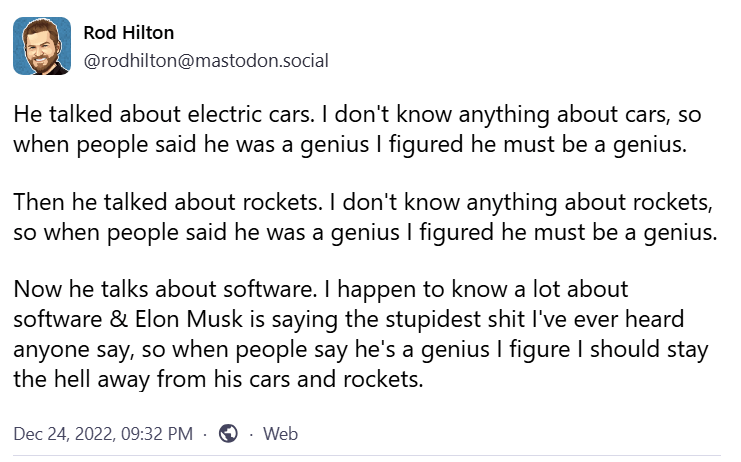
If you can’t see that, it says:
He talked about electric cars. I don’t know anything about cars, so when people said he was a genius I figured he must be a genius.
Then he talked about rockets. I don’t know anything about rockets, so when people said he was a genius I figured he must be a genius.
Now he talks about software. I happen to know a lot about software & Elon Musk is saying the stupidest shit I’ve ever heard anyone say, so when people say he’s a genius I figure I should stay the hell away from his cars and rockets.
I get the feeling that a lot of government workers who previously thought he was a genius may also now choose to stay away from Musk’s cars and rockets. As they should.
Filed Under: doge, elon musk, firings, gsa, inefficiency, irs, waste


No comments:
Post a Comment