TRADE, POWER, SECURITY >> “We’re in a New World”: ECB Chief’s Stark Warning to Europe #TradeWar #ChristineLagarde #ECB
INTRO: In a speech to a top-level banking
conference in Helsinki, European Central Bank (ECB) head Christine Lagarde said the impact of Trump’s
trade war on eurozone economies had also been eased because of a
stronger euro and the trade deal the EU negotiated with Trump that
capped tariffs at 15%. This, she maintained, had helped remove
uncertainties threatening business investment. . .
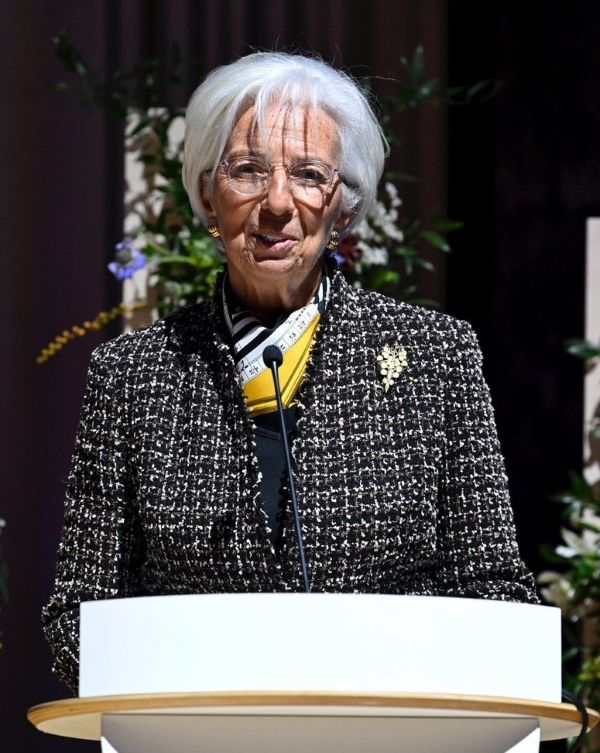
In Helsinki, European Central Bank President Christine Lagarde delivered a striking and reflective speech on September 30, 2025, at the Bank of Finland’s 4th International Monetary Policy Conference, warning that Europe has entered “a new geoeconomic era” where trade, power, and security are inseparably linked.
Speaking to an audience of policymakers and economists, Lagarde declared that “economics can no longer be separated from geopolitics,” drawing parallels between Europe’s current challenges and Finland’s historic dependence on trade with the Soviet Union.
She said Europe now faces its own reckoning amid “the highest tariffs since the 1930s,” imposed by the United States — its largest trading partner.
Lagarde reviewed how U.S. tariffs rising from 1.5% to 13% were initially feared to cause a major shock to the eurozone. Yet, she noted, the impact has been far milder than expected.
Contrary to forecasts, there was no major EU retaliation, the euro appreciated 12–13% against the dollar, and inflation remained contained.
“Trade shocks are not creating new inflationary pressure,” Lagarde said, emphasizing that the euro area remains “in a good place” after cutting rates by 100 basis points since December.
However, she warned that Europe cannot be complacent.
“We live in a world of geoeconomic turbulence,” she said, describing tariffs as tools of power rather than simple protectionism.
Lagarde urged European governments to complete long-delayed reforms — from the capital markets union to digital infrastructure — to safeguard competitiveness and strengthen resilience.
She noted that government rearmament and investment are now offsetting about one-third of the trade shock, while new trade deals with Mercosur, Mexico, and negotiations with India, Indonesia, and the Philippines are expanding Europe’s global reach.
But she cautioned that Europe’s internal market “is far more important than the global market,” arguing that just a 2% rise in intra-EU trade could offset losses from reduced U.S. exports.
Lagarde called for agility and humility in policymaking:
“We cannot pre-commit to any future rate path. We must remain ready to respond to data as it comes.”
Quoting Finland’s cultural concept of Sisu — courage and perseverance — she ended on a message of determination:
“We’re in a good place today, but that place is not fixed forever.
Our task is to sustain it with agility, humility, and a firm grounding in the data.”
In a spirited Q&A, Lagarde acknowledged Europe’s slow pace of reform, admitting frustration that only about 10–11% of Mario Draghi’s recommended reforms have been enacted.
“Change is happening faster than our institutions,” she said, urging leaders to “accelerate” progress to ensure Europe “is not left in the dust.”
Trump’s policies have been
accompanied by a fall in the dollar and a strengthening of the euro,
which makes Europe’s imports cheaper and helps the ECB in its efforts to
contain the annual rate of inflation, which in August was a moderate
2%.
Growth, however, remains mediocre,
coming in at only 1.1% in the second quarter, which is above the rate
of the previous quarter.
Tariffs and associated uncertainty are expected
to reduce performance by approximately 0.7% through 2025 and 2027. . .
--- (This article used information from the Associated Press)
DAY-TO-DAY COUNTDOWN
A year ago, most would have assumed
that U.S. tariffs “would trigger a major adverse shock to the euro area
economy,” Lagarde declared, yet she noted that “some of these
assumptions have not been borne out.” There had been little impact on
inflation while the impact on growth had been “relatively moderate”,
positives she attributed to European governments opting for pro-growth
measures in response to Washington’s moves.








No comments:
Post a Comment