

The Collapse of US-PRC Negotiations?
On Thursday Beijing time, the PRC unveiled an expansive plan to strangle portions of the U.S. economy using extraterritorial authority to exert control through rare earth elements over parts and products that include as little as 0.1% Chinese content.
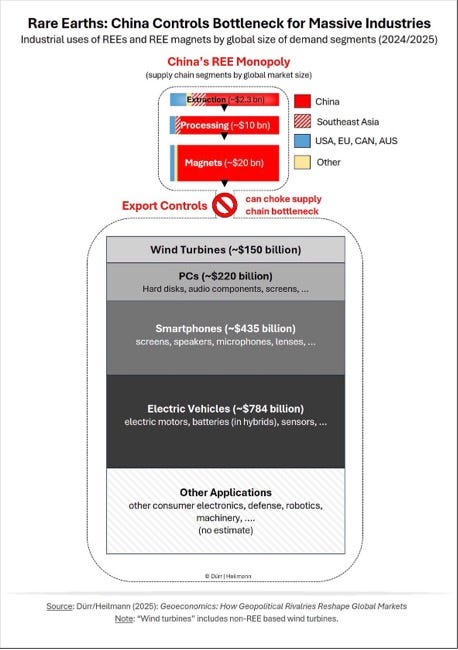
We have all gotten a bit desensitized to tariffs, export controls and embargos, but this announcement by Beijing is quite expansive.
In essence, Beijing unveiled new export controls that demand companies seek Chinese government approval to export products, including magnets, containing 0.1% or more of an expanded list of rare earths including holmium, erbium, thulium, europium, ytterbium.
These export restrictions apply to products that contain just trace amounts of PRC-sourced minerals or made with PRC equipment. Most obviously this targets essentially all 14 nanometer and below semiconductors, advanced memory chips, semiconductor manufacturing or testing equipment… all of which contain at least 0.1% rare earths processed in the PRC. For the first time, the PRC is employing its foreign direct product rule (clearly built to model the U.S. Commerce’s Department’s foreign direct product rules under the Export Administration Regulations (EAR)). This will grant the PRC the ability to impose secondary sanctions on third countries and companies that don’t comply with the spirit of Beijing’s coercion.
It also appears clear that the PRC has established a licensing regime that will demand proprietary data from companies around the world which will enable the PRC to further refine these controls and restrictions for maximum leverage and coercive power… something I and others have been advocating the U.S. and allied countries do for years, but has been met largely with bureaucratic shrugs.
The licensing process will undoubtably be opaque and arbitrary, requiring companies to surrender IP and other valuable data to even have the license considered.
The one thing that the PRC Commerce Ministry has been clear on is that it has already signaled that it will reject export licenses connected to materials for military applications or used by companies associated with the defense industrial base. This was entirely predictable, but unfortunately far too many defense companies have been lackadaisical in their efforts to build alternative supply chains for critical components which Beijing has a monopoly over (side-eye at you RTX, aka Raytheon)… and years of U.S. Government inaction, continuing resolutions and a broken congressional budgeting process has only made things worse.
These new restrictions on rare earth elements and lithium batteries are scheduled to begin on November 8 (about a week after Xi-Trump were scheduled to meet in South Korea) with the extraterritorial rules coming into effect on December 1.
Some restrictions went into effect immediately, for example the prohibition on Chinese entities and individuals from facilitating the export of the restricted items, including barring individuals from participating in unauthorized mining overseas.
I suspect that the PRC has been building this set of tools for weeks, if not months, waiting for the right opportunity to employ it for maximum effect on the United States.
The combination of the Government Shutdown and President Trump’s apparent desperation for a deal, likely persuaded Beijing that the time was ripe to employ this significant escalation.
Folks have started to dig into the specifics of Beijing’s announcement and discovered even wider implication… here is Bill Bishop’s observation on Thursday:
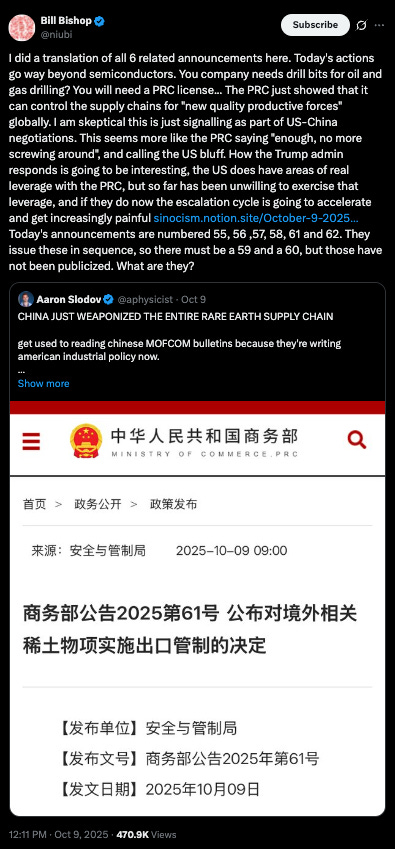
Drill bits for the oil and gas industry… yikes!
Needless to say, this was received poorly by President Trump who on Friday at 10:57am Eastern posted this on his social media platform, Truth Social:
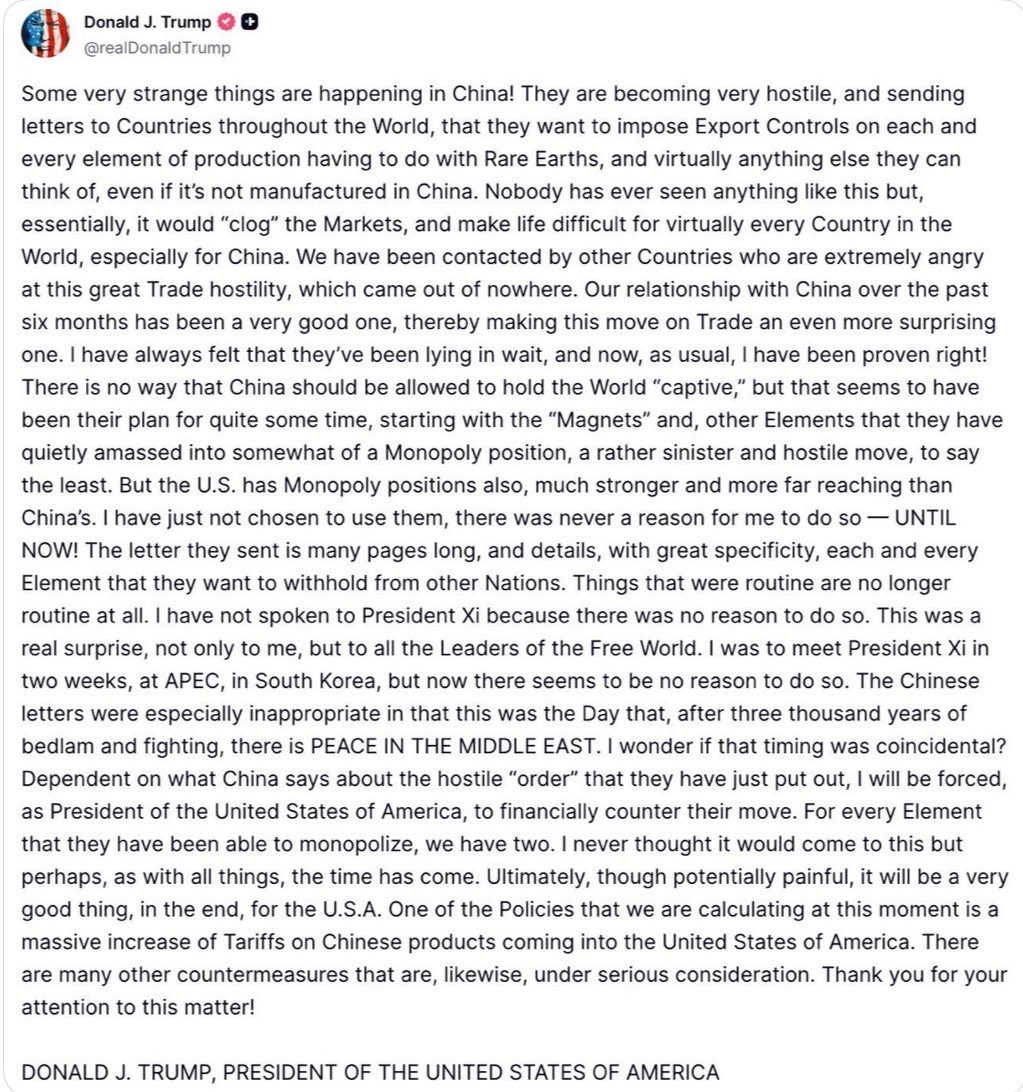
That is a long post.
According to this, it seems like Trump canceled his meeting with Xi at APEC later this month in South Korea, quote: “I was to meet President Xi in two weeks, at APEC, in South Korea, but now there seems to be no reason to do so.” (later, Trump seemed to reverse himself and suggest that he would meet with Xi, but it is unclear if that will happen).
Needless to say, U.S. equity markets were not amused by this post on Friday morning, with the S&P 500 dropping nearly 200 points over the next five hours of trading.
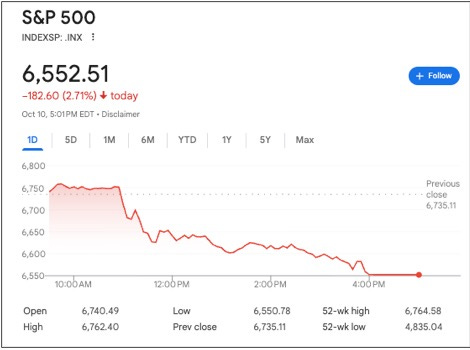
The market losses weren’t as serious as the April 2 announcement of Global Reciprocal Tariffs which saw a 700-point drop in the S&P 500 over the course of a week, but we will see what happens on Monday morning when U.S. markets reopen (so far they seem to be recovering).
Then at 4:50pm on Friday, October 10th, Trump posted again:
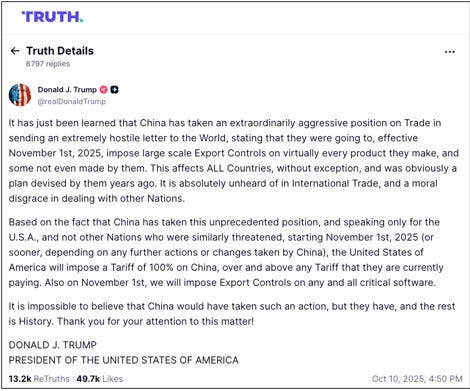
Wow, that looks serious… imposing 100% tariffs “over and above any Tariff that they are currently paying.”
Also export controls on “any and all critical software.”
However, by 12:43pm on Sunday, October 12, Trump posted this, which has of course generated a new series of TACO trade memes:
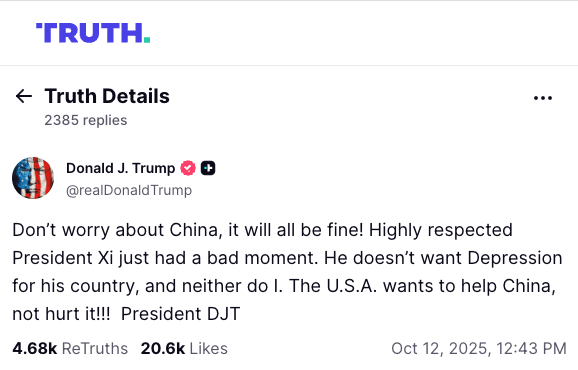
Sooo… I guess everything is fine now.

Weaponizing Global Supply Chains
I hope this will finally settle the debate over whether the PRC will seek to weaponize industries that it dominates (think EVs, telecom equipment, green energy technology, etc.)… unfortunately, I suspect folks will still assert that Beijing has no interest in doing so.
A colleague reminded me of an article from The China Project four years ago, titled “The Rare Earth Myth.” The subtitle was:
China dominates the mining and refinement of rare earths, which are needed for almost all of the electronic devices that power our 21st-century lives. But contrary to popular perception, China neither can nor wants to weaponize the global supply.
Well that aged poorly…
The China Project is now defunct, but back in 2021 it was Kaiser Kuo’s labor of love that sought to make Communist China cool and hip for Americans.
In an effort to be cool and hip, Kaiser got Max Baucus, the former Montana Senator and Obama’s second Ambassador to China, to give his media outlet the plug of “a jewel in the crown of China reporting. I look to it daily... It adds so much insight into the real China.”
No one screams cool and hip quite like Max Baucus.
In this 2021 article by Chang Che, one of The China Project’s business and technology staff writers, he asserts:
“After the U.S. weaponized its technologies during the apogee of the trade war, there was no “tit-for-tat,” despite much speculation that China could retaliate with its rare earths. The reason, quite simply, is because China is not the United States. If there is one lesson the rare earths issue imparts, it is that under the shadow of a rising other, a paranoid power can conjure its own demons.”
Well apparently, Xi Jinping does not read The China Project, nor listen to its staff writers because obviously China is more than capable of weaponizing what it dominates and has no compunction about doing so (despite Chang Che’s moralizing about the supposed superiority of China… I can almost hear the mantra about China’s Peaceful Rise and how China never interferes in the internal affairs of other countries).
This should not have come as surprise to Chang Che, or his editors at The China Project like Kaiser Kuo, because a decade before he wrote his article about how the PRC wouldn’t weaponize rare earths, the PRC had weaponized rare earth elements in a geopolitical dispute with Japan over the Senkaku Islands.
What’s amazing is that a good chunk of the article acknowledged that the PRC weaponized rare earths in its dispute with Japan… but instead of recognizing that this precedent signaled that the PRC might do it again, Chang Che came to the opposite conclusion that the embargo of rare earths meant the PRC would NOT do it again and interpreted that the entire episode “triggered insecurities in the West, both real and imagined.”
![Shipping Cost from China to the USA [Updated October 2025] - Basenton](https://www.basenton.com/wp-content/uploads/2024/06/Shipping-from-China-to-USA.jpg)


No comments:
Post a Comment