Wednesday, November 05, 2025

How the shutdown threatens food aid across the U.S.


The threatened, on-again-off-again, now partial lapse in SNAP benefits has made the public aware of a disturbing statistic: that 42 million of our neighbors rely on government assistance to feed their families.¹ That’s nearly 12 percent of households and, more shockingly, one in five children.²


Where any SNAP lapse will bite hardest

How the shutdown threatens food aid across the U.S.


How many Americans are potentially at risk of losing some of their Supplemental Nutrition Assistance Program (SNAP) payments because of the seemingly interminable federal government shutdown? . . .

Sadly, we at EIG were all too aware of these facts because of our prior work on transfers, which chronicled the dramatic rise in income and support that Americans have derived from federal programs over the past several decades. 

  • Here we zoom in on SNAP payments specifically to better understand how they are distributed throughout the country and the communities that most rely on them.

Who receives SNAP and where do they live?

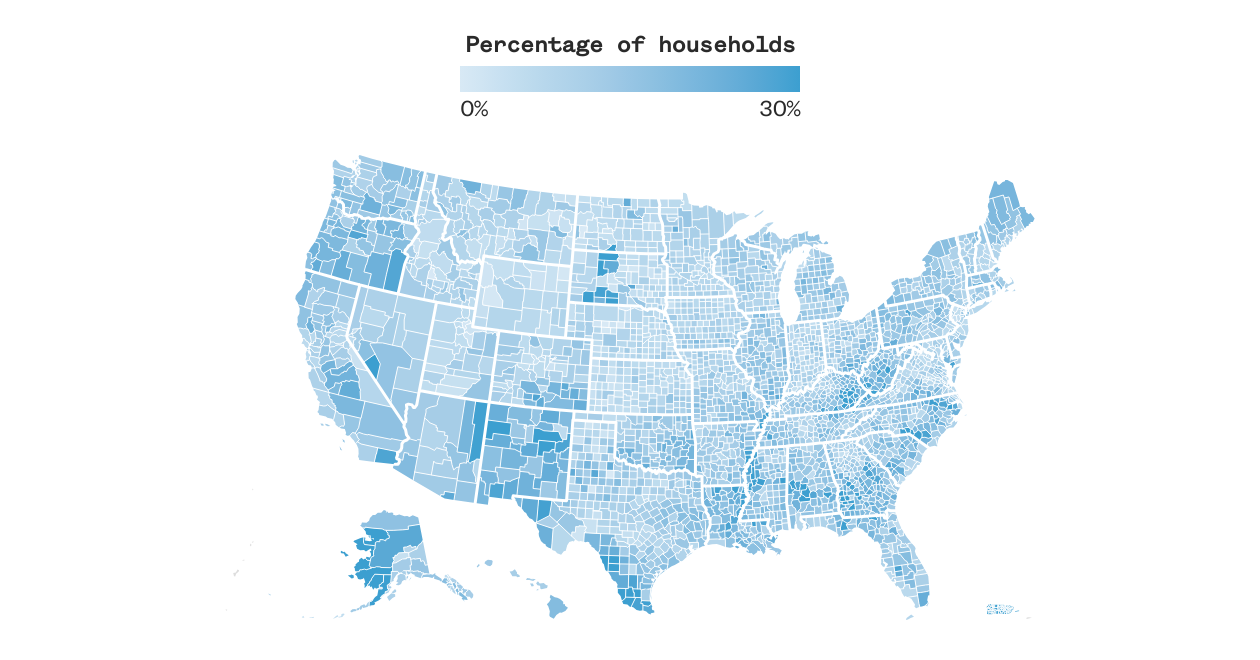
The share of households that rely on SNAP to fill the pantry each month varies significantly from place to place.

  • On the high end, 30 percent or more of households depend on SNAP in some of the country’s most distressed corners. These 138 counties are nearly fully rural, and have some of the highest poverty rates in the nation.

  • But even on the low end, in the most well-off communities, around one in 20 households receive SNAP each month.

  • Generally, SNAP usage runs higher in rural parts of the West and South, and highest of all in struggling tribal areas.


Voting patterns and SNAP

SNAP has become such a salient issue for both parties during the shutdown because it affects them both:

  • 48.5 percent of households receiving SNAP benefits live in counties that voted for Trump in the 2024 election and 51.5 percent live in those that voted for Harris.

  • Among counties that voted for Harris, 11.9 percent of households received SNAP benefits, and 11.6 percent of households living in counties that went for Trump did.

But a striking political difference does emerge when looking at the counties that rely on SNAP the most:

  • Among counties that received more than 1.0 percent of total income from SNAP, 82.2 percent voted for Trump and 17.8 percent voted for Harris.

Extreme economic exposure

To really understand the economic impact of a lapse in SNAP benefits, it’s helpful to look at the share of total personal income that the program represents for households.³

  • Nationwide, SNAP accounts for 0.6 percent of total personal income annually, but for some counties, it accounts for significantly more. (See the next two figures below.)

  • Since SNAP benefits are nearly always spent on local consumption, and quickly, any lapse would directly drain local economies of income. In places of high reliance, the suspension of even this modest overall income stream could meaningfully dent the local economy.

  • SNAP exceeds 1.0 percent of total personal income in 26.6 percent of counties — home to 56.8 million people. In these counties, 19.5 percent of households receive SNAP benefits, relative to 12.1 percent across all counties.


  • The 15 counties most reliant on SNAP benefits to top up local area personal income are economically distressed rural communities. Many are home to large Native American populations, and others such as Alexander, IL (at the confluence of the Mississippi and Ohio Rivers), or McDowell, WV (deep in coal country), are among the highest poverty counties nationwide.


What’s next?

SNAP payments were scheduled to end on November 1st amid the continuing government shutdown. However, last week two federal judges ordered the Trump administration to use emergency funds to continue payments until Congress passes a funding bill. According to Treasury Secretary Bessent, the administration does not plan to appeal the ruling. And just today, the Administration announced that it will resume paying partial SNAP benefits (roughly 50 percent) in the coming days but expects delays as states resume and adjust disbursements.

Meanwhile, the shutdown and ongoing threat to SNAP payments have underscored the increasing risk in Congress’ lurching, short-termist approach to public finance. As dependence on transfers has climbed across the United States, the human stakes of political brinksmanship have climbed with it.

View the Github with code for replicating this analysis here.

3

Note that detailed county level income by transfer program data are only available through 2022 from the Bureau of Economic Analysis, and nationwide county level household SNAP usage figures are available through 2023 from the U.S. Census Bureau.

 RELATED

As millions of Americans prepare to lose SNAP benefits, some states are  moving to bridge the gap


No comments: