The Markets in Crypto-Assets (MiCA) regulation is the European Union’s groundbreaking, single legal framework designed to govern the digital asset sector across all 27 EU member states. [1]
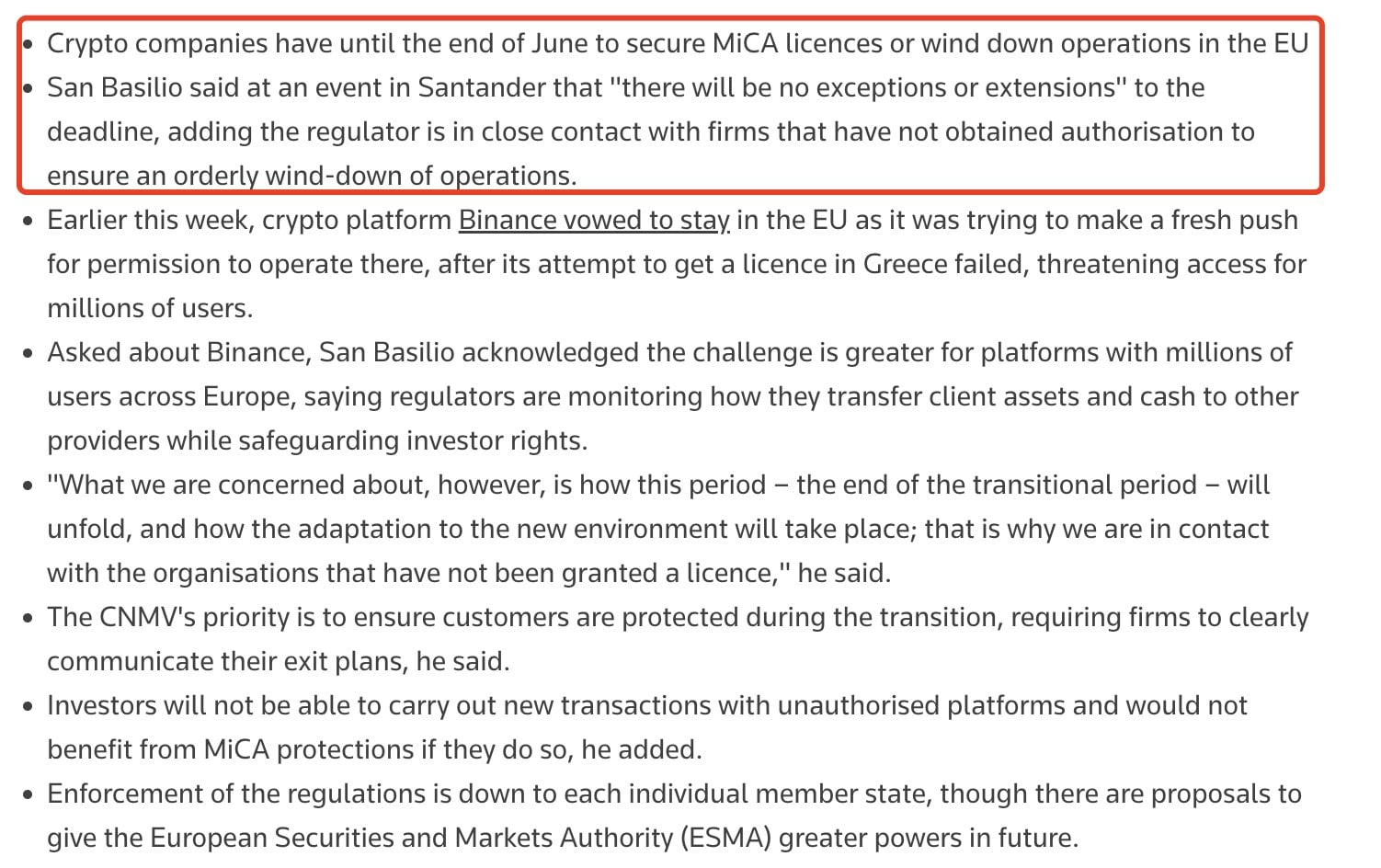
- The Rule: Any Crypto-Asset Service Provider (CASP) or exchange operating without an authorized MiCA license by this date is in breach of EU law and must immediately cease operations or face heavy fines. [1, 2]
- The Reality: Only about 17% of legacy crypto firms converted to full MiCA licenses ahead of the deadline. Platforms like Binance recently experienced massive net outflows after withdrawing local license applications (e.g., in Greece) and restricting service. [1, 2, 3]
- The Shift: Fully compliant exchanges like Kraken (licensed via Ireland) and Coinbase are aggressively capturing users fleeing non-compliant platforms. [1, 2]


World’s largest crypto exchange stopping EU operations
Published 27 Jun, 2026 12:57 | Updated 27 Jun, 2026 14:00

Binance has announced plans to temporarily suspend services to its customers in the European Union starting next week. The crypto exchange, which is the world’s largest by trading volume, has so far failed to secure authorization under the bloc’s new licensing regime.
All crypto-asset service providers are obliged to get a license under the Markets in Crypto-Assets Regulation, known as MiCA, by July 1, or risk penalties. Adopted in 2023 and rolled out in stages from 2024, the legal framework aims to reduce the risks of market abuse and financial crime, protect consumers and investors, strengthen oversight of the sector, and replace fragmented national regulations with a single set of rules.
The move comes after years of regulatory scrutiny of Binance. French authorities are continuing an investigation into the exchange, while co-founder and former Chief Executive Changpeng Zhao pleaded guilty in the United States in 2023 to anti-money-laundering violations and served a four-month prison sentence the following year.
- However, any new application is unlikely to be approved before July 1.
- The exchange will not be able to serve European customers until it receives the necessary license.
The Financial Times reported on Friday that customers in Poland, Italy, Spain, and France, where Binance currently operates under local licenses, had received emails earlier this week explaining how they could withdraw their assets due to the halt of operations.

The company noted it was contacting affected users directly and that their assets remained safe and secure. Binance added it was confident it would obtain a MiCA license in the coming months and would announce the member state through which it planned to operate once the authorization process was complete.

- While the regulation is designed to harmonize crypto regulation across the EU, analysts and industry participants have raised concerns about uneven implementation across member states, reliance on national regulators for licensing decisions, and the risk of market consolidation as smaller firms struggle to meet compliance costs.
- Meanwhile, governments around the world have increasingly moved to regulate the fast-growing crypto sector, although approaches vary widely.

- The Rule: Any Crypto-Asset Service Provider (CASP) or exchange operating without an authorized MiCA license by this date is in breach of EU law and must immediately cease operations or face heavy fines. [1, 2]
- The Reality: Only about 17% of legacy crypto firms converted to full MiCA licenses ahead of the deadline. Platforms like Binance recently experienced massive net outflows after withdrawing local license applications (e.g., in Greece) and restricting service. [1, 2, 3]
- The Shift: Fully compliant exchanges like Kraken (licensed via Ireland) and Coinbase are aggressively capturing users fleeing non-compliant platforms. [1, 2]



No comments:
Post a Comment