A federal judge granted a Maricopa County, Arizona, motion for
sanctions against Republican gubernatorial candidate Kari Lake Thursday,
meaning she will have to pay a fine one week after filing a lawsuit accusing county election officials of violating elections laws.
‘False, Misleading’ Accusations: Federal Judge Sanctions Kari Lake For Challenging Arizona’s Voting Procedures
Ty Roush
11 - 14 minutes
Key Facts
U.S. District Judge John Tuchi said in his decision that Lake made
“false, misleading and unsupported factual assertions” in her initial
lawsuit claiming “unauthorized persons” manipulated voting machines
during Arizona’s gubernatorial election.
Tuchi cites insufficient evidence supporting any of Lake’s claims,
adding the plaintiffs—members of Lake’s election staff in addition to
Lake herself—”have voted on paper ballots, contradicting allegations and
representations” of statements made by Lake.
Steve Bannon—who served as President Donald Trump’s chief
strategist—was not named in the sanctions despite counseling Lake in her
bid to contest election results.
✓ Sanctions must be enough to “deter repetition” of similar
allegations in the future in addition to the payment of Katie Hobbs’
attorney fees, but it is not yet clear how much Lake will have to pay.
Crucial Quote
“Imposing sanctions in this case is not to ignore the importance of
putting in place procedures to ensure that our elections are secure and
reliable,” Tuchi said. “It is to make clear that the court will not
condone litigants ignoring the steps that Arizona has already taken
toward this end and furthering false narratives that baselessly
undermine public trust at a time of increasing disinformation about, and
distrust in, the democratic process.”
What To Watch For
Cochise County, Arizona, the lone county
in the U.S. refusing to certify midterm election results, was ordered
by a judge Thursday to have its Board of Supervisors canvass the
election, according to ABC.
Key Background
Lake has remained adamant in her refusal to concede to Katie Hobbs,
who won Arizona’s gubernatorial election by 0.6% of the vote, according
to the Associated Press.
✓ Trump joined in on Lake’s unfounded claims on
Truth Social alleging
ballot tabulator issues skewed results in Hobb’s favor and accused
election officials of running a “criminal voting operation.” State
Attorney General Mark Brnovich has since called on the county to produce a report on its voting machines after his office received complaints about the election process."
The lesson from this event further supports advice Ars gave on Tuesday
concerning Mastodon, another social media site that has also seen
skyrocketing user numbers in the aftermath of the Twitter takeover by
Musk.
Put nothing on the site that you wouldn’t mind being public.
Confidential information should never be put in direct messages or any
other place. Here’s hoping Hive Social users already knew that.
Hive Social turns off servers after researchers warn hackers can access all data
by
Dan Goodin
- Dec 1, 2022 8:20 pm UTC
3 - 4 minutes
Site officials say site will be down for a couple of days.
Hive Social
"Hive Social, a social media platform that has seen meteoric growth
since Elon Musk took over Twitter, abruptly shut down its service on
Wednesday after a security advisory warned the site was riddled with
vulnerabilities that exposed all data stored in user accounts.
“The issues we reported allow any attacker to access all data,
including private posts, private messages, shared media and even
deleted direct messages,” the advisory, published on Wednesday by
Berlin-based security collective Zerforschung, claimed. “This also
includes private email addresses and phone numbers entered during
login.”
The post went on to say that after the researchers privately reported
the vulnerabilities last Saturday, many of the flaws they reported
remained unpatched. They headlined their post “Warning: do not use Hive
Social.”
Hive Social responded by pulling down its entire service.
“The Hive team has become aware of security issues that affect the
stability of our application and the safety of our users,” company
officials wrote.
“Fixing these issues will require temporarily turning off our servers
for a couple of days while we fix this for a better and safer
experience.”
The Zerforschung post said the vulnerabilities were so serious that
they were withholding technical details to prevent the active
exploitation of them by malicious hackers.
The series of events raised questions about why Hive Social waited
some 72 hours to shut down its site after receiving notification users’
most private data was free for the taking. Zerforschung said that after
multiple communications, Hive Social claimed to have fixed all issues
when that was clearly not the case. The social media site said it never claimed the vulnerabilities were fixed.
Hive Social’s user base reportedly doubled in the last few weeks, going from about 1 million to 2 million as of last week, according to
Business Insider. Despite the massive growth, the social media site
continued to be staffed by just two people, neither of whom had much of a
background in security.
Representatives of both Hive Social and Zerforschung didn’t respond to questions sent by email.
While there are no reports that the vulnerabilities were actively
exploited, there’s no way at the moment to rule that out. Anyone with a
Hive Social account should be prepared for the possibility that the data
they provided during sign-up, as well as private messages, whether
deleted or not, have been obtained. . ." READ MORE
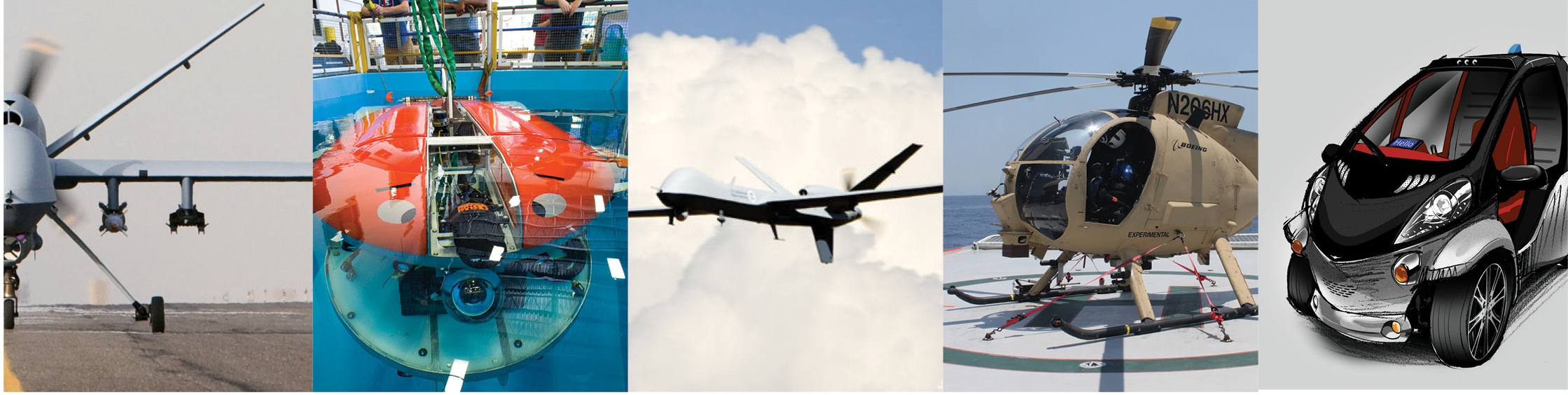
Essential UAS industry coverage with global reach and influence.
Inside Unmanned Systems provides
actionable business intelligence to decision-makers and influencers
operating within the dynamic global UAS / UAV / drone community. News
and analysis of key technologies, independent reports on the latest
policy and regulatory developments, and actionable evaluation of new
product designs and applications support the results stakeholders need
to succeed across the commercial, civil and defense sectors.
Audience Profile: IUS serves an international
readership of 20,000 unmanned system engineers, system integrators,
product designers and unmanned program and policy leaders.
Application Segments Covered:Military,
Homeland Security, Precision Agriculture, Survey, GIS/Mapping,
Driverless Vehicles, Film Industry, Remote Sensing, Delivery Services,
Search and Rescue, Mining, Oil And Gas, Arctic Research, Deep Ocean
Studies
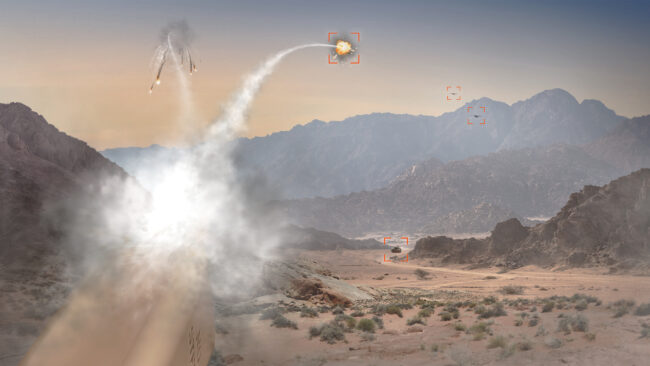
> During the demonstration in Southern Arizona, five APKWS-guided
counter-UAS rockets were fired from a containerized weapon system and
destroyed all targets, including fast-moving drones. . .The resulting precision munition is a low-cost, supersonic,
lock-on-after-launch strike weapon with a large 10-pound warhead that
can destroy large drones in a matter of seconds with or without direct
contact.
BAE Systems Demonstrates Effectiveness of Rockets Against Agile, High-Speed Military Drones
Inside Unmanned Systems
3 minutes
An illustration of a precision-guided rocket taking out a Class 2 drone. Credit: BAE Systems
"HUDSON, N.H.—BAE Systems said it completed additional ground-to-air
test firings to prove the effectiveness of 70mm rockets guided by APKWS
kits—the Advanced Precision Kill Weapon System—against speedy Class 2
unmanned aircraft that weigh 25 to 50 pounds and can fly up to 100 miles
per hour.
During the demonstration in Southern Arizona, five APKWS-guided
counter-UAS rockets were fired from a containerized weapon system and
destroyed all targets, including fast-moving drones. The test results
further demonstrate APKWS guidance kits’ ability to enable low-cost,
precision strikes against airborne threats.
“Militarized drones are becoming more prevalent in conflicts around
the world, and we’re giving our customers an efficient way to counter
them without wasting expensive missiles,” said Greg Procopio, director
of Precision Guidance and Sensing Solutions at BAE Systems. “Our tests
demonstrate that APKWS guidance kits have the flexibility to engage a
variety of targets to meet the evolving mission needs of the
warfighter.”
The 70mm rockets can destroy Class-2 aerial drones by combining
standard motors and warheads with APKWS guidance kits and proven
proximity/point-detonation fuzes. The resulting precision munition is a
low-cost, supersonic, lock-on-after-launch strike weapon with a large
10-pound warhead that can destroy large drones in a matter of seconds
with or without direct contact.
BAE Systems had previously tested APKWS kit-equipped rockets against Class 2 drones in October 2021.
Combat-proven APKWS-guided rockets can be fired by many different
platforms, including jets, helicopters, trucks, boats, and weapon
stations, and stowed APKWS guidance kits protect seeker optics from
adjacent rocket fire, unlike nose-mounted seeker optics. APKWS guidance
kits are the only U.S. government program of record for 70mm
laser-guided rockets. The kits are available to all U.S. armed forces,
as well as U.S. allies via Foreign Military Sales."
APKWS guidance kits are produced at BAE Systems manufacturing facilities in Hudson, New Hampshire and Austin, Texas.
UAvionix Awarded FAA Contract to Demo C-Band Frequency Assignment Manager for Multiple UAS
Inside Unmanned Systems
3 - 4 minutes
"uAvionx announced Nov. 30 it has won a contract from the Federal
Aviation Administration for multiple end-to-end demonstrations of a
Frequency Assignment Manager (FAM) as a component of the uAvionix
SkyLine Command and Control Communications Service Provider management
platform.
This large-scale demonstration will enable a Frequency Management
Organization operating the SkyLine platform to dynamically assign
available frequencies within the internationally recognized UAS C-Band
Command and Non-Payload Control range of 5030-5091MHz to uncrewed
aircraft systems operating with CNPC radios.
For this purpose, uAvionix will leverage mature technology already
being used in UAS flight missions today, including the SkyLine C2CSP
platform and the uAvionix SkyLink CNPC radios. UAvionix teamed with
the Northern Plains UAS Test Site, which is is very familiar with the
concept of centralized C2 Service Provision through the uAvionix plays
in the North Dakota Vantis UAS network. The demonstrations are intended to demonstrate:
• The ability of SkyLine C2CSP platform to manage a pool of allocated (and licensed) frequencies in a geographic area. •
The ability of SkyLine C2CSP platform to allocate available frequencies
(frequencies which are both allocated and not in use) to a specific
CNPC radio for a specific mission. • The ability of the SkyLink CNPC radios to receive assigned frequencies for the designated mission. • The ability of the SkyLink CNPC radios to operate on the assigned frequencies for the designated mission. •
The ability of the SkyLine C2CSP platform to monitor and perform C2CSP
functionality to the SkyLink CNPC radios during the designated mission. •
The ability to demonstrate non-interference when multiple aircraft
using uniquely assigned frequencies are operating within proximity.
The goal of this contract is to demonstrate and verify real-world
operations of dynamically allocated FAA protected spectrum for UAS
operations. In doing so, uAvionix builds upon the work of the ITU, ICAO,
RTCA, FAA, and FCC in the allocation and establishment of service rules
for UAS CNPC protected frequencies, bringing beyond visual line of
sight operations closer to daily reality. The contracted solution is
intended to ultimately manage a limited amount of protected spectrum on
behalf of many operators in the same area at once, through use of
specialized radios on each drone and on the ground to dynamically manage
frequency assignments when they are needed, and just for the duration
of each flight."
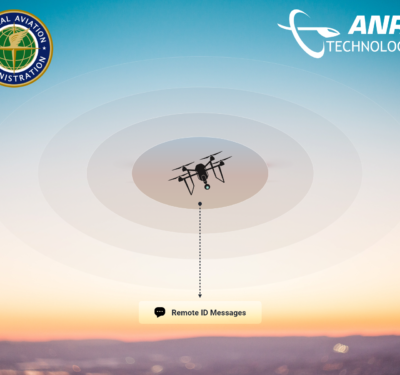
ANRA Technologies said it has won a Federal Aviation
Administration contract to demonstrate the ability to collect, aggregate
and retransmit Broadcast Remote ID (B-RID) messages.
Both sides get better at killing drones – and need them more than ever
A
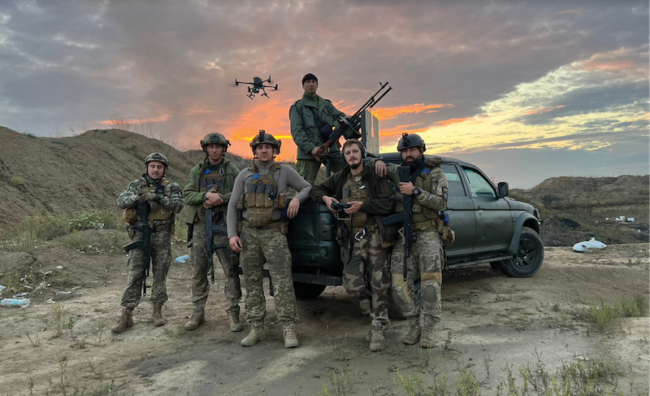
mobile drone team from Ukraine’s 72nd Mechanized Brigade, with its DJI
Matrice 300 improvised “bomber” and a “technical” truck. Photo courtesy of Ukrainian military.
After a summer of grinding attrition warfare, Russia’s invasion of
Ukraine entered a dramatic new phase this fall: In a stunning battle of
maneuver, a Ukrainian counteroffensive routed Russian forces in Kharkiv
province, and then northern Kherson province. Kyiv’s battlefield
fortunes have so improved that many analysts believe the forthcoming
infusion of poorly-trained Russian conscripts can only delay eventual
defeat.
Nevertheless, Putin has doubled down on his calamitous war by
announcing a partial mobilization aimed at conscripting 300,000 (and
possibly many more) troops for Russia’s increasingly depleted military.
He also has ordered missile, manned bomber and drone attacks on major
Ukrainian cities and infrastructure.
Unmanned aerial vehicles large and small continue to play a dominant
role in this terrible conflict. Missile-armed unmanned combat air
vehicles (UCAVs) and loitering munitions have shown their value. Russia
has been running low on conventional stand-off range missiles it can
only build in single digits monthly, prompting it to purchase hundreds
of “kamikaze drones” from Iran and fly them into action; Starting in
September, at least 200 have carried out attacks on Kviv, Odessa and
beyond. Also disruptive has been the adaptation of cheap, commercial
off-the shelf (COTS) drones by both sides to execute surprisingly
effective tactical-range strikes and, even more lethally, to acquire
targets for artillery fire of unprecedented precision and speed.
This has resulted in an indirect-fire-centric battlefield, in which
even main battle tanks are more likely to be knocked out by
drone-assisted howitzers than by anti-tank missiles, air strikes and
enemy tanks.
Events are unfolding rapidly on the UAS front. In mid-October,
Ukrainian President Volodymir Zelensky claimed Russia plans to order
2,400 more loitering munitions, indicating a desire to sustain a
campaign of strategic attacks on Ukrainian cities and civilian
infrastructure—even as both sides have become much more effective at
destroying them.
ELECTRONIC WARFARE VS. DRONES
While counter-drone air defense underperformed in the war’s first
weeks, by late spring both sides’ UAVs began to suffer heavy attrition. A
study published in July by Jack Watling and Nick Reynolds of the UK’s
RUSI think tank found that a Ukrainian drone averaged just 7 days of
combat activity before being lost.
That attrition imposed difficult choices for Ukrainian commanders. As
the study states: “…many Ukrainian units are forced to choose between
having a live feed from their UAVs and thereby risking a high likelihood
of losing the platform or sending UAVs out on pre-set flight plans and
analyzing the images they take on their return to a pre-set location.”
Of course, fully automated flight plans assisted by inertial
navigation systems (INS) to compensate for Russian GPS-jamming allow
UAVs to operate independently of a command signal—but without the
benefit of situational reactivity. Overall, the resulting intel is less
useful, particularly for mobile targets, and processing hours of
recorded footage is time consuming.
Thus, Ukrainian command center operations have become dependent on
windows of opportunity where/when Russian electronic warfare (EW) is
weak. Reliance on the Starlink satellite network, so far impervious to
Russian jamming, has enabled Ukraine units to reliably relay targeting
data to friendly forces.
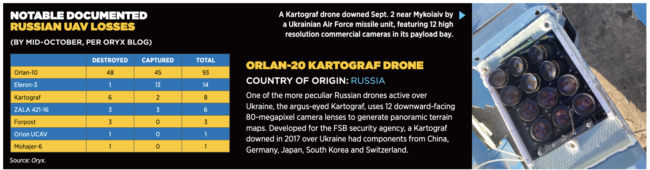
The Oryx blog found images confirming destruction of at least 14
Bayraktar TB2 combat drones, and the loss or capture of eight
Ukrainian-built A1-SM Fury and three Leleka-100 ISR drones by early
September.
Russian tracked R-330Zh Zhitel and phone-tower mounted Pole-21
systems provide near-constant, generalized area jamming affecting drones
and GPS. More targeted EW attacks against Ukrainian drones are executed
by a variety of tactical jammers, from the Repellant-1 truck (allegedly
only effective within 1.6 miles) to space-age counter-UAS guns.
But according to the RUSI study, Russia’s most important tactical
counter-UAS system is the truck-mounted Shipovnik-Aero tactical jammer,
which can engage two drones simultaneously and also suppress local
communications networks. When an Aero detects a drone, it takes about 25
seconds to classify the type, then employs an appropriate transmitter
to disrupt its command frequency along a 3-degree azimuth. Sometimes, it
can even redefine the drone’s “home base” to a point under Russian
control, enabling capture of the UAV.
Russia first deployed Shipovnik-Aero in Ukraine in 2016. By the
summer of 2022, according to Watling and Reynolds, “their presence has
become widespread, limiting the airspace that Ukrainian UAVs are able to
penetrate and monitor,” though its 40-minute deployment time offers an
Achilles’ heel.
On the Russian side, photos show loss of well over 100 mostly
reconnaissance drones. Actual total losses for both sides surely number
in the hundreds, particularly factoring in smaller copter-style UAVs.
A high ratio of captured drones reveals Russian units too are feeling
the sting of electronic warfare, with some operators concluding it was
safer to simply hover drones above friendly positions to avoid losses.
One video released by a Russian military journalist shows a drone team
helplessly looking through a video feed as Ukrainian forces hijack its
drone. Their position compromised, they hastily decamp to avoid attack.
What can operators do to curb the counter-drone war? Samuel Bendett,
an expert on AI and unmanned systems advising the Russia Studies Program
at the Center for Naval Analyses, wrote to me: “Both sides are now
reworking their drone software to make quadcopters more EW-resistant and
sharing battlefield lessons with other operators, especially on
avoiding the other sides’ defenses.”
However, quantitative solutions may be more practical than
qualitative ones. “In the end, many EW systems cannot be overcome,”
Bendett continued. “The simplest method is to replace lost drones,
especially cheaper quadcopters.”
Of course, UAVs are also responsible for a substantial share of EW
and air defense systems destroyed, using both direct attacks or by
calling in and adjusting indirect fires.
Kinetic air defenses, including costly ground-based air defense
missiles, are also accounting for many drone losses. Though many drones
cost less than the missile fired at them, the potential destruction an
accurate artillery strike called in by a drone could wreak makes it
worth using whatever means at hand.
Still, the importance of fielding more diverse and cost-efficient
counter-drone weapons is clear. Drones have been destroyed by small arms
fire, flak, cannons and jet fighters. Supporters of Ukraine are sending
laser-guided rockets and vehicle-mounted jammers. Soldiers from both
sides are employing counter-UAS guns often obtained outside regular
military procurement channels.
As small UAVs can be difficult to detect compared to manned aircraft,
combat experience from this war arguably makes a case that even-smaller
tactical formations such as infantry companies should integrate
lightweight radars and EO/IR sensors to more reliably detect nearby UAVs
without depending on external air defense attachments.
LOGISTICS AND TRAINING FOR THE FUTURE DRONE FORCE
Despite—or because of—massive attrition, the demand from frontline
troops for more drones is voracious. Russian military bloggers have
fumed at the inadequate numbers of Orlan-10 ISR drones—reportedly often
no more than one per battalion—the loss of which can be crippling.
Russian forces are also heavily reliant on civilian donations due to a
procurement gap pertaining to smaller, shorter-range ISR drones. A list
circulating on Russian social media of suggested gear for newly
conscripted soldiers recommends bringing a drone along with an extra
pair of socks.
The government of Buryatia (a minority region in Russia
disproportionately represented among frontline soldiers) spent $3.4
million of its own funds to provide drones and other equipment to its
soldiers, reflecting popular awareness that the Russian military is
failing to adequately equip them.
Russia’s military is taking steps to procure more UAVs, but also is
suffering a shortage of drone pilots. Between September 1-5, veteran
drone operators assembled at Lake Ilmen, Russia, for the Dronnitsa
conference to share best practices toward the ultimate goal of creating a
professional instructor corps and developing a standardized training
curriculum. Moscow has announced measures to scale up drone production,
as well as to integrate education on using drones into school curricula.
A few days earlier, Ukraine had held its own “hackathon,” gathering
150 operators, engineers and programmers in Kyiv to share exchange ideas
on leveraging Ukraine’s sizeable tech sector to improve effectiveness
of unmanned operations.
These moves show both sides recognize how even small civilian-class
drones have become a key component of military power, and that
governments must standardize training and procurement of capabilities
that heretofore had evolved organically from improvisations in the
field.
A September photo of a Ukrainian quadcopter loaded with a mortar bomb. Photo courtesy of Ukrainian Ministry of Defense.
LOITERING MUNITIONS: THE BIGGER, THE BETTER?
Loitering munitions (or kamikaze drones) have taken on an expanding
role as both Ukraine and Russia turn to them to perform penetrating
strikes—operations both sides consider near-suicidal for manned aircraft
due to ground-based air defense.
Media showing the effective use of smaller loitering munitions early
in the war remains sparse, however. The few videos of Switchblade-300s
given in the hundreds to Ukraine show them picking off individual
soldiers. Russia’s delta-winged ZALA KUB displayed poor accuracy and
lacked the punch to reliably disable a towed howitzer.
But a caution: “Limited video evidence of their use,” Bendett said,
“does not mean that such loitering drones are not used on a larger
scale.”
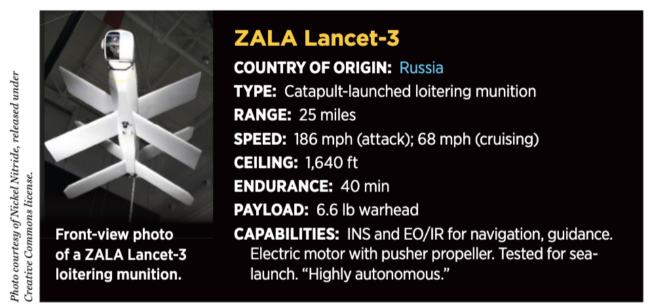
During the summer, Russia began employing the newer, missile-like
ZALA Lancet-3 with a larger warhead to greater apparent affect.
Recordings show Lancet-3s ramming into towed howitzers, on-the-move
self-propelled artillery and vans, entrenchments and even a Bayraktar
radio repeater tower.
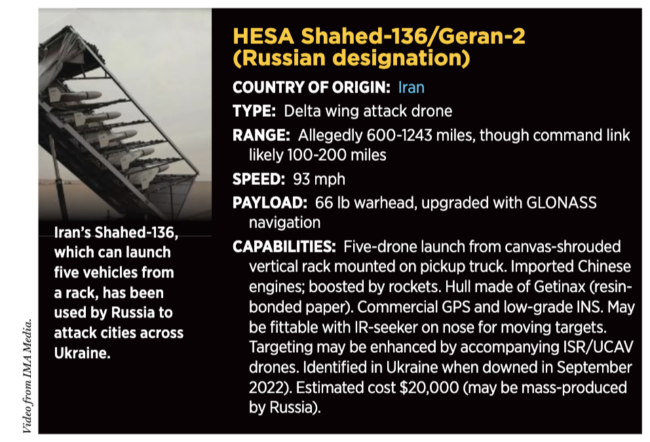
Then, in September, Russia began deploying Iranian-built Shahed-136
munitions (redubbed the Geran-2) to some success according to the
commander of Ukraine’s elite 92nd Brigade, who told the Wall Street
Journal that in just a few days Shahed-136s (see “HESA Shahid” box)
destroyed four self-propelled howitzers and two APCs. Older Shahed-131s
loitering munitions (smaller but otherwise similar to Shahed-136s) were
also apparently transferred.
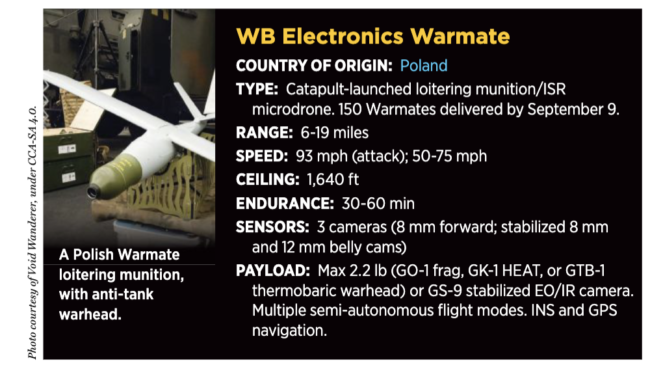
Meanwhile, Ukrainian forces are reportedly satisfied with the Polish
Warmate loitering munition (see “Warmate” box). They’ve received a small
number of Switchblade-600s, which have required time to enter
production. Kyiv has also obtained hundreds of secrecy-shrouded,
backpackable Phoenix Ghost loitering munitions. Ukrainian presidential
adviser Oleksii Arestovysch, in July, ascribed a 60% kill rate to the
“back-packable” munition.
In October, Ukraine debuted the recoverable RAM-II munition derived
from the Leleka-100, recorded destroying an Osa air defense vehicle.
Ukrainians have also employed first-person-view racing drones, and their
specialized user goggles, as loitering munitions capable of attacking
targets inside buildings.
Clearly, militaries should field a tiered mix of loitering munitions
ranging in cost, range and hitting power, with at least one “medium”
option that can be used cost-efficiently for tactical strikes on
artillery and armored vehicles. Such munitions are particularly
intriguing when they can be built at a similar or lower price than, say,
a Javelin missile ($80,000+ not including launcher) or Excalibur
artillery shell ($112,000 per).
RUSSIA’S IRANIAN DRONE ATTACK
Iran deployed its first crude bomb-toting UCAVs in combat in the
1980s. Today, it fields a broad variety of UAVs, UCAVs and
micro-missiles produced by rival manufacturers. Tehran has used these to
project power over the Persian Gulf and Syria, and to arm overseas
allies like Hamas, Hezbollah and Houthi insurgents in Yemen. According
to posts by military aviation historian Tom Cooper, Iran’s drones,
sensor turrets and munitions have developed considerably since 2016,
thanks to technology transfers from China.
As Russia’s UCAV capability via the Orion platform only entered
service in 2021, this July Moscow looked to quickly procure more combat
and ISR drones from Iran, possibly in exchange for Su-35 jet fighters.
The first Iranian drones were delivered mid-August, with Russian
personnel training in Iran to operate the UAVs.
Then, on October 8, an estimated 24 Shahed-129 UCAVs and Shahed-136
kamikaze drones based in Crimea and Belarus were employed on targets
across Ukraine, the drones possibly assisting with missile targeting.
Ukraine’s military claims 12 UAVs were downed by air defenses, including
nine of 12 Shahed-136s.
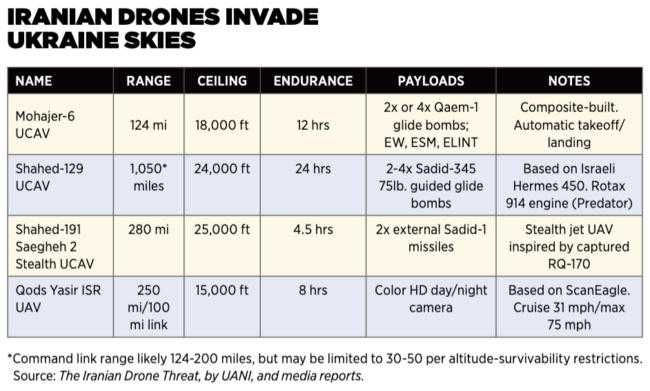
The three runway-using Iranian UCAVs identified as being delivered to
Russia have seen prior combat use and are equipped with the requisite
electro-optical sensor turrets and small guided missiles in laser, IR
and TV-guided variants (see “Iranian Drones Invade Ukraine Skies” box).
However, intelligence sources cited by the Washington Post suggest
Russia has been “not satisfied” with the Iranian UCAV’s for experiencing
“numerous failures,” echoing reports that Mohajer-6s imported by
Ethiopia in 2021 performed poorly. On Sept. 23, Ukraine shot down a
Mohajer-6 UCAV over water, recovering it intact with its Qaem-5 (or
Ghaem) TV-guided glide bomb, sensor turret and Austrian-built Rotax
engine. Furthermore, Russian drone footage seemingly betrays the use of
Iranian Qods-Yasir ISR drones, the “Iranian ScanEagle.” Qods was
test-converted for use as a kamikaze drone, but its operational use in
that capacity is unclear. Russia allegedly plans to buy the larger
Arash-2 loitering munition from Iran.
UCAVS OVER UKRAINE
Both Russia and Ukraine continue to employ UCAVs in combat, the
latter more prominently, with a decisive impact on Ukraine’s siege of
the Russian garrison on Snake Island and penetrating attacks onto
annexed Crimea or Russian soil. These raids have occasionally caused
spectacular damage, appealingly with little loss of life, but weakening
Putin politically.
However, density of air defenses and electronic warfare environment
has prevented unrestricted use of UCAVs, and neither Ukraine’s
Bayraktars nor Russia’s Orion and Forepost-R drones have wreaked the
mass destruction achieved against Armenian and Syrian ground forces in
2020. Both sides’ UCAV fleets are too small to “trade off” against more
numerous air defenses in a battle of attrition. Ukrainian fighter pilots
have evenargued that procurement of more UCAVs is pointless under these
circumstances, though they may have a professional bias.
Nonetheless, both sides can and do accept greater risks with UCAVs
than with their combat aircraft. Furthermore, Ukraine has conducted
standoff strikes on Russian air defenses using HIMARS, Neptune and HARM
missiles to create windows of opportunity to deploy UCAVs in its ongoing
Kherson offensive.
Russia, arguably, could benefit from UCAVs even more; their
combination of long-endurance ISR and strike capability and
expendability compared to manned aircraft would make them an ideal
platform for hunting down and destroying precise western artillery and
GPS-guided rocket systems (HIMARS, MARS) that have been relentlessly
destroying Russian ammunition depots and HQ buildings. In practice,
though, Russia has not provided convincing evidence that its UCAVs have
located and destroyed any HIMARS systems, perhaps due to Ukraine’s
effective use of wooden decoys to absorb Russian attacks.
Over the summer, Russia developed a method to arm Orlan-10 ISR drones
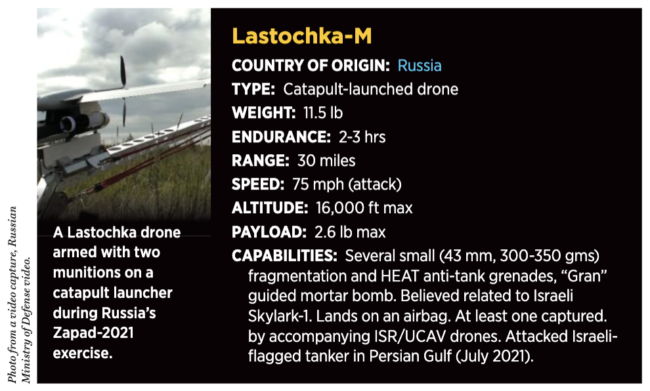
with grenades, and began deploying a new small Lastochka-M attack drone
dropping unguided munitions. By 2023, Russia hopes to ramp up
production of Orion UCAVs, and install satellite links and develop
autonomous air-to-air refueling technology to extend the range of its
drones.
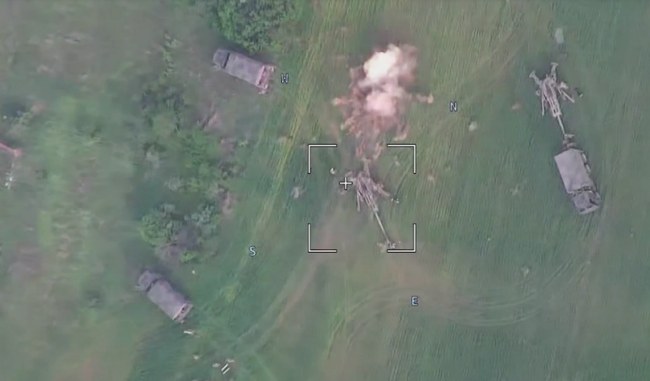
An
attack by a KYB kamikaze drone on May 18 failed to directly hit an M777
howitzer supplied to Ukraine. Any damage was unclear. Photo capture from video released by Russian Ministry of Defense.
✓✓ GREY EAGLE: TOO SENSITIVE FOR UKRAINE
Washington would like to give Ukraine four Hellfire missile-armed
General Atomics MQ-1C Grey Eagles, the U.S. Army’s in-house UCAV, with
greater capability than the Bayraktar. The transfer has been under
review since June, however, because of concerns Ukraine’s military might
be unable to properly support the system, and that Russia might acquire
sensitive technologies from downed MQ-1Cs. General Atomics has proposed
an intense five-week cram course (12 hours a day, no days off) to
rapidly familiarize Ukrainian operators and technicians.
AI is another edge technology that has been used in Ukraine for
collation of battlefield intelligence. But when it comes to unmanned
systems, Rita Konaev, a military AI expert at the Center for Security
and Emerging Technology (CSET), noted in a tweet: “It’s hard to tell
whether these are in fact autonomous or automated, and if they’re even
being used; or are they mostly if not fully remotely operated.”
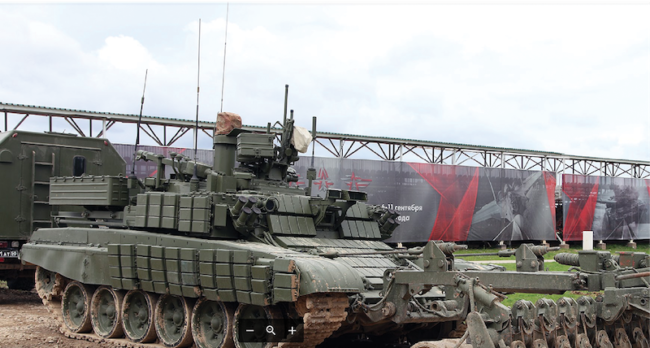
Prokhod-1 de-mining Russian UGV, based on the BMR-3/T-90A tank, at an Army expo. Photo courtesy of Vitaly Kuzmin, CCL 4.0-SA.
WAR OF THE CAMERA DRONES
Despite producing various indigenous fixed-wing drone platforms, both
Ukraine and, increasingly Russia, are heavily dependent on purchase or
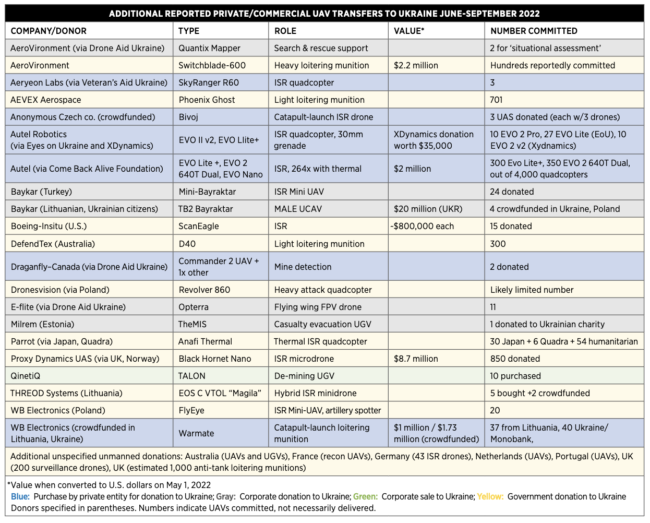
donation of UAVs large and small from overseas—whether through privately
crowdfunded drives, transactional arms sales and, in Ukraine’s case,
free-of-charge government-to-government military aid.
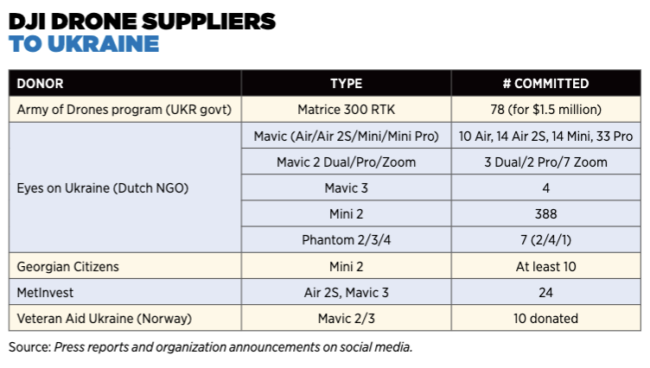
Most numerous are cost-efficient DJI camera drones built in China.
Wartime demand has reportedly caused the price of drones to at least
double in Russia, particularly after DJI halted sales to Russia and
Ukraine in April. Nonetheless, the Russian embassy in China praised the
DJI Mavic on social media as “a symbol of modern warfare.” Autel
Robotics’ EVO series of drones (U.S.-based but Chinese-owned) are also
used prolifically by Ukraine.
Moscow has its ways of circumventing bans and sanctions. “Russians
are specifically instructing volunteers to procure DJIs at different
online and physical marketplaces in eastern Europe and Asia,” Bendett
explained—particularly Belarus, and southeast Asia. “With so many DJI
Mavics sold all over the world, there is a massive supply that can
potentially flow to the front.”
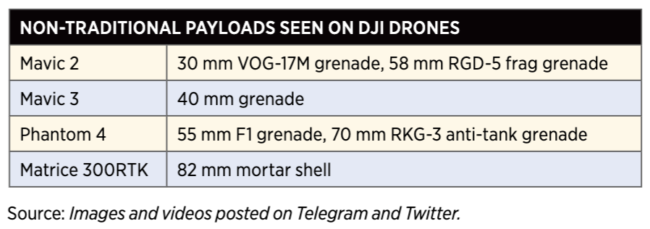
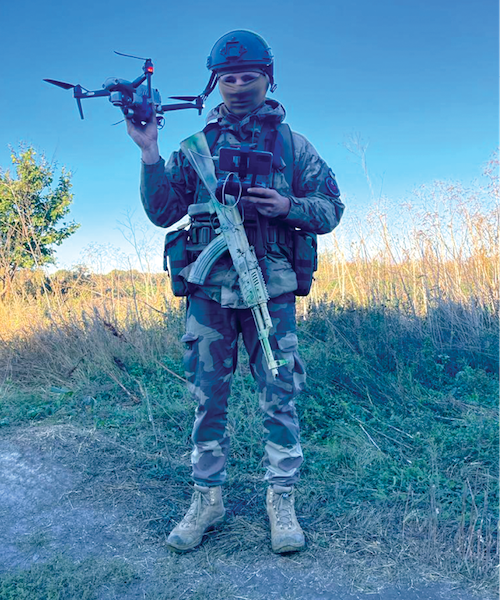
Commercial quad- and octocopters have also proven readily convertible
into precision strike weapons. Videos posted by both Ukrainian and
Russian soldiers continue to display outrageous feats of gravity
bombing, dropping tiny antitank grenades through the open hatches of
main battle tanks and other vehicles with absurdly destructive results.
In some cases, the attacks target abandoned vehicles, but their
destruction is nonetheless useful in places where they can’t be safely
recovered.
Just as Ukraine’s military learned and improved on drone tactics
Russian separatists employed in the 2014-2015 war, videos are showing
Russia copying Ukraine’s improved methods.
Massive use of DJI products could theoretically be compromised should
the company, or state regulators, attempt to impose geographic locks.
However, Ukraine has reportedly developed a hack to “reflash” DJI drones
and remove safety software Russia exploited in the past to locate and
disable drones or attack their operators.
Ukraine and Russia could produce similar camera drones domestically,
but production quality, scale and cost-efficiency would likely not be
the same, Bendett advised—especially for Russia as it struggles to
obtain microelectronics because of international sanctions.
Nonetheless, Russian arms manufacturer Almaz-Antey announced it was
testing a self-developed quadcopter with 90% domestic parts made of
lightweight polymers and carbon fibers that could eventually serve as a
“Russian DJI.”
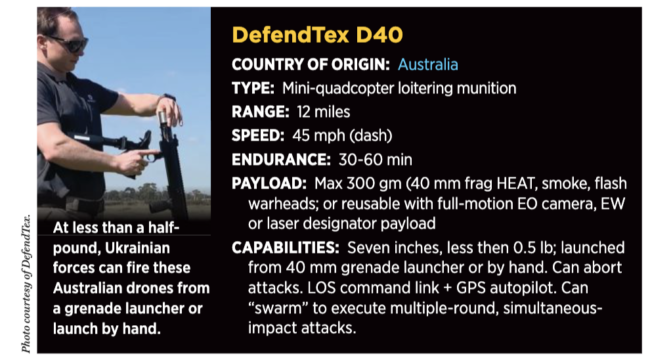
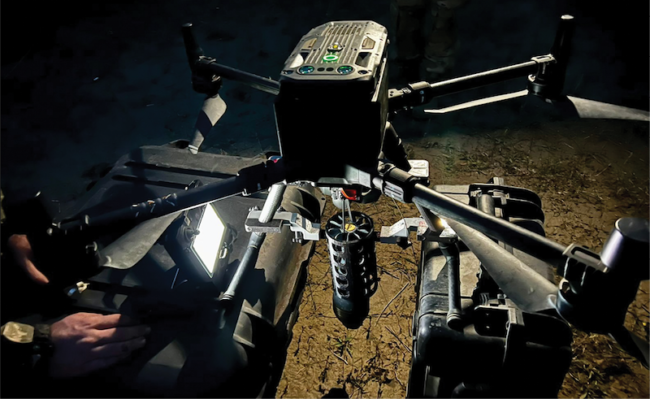
Soldier fits a 30-millimeter VOG-17 grenade to a DJI Mavic 2 Pro quadcopter. Photo posted to Facebook by Ukraine’s 17th Tank Brigade.
UNMANNED LAND AND SEA VEHICLES
To supplement its Uran-6 de-mining vehicles, Russia has begun using
the remote-controlled 45-ton Prokohd-1 UGV, a disarmed T-90A tank
equipped with KTM-7 or -8 mine-rollers—possibly the heaviest
operationally deployed UGV so far. Ukraine, meanwhile, is reportedly
deploying the Roomba-like Temerland GNOM kamikaze mine. Directed via a
quadcopter, it’s designed to roll under armored vehicles and detonate a
TM-62 anti-tank mine. A machine-gun-armed variant of GNOM may see patrol
use, while Russia says it’s preparing a 3-ton Marker 2 UGV for eventual
combat deployment in Ukraine.
At sea, around two dozen mostly unspecified UUVs and USVs, donated to
Ukraine by the U.S., U.K. the Netherlands and Germany, play a quiet but
strategically high-stakes role mitigating risks from mines or
clandestine sabotage attacks on Ukraine’s grain shipping.
Furthermore, on September 21, a novel USV ran aground near Russia’s
major naval base at Sevastopol, in Crimea. According to submarine expert
H.I. Sutton, the stealthy (median radar cross-section around 0.6 sqaure
meters) USV was likely Ukrainian and intended for an explosive kamikaze
attack. If Ukraine manages to use UUVs/USVs to damage valuable Russian
naval assets in port, that could further weaken the Russian Black Sea
Fleet’s posture after the loss of flagship missile cruiser Moskva.
.jpg)


.jpg)
.jpg)
.jpg)
.jpg) ✓ Trump joined in on Lake’s unfounded claims on
Truth Social alleging
ballot tabulator issues skewed results in Hobb’s favor and accused
election officials of running a “criminal voting operation.” State
Attorney General Mark Brnovich has since called on the county to produce a report on its voting machines after his office received complaints about the election process."
✓ Trump joined in on Lake’s unfounded claims on
Truth Social alleging
ballot tabulator issues skewed results in Hobb’s favor and accused
election officials of running a “criminal voting operation.” State
Attorney General Mark Brnovich has since called on the county to produce a report on its voting machines after his office received complaints about the election process."
.jpg)

.png)

.jpg)


.jpg)