Sunday, May 21, 2023

MONDAY MONDAY Rocky Road...Investors girding for Spikes in Currency Volatility-and-Losses in Equities | Bloomberg Markets


Traders Brace for Volatility With US Debt Deal Elusive

  • Dollar, Treasury futures will be closely monitored at open
  • McCarthy says he plans to meet with Biden on Monday afternoon
Updated on

Investors are girding for spikes in currency volatility and losses in equities as the US struggles to clinch a debt-limit deal.

House Speaker Kevin McCarthy said he and President Joe Biden will meet Monday afternoon, and negotiators will resume debt talks later Sunday. The Republican leader said he and Biden, who’s returning from the G-7 summit in Japan, had a “productive” call. “Time is of the essence,” McCarthy added. Treasury Secretary Janet Yellen said on NBC’s Meet the Press that the US is unlikely to reach mid-June and still be able to pay its bills.

Currency trading begins at 5 a.m. Sydney, while futures contracts for Treasuries and US stocks start three hours later.

The debt-ceiling debate has become an unwelcome sideshow for investors already dealing with the uncertainty surrounding the Federal Reserve’s next policy decision in June. Strategists at JPMorgan Chase & Co. and Morgan Stanley have warned that an impasse threatens the outlook for equity markets, while traders have also piled into swaps and options for major currencies to hedge their portfolios. European Central Bank President Christine Lagarde appealed to US politicians to resolve the standoff in a TV interview aired Sunday.

“Despite encouraging headlines, history suggests lawmakers will take things down to the wire, which will add to market volatility,” said Carol Kong, strategist at Commonwealth Bank of Australia in Sydney. “If, and once, an agreement is reached, focus will quickly shift back to economic data and the FOMC, which I think will lead to further modest dollar gains.”
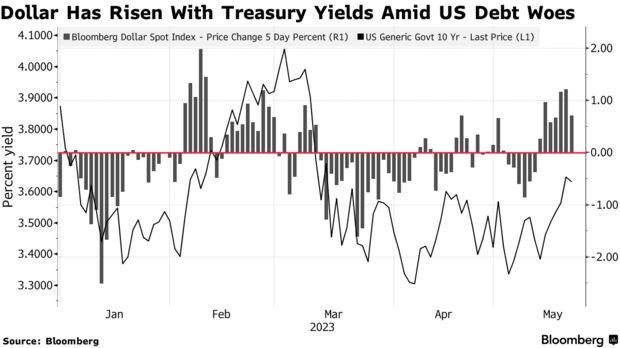
Dollar Has Risen With Treasury Yields Amid US Debt Woes


The back-and-forth between lawmakers has Wall Street preparing for the worst, with executives in trading, corporate and consumer banking in the nation’s three biggest lenders trying to predict how the government’s failure to pay bills would cascade through markets. Some are looking back to 2011, when a similar episode led to massive price swings across asset classes.

Still, investors may be underprepared. Some 71% of respondents to a recent Bank of America survey expect a resolution before the so-called X-date, the point at which the government exhausts options to fund itself, though without necessarily entering a default.

The S&P 500 Index rose last week on hopes that a resolution is close. A gauge of the dollar’s strength touched a two-month high, boosted by haven demand and stronger expectations for Fed hikes.

Yen, Stocks Bets

In addition to US assets, the yen, commodity currencies and emerging-market equities that are sensitive to swings in risk sentiment will also come under close scrutiny. 

Goldman Sachs Group Inc. says the looming US debt ceiling is a “plausible catalyst” for hits to economic growth and stock markets. 

“The EM template is fairly straightforward: large export markets, such as Korea, Mexico, and Taiwan, tend to underperform the most,” strategists including Caesar Maasry wrote in a note. 

(Updates with latest on talks in second paragraph.)
    Updated on

    Investors are girding for spikes in currency volatility and losses in equities as the US struggles to clinch a debt-limit deal.

    House Speaker Kevin McCarthy said he and President Joe Biden will meet Monday afternoon, and negotiators will resume debt talks later Sunday. The Republican leader said he and Biden, who’s returning from the G-7 summit in Japan, had a “productive” call. “Time is of the essence,” McCarthy added. Treasury Secretary Janet Yellen said on NBC’s Meet the Press that the US is unlikely to reach mid-June and still be able to pay its bills.

    Currency trading begins at 5 a.m. Sydney, while futures contracts for Treasuries and US stocks start three hours later.

    The debt-ceiling debate has become an unwelcome sideshow for investors already dealing with the uncertainty surrounding the Federal Reserve’s next policy decision in June. Strategists at JPMorgan Chase & Co. and Morgan Stanley have warned that an impasse threatens the outlook for equity markets, while traders have also piled into swaps and options for major currencies to hedge their portfolios. European Central Bank President Christine Lagarde appealed to US politicians to resolve the standoff in a TV interview aired Sunday.

    “Despite encouraging headlines, history suggests lawmakers will take things down to the wire, which will add to market volatility,” said Carol Kong, strategist at Commonwealth Bank of Australia in Sydney. “If, and once, an agreement is reached, focus will quickly shift back to economic data and the FOMC, which I think will lead to further modest dollar gains.”

    Dollar Has Risen With Treasury Yields Amid US Debt Woes


    The back-and-forth between lawmakers has Wall Street preparing for the worst, with executives in trading, corporate and consumer banking in the nation’s three biggest lenders trying to predict how the government’s failure to pay bills would cascade through markets. Some are looking back to 2011, when a similar episode led to massive price swings across asset classes.

    Still, investors may be underprepared. Some 71% of respondents to a recent Bank of America survey expect a resolution before the so-called X-date, the point at which the government exhausts options to fund itself, though without necessarily entering a default.

    The S&P 500 Index rose last week on hopes that a resolution is close. A gauge of the dollar’s strength touched a two-month high, boosted by haven demand and stronger expectations for Fed hikes.

    Yen, Stocks Bets

    In addition to US assets, the yen, commodity currencies and emerging-market equities that are sensitive to swings in risk sentiment will also come under close scrutiny. 

    Goldman Sachs Group Inc. says the looming US debt ceiling is a “plausible catalyst” for hits to economic growth and stock markets. 

    “The EM template is fairly straightforward: large export markets, such as Korea, Mexico, and Taiwan, tend to underperform the most,” strategists including Caesar Maasry wrote in a note. 

    (Updates with latest on talks in second paragraph.)

      Lack of Transparency: Commercial Spaceflight Services


      Opinion

      Enter outer space at your own risk?

      Credit: SpaceNews/Midjourney illustration

      Douglas Ligor is a senior behavioral/social scientist at the nonprofit, nonpartisan RAND Corporation, and a member of RAND’s space enterprise initiative. Josh Becker is an adjunct policy researcher at RAND.

      "If you pay a company like SpaceX, Blue Origin, Virgin Galactic, or Boeing to go into space, perhaps even perform your own spacewalk, should those companies be bound by safety regulations issued by the Federal Aviation Administration (FAA)?

      Currently, the answer is “no,” thanks to a law that bans federal regulation of commercial space enterprises.

      As a result, individuals who choose to go to space, and the general public, may not have sufficient information to reasonably assess the safety of commercial spaceflight. It’s time to allow the moratorium on regulation to expire and allow the development of safety standards, led by the FAA.

      Since 2004, federal law has barred most participant safety regulations and leaves nearly all issues of safety procedures, equipment, and standards for commercial spaceflight participants like amateur astronauts up to the discretion of the company providing the service. As a result, companies voluntarily determine and choose to apply safety standards that they deem appropriate. These include basic, critical safety aspects like when passengers should be strapped into the vehicle’s cabin, when they should wear pressurized suits in case of a loss of oxygen and what risk tolerance for serious injury or death they might encounter.

      There were several reasons why Congress imposed the moratorium and continued to extend it up to the present. Lawmakers, the commercial space industry, and other stakeholders believed that a “learning period” was necessary to ensure that any regulations eventually issued would necessarily “take into consideration the evolving standards of the commercial space flight industry.” In other words, because the industry was so new, and the number of commercial spaceflights continued to be limited, there was insufficient data, information, testing, and experience to craft effective safety rules.

      It’s time to allow the moratorium on regulation to expire and allow the development of safety standards, led by the FAA.

      Another reason is that as different companies designed and developed unique types of vehicles, systems, and equipment to go into space, it would be impractical to impose a single set of rules that would have broad applicability. This has certainly become the case as even the basic designs of the current crop of commercial space vehicles differ significantly.

      For example, SpaceX and Blue Origin employ different types of crew capsules, and Virgin Galactic employs a fuselage-type crew vehicle rather than a capsule. Each vehicle would naturally require safety standards specific to its design.

      Moratorium Memento Mori

      On Oct. 1, 2023, the moratorium on federal regulation is set to expire. RAND was asked by Congress to assess the state of the development of voluntary safety standards led primarily by industry in coordination with private standards development organizations and the FAA’s Commercial Space Transportation Advisory Committee. RAND was also asked to assess if commercial spaceflight is ready for government regulation.

      One significant finding that drove our conclusions is that the current state of participant safety is largely unknowable because sufficient data and information are not available.

      Three factors contribute to this lack of transparency.

      • First, companies that offer commercial spaceflight services are not required to share their safety data and information publicly, including incidents or anomalies that may indicate risk. Additionally, companies are reluctant to share this data voluntarily because it may disclose proprietary information that, if revealed, could harm a company’s reputation, or allow its intellectual property to be appropriated by others unfairly. This fact is despite the National Transportation Safety Board (NTSB) recommendation after the 2014 crash of Virgin Galactic’s SpaceShipTwo that the FAA should work in collaboration with the spaceflight industry to develop a database of lessons learned from commercial space mishap investigations, and encourage industry members to voluntarily submit lessons learned.
      • Second, current regulations direct companies to provide “informed consent” notification to individuals who pay to go to space on their vehicles. The belief underlying the informed consent rule is that if companies provide information to would-be spaceflight participants about the risks and hazards of spaceflight, individuals can judge for themselves whether they are willing to accept the risks. However, these notifications are also not publicly available.

      • Third, industry and interested stakeholders participate in public and semi-public forums to develop voluntarily agreed-upon, industry-wide, safety standards, but consensus has been elusive. Because of the varied types of companies and stakeholders involved, and because of the diverse interests at stake, some who participate are incentivized to slow the development of safety standards out of a concern that they may be disadvantaged in comparison to competitors. As a result, there have been very few safety standards published that relate to participant safety.


      Based on these factors, it is not possible to independently assess and analyze whether policymakers, spaceflight participants, industry, or the public have sufficient information to make reasonably informed decisions about the safety of commercial spaceflight. commercial spaceflight services

      Clearing the way for rulemaking

      Allowing the moratorium to expire would clear the way for the FAA to begin informal, publicly accessible, rulemaking activities. As part of these activities, the FAA, industry, standards development organizations, and other interested stakeholders could work in collaboration to determine next steps for the development of safety standards—whether they continue to be developed voluntarily, or whether binding rules should be considered.

      While we’re not suggesting any specific types of regulations at this time, our research generally supports considering rules that would increase transparency with respect to the identification, collection, reporting, and analysis of key safety data and information. The current practice of nondisclosure and siloing of data and information may result in gaps or blind spots that could increase the likelihood of a catastrophic event.

      A system that would enable the FAA, industry, and stakeholders to develop safety standards more collaboratively, while also providing sufficient protections for sensitive corporate information, may help to enhance the sustainability and growth of the commercial spaceflight industry.

      Global defence technologies and new WhatsApp features | Tech It Out: ​| WION 3,918 views May 21, 2023

      Uninterrupted Footage of the 12th Landing of Falcon9 1063 in the Pacific...1,165 views

      SpaceX Launch Axiom Mission 2 (Ax-2) to the International Space Station ...Perpetual Commercial Sustainable Micro-Economy Habitats!

      Axiom Mission 2 is a planned private crew mission to the International Space Station, operated by Axiom Space. In December 2021, NASA confirmed that the mission would fly on a Crew Dragon. In May, NASA announced that the mission would launch on 21 May 2023, and then expected to dock with the ISS at the next day. Wikipedia
       

      VIRAL MOMENT: Reporter Presses Patel On State Dept Allegedly Automatically Adding Pronouns In Emails | Forbes Breaking News 808 views May 21, 2023