Final opportunity zone regulations have been released Stakeholders interested in maximizing tax incentives must initiate an investment prior to the end of the year.
21 December 2019IRS Issues Final Regulations on OZones + Qualified Opportunity Funds
The Office of Information and Regulatory Affairs (OIRA) is reporting that its review of the final IRS regulations on Qualified Opportunity Funds concluded on December 17th. Yesterday Jimmy Atkinson writing in Opportunity Database announced that the long wait is over. IRS has issued final regulations on Qualified Opportunity Funds, nearly two years after the Opportunity Zone initiative was enacted into law as part of the 2017 Tax Cuts & Jobs Act. ________________________________________________________________________ There are a number of sticking points from the first two tranches of proposed regulations — many of which were discussed at the most recent IRS hearing on Qualified Opportunity Funds — that should be clarified in these final regs, including:
Data collection and reporting, and what Treasury’s limits may be.
Multi-asset fund exit options, and the discrepancies that exist between tax treatment at the different QOF, QOZB, and QOZBP levels.
Whether the substantial improvement test can be conducted on an aggregate basis, as opposed to an asset-by-asset basis.
The treatment of debt-financed distributions.
The treatment of Section 1231 gains.
The definition of vacant property.
How to pair the Opportunity Zone tax incentive with real estate tax credits such as New Markets, Low Income Housing, Renewable Energy, and Historic.
READ MORE AT THE ABOVE LINK
Click here to read the complete draft of the final regulations. The final regulations are a modification and merger of the first and second tranches of regulatory guidance and provide additional clarification on topics that remained unresolved after the first two sets of proposed regulation. In total, the notice is 544 pages in length. IRS completed the final regulations and submitted them for review to the Office of Information and Regulatory Affairs (OIRA) on December 6.
The final regulations do not officially take effect until they are published in the Federal Register.
It was "a dream come true" for JenniferDuff, District 4 Mesa City Councilmember (or so she said) in a 01:18 streaming video produced for the occasion by the City of Mesa. Developer Tony Wall pitched-in too, saying there were 297 units for 'Luxury Living." Hizzoner John Giles opened the short clip by saying "it's a great addition to the other development on the east side of the street," but couldn't say the name of the for-profit religion real estate development there. Notice how quick-and-clipped the uploaded streaming video is - not the usual wide shots of assembled dignitaries and city officials COVERING MESA: The GRID Ground-Breaking The GRID breaks ground on a new $75-Million Mixed-Use Development in Downtown Mesa 32 Views 1 day ago
__________________________________________________________________________________ RELATED CONTENT ON THIS BLOG:
> "Bringing jobs into the community is a leap forward.” . . . real estate investors would like more from the Treasury in the next round of regulations.
In an interview, Quinn Palomino, chief executive at Virtua Partners a private equity group, said she hopedthe government would mandate reporting on metrics such as the number of jobs and affordable housing units created in the zones.
“Everyone’s running to this industry,” including a lot of people without the background in real estate development, she said.“It’s pretty scary out there, some of the projects that are coming in.
Kind of, two guys in the back of a van, trying to get an Opportunity Zone project done.”
What should unite Opportunity Zones backers and detractors
September 4, 2019
Editor's note: A version of this blog post also ran on Impact Alpha here. By Aaron Seybert
" . . . Depending on your ideological, political, or economic interests, you can pick the facts and examples around Opportunity Zones that most confirm your bias and dismiss the critiques you disagree with . . ."
I believe anyone who cares about this legislation producing sustainable, positive impact in communities should be asking for mandatory disclosure.
Without the knowledge of where the money came from, who raised it, and where it went, how can we possibly hope to know if this incentive is helping or hurting on the whole?
We should absolutely support the best actors to show a path forward. However, we in philanthropy should just as forcefully demand mandatory reporting at every level and remain extremely sensitive to what we lend our name to. We should fund advocacy organizations, investigative journalism, and think tanks to increase the reputation risk for policy makers and practitioners and insist this debate continues in the public eye. In the absence of a fully transparent market, I will remain skeptical but engaged.
Final opportunity zone regulations have been released Stakeholders interested in maximizing tax incentives must initiate an investment prior to the end of the year.from this blog
21 December 2019IRS Issues Final Regulations on OZones + Qualified Opportunity Funds
The Office of Information and Regulatory Affairs (OIRA) is reporting that its review of the final IRS regulations on Qualified Opportunity Funds concluded on December 17th. Yesterday Jimmy Atkinson writing in Opportunity Database announced that the long wait is over. IRS has issued final regulations on Qualified Opportunity Funds, nearly two years after the Opportunity Zone initiative was enacted into law as part of the 2017 Tax Cuts & Jobs Act. ________________________________________________________________________ There are a number of sticking points from the first two tranches of proposed regulations — many of which were discussed at the most recent IRS hearing on Qualified Opportunity Funds — that should be clarified in these final regs, including:
Data collection and reporting, and what Treasury’s limits may be.
Multi-asset fund exit options, and the discrepancies that exist between tax treatment at the different QOF, QOZB, and QOZBP levels.
Whether the substantial improvement test can be conducted on an aggregate basis, as opposed to an asset-by-asset basis.
The treatment of debt-financed distributions.
The treatment of Section 1231 gains.
The definition of vacant property.
How to pair the Opportunity Zone tax incentive with real estate tax credits such as New Markets, Low Income Housing, Renewable Energy, and Historic.
READ MORE AT THE ABOVE LINK
Where Opportunity Zones stand, heading into 2019
The stage is set for Sean Parker’s pet project—now it’s time for the money to start rolling in
After the dust settled in the spring, the industry realized a hidden gem had been tucked away in the law: Opportunity Zones.
The brainchild of Silicon Valley financier Sean Parker, Opportunity Zones allow investors to obtain massive tax advantages if they invest capital gains—money made on the sale of assets like a home, a business, or a piece of art—into “distressed” areas of the country where the post-financial crisis recovery passed by. While the provision theoretically allows investors to put money into any type of project so long as it’s in a designated zone—a business, infrastructure, whatever—most observers believe it is especially attractive to real estate developers, partly because the largest tax benefits go to those who stay invested in the zone for at least 10 years. Advocates for the program believe this could be a game-changing community development tool. __________________ From Bloomberg News
Will ‘Opportunity Zones’ Help the Rich, the Poor or Both?
By Noah Buhayar January 3, 2019 10:00 PM
(Blogger Note: If this is one of your TLDR - Too Long Didn't Read - challenges, there's a 04:54 minute audio you can listen to at the underlined link above the article headline)
"Buried in the Republican tax overhaul that President Donald Trump signed into law in late 2017 are incentives for investors who fund businesses or develop real estate in new “opportunity zones.”Banks, private equity firms, insurance companies and wealthy individuals are now rushing to take advantage. . .
Finally 18 months after designating and qualifying more than 8,700 Opportunity Zones, there a new Triple-Play to track millions in investments and how they are accounted for. Previously it was all self-reported with a lot of "loop-holes." That might help to explain all the real estate transactions and in-hand changes here in Mesa in The Inner Loops and The Outer Loops, or The Outer Fringes, and inside The Old Donut-Hole. All at the same time.
Typically Ozone Updates and guidelines are published in April and October after the Tax Credits and Jobs Act in December 2017. Surprisingly - or not - most of the projects spurred so far by the Opportunity Zone designations are real estate. _________________________________________________________________________
Every new batch of tax regulations from the Treasury Department will establish the most comprehensive guidelines yet for what sorts of investments qualify for tax benefits associated with opportunity zones, and how investors must proceed in order to take advantage of them.
Potentially billions of dollars are waiting on the Treasury’s decisions.
“The second tranche of regulations is a moment of truth for investors and communities,” said John Lettieri, the president of the Economic Innovation Group think tank, who was an architect of the Opportunity Zone concept.
The difference in potential investment in the zones between favorable and unfavorable regulations, he said, “is orders of magnitude.”
> In the first batch of regulations, Treasury officials took a more restrictive approach, according to documents obtained through a Freedom of Information request. But those were ultimately overruled by the White House, which prevailed on several points that investors had championed, those records show.
> While investors wait for clarity, the existing regulations have “frozen some of the market for business investment,” said Steve Glickman, another architect of the concept who now runs an Opportunity Zone-related consulting business called Develop L.L.C., and who has produced an Opportunity Zone Index to help investors find and select promising zones for projects.
> The Kresge Foundation established two funds - funds that are committing to a set of rules that would require them to invest in creating living-wage jobs, form community advisory boards and seek to avoid displacing residents from those zones. They will also compile and share data on the quality and impact of their investments, which is not currently required by the federal government.
The existing regulations have made that calculation relatively easy for real estate investors, who are accelerating previously planned projects in the zones and starting new ones that might not have worked without the special tax treatment.
That activity has already paid off for incumbent landowners in Opportunity Zones, according to research by the real estate firm Zillow: Average sales prices in the zones jumped 25 percent last fall, compared with the year before. . .
“At the end of the day, real estate development is a very important step forward,”Senator Tim Scott, Republican of South Carolina and the principal champion of the Opportunity Zone provision in the tax law, said in a brief speech. “
"Bringing jobs into the community is a leap forward.” . . . real estate investors would like more from the Treasury in the next round of regulations.
In an interview, Quinn Palomino, chief executive at Virtua Partners a private equity group, said she hopedthe government would mandate reporting on metrics such as the number of jobs and affordable housing units created in the zones.
“Everyone’s running to this industry,” including a lot of people without the background in real estate development, she said.“It’s pretty scary out there, some of the projects that are coming in. Kind of, two guys in the back of a van, trying to get an Opportunity Zone project done.”
Fundraising for these real estate vehicles is lacklustre as the industry awaits final regulatory guidelines from the US Treasury
Opportunity Zone Funds (OZFs) are designed to enable investors to do well by doing good. Created to spur investment in low-income communities designated as 'Opportunity Zones' by the US Government, OZFs have champions in high places. Tech entrepreneur and philanthropist Sean Parker – who co-founded music sharing service Napster and later became Facebook’s first President – helped to drive the initiative to create these Zones. OZFs have the potential to become “its own asset class, and it could be a very large asset class,” Parker told the New York Times in an interview last year.
But sparking investor interest in a new asset class has not been easy.
Opportunity Zones arose as part of the Tax Cuts and Jobs Act of 2017, and today they span all 50 states, the District of Columbia, and the five US territories. To attract investment, OZFs offer investors significant deferrals on their capital gains taxes. By channelling the gains from an asset sale into an OZF and retaining their interest in the fund for at least 10 years, investors are exempt from paying capital gains taxes on any rise in the value of their OZF investment.
But so far, take up has been slow. Back in January 2019, when Preqin surveyed investors to gauge their interest in OZFs, 92% of respondents said they were currently not invested in OZFs, citing regulatory uncertainty and the risks of investing in distressed areas. Fast-forward to today, and investor demand remains sluggish.
A Slow Start to Fundraising Opportunity Zone FundsConsider the fundraising figures for OZFs.
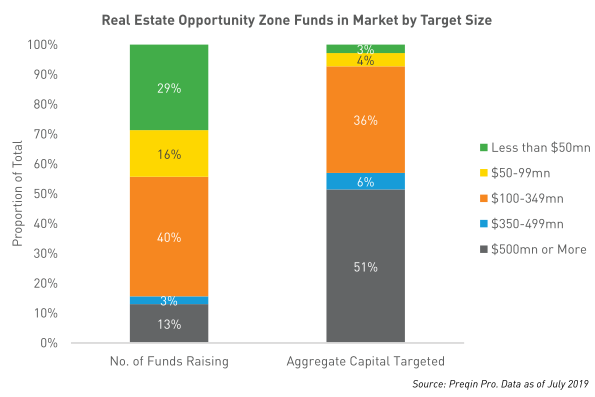
> Right now there are 151 closed-end OZFs in market, a small fraction of the 7,400+ private real estate funds listed on Preqin Pro.
> Of these 151 funds, just 18 have held a final close, accounting for $2.3bn in commitments. > Moreover, $755mn of that capital is committed to just one GP, Federal Capital Partners, whose FCP Realty Fund IV targets value-added investments in the US.
> The remaining 133 OZFs are targeting a total of $20bn in capital, with only 24% having held at minimum a first close.
That means the majority of OZFs now in market have yet to secure significant investor capital.
Investor Demand for Opportunity Zone Funds Will Come Down to PerformanceA major reason for the slow uptake of OZFs is the lack of regulatory clarity.
In January 2018, shortly after the tax cut that gave rise to OZFs was enacted, the US Government shut down. Fund managers that were just getting started with OZFs had to wait for further guidance, and the long delays put off potential investors.
While part two of the regulations is now available, fund managers are still awaiting the final guidelines, which are slated to be released later this year.
Since the regulatory framework has yet to be fully clarified, there are currently only a small number of established firms that have set up OZFs.
Indeed, nearly 70% of the OZFs in market are first-time funds. Their struggle to gain traction mirrors the broader trend seen in the private real estate market: these days larger, more established managers are attracting the lion’s share of investor capital, crowding out emerging managers.
> Industry participants say there are plenty of Opportunity Zone deals to be made, but the supply of capital is limited since the fundraising pace has been slower than expected.
> Another complication is the way OZFs are structured.
OZFs are designed to encourage long-term investment of at least 10 years to realize their full benefit.
Their performance J-curve is expected to be 'low and long' compared with typical private real estate funds, which means investors have to wait longer for distributions.
There are some bright spots, of course.
Since 2018, five funds have successfully raised more than $100mn.1 That is less than a third of the 18 OZFs that have closed, but it is still early days for OZFs. Plus, as the end of the tax year approaches, investors will be assessing their portfolios and fund managers will be hoping that some of their capital gains will be diverted into their OZFs.
A number of OZFs are known to be targeting net IRRs in the high teens to the low twenties, an attractive long-term return for investors on the hunt for yield. If returns are as strong as targeted, investors may well decide that there is money to be made in doing good after all.
For more information on OZFs, read our factsheet which further examines investors' plans for OZFs.
What should unite Opportunity Zones backers and detractors
September 4, 2019
Editor's note: A version of this blog post also ran on Impact Alpha here. By Aaron Seybert
" . . . Depending on your ideological, political, or economic interests, you can pick the facts and examples around Opportunity Zones that most confirm your bias and dismiss the critiques you disagree with . . ."
I believe anyone who cares about this legislation producing sustainable, positive impact in communities should be asking for mandatory disclosure.
Without the knowledge of where the money came from, who raised it, and where it went, how can we possibly hope to know if this incentive is helping or hurting on the whole?
We should absolutely support the best actors to show a path forward. However, we in philanthropy should just as forcefully demand mandatory reporting at every level and remain extremely sensitive to what we lend our name to. We should fund advocacy organizations, investigative journalism, and think tanks to increase the reputation risk for policy makers and practitioners and insist this debate continues in the public eye. In the absence of a fully transparent market, I will remain skeptical but engaged. The history of our country (or of this administration) does not justify defaulting to the assumption that this will work out fine. We seek to partner with other like-minded organizations who are not content to sit on the sidelines and see all the potential benefits as well as the perils. My modus operandi is: Engage, support the best and brightest, demand transparency, stay vigilant, and be careful who you associate with. Aaron Seybert is a social investment officer at The Kresge Foundation. Follow his team on Twitter @kresgesocinv.
Mesa launches Opportunity Zone Prospectus to spotlight notable investment opportunities across the City
December 12, 2018 at 3:12 pm
Today the City of Mesa announced the launch of the Mesa Opportunity Zone Investment Prospectus located at www.MesaAzOpportunityZones.com.
The Prospectus provides important information for potential investors regarding Mesa's Opportunity Zones, namely the Gateway Area
Falcon District
Main Street Corridor
Fiesta District
and the key geographic, demographic, infrastructure, and marketadvantagesof Mesa's OZones.
Blogger Notes:
1. What is covered in the city's press release are four of 11 pre-designated areas that qualified for being low-income neglected, distressed neighbors or were contiguous to those census tracts here in Mesa. The Gateway Area and The Falcon District qualified for being contiguous to distressed census tracts.
2. Here in the image above right and a week after the monthly Economic Development Advisory Board meeting on 04 Oct 2018 are Mesa's EconDev Director Bill Jabjiniak flanked by other city officials and a consultant making a pitch for RDAs. At the same study session there were questions and discussions about OZones. Mark Valenzuela, hired-on last year from ASU was not present at that time.
The Opportunity Zone program is a federal program meant to spur investment in low-income areas by providing tax benefits to investors who reinvest capital gains into Opportunity Zones.
The tax on the realized gain is deferred and reduced if the investment is held in an Opportunity Fund for five to seven years.
Moreover, gains on the Opportunity Fund investment will not be taxed if the investment is held for ten years.
Opportunity Funds in turn must have at least 90% of their assets in qualified Opportunity Zone property.
The City of Mesa has 11 census tracts that have been designated Opportunity Zones by the U.S. Department of Treasury.
"Our Opportunity Zones provide a boost in returns for private, tax-free investment in low-income areas with economic need," Mayor John Giles said.
"Investment in these areas will bring great benefit to our residents and private investors alike." Mesa's various opportunity zones are well-suited for industrial, office, retail, and residential development projects. The Gateway Area Opportunity Zone includes industrial and commercial development opportunities proximate to Phoenix-Mesa Gateway Airport, along the burgeoning Ray Road Business Corridor, and in the Pecos Advanced Manufacturing Zone, which also has the unique advantage of a streamlined entitlement process.
Furthermore, investors can maximize the property tax incentives for qualified projects locating in Mesa's Foreign Trade Zone and the Military Reuse Zone, also located in the Gateway Area Opportunity Zone. Anchored by Falcon Field Airport and already home to major operations for Boeing, Northrop Grumman, MD Helicopters, and Nammo Talley, Mesa's Falcon District Opportunity Zone has many additional opportunities for manufacturing, office, retail, and hotel development. The District's targeted industry segments included aerospace, defense, medical technologies, and advanced business services.
Located along the Red Mountain Loop 202, the Falcon District is ripe for development and is already seeing tremendous new activity. TheMain Street Corridor Opportunity Zone is Mesa's heart for arts, culture, entertainment, government, and education, and will soon be the home of a new Arizona State University facility and innovation studio.
The Main Street Corridor hosts a variety of mixed-use, office, restaurant, hotel, and multi-family housing development opportunities. Already a blossoming employment area, the Fiesta District Opportunity Zone is prime for additional development in mixed-use, restaurant, office, advanced business services, medical technology, and healthcare services.
Nearby are campuses for Cardon Children's Medical Center, Banner Desert Medical Center, and Mesa Community College, as well as Santandar, National General Lender Services, and Esurance. _________________________________________________________________________ To download or share the City of Mesa's Opportunity Zone Investment Prospectus, visit www.MesaAzOpportunityZones.com.
If you would like to invest in one of Mesa's Opportunity Zones, please contact
< OZones here in Mesa . . . there are 11 that qualify
"The Opportunity Zones policy was designed to benefit low-income communities, and the residents of those communities must have a voice in the process.
An impact framework must have clear and accessible avenues for communities to provide input."
- Federal Reserve Bank of New York, August 2018
Let's be very clear why that citation from the New York Federal Reserve Bank is prominently featured here today. Just two reasons: 1. John Williams is now the President of the NYFRB 2. John Williams knows Downtown Mesa He was invited here by Terry Benelli, President/CEO of LISC Phoenix (Local Initiatives Support Corporation) for an on-site visit three years ago. Not much has changed on ground-zero downtown since then, except for the TCAJA 2017 that created Opportunity Zones. OZONES for short or just OZ.
--------------------------------------------------------------------------------------------------------------------------
INPUT: Up on the rooftop at City Hall, we can see MesaMayor John Giles and ASU President Michael Crow making plans for new construction of one building and one renovation of an existing building - Price Tag: $100M, and all paid for by hikes in sales/use taxes.3rd person is unknown. As the data make clear Opportunity Zones are deeply distressed communities Blogger Note: That's not the same as "vibrant and exciting" Some investors - like John Giles and his closely-connected cohorts of friends-and-family in the Finance, Insurance, and Real Estate Industries are here for their own private wealth-creation: They snatched-up buying eight downtown commercial properties on Main Street before the end of December 2017 to gamble on rampant real estate speculation. One is The Caliber Wealth Development Fund (scroll down to read more)
The Opportunity Zones Reporting Framework is a project of the U.S. Impact Investing Alliance and the Beeck Center for Social Impact + Innovation at Georgetown University.
Let's not skip down that Yellow Brick Road again off-to-see the wizard in that shining green city over the rainbow The Economic Innovation Group (EIG) developed a Distressed Community Indexto measure economic well-being across long-neglected low-income contiguous zip codes. The data should demonstrate if Opportunity Zones are moving toward parity with better-off places There is a huge need for more community engagement in understanding needs and ensuring that communities are poised to benefit from investment.
IN THE SPOTLIGHT HERE IN DOWNTOWN MESA
11 Feb 2019 Phoenix, Ariz. – CBREannounced today that the firm was awarded the exclusive leasing assignment for eight historic urban retail properties on Main Street in Mesa, Ariz., that consist of nearly 110,000 square feet. The properties were acquired in February 2018 by Caliber Wealth Development Fund, who plans to re-develop the buildings as part of the city of Mesa’s downtown revitalization plans. . . This redevelopment is among several proposed and announced projects in downtown Mesa.
> In June 2018, the city of Mesa announced that ASU will add a new downtown Mesa campusto house its film, media and gaming programs, bringing an estimated 750 students to the area.
> Additionally, The Church of Jesus Christ of Latter-day Saintsis undergoing a two-year renovation of its 75,000-square-foot Mesa temple and surrounding grounds. No financial deals, however, were ever disclosed from news reports in MormonLand. It was disclosed that For-Profit affiliates of The Church had been working with city official for years.
What do we know? Reference: https://medium.com/new-york-fed-framework "One approach is to combine metrics that capture performance over time and across dimensions. Economic Innovation Group (EIG) developed a Distressed Community Indexto measure economic well-being across zip codes. Kenan Fikri, Director of Research at EIG, noted that relative indices allow us to “control for what’s happening in the macro environment,” adding that the data should demonstrate if Opportunity Zones are moving toward parity with better-off places
Another approach is to create a detailed, data-driven profile for each low-income community. This is the goal ofOpportunity 360, a tool from Enterprise Community Partners that aggregates 200 data points to identify characteristics of opportunity by census tracts. Some states used this tool in deciding zone nominations. “What we’re exploring now is: how can we pivot and iterate on this data?
Participants also stressed that using data is only one lens of many for understanding needs. Truly finding the opportunity in Opportunity Zones requires conversations with the community. Kevin Boes, President and CEO of New Markets Support Corporation at the Local Initiatives Support Corporation (LISC), has toured designated zones to identify gaps and how investors can fill them. Boes emphasized that “there is a huge need for more community engagement” in understanding needs and ensuring that communities are poised to benefit from investment.
The families living in these areas and community-based organizations serving them are in the best position to identify the needs, priorities, and opportunities to invest for strong community outcomes. But their engagement is not baked into the Opportunity Zones legislation, so it will fall to local leaders and private actors to create space for community voices in the market.
Establishing Evidence of Outcomes for Communities in Need
> Gathering baseline data on Opportunity Fund investments will allow policymakers, researchers, and community development practitioners to assess the short- and long-term impact of these flows of capital to underserved communities. Tracey Hsu, Director at Social Finance, pointed out the importance of having a shared understanding of what improvement looks like in a particular Opportunity Zone — not only to assess impact, but also to align this incentive with existing community development programs.
> Nick Fritz, Senior Associate for Sorenson Impact, suggested that a best practice may be to establish “impact measurement” milestones at the five-, seven-, and 10-year marks
tracking progress by reporting on specific yearly data points
also recording and reporting on specific metrics each year.
These metrics could build off of transaction-level data (location of investments, investment size, type of project or enterprise, etc.) to determine alignment with community needs and with an Opportunity Fund’s investment thesis.
> In the same way that community voices will help to determine need, Opportunity Zone residents will also help to contextualize data on outcomes and raise awareness of unintended consequences. “The great thing about the Opportunity Zones is that we are talking about place, but more importantly we are talking about people in place. A bottom-up approach is where we start to win”, said Frank DiGiammarino, a Senior Fellow at the Beeck Center.
> DiGiammarino also highlighted the importance of transparency, saying, “investment tends to be a black box,” but openly discussing what investments are being made in Opportunity Zones will help ensure that the benefit is effective. And as early movers will shape the market, he urged participants to act swiftly and cautioned that “perfect is the enemy of the good”. Endlessly discussing the “right” data to gather may dampen the interest of investors from contributing to the development of the market place.
Existing Frameworks for Evaluating Impact with a View Toward Investor Demand
Participants discussed key considerations when developing tools that help funds and investors to quantify impact and maximize opportunities. This will also require collection of impact data from recipients of Opportunity Fund investments, which may include start-ups and other local businesses.
First, the development of these market-facing tools has been driven by investor demand. Institutional and high-net worth investors have become increasingly aware of the ways that their financial decisions can align with their values. Greater market transparency enables investors to better understand risk and opportunity, ultimately helping them to make better decisions and improve returns. Amanda Kizer, Director of Impact Management at B Lab, spoke specifically about “a frame of maximizing stakeholder value rather than viewing impact through the lens of compliance.”
Second, business owners are seeing the benefit of collecting and reporting data. “Impact occurs at the point where an enterprise touches the people in the community,” said Brian Trelstad, Partner at Bridges Fund Management and representing the Impact Management Project. Understanding impact as a business owner is fundamentally a matter of understanding your customers and your market. Learning to glean and interpret these insights also develops skills and expertise in entrepreneurial ventures, preparing them to succeed and grow.
But powerful as these benefits can be, participants in the roundtable underscored the need for flexibility. Impact reporting should focus on data that is both material to impact goals and responsive in nature, allowing businesses to adapt if they aren’t meeting community needs. It should also be practical from the standpoint of collection, according to Paige Chapel, President and CEO of Aeris, who noted that “impact accountability and transparency shouldn’t serve as an undue burden to those Opportunity Fund managers who are explicitly and intentionally centered on community impact.”
Building the necessary environment to ensure effective reporting about investments in Opportunity Zones will take sustained effort, and a collaborative approach will help shape the market in these critical early stages.
Next Steps
The day-long meeting ended with a clear call to action: develop a shared understanding of how to measure impact in Opportunity Zones and how to help shape the nascent market for Opportunity Funds. A growing number of investors now acknowledge that incorporating impact metrics into their strategy can serve as an important risk management tool and produce better results. How do we build consensus and the necessary community to enable that action?
First, the Opportunity Zones legislation should lead to the creation of a market where there really wasn’t one — investing in communities that have otherwise been overlooked. The hallmark of a healthy marketplace is transparency. Investors and communities need access to baseline, transactional data about Opportunity Zones to enable targeted investment. Transparency will also produce data to observe the effectiveness of this new incentive and demonstrate accountability.
Second, a framework for impact will require authentic community engagement. The Opportunity Zones policy was designed to benefit low-income communities, and the residents of those communities must have a voice in the process. An impact framework must have clear and accessible avenues for communities to provide input.
Further, we must expand the conversation. This first roundtable was meant to articulate the potential for a shared impact framework, understand the existing tools at our disposal, and establish the impetus to act. Carrying the conversation forward will require input from actors across this new market, weaving together the diverse expertise of each stakeholder — policy makers, academics, researchers, investors, wealth advisors, fund managers, businesses, and, of course, the communities themselves.
Finally, we need to be prepared to learn and grow over time. “This policy is in a state of becoming,” was a common refrain, underscoring the need to move swiftly to shape it for the highest community benefit. But with the market developing at a heady pace, a lack of consensus regarding a successful impact framework cannot stand in the way. Rather, we should look at this as an opportunity to enable the flow of capital to the places most in need and also those most ready to use it. _______________________________________________________________
The Beeck Center mobilizes talent to drive social impact at scale by taking a systematic approach to delivering exponential outcomes that leverages the tools of data, technology, policy, and finance to improve people’s lives. The Beeck Center incubates and spreads cutting edge ideas; creates unique and unconventional networks of government, private and social sector leaders who come together through to solve complex problems; and equips and trains students, practitioners, and executives with the mindset and tools necessary to take action.
The U.S. Impact Investing Alliance is a field-building organization committed to raising awareness of impact investing in the United States, fostering deployment of impact capital across asset classes, and working with stakeholders, including government, to help build the impact investing ecosystem. Its vision is to catalyze a movement that will transform finance by putting measurable social and environmental impact, alongside risk and financial return, at the core of investment decisions.
The New York Fed works within the Federal Reserve System and with other public- and private-sector institutions to foster the safety, soundness, and vitality of our economic and financial systems. The New York Fed’s Community Development Finance initiative (CoDeFi) helps community organizations, banks, and investors work together to increase the effectiveness of the community development investments in low- and moderate-income communities.
The views expressed in this post are those of the contributing authors and do not necessarily reflect the position of the New York Fed or the Federal Reserve System.
New York Fed content is subject to our Terms of Use.
New York Fed
We welcome engagement and discussion on the New York Fed’s Medium pages. We reserve the right to remove any profane, repetitive, commercial or off-topic comments or posts that are inconsistent with Medium’s Rules or Terms of Service.
Impact.
We are committed to evaluating and amplifying the long-term outcomes benefiting those living and working in Opportunity Zones today.

 The final regulations do not officially take effect until they are published in the Federal Register.