BEWARE THE REDUX...
Uncovering untold secrets of NATO --- monstrous remnant from Cold War days
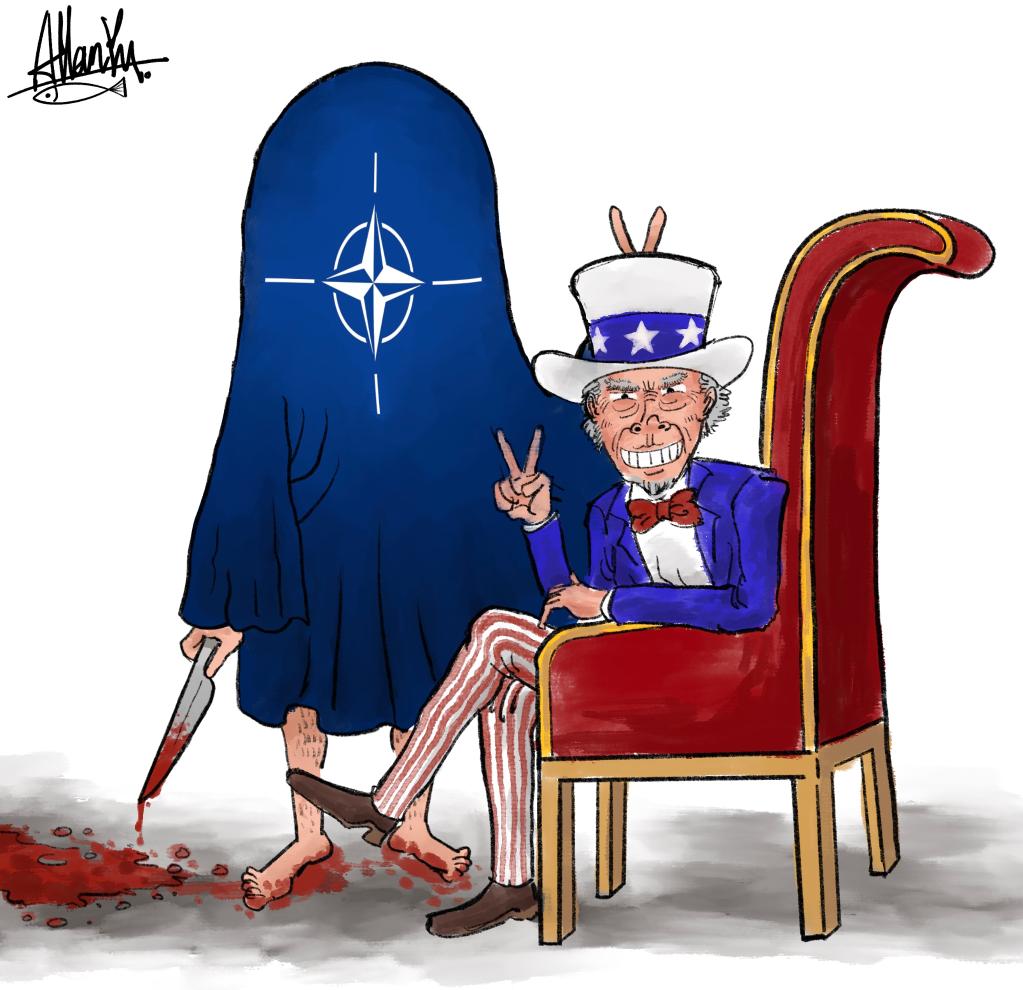
Source: Xinhua
Editor: huaxia
2022-04-26 19:33:00
Source: Xinhua
Editor: huaxia
2022-04-26 19:33:00
OFFICAL INFORMATION
Operations and missions: past and present
Last updated: 14 Jun. 2022 13:11
NATO is an active and leading contributor to peace and security on the international stage. It promotes democratic values and is committed to the peaceful resolution of disputes. However, if diplomatic efforts fail, it has the military capacity to undertake crisis management operations alone or in cooperation with other countries and international organisations.
Current operations and missions
Terminated operations and missions
From 1949 to the early 1990s
NATO in Afghanistan - Following the 9/11 terrorist attacks against the United States, the International Security Assistance Force (ISAF) was established under the request of the Afghan authorities and a UN mandate in 2001. ISAF was led by NATO from August 2003 to December 2014 and was succeeded on 1 January 2015 by the Resolute Support Mission (RSM), which was terminated early September 2021.
Operation Active Endeavor - Operation Active Endeavour (OAE) was initiated in the immediate aftermath of the 9/11 terrorist attacks to deter, defend, disrupt and protect against terrorist activity in the Mediterranean. It helped to secure one of the busiest trade routes in the world and was among eight initiatives launched by the Alliance in 2001, in solidarity with the United States. It was an Article 5 operation, i.e., a collective defence operation that, initially only involved NATO member countries until it started accepting non-NATO countries' participation in 2004.
NATO and Iraq - NATO conducted a relatively small but important support operation in Iraq from 2004 to 2011 that consisted of training, mentoring and assisting the Iraqi Security Forces. At the Istanbul Summit in June 2004, the Allies rose above their differences and agreed to be part of the international effort to help Iraq establish effective and accountable security forces. The outcome was the creation of the NATO Training Mission in Iraq (NTM-I). The NTM-I delivered its training, advice and mentoring support in a number of different settings. All NATO member countries contributed to the training effort either in or outside of Iraq, through financial contributions or donations of equipment. In parallel and reinforcing this initiative, NATO also worked with the Iraqi government on a structured cooperation framework to develop the Alliance's long-term relationship with Iraq.
NATO and Libya -
Following the popular uprising against the Gadhafi regime in Benghazi, Libya, in February 2011, the UN Security Council adopted Resolutions 1970 and 1973 in support of the Libyan people, "condemning the gross and systematic violation of human rights". The resolutions introduced active measures including a no-fly zone, an arms embargo and the authorisation for member countries, acting as appropriate through regional organisations, to take "all necessary measures" to protect Libyan civilians.
Initially, NATO enforced the no-fly zone and then, on 31 March 2011, NATO took over sole command and control of all military operations for Libya. The NATO-led Operation Unified Protector had three distinct components:
- the enforcement of an arms embargo on the high seas of the Mediterranean to prevent the transfer of arms, related material and mercenaries to Libya;
- the enforcement of a no-fly-zone in order to prevent any aircraft from bombing civilian targets; and
- air and naval strikes against those military forces involved in attacks or threats to attack Libyan civilians and civilian-populated areas.
The UN mandate was carried out to the letter and the operation was terminated on 31 October 2011 after having fulfilled its objectives.
Assisting the African Union in Darfur, Sudan - The African Union Mission in Sudan (AMIS) aimed to end violence and improve the humanitarian situation in a region that has been suffering from conflict since 2003. From June 2005 to 31 December 2007, NATO provided air transport for some 37,000 AMIS personnel, as well as trained and mentored over 250 AMIS officials. While NATO's support to this mission ended when AMIS was succeeded by the UN-AU Mission in Darfur (UNAMID), the Alliance immediately expressed its readiness to consider any request for support to the new peacekeeping mission.
Second Gulf Conflict - During the second Gulf Conflict, NATO deployed NATO AWACS radar aircraft and air defence batteries to enhance the defence of Türkiye in an operation called Display Deterrence. This operation started on 20 February 2003 and lasted until 16 April 2003. The AWACS aircraft flew 100 missions with a total of 950 flying hours.
Transcript
Follow along using the transcript.


No comments:
Post a Comment