Studying humans' two closest living relatives, chimpanzees and bonobos, can help reconstruct ancestral human traits like cooperation and conflict. Despite living in similar social groups composed of several adult members of both sexes, the two species are fundamentally different in how they interact across social groups.
NOVEMBER 16, 2023
Love thy neighbor: Cooperation extends beyond one's own group in wild bonobos
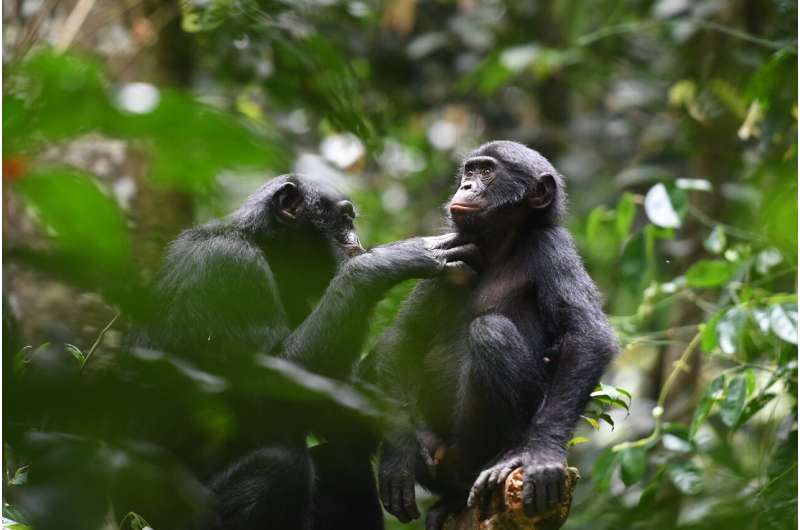
A study published in Science challenges the notion that only humans are capable of forming strong and strategic cooperative relationships and sharing resources across non-family groups.
Researchers from Harvard University and the German Primate Center examined the pro-social behavior of bonobos (Pan paniscus), one of humanity's closest living relatives, finding that their cooperation extends beyond one's own group to societal cooperation with different groups.
Among chimpanzees, our more studied relatives, relationships between different groups are predominantly hostile, and lethal aggression is not uncommon. As a result, models of human evolution often assume that group hostility and violence are innate to human nature.
Researchers from Harvard University and the German Primate Center examined the pro-social behavior of bonobos (Pan paniscus), one of humanity's closest living relatives, finding that their cooperation extends beyond one's own group to societal cooperation with different groups.
Among chimpanzees, our more studied relatives, relationships between different groups are predominantly hostile, and lethal aggression is not uncommon. As a result, models of human evolution often assume that group hostility and violence are innate to human nature.
Studying the bonobos unearths a different story. The endangered bonobos are notoriously difficult to study in their natural habitat, as they only live in remote, largely inaccessible parts of the Democratic Republic of the Congo.
Harvard Professor Martin Surbeck and senior author on the study, who established and directs the research in the Kokolopori Bonobo Reserve, notes, "It is through strong collaborations with and the support of the local Mongandu population in Kokolopori, in whose ancestral forest the bonobos roam, that studies of this fascinating species become possible."
Surbeck continued, "Research sites like Kokolopori substantially contribute not only to our understanding of the species' biology and our evolutionary history, but also play a vital role in the conservation of this endangered species."
Harvard Professor Martin Surbeck and senior author on the study, who established and directs the research in the Kokolopori Bonobo Reserve, notes, "It is through strong collaborations with and the support of the local Mongandu population in Kokolopori, in whose ancestral forest the bonobos roam, that studies of this fascinating species become possible."
Surbeck continued, "Research sites like Kokolopori substantially contribute not only to our understanding of the species' biology and our evolutionary history, but also play a vital role in the conservation of this endangered species."
- When different groups of bonobos meet, they often travel, rest, and feed together.
- Unlike chimpanzees, researchers have not observed bonobo disputes that lead to lethal aggression.
- The study finds that the bonobos do not interact randomly between groups. Instead, cooperation happens between a select few. "They preferentially interact with specific members of other groups who are more likely to return the favor, resulting in strong ties between pro-social individuals," says Surbeck. "Such connections are also key aspects of the cooperation seen in human societies."
Samuni added, "The ability to study how cooperation emerges in a species so closely related to humans challenges existing theory, or at least provides insights into the conditions that promote between-group cooperation over conflict."
Human cultures, traditions, and social norms enable cooperation across our societies. The importance of this cooperation between different human groups is undisputed. It leads to the exchange of ideas, the spread of innovations, and the accumulation of knowledge over space and time.
Human networks foster the exchange of resources, resulting in the trade of materials and goods that can offset shortfalls. Bonobos also share resources across groups, and they do so without any strong cultural influence.
The study's authors emphasize the similarities between bonobo social cooperation and humans.
- According to the authors, the insights from bonobos should challenge the idea that culture and social norms are necessary components for cooperation between groups to emerge.
- The bonobos show that constant warfare between neighboring groups is not necessarily a human legacy and does not seem evolutionarily inevitable, the authors say.
More information: Liran Samuni et al, Cooperation across social borders in bonobos, Science (2023). DOI: 10.1126/science.adg0844. www.science.org/doi/10.1126/science.adg0844
Journal information: Science
Provided by Harvard University


No comments:
Post a Comment