11 APR, 04:36
Angara-A5 rocket booster orbits Gagarinets CubeSat of Avant Space private company
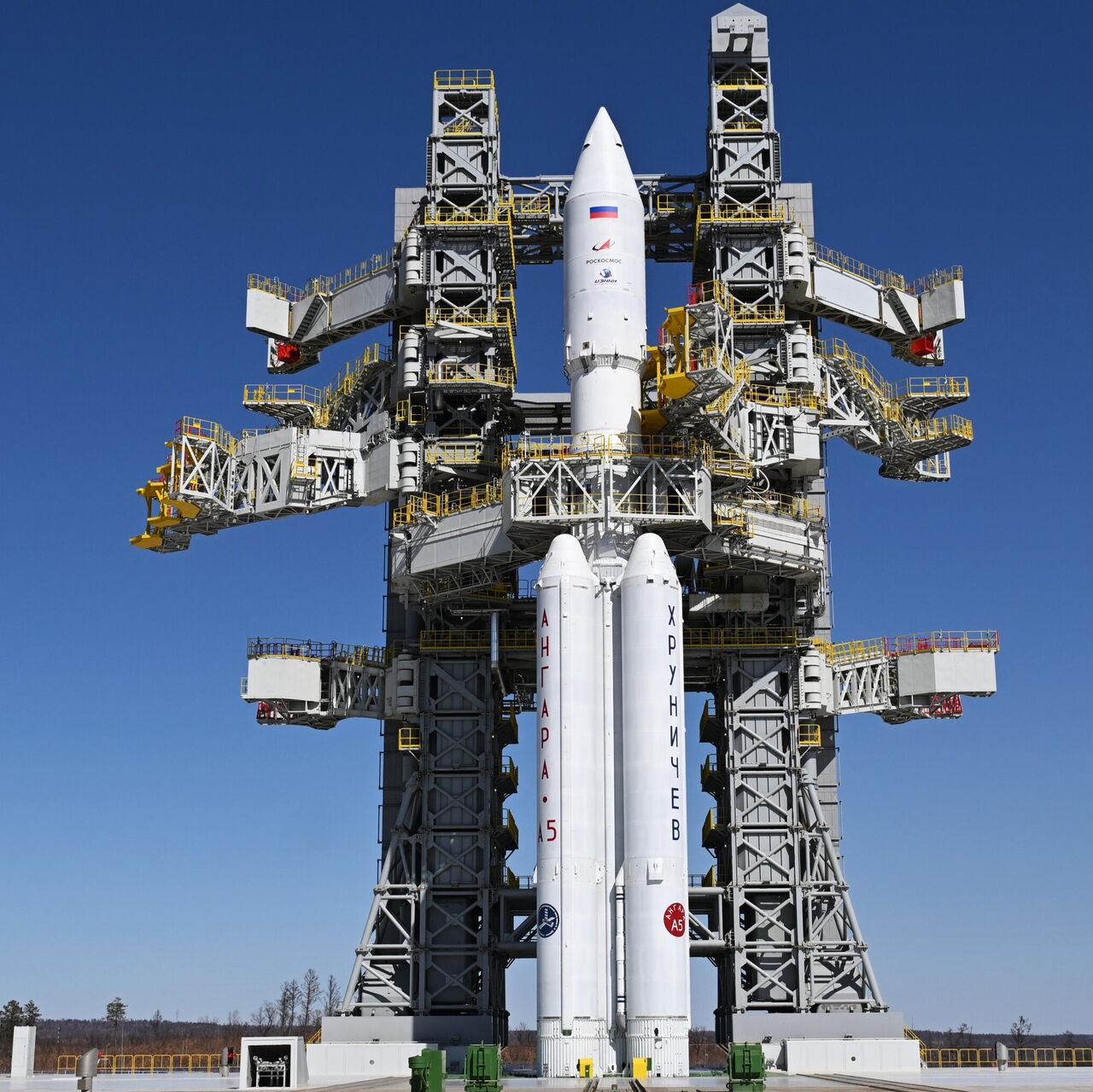
MOSCOW, April 11. /TASS/. The Angara-A5 rocket booster has placed a Gagarinets CubeSat created by the Russian private company Avant Space into the target orbit, the State Space Corporation Roscosmos announced on Thursday.
"Today, the Orion booster launched by the first Angara-A5 carrier rocket has delivered a Gagarinets small satellite into low-Earth orbit," Roscosmos said in a statement.
The Gagarinets CubeSat 3U was engineered by the private company Avant Space and is designed to test the platform’s elements, it specified.
The Orion booster keeps delivering test payload into the target orbit, Roscosmos said.
The Angara-A5 heavy-lift rocket blasted off from the Vostochny spaceport in the Russian Far East at 12:00 p.m. Moscow time (9:00 a.m. GMT) on April 11 after two failed attempts in the previous two days.
This is the first test-flight of the Angara rocket from the Vostochny spaceport in eastern Russia. Previously, these launch vehicles blasted off only from the Plesetsk Cosmodrome in northwestern Russia.
The first three launches of Angara heavy rockets from the Plesetsk spaceport took place on December 23, 2014, December 14, 2020 and December 27, 2021. The launch of the light Angara rocket took place on July 9, 2014 (the suborbital test flight), on April 29, 2022 (the orbital flight) and October 15, 2022 (the orbital flight).
The construction of infrastructure for the Angara rocket at the Vostochny Cosmodrome began in 2019 and late last year the operational capacity of the technical compound and the launch pad was confirmed during the tests of the Angara-NZh, a full-size mockup of the Angara-A5 rocket. Technological solutions allow for launching all types of Angara rockets from one launch pad: from light to heavy carrier vehicles.

Russia launched a new military spacecraft that could be used over Ukraine
Russia launches a military payload atop an Angara 1.2 rocket
Little is known about the mission of Russia’s newest spacecraft, but there are several possible payloads, including an advanced radar. So far, we can only confirm that it was dubbed Kosmos 2555 after its successful deployment from the launch vehicle.
Of course, the most likely scenario is a radar satellite designed specifically for the Russian military, in which case it’s almost certainly slated for use in the current conflict with Ukraine — but this, too, is unconfirmed. It does, however, share a naming scheme and satellite bus with two 6U CubeSats called MKA-N 1 and 2. Both of these were launched atop a Soyuz in July of 2017.
But these satellites didn’t reach their intended orbits, and never achieved communications with ground control. The new mission lifted off from Plesetsk Cosmodrome, and marked the first successful launch for the Angara 1.2 vehicle. A variant of that rocket, the Angara 1.2, was specifically built to carry payloads into low-Earth orbit (LEO).
Its maximum payload is 8,377 lbs (3,800 kg) for LEO insertions, but its more versatile sister rocket, Angara A5, has carried most of the Angara missions to date. The April 28 launch was one of three slated for 2022, with another coming later this year from Roscosmos, and a final commercial one for South Korea.
- So while it may not make as many launches into space (nor as widespread and deep), Russia is still an active space power.
- And its ongoing central role as a major oil producer, sold in Rubles and crypto, could mean these launches will grow in frequency, in the coming decade.
___________________________________________________________________________________
Angara rocket key to Russia’s launch futurePosted by
Tim Reyes

March 16, 2015
. . .While not a reusable vehicle, the Angara family of rockets could be cost-competitive with SpaceX’s Falcon. Russian labor costs are half that of American-made manufacturers, and the Russian agency provided government support.
Launch vehicle upgrades underway across space industry
In the meantime, every major industry launch provider is actively planning upgrades to its launch systems, either complete replacements or substantial upgrades.
Last year, United Launch Alliance (ULA) – a corporation developed by Lockheed-Martin and Boeing to merge production and sales of their Evolved Expendable Launch Vehicle – was rocked by Russian officials planning to end the supply of the famous Russian-made RD-180 rocket engine. The engine defines the 1st stage of the Atlas V rocket which the United States Defense Department and NASA also depend upon for military payload and robotic space probes launches. ULA has now announced the planned retirement of both the Delta family and the Atlas V.
Orbital ATK – recently created from the merger of Orbital Sciences with Alliant Techsystems Inc. (ATK) – saw its Antares rocket fail spectacularly seconds after lift-off on October 28, 2014 during a resupply mission to the International Space Station. It announced the replacement of Antares’ first stage engine AJ26 with another Russian made engine – the Energomash RD-193 – which it considers more reliable.
In addition to changes at ULA and Orbital ATK, upstarts are also planning new entrants into the industry. Past Microsoft vice president James Allen is supporting the development of the largest airplane ever flown – Stratolauncher – which will piggyback a launch vehicle to deliver payloads to orbit and beyond. Virgin Galactic has a similar plan using White Knight Two to support launch of small-sat payloads up to 150 kg (400 lbs). And Jeff Bezos’ Blue Origins is developing a rocket engine which is in competition with Aerojet to supply ULA’s replacement of the Delta launch system.
Behind many of the on-going developments are the success of SpaceX’s Falcon launch vehicle, designed for reuse, and the introduction of the Falcon Heavy, scheduled for a maiden launch from the historic and newly redesigned Cape Canaveral Pad 39A, which hosted launches of the Apollo Saturns to the moon and the Space Shuttle over a 30-year span.
Bottom line: On March 12, 2015, Russian Space Agency officials announced plans to postpone Russia’s heavy lift launch vehicle and called for reliance on the Angara family of rockets. Russia’s new plans are yet another change among launch providers in the space industry, an industry with numerous aged launched vehicles facing increasing competition.


No comments:
Post a Comment