- in Europe in 2003, 2010 and 2019,
- in North America during 2018 and 2021, and
- in eastern China in 2013 and 2022.
Findings reveal an important link to Northern Hemisphere extreme temperatures


More information: Shankai Tang et al, Recent changes in ENSO's impacts on the summertime circumglobal teleconnection and mid-latitude extremes, Nature Communications (2025). DOI: 10.1038/s41467-025-55925-8
Journal information:
Nature Communications
Two lunar landings in a week for NASA's private moon fleet
More than fifty years passed between the last Apollo mission and the United States' return to the lunar surface, when the first-ever private lander touched down last February.
Private lunar lander Blue Ghost aces moon touchdown with a special delivery for NASA

A private lunar lander carrying a drill, vacuum and other experiments for NASA touched down on the moon Sunday, the latest in a string of companies looking to kickstart business on Earth's celestial neighbor ahead of astronaut missions.
Firefly Aerospace's Blue Ghost lander descended from lunar orbit on autopilot, aiming for the slopes of an ancient volcanic dome in an impact basin on the moon's northeastern edge of the near side.
Confirmation of successful touchdown came from the company's Mission Control outside Austin, Texas, following the action some 225,000 miles (360,000 kilometers) away.
"You all stuck the landing. We're on the moon," Firefly's Will Coogan, chief engineer for the lander, reported.
An upright and stable landing makes Firefly—a startup founded a decade ago—the first private outfit to put a spacecraft on the moon without crashing or falling over. Even countries have faltered, with only five claiming success: Russia, the U.S., China, India and Japan.
A half hour after landing, Blue Ghost started to send back pictures from the surface, the first one a selfie somewhat obscured by the sun's glare. The second shot included the home planet, a blue dot glimmering in the blackness of space.
Two other companies' landers are hot on Blue Ghost's heels, with the next one expected to join it on the moon later this week.

Blue Ghost—named after a rare U.S. species of fireflies—had its size and shape going for it. The squat four-legged lander stands 6-foot-6 (2 meters) tall and 11 feet (3.5 meters) wide, providing extra stability, according to the company.
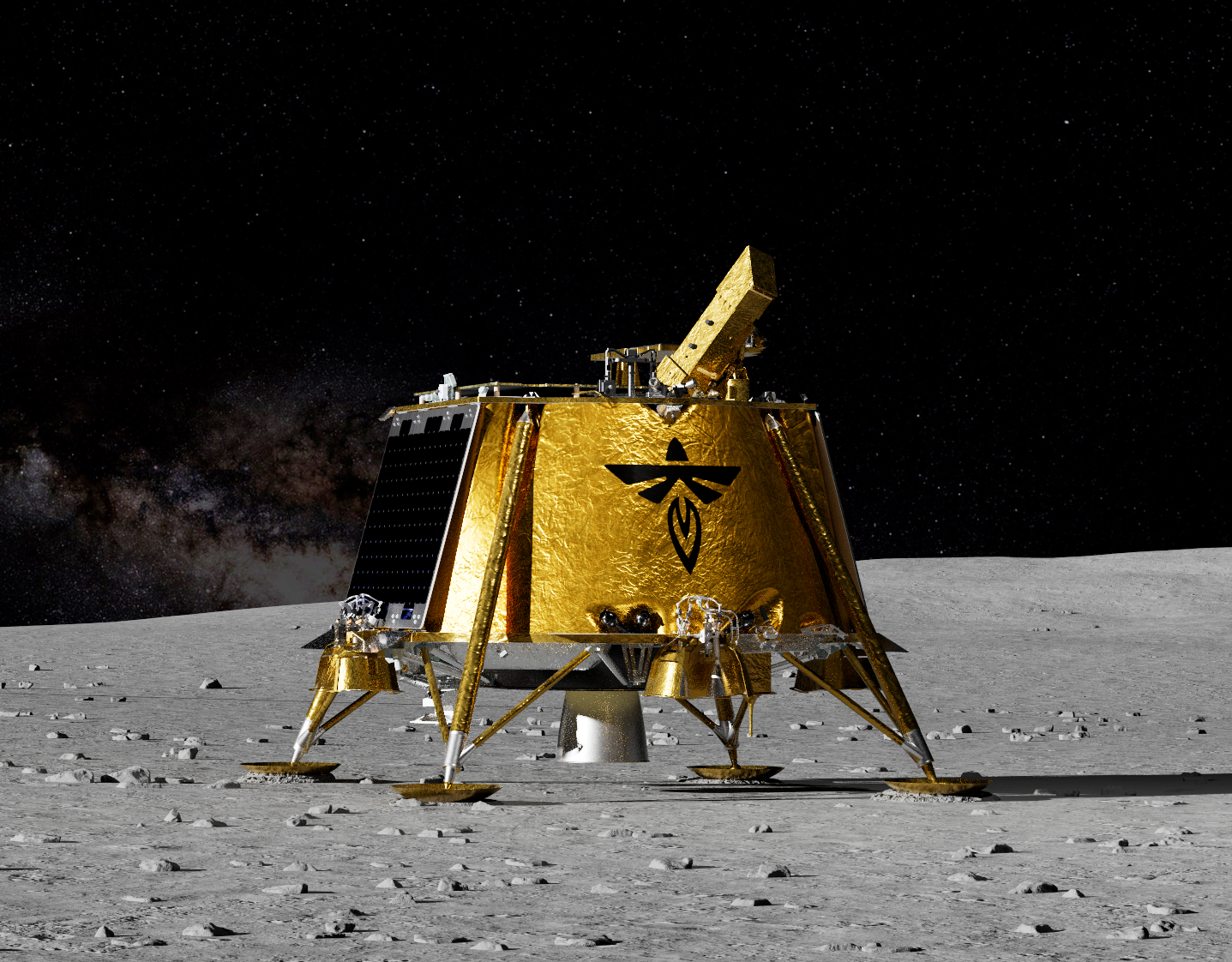
Launched in mid-January from Florida, the lander carried 10 experiments to the moon for NASA. The space agency paid $101 million for the delivery, plus $44 million for the science and tech on board. It's the third mission under NASA's commercial lunar delivery program, intended to ignite a lunar economy of competing private businesses while scouting around before astronauts show up later this decade.
Firefly's Ray Allensworth said the lander skipped over hazards including boulders to land safely. Allensworth said the team continued to analyze the data to figure out the lander's exact position, but all indications suggest it landed within the 328-foot (100-meter) target zone in Mare Crisium.

The demos should get two weeks of run time, before lunar daytime ends and the lander shuts down.
It carried a vacuum to suck up moon dirt for analysis and a drill to measure temperature as deep as 10 feet (3 meters) below the surface. Also on board: a device for eliminating abrasive lunar dust—a scourge for NASA's long-ago Apollo moonwalkers, who got it caked all over their spacesuits and equipment.
On its way to the moon, Blue Ghost beamed back exquisite pictures of the home planet. The lander continued to stun once in orbit around the moon, with detailed shots of the moon's gray pockmarked surface. At the same time, an on-board receiver tracked and acquired signals from the U.S. GPS and European Galileo constellations, an encouraging step forward in navigation for future explorers.
The landing set the stage for a fresh crush of visitors angling for a piece of lunar business.
Another lander—a tall and skinny 15-footer (4 meters tall) built and operated by Houston-based Intuitive Machines—is due to land on the moon Thursday. It's aiming for the bottom of the moon, just 100 miles (160 kilometers) from the south pole. That's closer to the pole than the company got last year with its first lander, which broke a leg and tipped over.
Despite the tumble, Intuitive Machines' lander put the U.S. back on the moon for the first time since NASA astronauts closed out the Apollo program in 1972.
A third lander from the Japanese company ispace is still three months from landing. It shared a rocket ride with Blue Ghost from Cape Canaveral on Jan. 15, taking a longer, windier route. Like Intuitive Machines, ispace is also attempting to land on the moon for the second time. Its first lander crashed in 2023.
The moon is littered with wreckage not only from ispace, but dozens of other failed attempts over the decades.
NASA wants to keep up a pace of two private lunar landers a year, realizing some missions will fail, said the space agency's top science officer Nicky Fox.
"It really does open up a whole new way for us to get more science to space and to the moon," Fox said.
Unlike NASA's successful Apollo moon landings that had billions of dollars behind them and ace astronauts at the helm, private companies operate on a limited budget with robotic craft that must land on their own, said Firefly CEO Jason Kim.
Kim said everything went like clockwork.
"We got some moon dust on our boots," Kim said.
March 1, 2025 report
Saturday Citations: 'Thar she pokes!' Scientists capture drone footage of narwhals
 |
Look, all somewhat positive climate news has to be placed in the context of the ongoing global climate crisis, but this week, researchers did report a new simulation suggesting that the Atlantic Meridional Overturning Circulation is unlikely to shut down within this century. Engineers developed a new flat telescope lens that captures color while detecting light from distant stars, minimizing some of the tradeoffs inherent to traditional lenses. And as a person who lives in a hurricane-prone region of the U.S., I was personally alarmed by the mass firings at the National Oceanic and Atmospheric Administration by Elon Musk's Department of Government Efficiency, but this is ultimately going to impact everyone.
March 1, 2025
Immune 'fingerprints' aid diagnosis of complex diseases
by Krista Conger, Stanford University

Your immune system harbors a lifetime's worth of information about threats it's encountered—a biological Rolodex of baddies. Often the perpetrators are viruses and bacteria you've conquered; others are undercover agents like vaccines given to trigger protective immune responses or even red herrings in the form of healthy tissue caught in immunological crossfire.


No comments:
Post a Comment