Wednesday, May 31, 2017

President of High Ground - Arizona’s Premier Lobbying Firm - Complains About Election Spending

HighGround helped build the diverse coalition of conservation groups, elected officials and others to create the Arizona Growing Smarter Act  - How do these highly-paid lobbyists and group of political consultants want to shape Arizona Policy? . . . that's a good question readers of this blog might want to ask. Here's an Op-ed Opinion Piece published online yesterday that's reproduced for information purposes below in its entirety. There is a disclaimer after it from Chuck Coughlin, President of High Ground Political Affairs Consultants
Viewpoints: Why don't the people we elect represent us?
Chuck Coughlin, AZ I See It 9:47 p.m. MT May 27, 2017
James Madison wrote in Federalist Paper No. 10, “If a faction consists of less than a majority, relief is supplied by Republican principle which enables the majority to defeat its sinister views by a regular vote.”
Yet here in Arizona, our Legislature just passed two laws substantially curtailing the public’s ability to place issues before the electorate through the initiative process, which has been effectively used since statehood to provide some form of relief valve for the Arizona electorate over actions taken by the Legislature.
I wonder what Madison would make of our Congress, our state Legislature and many of our leaders if he were alive today to see that a wide majority of the electorate disapproves of the job these people are doing.

We don't really have open elections 

Why is this happening? Why does it feel like a minority point of view is being driven into law by elected officials who were chosen by the people of Arizona in a supposed open and free election?
Let’s start with the idea that Arizona elections are open – they are not. The American experiment today is dominated by two special interests that use taxpayer dollars to fund their private elections while restricting access to those elections to only candidates who are a member of their private party.
A person who is not registered to vote, or does not belong to a party, is not entitled to put their name forth as a candidate in a publicly financed “primary election” for public office. This group of voters that is not registered to either party makes up 34 percent of the current registered Arizona electorate.
It is not surprising, in such a closed market system for recruiting candidates, that only about 54 percent of the eligible adult population is even registered to vote. Essentially, American voters get only two choices.

Signs the system isn't working

Here is a snapshot of Arizona's electorate landscape, according to Arizona Secretary of State and U.S. Census data
  • 54 percent of eligible voters are registered to vote.
  • 40 percent of eligible voters participate in presidential elections.
  • 23 percent of eligible voters participate in gubernatorial elections.
  • 15 percent of eligible voters participate in partisan primary elections.
Keep in mind, with gerrymandered congressional and legislative districts, more than 75 percent of general-election outcomes are virtually decided in the partisan primary election.
Whether you are a Republican who abhorred the Obama years of governance by executive orders or a Democrat who firmly believes we just elected an unstable man with authoritarian impulses – you must be telling yourself, this system isn’t working anymore for the people.
To fix this, we must admit the laws and rules governing our elections are determined by these two parties. In fact, there is a coordinated effort to maintain the status quo of regional party dominance.

'Dark money' poisons free elections

As for “free elections,” recent laws passed by our elected leaders have made it even harder for voters to address their grievances via the ballot box when they encouraged the use of undisclosed contributions, or “dark money,” through super PACs in Arizona elections.
For the most part, undisclosed campaign spending through super PACs is not commonly used to promote a candidate. Instead, it is almost always used to batter and smear the opponents of their preferred candidate.
They are the paid hit squad used to bury an opponent under an avalanche of mud, making a lesser known challenger candidate virtually unelectable in a small turnout primary election.
In 2014, we saw a super PAC come to Secretary of State Michele Reagan’s rescue in the last two weeks of her race against Terry Goddard by attacking his record.
We don’t know who funded the attacks. We can only be sure they did not want Goddard elected and that these attacks worked, as Reagan came from behind to win.
Is it any surprise, then, to see Secretary Reagan retreat from her past statements regarding campaign finance transparency and instead work to write and support legislation which loosened the laws on the very dark money groups that contributed to her victory?

Candidates can't run their own campaigns

With candidates no longer in charge of their own campaigns, dark-money groups handle the dirty work that campaigns used to abhor. If the third-party group goes negative, the candidate can continue to tell people what a great person he or she is and claim ignorance about who is behind the nasty campaign ads talking about his or her opponent.

And of course, a candidate can’t publicly ask a dark money group to stop attacking their opponent. That would be coordination with an outside group and that, of course, is illegal!
Before our Republican partisan friends howl with cries of how their right to free speech would be hindered by more disclosure laws, I would simply remind them that the brightest conservative legal mind of the past century, Justice Antonin Scalia, fell squarely in the camp of more disclosure.
Now that we’ve laid out our state’s electoral process flaws and why this is preventing us from electing leaders that represent all Arizonans, not just 15 percent of us, what should we do?
How do we get more voters to participate?

Here are some simple ideas for our elected officials that we believe will get the ball rolling:

Admit that independent and Party Not Designated voters and candidates are not treated fairly through our entire electoral process. Gov. Doug Ducey admirably called for the presidential primary election to allow independents to participate in 2016, but we think that should be taken a step further.
If partisan actors want to continue making it nearly impossible for independent candidates to make the ballot or participate in primary elections, they clearly run the risk of a lawsuit challenging equal access to the ballot. Before that, however, they could choose to fix the system.
Stop the flow of taxpayer dollars to private party elections. As private parties, Republicans and Democrats have the right to choose their preferred candidate through any process they choose; they do not, however, have the right to a private election subsidized by taxpayers, who may themselves be barred from participating.
The state’s Constitution prohibits gifts to private parties that do not promote the public good. So again, before you get sued, change the primary system and give every candidate equal access regardless of party affiliation.
Put the power back in the hands of the candidates. Introduce legislation similar to the bill introduced in Congress by Sen. Ted Cruz earlier this year called “The SuperPAC Elimination Act of 2017.”
This legislation would eliminate caps on individual and group contributions to candidates and require disclosure of any contribution within 24 hours, putting candidates in control of and responsible for their message and increasing transparency for voters.
Of course, we would improve Senator Cruz’s legislation when a group is the contributor to require disclosure of the “original sources” of the contributions. Republicans will appreciate the removal of limits on free speech, and Democrats will be in favor of more transparency.
Make candidates do their own dirty work.
Samuel Johnson said, “The first step to greatness is to be honest.” So let’s first admit our electoral system no longer represents the people.
Then, let’s do something real that Makes America Great Again by ensuring the integrity of electoral process and guaranteeing equal access to the ballot for everyone regardless of party – our Founding Fathers would be proud.
Chuck Coughlin is the president and founder of HighGround Inc., a public-affairs and consulting firm in Arizona.
He served as chairman of Gov. Jan Brewer’s transition team and has run numerous political campaigns in Arizona.
Email him at coughlin@azhighground.com​.
 
 
Airdate: October 18, 2016
We’ll talk about the Mormon vote and its potential impact on the 2016 election with Chuck Coughlin, president of HighGround consulting group.
Guests:  
Chuck Coughlin, president of
 
HighGround consulting group.
Watch it Here on AZ PBS


TY Very Much > Nepotism Here In Mesa Is Going Very Well

. . . or should we say 'family-values'? At any rate it's good for some people to have overlapping family connections of one sort or another. You, dear readers, can sort it out.
Both have connections with real estate development, an entrenched political machine, and high-power political affairs consultants and lobbying firms.
Meet Ryan Smith, [son of Ex-Mayor Scott Smith]
Communications and Government Relations Director
Phoenix-Mesa Gateway Airport Authority
April 2017 - present 2 months
He began his climb-up at PMGAA in April 2016 as Assistant to the Executive Director for Inter-Governmental Relations.
From June 2008-April 2016 he was an Account Executive within a company named High Ground, Public Affairs Consultants calling itself Arizona’s Premier Lobbying Firm 
More Experience:
Sep 2007-May 2008 Campaign Manager for his father

Before that - for 3 years and 3 months - he was Regional Vice-President K Hovnanian Homes from July 2004-Sep 2007.
He attended ASU and got a Bachelor's Degree in Political Science 2002-2007
Source: LinkedIn

One item missing on anything in Ryan Smith's work experience is that just about the same time in 2002 he began his studies in Political Science at ASU, Scott Smith and his son started a business: Qualtrics, which conducts online market research, is a prime example of the rapid growth of the Utah economy — and the sense that Utah is straining at the limits of its growth potential.
Scott Smith started the company with his son, Ryan, and a college classmate in his Provo home in 2002. Qualtrics now employs 1,300 people, including about 800 in a new headquarters building opened in August at the mouth of Provo Canyon. And it is bringing workers to Utah as fast as it can. 
Ryan Smith, now the chief executive, said Qualtrics had hired about three dozen graduates from the University of Michigan alone last year. The company estimates that new arrivals bought 100 homes in Provo last year. . . by the end of the year, Mr. Smith said, he expects the company will have more employees outside Utah than in its home state. It is growing where it finds workers.
Source: New York Times May 21, 2017

Qualtrics Locations worlwide
According to Wikipedia
Qualtrics is a private research software company, based in Provo, Utah, in the United States.
The company was founded in 2002 by Scott M. Smith, Ryan Smith, Jared Smith and Stuart Orgill. Wikipedia
CEO: Ryan Smith (Dec 2002–)
Founded: 2002

Website: https://www.qualtrics.com/
 
J. Chuck Coughlin, President of High Ground, had this to say about Ryan in April 2016
"After nearly eight years at our firm, Ryan began his new career today as the Government Relations Coordinator for Phoenix-Mesa Gateway Airport.  All of his colleagues here at HighGround cannot be more pleased for him and for the Airport Authority; they are getting a wonderful human being and we still have a great friend.. .  It was during Ryan’s father’s initial campaign for Mayor of Mesa in 2007-08 that we first met him.
 He was working tirelessly for his father’s campaign and I joked with him that he was like a Mormon on a mission.  Everything I needed to know about Ryan I learned in that campaign: tireless and kind, he exuded a genuine warmth for everyone around him. And after that successful campaign, we happily adopted him and it was a blessing for both parties ever since. . . "

Here's a link to High Ground to see what they do >>
http://www.azhighground.com/shaping-arizona-policy/ 

Scott Smith progeny Ryan Smith is no stranger to Arizona politics, according to this article Aug 19, 2014 written by Mike Sunnucks in Phoenix Business Journal that calls him out for taking 'a cheap shot'
"Ryan Smith — the son of former Mesa Mayor Scott Smith and a close political adviser to his father – took a jab at Arizona Cardinals President Michael Bidwill in a social media post.
Scott Smith is running in the Republican primary for governor, while Bidwill backs Arizona Treasurer and former Cold Stone Creamery CEO Doug Ducey.
Ryan Smith — a political strategist at heavyweight consulting firm Highground Inc. — compared his father’s business experience as a home-building executive to Bidwill, the son of Cardinals owner Bill Bidwill.
Michael Bidwill led a recent effort to get business executives and leaders who were backing Smith to swing over to Ducey. Bidwill sent letters to top local CEOs looking to garner more business backing from Ducey and away from Scott Smith 
Ryan Smith referenced the Cardinals president in a Facebook response to a Scott Smith campaign posting about business leaders backing the former mayor.
“Unlike a letter from a guy that was born into a family, given a taxpayer-funded stadium and guaranteed league revenue. These business leaders have worked to create jobs and know what leadership looks like,” Ryan Smith posted on Facebook earlier today.
The critical post was later deleted. It referenced public financing for University of Phoenix Stadium, the Bidwill family’s long tenure owning the Cardinals and the National Football League’s business model.
Smith spokesman David Leibowitz said Ryan Smith was frustrated with the negative attacks on his father, including a recent political ad that shows his parents’ house. Leibowitz said Ryan Smith has been working long hours for his dad’s gubernatorial bid.
More than $2 million has been spent so far in the GOP primary by political groups on negative ads and mailers, according to the Arizona Secretary of State’s office.
Cardinals spokesman Mark Dalton said Bidwill and the team were not going to wade into the political sniping.
“We can’t keep members of the Smith campaign from taking cheap shots but certainly are not going to stoop to that level ourselves,” Dalton said."                    
                                                                            
Twitter : @Ryansmithaz
Profile picture standing in front of the White House on March 2, 2017


____________________________________________________
 
The Republic | azcentral.comFri Oct 4, 2013 10:19 AM
Mayor Scott Smith has launched a non-profit foundation meant to develop leaders who can deal with some of Arizona’s most pressing problems.
The Arizona First Leadership Foundation Inc. was incorporated in December and last month began issuing news releases highlighting Smith’s work at the state and national levels.
Smith has been widely mentioned as a potential Republican candidate for governor, but told the Mesa Republic that he hasn’t decided whether to run and that the foundation is not directly connected with a potential gubernatorial campaign.
Chuck Coughlin, a Republican political strategist who often advises Gov. Jan Brewer and is a founder of the HighGround political-consulting firm, worked with Smith to set up the foundation. Smith’s son, Ryan Smith, works at HighGround.
The foundation could be useful in promoting a gubernatorial run, Coughlin said, but it would have work to do even if Smith bows out of electoral politics when his mayoral term ends in 2017.
“We brainstormed over a year and a half ago about things he wanted to see happening in Arizona that were not necessarily just Mesa-based, that were potentially bigger issues that would involve leadership, recruiting leaders from all over Arizona to work on shared community goals,” Coughlin said.
The foundation will seek potential leaders, pair them with experienced mentors, and explore “nonpartisan solutions to major problems facing the state,” Smith said. Information on how to enlist will be available when the foundation’s website is finished.
Smith told The Republic the foundation could play into a gubernatorial campaign, but its purpose is broader than that.
“It’s something I’ve wanted to do since I came into office,” Smith said. “I looked at who was getting involved in leadership in this state, and I felt we were lacking. We were lacking people who put the interests of the state first and who serve because they see it as a civic duty as opposed to a personal ambition. And that’s on both sides of the aisle.”
On occasion, he said, leadership “means going against your party and possibly going against what’s popular and making tough decisions.”
Incorporated as a 501(c)(4) entity under IRS rules, the foundation states its goal as “the development of leaders to serve in all levels of the government, but the purpose shall exclude any political activity.”
“Arizona has a long history of leaders at all levels of government working together to find innovative solutions to the problems that face our state,” the incorporation papers say. Among those issues were the procurement and protection of military bases, water, federal land and transportation.
Karrin Taylor, a vice president for DMB Associates who is involved in regional economic development efforts, is a director of the foundation.
DMB is developing Eastmark on former General Motors property in southeast Mesa.
“I got involved because (Smith) asked me to get involved,” Taylor said.
She said the foundation will “reach out to some of the leaders in the business community around the state and say we need people with business experience that are willing to stand up and serve.”
The goal, she said, is to find people with “depth of experience that in many cases was lacking.”
As chairman of the foundation, Smith said he will visit six small Arizona cities this fall to conduct joint town halls with their mayors.
Topics include forest preservation, agriculture and flood control. The towns he plans to visit are Lake Havasu City, Prescott Valley, Maricopa, Thatcher, Payson and Pinetop-Lakeside.
HAH! At least one Valley reporter interpreted the tour as an indication that Smith is running for governor, but Coughlin and Smith insisted that is not the case.
Smith did say, however, that the tour could help him make the decision.
“What I said when I said I was going to consider running for governor was that I was going to get around the state” to assess whether leadership was adequately addressing issues, he said.
“All those things came together but they weren’t started simply because I might be running for governor,” Smith said.

The Private Prison Project Looks Into 2 For-Profit Private Prisons in Florence AZ

May 30, 2017
The Private Prison Project heads to Florence, Arizona
Source: Muckrock
Beryl Lipton’s research trip to the desert mecca of for-profit detention is derailed by broken computers, misinformed security guards, and police on the look-out for “suspicious activity”
Written by Beryl Lipton Edited by JPat Brown                                    


The most regular rides on public transportation from Phoenix, Arizona to Florence - an out-of-the-way halfway point between the state capital and Tucson in the south - happen on the white buses stamped “Corrections” that traverse multiple times a day down Route 79.


Blogger's Note: these 'white buses' used to be owned and operated by a corporation named WACKENHUT. In questions last week at the Mesa City Council when asked about who had the transportation contract for the $5 million annual transportation contract approved by city government, the CoreCivic rep simply stated 'it's a wholly owned subsidiary' ???? no name?


 Without one’s own vehicle or a spot waiting for you in one of the town’s multiple correctional facilities - seven, if you only count state-related operations, more if you start adding juvenile and county lock-ups - the options for reaching the desert town are limited to a long-distance Uber ride or the horde of Craigslisters competing for your flat-rate or by-the-mile attention.
On Monday, the Phoenix suburb of Mesa made the decision to ink another Copper State contract with for-profit correctional giant CoreCivic and begin sending their jail population to the hard-to-reach locale. On Tuesday, armed with a camera and 100+ SPF sunscreen, I took my own trip to the Arizona town that has built an entire economy around incarceration.
The trip was intended to be an in-person adventure into the County’s court records. Two weeks ago, ahead of planned trip to the Arizona seat, I gave a call to the Pinal County Courthouse to ensure that their in-house records terminal would be available and browsable along particular parameters. Assured that my needs would be met by a real life trip to the courthouse computer terminals, I planned to spend a couple of days in the primo example of a prison town, and get a fresh sense for the circumstances and suspicion that come along with that distinction.
Florence has been heavily involved in incarceration for almost as long as it’s been a town, since just after the Civil War. It was home to prisoner-of-war camps during World War II, and now boasts its status as a recognized National Historic Landmark on over a hundred locations throughout. Signs boasting its Historic Sites are spread through the primary grid and downtown, which primarily offers a bar and a True Value, among empty buildings dressed with signs “for sale” and announcing indefinite closure.
On Day Two of the foray to Florence, then, I focused on simply taking photographs of some of the buildings along and near Jason Lopez Way, the main loop of criminal justice buildings.
Here is the Superior Court, the Pinal County Sheriff’s Office, the local jail, and one of the town’s private prisons: CoreCivic’s Central Arizona Detention Center.
Two ladies power walked by, and discussed how suspicious my taking photos was - “Doesn’t she realize the Sheriff’s Office is right there?”
On cue, I made a trip to to see the local county law enforcement. “You’re making people nervous,” laughed a very helpful sergeant as I walked through the door. He assured me that I was well within my rights to photograph from the public roadway.
I proceeded to take some exterior photographs of the CoreCivic facility.
The ability to photograph from public roadways is well-established as being within the law.
For one, it’s how Google Street View is able to operate.

However, as I carefully clicked away from a clear distinguishing line separating the freshly-paved public road and the duller asphalt of the private parking lot, a white pickup truck sped along the side of the building and headed straight in my direction, stopping a few feet before me.

“This is private property,” said the security officer.
“Yes,” I acknowledged, “but this,” indicating the tar on which I stood, “is not. This is public property.”
“This is a private facility. You can’t take photos.”
Of course, this was untrue. I informed him of as much and invited him to point to a law that prohibited the photographic capture of private property by people standing on public land. He responded by reversing the truck, blocking my way around, and certainly blocking any traffic that may have been coming down the lane.
At this point, I informed him that, now, he too was on public property and vulnerable to photography.
I realized he was in a difficult position, and I told him I understood as much. He had particular instructions intended to deter photography, but I - as do you - have particular rights as an individual on public ground. He agreed, and the rest of the interaction went amicably, as he attempted to locate in a binder kept on the dashboard the contact information of an appropriate public relations person. Unable to find it - “It must have gotten taken out” - he directed me to consult the website, and I agreed to do so. My email to the facility’s designated public information officer, at this point, has gone unacknowledged.
After another quick trip to the courthouse, I made my way to its other side, Diversion Dam Road, on which lives another private prison: GEO Group’s Arizona State Prison - Florence West.
It was here that I noticed a police car from nearby Coolidge seeming to slow and observe my actions. Though they don’t have jurisdiction within the town of Florence, I was later informed at the nearby restaurant that a Florence police officer had inquired about my moves. From behind the strip mall in which the cafe lives, one can easily see the orange jumpsuits of inmates sweeping the perimeter or moving in the yard.
“A cop just came to the back door and asked if you had snuck in and are hiding inside,” one of the wonderful waitresses relayed from the cook in back.
I sipped my lemonade, amused. The Florence Police Department was going to be my next stop, but now I wanted to see what may have come of my unusual behavior.
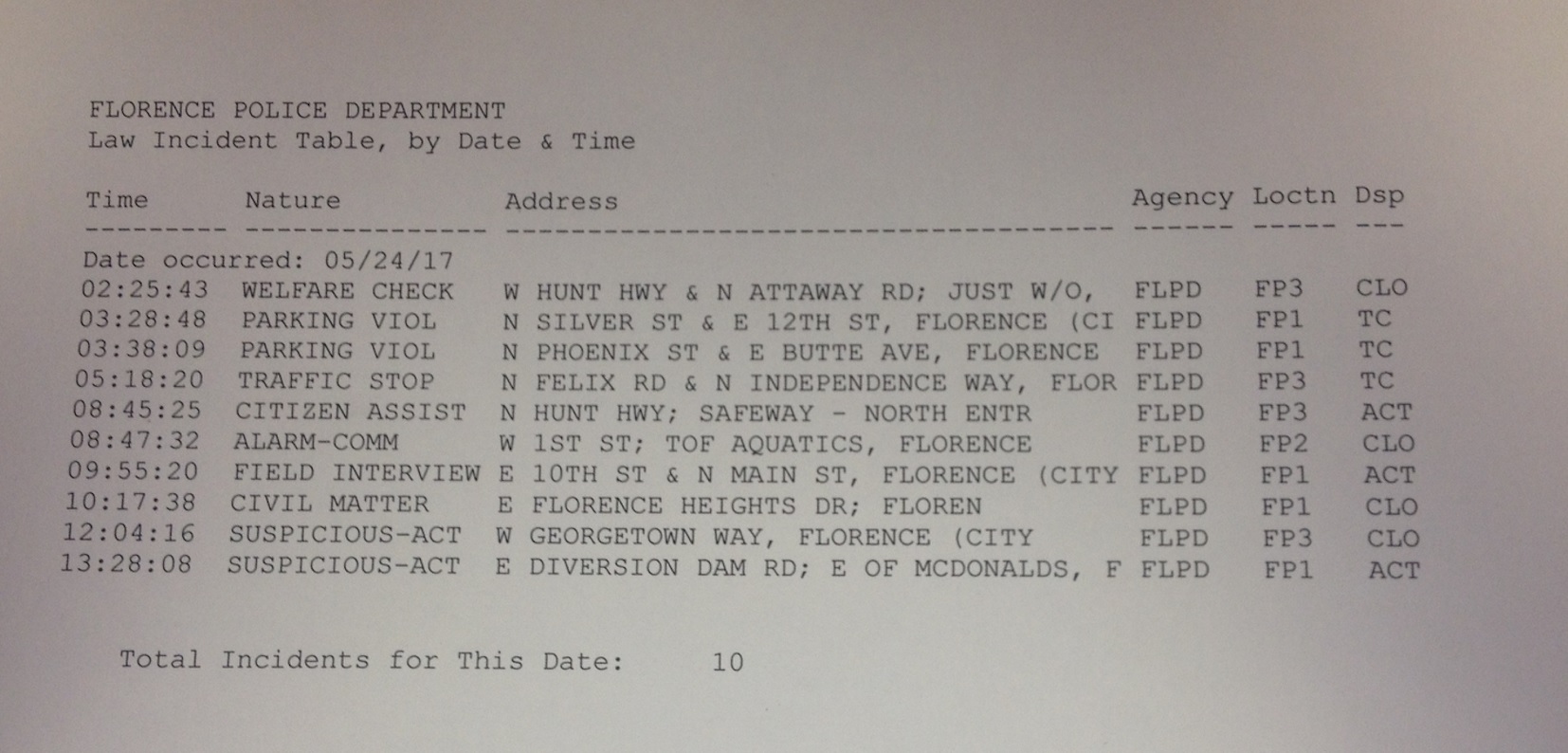
An in-person request for the day’s log of calls for service revealed I’d been called in for “Suspicious Activity.” A formal request for the recording of that call could not immediately be filled, though I’m looking forward to hearing just how suspicious I seemed to the caller.

My final official stop of the trip was back to the Town Hall to inspect and capture additional records related to the development of the two private prison facilities. There, I had a lovely and friendly experience with the deputy clerk as I inspected development records.
I rode out of town on Thursday, using a locally-available driver to make my escape.
As a court record research mission, the excursion had been thwarted early. But as an introduction to the touchiness of a desert town dependent on its inmate populations, the quick trip through the hot, hot streets had proved an education in itself, one I was thankful to be able to freely leave.
Want to know more about how prisons, both public and private, operate in Arizona? Check out Beryl’s guide here.


Image by Beryl Lipton


News from AHF Developer Forum in New Orleans [2 items]

AFFORDABLE HOUSING FINANCE
Inside the AHF 50: Top Developers Identify New Opportunities
Reporter Donna Kimura caught up with four veteran developers on May 24, 2017 @ AHF 50 Developers - (left to right, top to bottom) Brett Johnson of Overland Property Group, Matthew Rieger of Housing Trust Group, Meg Manley of McCormack Baron Salazar and Tom Capp of Gorman & Company. All their firms are on this year’s AHF 50 list of top developers.
They reveal how they are approaching the current environment of lower low-income housing tax credit (LIHTC) pricing and identify the traits that made their companies leaders in the field. They also share the trends they see coming for the industry
AHF Developer Forum
In an 11:13 video that you can listen to and watch accessible on the above source link, the four developers reveal how they are approaching the current environment of lower low-income housing tax credit (LIHTC) pricing and identify the traits that made their companies leaders in the field. They also share the trends they see coming for the industry.
> One move may be for developers and housing finance agencies to really examine what’s necessary to provide quality housing, including considering smaller units, in this era of cost containment, says Manley.
“I think the trend we’re going to see in the immediate future is maybe getting to a more economical design of our units,” she says.
> The biggest opportunity for LIHTC developers is finding a way to reach renters earning just above the housing credit maximum of 60% of the area median income, says Capp. “Every community we work with right now wants to brainstorm with us about how to hit workforce housing and those income levels that are just a bit higher than our traditional LIHTC population,” he says.
Watch this video sponsored by Love Funding to learn more from the veteran developers.

Washington Update From the 2017 AHF Live: Housing Developers Forum http://www.housingfinance.com/videos/washington-update-from-the-2017-ahf-live-housing-developers-forum_o
Emily Cadik of Enterprise Community Partners and Bob Moss of CohnReznick break down the prospects for tax reform as well as legislation aimed at improving the low-income housing tax credit. The Washington insiders also share their thoughts on the proposed 2018 HUD budget and give us their calls to action.

Tuesday, May 30, 2017

Hey! This Is Way Serious: What's Gonna Go Down Here?

                                                                                        For what seems like more-than-months now, your MesaZona blogger has put Lynn Tilton in the spotlight here for a number of posts for different reasons - six altogether starting 26 Jan 2017, including a Barbara Walters interview from Nov  
This news from Bloomberg today is the latest episode
Tilton Rejected by U.S. Supreme Court on SEC Fraud Complaint
by Greg Stohr  ‎May‎ ‎30‎, ‎2017‎ ‎6‎:‎33‎ ‎AM
Source: Bloomberg
Tilton is fighting an SEC administrative complaint that accuses her of misleading investors about the value of risky pools of corporate loans. A ruling from a judge at the SEC could come any day.
Tilton argued in her appeal that the SEC’s use of in-house judges is unconstitutional and gives the agency an unfair advantage. She will have another chance to make that argument -- and perhaps seek Supreme Court review -- should the SEC judge rule against her.
The agency says Tilton overcharged investors almost $200 million on fees she collected on $2.5 billion of collateralized loan obligations she created to help fund her various businesses
Patriarch and Tilton say the claims are meritless.
[ Blogger's Note: Patriarch Partners owns Boeing and MD Helicopters here in Mesa, among 60 other companies
Federal courts are divided on the constitutionality of SEC judges. With Tilton, two lower courts said they didn’t have the power to consider that issue until the case first made its way through the SEC.


In September, the Supreme Court refused a request by Tilton to block the SEC proceeding from going forward.
The case is Tilton v. SEC, 16-906.

See what's posted on this blog from an earlier Bloomberg interview
https://mesazona.blogspot.com/2017/02/sec-lynn-tilton-defrauded-investors-did.html