Wednesday, January 29, 2020

Yield Curve Inversion - A Predictor For A Recession - Has Been Wrong Only Once In The Past 50 Years

2 days ago on 27 January 2020 it re-inverted . . . the clock is ticking down
Image result for yield curve inversion"

Inversion has been a false signal just once in that time.
Here's a clip of a report in Axios 2 hours ago
U.S. Treasury yield curve inverts again
Data: Investing.com; Chart: Chris Canipe/Axios 
What the Yield Curve can tell us about the next recession
 
 
What it means: When yields on short-dated Treasury notes (typically 3-month bills to 2-year notes) climb above longer-dated ones, it signals short-term borrowing costs are more expensive than longer-term loan costs.
  • As Reuters' Dhara Ranasinghe and Sujata Rao note, "Under these circumstances, companies often find it more expensive to fund their operations, and executives tend to temper or shelve investments. Consumer borrowing costs also rise and consumer spending, which accounts for more than two-thirds of U.S. economic activity, slows."
  • "The economy eventually contracts and unemployment rises."
Timing: The yield curve has inverted six to 24 months before every U.S. recession and it typically reverts to normal before the recession comes.
  • It first inverted in March.
_______________________________________________________________________
 
Percentage point difference between 3-month and longer-term yields on U.S. Treasury bonds
Normal yield curve
Normal yield curve
A Treasury bond is a bet on economic growth. When investors are confident, longer terms have higher yields.
3M6M1Y2Y3Y5Y7Y10Y–1%0+1%+2%+3%⟻ Terms ⟼
December 2013
Long-term yields were higher
An inverted yield curve
If investors fear a recession, they'll settle for lower yields on long-term debt. The curve "inverts" when short-term yields are higher.
3M6M1Y2Y3Y5Y7Y10Y–1%0+1%+2%+3%⟻ Terms ⟼
June 1989
Recession began in July 1990
December 2000
Recession began in March 2001
March 2007
Recession began in December 2007
The yield curve in 2019
The difference between short- and long-term yields has been moving toward an inversion in 2019, which could indicate that investors think we're nearing a recession.
3M6M1Y2Y3Y5Y7Y10Y–1%0+1%+2%+3%⟻ Terms ⟼


Big Media's Free-For-All @ SkyBridge > Keep Shoveling, Guys!

Just another one of those not so magical created for public consumption - one more "Believe It or Not' stories emanating from the ground-level crew of media mainstream reporters working for  AZ Big Media.com
The more they pile-it up, the more you might believe it!
How SkyBridge creates opportunity to grow other business sectors
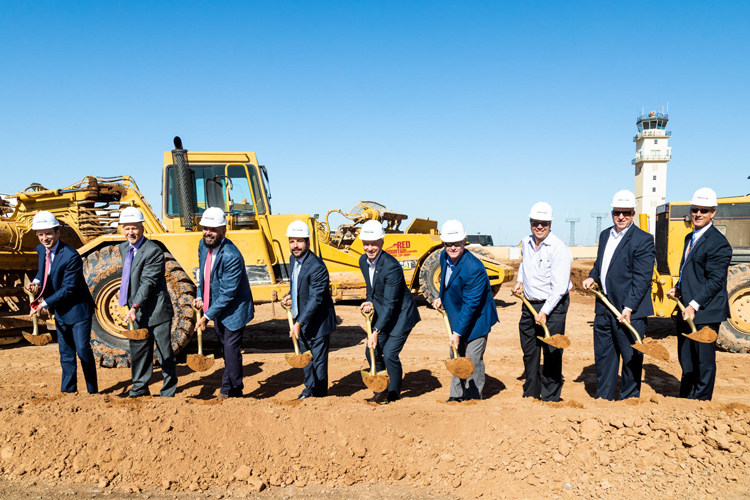
Above: Helping break ground at SkyBridge Arizona are Jose Pablo Martinez, SkyBridge project manager; Pete Wentis, senior vice president, CBRE; Felipe Monroy, SkyBridge Developments; Ariel Picker, president, Skyplus Developments; Mayor John Giles, City of Mesa; Councilmember; Kevin Thompson, City of Mesa; Jeff Flemming, director, ADM Group; Rusty Martin, project executive, Graycor Construction Company; and J. Brian O’Neill, executive director and CEO, Phoenix-Mesa Gateway Airport Authority.
"Erik Lee, executive director for North American Research Partnership, summarizes the impact very succinctly. “SkyBridge is the most consequential Mexico-Arizona business project in this part of Arizona,” Lee states emphatically."
_________________________________________________________________________
BLOGGER NOTE: OK.
That much is true: in this part of Arizona
However, Saints Holdings LLC is moving ahead fast on a big inland port patterned after one in Salt Lake City close to Coolidge, in Penal County.
Readers of this blog can use THE SEARCHBOX on this site to access and view earlier posts.
Natalie Lewis, who works in the Mesa City Manager's Office helped arrange the sale of 11,400 acres with water-rights to Pinal Land Holdings that was bought out by Saints Holdings -
providing a windfall of millions for the City of Mesa to pay off some outstanding Debt Bond Obligations.
An entity named Andersen CP LLC recently purchased another 686 acres for real estate development.
__________________________________________________________________________
__________________________________________________________________________
Summarizing the impact? HUH? Looks like it's just broken ground
"SkyBridge marks the nation’s first inland air cargo hub to house a joint United States-Mexico customs facility. The recent groundbreaking of SkyBridge, housed in Phoenix-Mesa Gateway Airport, marks an opportunity for 17,000 projected long-term jobs to enter the region — both directly and indirectly.
But job creation is just one snippet born of a much larger “SkyBridge vision. . .”
Opportunity knocks at SkyBridge
“Opportunity is tremendous when you think about the fact that we are currently at less than one-half of the market penetration into Mexico and Latin America,” López says.
“The question has been, ‘How can we facilitate it?’
"That’s where we come to the SkyBridge opportunity. This is an Arizona story centered at the Gateway-Mesa Phoenix airport.”
. . . According to López, 75 percent of goods bought online from Latin American countries are being purchased from e-commerce websites in the U.S. This makes SkyBridge perfectly positioned as an international clearance hub for goods bought in the U.S.
“It offers e-commerce to Mexican consumers in big-box retailers,” Lee says.
“It seems to me that it’s a golden opportunity to connect high tech, automotive and aerospace industries in Mexico. It’s both highly profitable and time-sensitive.”
__________________________________________________________________________________
NOTE: Ryan Smith
(Nice job if you can get it! He's the son of former Mesa Mayor Scott, who worked for real estate developer KB Homes before getting his present position)
“SkyBridge is a great asset to add to what we have at Phoenix-Mesa Gateway Airport,” says Ryan Smith, director, communications and government relations, Phoenix-Mesa Gateway Airport Authority. “We view Phoenix-Mesa Gateway Airport not as much as an airport, but as a large redevelopment project that just happens to have an airport. So when you look at a project like SkyBridge, with lots of acreage and direct access to three 10,000-foot runways, the possibilities are limitless as to what you can produce there and what can locate at SkyBridge. . ."
 
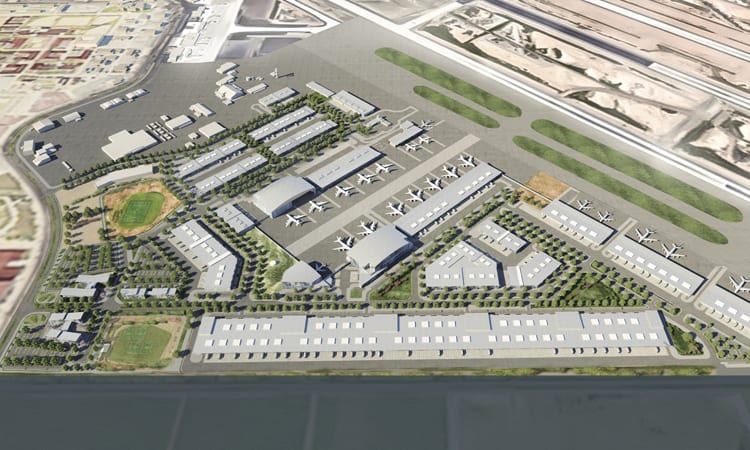
> According to Gov. Doug Ducey’s office, SkyBridge is a $230 million commercial development that will have 2 million square feet of warehouse space, 1 million square feet of office space, 800,000 square feet of air cargo operations, 900,000 square feet of light industrial and flex space, and 100,000 square feet of retail and restaurants. It is also expected to increase cargo flights out of Phoenix-Mesa Gateway to 2,000 per year, a number that will skyrocket to 10,000 by 2036.
________________________________________________________________
Time is of the essence
Camacho agrees with Lee that when it comes to maximizing SkyBridge opportunities, time is of the essence.
“SkyBridge got out the gate quickly with Mexican and U.S. customs,” Camacho says. “What I hear every day is the clock ticking because every day there are other states that are running vigorously to pursue similar opportunities. They also see the Latin American market as a tremendous e-commerce platform.”
Why will other regions rush to formulate their own versions of SkyBridge — or try to anyway? There are several motivating factors.
First, SkyBridge enables a streamlined duty process essential to fostering a healthy and productive e-commerce environment.
“The duty for goods is paid here in Arizona and transmitted to each country’s tax collection office,” López says, “which means no more abandoned goods that taxes aren’t collected on.”
This results in a win-win for the consumer who buys the product; the tax authority
who collects the duty; the logistics chain that can expand its operation into Latin America; and the company that operates only in the U.S.today, but wants to expand south of the border.
“Arizona then becomes the leader in logistics,” López says. “We have the Arizona State University Polytechnic Campus across from SkyBridge. We know that e-commerce will not only continue to grow in Latin America, but also locally and globally.”
It’s also an opportunity to grow other business sectors.
“This is an inland port that brings the conversation to tech businesses in Arizona,” Lee adds. “It was going to take someone like Marco (López ) bringing his meaningful relationships with Mexico to make this work. It’s a real project for Arizona politicians and local officials and focus on — touch, feel and think about — and anchor their interest in Mexico and border relationships.”
Better delivery
". . . In addition, companies operating out of SkyBridge benefit by saving three to four months of tax benefits since taxes are not required to be paid until a company has a buyer.
Goods can be trucked to Mesa, stored in a warehouse, add value by being assembled onsite, and all the while, still be classified as a foreign product until it goes to the buyer.
“For Arizona, this means our state becomes the place where companies come that want to interact with Mexico,” López says.
“There’s no stop in terms of opportunity potential. The long-term potential of SkyBridge is that in terms of national logistics leadership, no other city in America has this type of infrastructure ready to go.”
Saint Holdings LLC. No Longer A Low-Profile


Jackob Andersen, Saint’s president and CEO, personally involved in bringing big economic development projects to the State of Arizona and Pinal County, by arranging land deals and acquiring rights-to-water, apparently likes the spotlight. All those BIG LAND DEALS have not gone un-noticed - or publicized - including getting put into the spotlight by your MesaZona blogger.
"We are one of the largest land owners and developers in the state of Arizona,”
---- Rose Law Group Reporter 17 May 2019
That's the outcome for the power-wielding influence from the Saints' control in the established intersection of Finance, Religion and Politics
Its holdings include:
  • Heritage Arizona: an 11,438-acre development in Coolidge slated for many land uses including commercial, residential and renewable energy developments.
  • Saint has also developed the 2,700 acre Inland Port Arizona. The Inland Port has direct railroad access and is modeled after Union Pacific’s hub in Salt Lake City. The Inland port is  home to the planned Nikola plant which landed there after originally looking to locate in Buckeye.
  • Central Arizona Commerce Park: a nearly 700-acre industrial park with shovel-ready parcels. The Casa Grande development is in an Opportunity Zone offering tax breaks for real estate and business investments. The project Is directly served by Union Pacific railroad. Lucid Motors and Tractor Supply Co. have located at the Casa Grande park.
  • The latter involves 360 job at a regional center.
  • Andersen said that deal was born in Nashville when he was at their headquarters to finalize contracts or agricultural products and ended up meeting with TSC executives about a western expansion.
__________________________________________________________________________
mm

Ground-Breaking Ceremony ? ASU Creative Futures Lab @ Mesa City Center

Let's have A REALITY-CHECK: It's a box-of-dirt constructed for celebrating the long-delayed occasion to mark the start of an ASU Mecca for Media-Creation campus here in Downtown Mesa - on top of an asphalt parking lot! . . .. .Looks like an oversized litter-box
__________________________________________________________________________________
Now really . . .
Once upon a time this was pretty pastel-colored vision specially created to make Mesa taxpayers believe and pay for some kind of development to leverage all those rampant real estate speculation schemes for the private wealth-creation of a closely-connected cohort of some of Mayor John Giles friends who wanted to gamble on gaining title to more than 10 downtown commercial properties. 
Their privately-funded $500,000+ public relations campaign to use public money turned into a major screw-up in 2016 when taxpayers rejected the proposition.
Before the end of the following year 2017, then-AZ State Senator Bob Worsley formed a number of holding companies to use private capital to scoop-up ownership of eight commercial properties on Main Street in close proximity to the proposed location. 

Tuesday, January 28, 2020

Add $6,000,000 More To Massive Mormon Make-Over of Downtown Mesa


City Council Report 
Date:  January 27, 2020

To:  City Council
Through: Kari Kent, Assistant City Manager
From:  Beth Huning, City Engineer   Rob Kidder, Assistant City Engineer 
Subject: 1st Avenue Right-of-Way Improvements - Phase 1 (Hibbert to LeSueur) Construction Manager at Risk (CMAR) 

Second (of two) Guaranteed Maximum Price (GMP) Contracts

City Project No. CP02791STS
Council District 4  

Purpose and Recommendation 
The purpose of this report is to present the Guaranteed Maximum Price (GMP) No. 2 for the proposed 1st Avenue Right-of-Way Improvements (Phase 1), a Construction Manager at Risk (CMAR) project. (See Exhibit “A” for project location).   
GMP No. 2 includes roadway improvement work on 1st Avenue from Hibbert Street to LeSueur.

This is the 2nd of two GMP’s for this Phase of this project. 
GMP No. 1 was previously approved by Council in the amount of $1,164,237 to address sewer line improvements in 1st Avenue. 
Staff recommends that Council award the construction contract for this portion of the CMAR project to Haydon Building Corp in the amount of $4,610,542 and authorize a change order allowance in the amount of  $230,527 (5%), for an authorized total of $4,841,069. 


Background 
In November of 2012, the City of Mesa voters approved the 2013 Street Bonds.

This funding provided for streetscape enhancements along 1st Avenue from Country Club Drive to LeSueur.
During the concept design phase, a review of the aging asphalt pavement identified a need for pavement replacement; however, due to escalated construction costs and planned budget reductions, the limits of the project were reduced to phase the construction for 1st Avenue.
The limits for this Phase 1 extend from Hibbert Street to LeSueur. 
The total improvements for Phase 1 include a new sewer line from Hibbert Street to
LeSueur, completed under GMP No. 1. 


GMP No. 2 will complete the roadway improvements on 1st Avenue which include: 
> A) Mesa Drive to LeSueur: 

New asphalt pavement, sidewalk improvements, a raised median, a new storm drain, electrical undergrounding, and rehabilitated street lighting.
Landscape and tree enhancements, as well as gas and water relocations will be completed by an adjacent developer.  

> B) Hibbert to Mesa Drive: 

New asphalt pavement, American’s with Disabilities Act (ADA) sidewalk improvements, a new curb return at the northwest corner of Pomeroy/1st Avenue, landscaping, water, gas, sewer line installations and rehabilitation, electrical undergrounding of mains and services in various areas, improved storm drains, and relocation of the City’s flood irrigation facilities from Hibbert Street to Mesa Drive.  

Discussion 
In March of 2019, Staff received three (3) “Statements of Qualifications” (SOQ) from contractors proposing to act as the CMAR for this project.

Based on an evaluation of these SOQ’s, Haydon Building Corp. was recommended as the most qualified CMAR and was awarded a Pre-Construction Services contract.
Haydon Building Corp has been responsible for pre-construction services including reviewing the design for constructability, preparing cost estimates, and developing the project schedule and phasing. 
This approval is for the second of two (2) GMP’s for Phase 1 of this project and will complete the roadway improvements from Hibbert Street to LeSueur.     
Once underway, the overall construction of this phase of the project is anticipated to last no more than 10 months. 


Alternatives 
An alternative to the approval of a Construction Services contract for this CMAR would be to construct this project using the traditional Design/Bid/Build method. 

This is not recommended due to the complexity, coordination with surrounding projects, construction sequencing and expedited timeline of the project
The majority of the work on this GMP was competitively bid by Haydon Building Corp to multiple subcontractors, and Mesa based businesses, including affiliated business, were given an opportunity to bid on the work.   
Alternatives include not performing the work or eliminating portions of the proposed project.  These alternatives are not recommended because of the need to support on- going development in the downtown area and provide pedestrian and transit friendly
infrastructure within this highly used corridor.


Fiscal Impact 
The total authorized amount recommended for this project is  $4,841,069, based upon a GMP of  $4,610,542, plus an additional  $230,527 (5%) as a change order allowance. 

This change order allowance will only be utilized for approved change orders.  
This project is funded by

  • 2013 authorized Street Bonds and
  • 2014 authorized Gas, Electric and Water Bonds.   
Coordinated With 
The Transportation, Energy Resources and Water Resources Departments concur with this recommendation.  

______________________________________________________________________
Item 4-m
File #: 20-0096   
Type: Contract Status: Agenda Ready
In control: City Council
On agenda: 1/27/2020
Title: 1st Avenue Right-of-Way Improvements Project - Phase 1 (Hibbert to LeSueur), Construction Manager at Risk (CMAR),
Second (of two) Guaranteed Maximum Price (GMP) (District 4)
GMP No. 2 will complete the roadway improvements on 1st Avenue which include: 1) Mesa Drive to LeSueur
new asphalt pavement, sidewalk improvements, a raised median, a new storm drain, electrical undergrounding, and rehabilitated street lighting.
Landscape and tree enhancements, as well as gas and water relocations will be completed by an adjacent developer; and
2) Hibbert to Mesa Drive
new asphalt pavement, American’s with Disabilities Act (ADA) sidewalk improvements, a new curb return at the northwest corner of Pomeroy/1st Avenue, landscaping, water, gas, sewer line installations and rehabilitation, electrical undergrounding of mains and services in various areas, improved storm drains, and relocation of the City’s flood irrigation facilities from Hibbert Street to Mesa Drive. Staff recommends awarding the co...
Attachments: 1. Council Report,
2. Project Map 

How Iran's Soleimani became a US target


61,552 views
Jan 28, 2020
He commanded an army of militias across the Middle East. Correction: At 6:09 and 7:33, we mistakenly labelled Iran's Ayatollah Ali Khamenei as Ayatollah Khomeini. The error is regretted. Further Reading: Jen Kirby, Vox: https://www.vox.com/world/2020/1/7/21... Dexter Filkins, the New Yorker: https://www.newyorker.com/magazine/20... Crisis Group: https://www.crisisgroup.org/trigger-l... The Soufan Center: https://thesoufancenter.org/wp-conten... The Middle East Institute: https://www.mei.edu/sites/default/fil... Before Qassem Soleimani was killed in a US air strike in Iraq, he was arguably Iran's second most important leader. He commanded the soldiers and spies of Iran's elite Quds Force, a group whose job was to forge partnerships with militias across the Middle East, through which Soleimani spread Iran's influence and his own. From Hezbollah in Lebanon to the many Shia militias in Iraq, these groups played a central role in the medley of wars that have roiled the Middle East for the last few decades. Soleimani didn't invent Iran's use of proxy militias; that dates back to at least 1979, when Iran's new regime looked around the region and found many enemies and few friends. But 40 years later, thanks in part to Soleimani's work, Iran has the advantage in the Middle East. Vox Atlas demonstrates where conflicts occur on a map and the ways in which foreign policy shapes a region. Watch all the episodes here: http://bit.ly/2SThVsf Become a Video Lab member! http://bit.ly/video-lab Vox.com is a news website that helps you cut through the noise and understand what's really driving the events in the headlines. Check out http://www.vox.com.