In March of this year, the US Attorney in Los Angeles, California secured an indictment against a secure vault company, alleging the company was engaged in money laundering, drug trafficking, and hiding taxable assets. None of the company's employees or owners were indicted.
FBI agents spent five days turning US Private Vaults upside down. Agents apparently emptied every safety deposit box housed by the business. They did this in complete contradiction of the limits imposed on them by the FBI's own warrant affidavit. . .
The FBI could have taken custody of the boxes without opening them and sought warrants for those implicated by the investigation. Instead, the FBI agents emptied the boxes while still on the premises, engaging in dozens of searches not authorized by any warrant. . .
The FBI says it's only willing to return items from about a quarter of the boxes its agents searched and seized without a warrant.
The FBI has returned the contents of about 75 boxes and plans to give back the items found in at least 175 more, because there was no evidence of criminality, Mrozek said. Federal agents have not determined who owns what was stored in many other boxes.
That's the latest from Thomas Mrozek, the spokesperson for the Los Angeles US Attorney's office. The FBI and federal prosecutors are hoping to take ownership of as much as possible from the remaining boxes, all of which is detailed in the very long inventory list compiled by the agents who performed the raid.
This is extremely ugly. Unfortunately, the use of civil forfeiture shifts some of the burden to those whose assets were seized. The government doesn't really have to do anything. If claimants don't come forward before June 24, those unclaimed assets will become government property, whether or not they had anything to do with criminal activity.
Those that do file a claim will have to deal with a convoluted and expensive process that helps ensure the government will still get to keep most of what it seized under the guise of performing an inventory. The burden of proof for the government is extremely low. And it's apparently telling judges a dog gave agents permission to engage in a bunch of warrantless seizures.
Drug-sniffing dogs at the store during the raid alerted to traces of drugs on most of the money found in boxes, FBI agent Justin Palmerton claimed in a court statement. The boxes containing that cash are subject to criminal investigation, he said.
This claim is stupid as fuck and hopefully won't be given any respect from judges that are subjected to it. Most currency contains trace amounts of drugs. That's common knowledge. But the FBI isn't raiding banks just because a dog alerted near the ATM. This is a completely disingenuous claim and, by itself, isn't evidence of anything more than the FBI's willingness to use literally anything to justify its warrantless acquisition of other people's property.
This starts off about 10 minutes into this Slide Show Presentation > Watch-and-Listen to what they have to say about "a relationship" they have with Ring Door Bells + their Neighborhood Surveillance Networks
RTCC Real Time Crime Center
Official Meeting Details if you want take a look ahead of time Items *3-g, *3-h and *3-i
EFF Publishes New Research on Real-Time Crime Centers in the U.S.
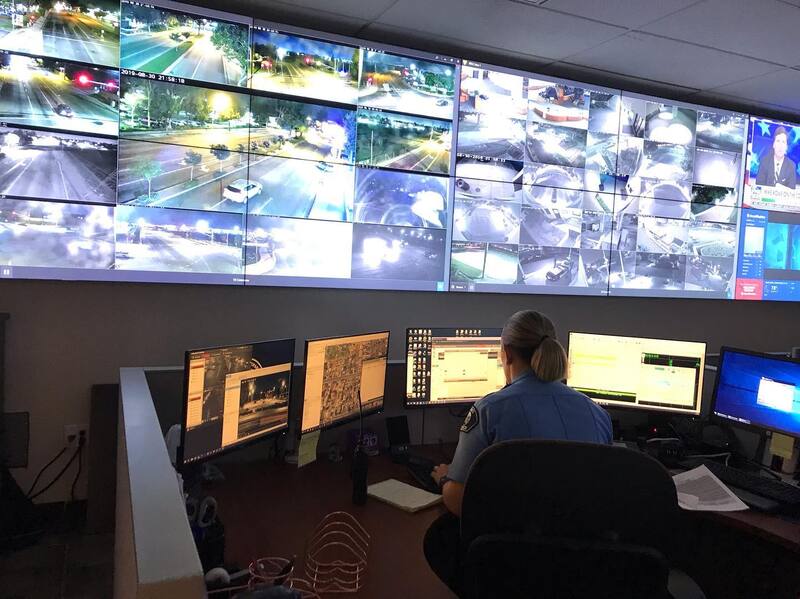
Researched and written in collaboration with students at the Reynolds School of Journalism at the University of Nevada, Reno, the report focuses on the growth of real-time crime centers (RTCCs). These police facilities serve as central nodes and control rooms for a variety of surveillance technologies, including automated license plate readers, gunshots detection, and predictive policing. Perhaps the most defining characteristic of a RTCC is that a network of video cameras installed in the community that analysts watch on a wall of monitors, often in combination with sophisticated, automated analytical software.
As we write in the report:
RTCCs are similar to Fusion Centers, to the extent the terms are sometimes used interchangeably. We distinguish between the two: fusion centers are technology command centers that function on a larger regional level, are typically controlled by a state-level organization, and are formally part of the U.S. Department of Homeland Security's fusion center network. They also focus on distributing information about national security "threats," which are often broadly interpreted. RTCCs are generally focused on municipal or county level activities and focus on a general spectrum of public safety issues, from car thefts to gun crime to situational awareness at public events.
The term “real-time” is also somewhat misleading: while there is often a focus on accessing data in real-time to communicate to first responders, many law enforcement agencies use RTCC to mine historical data to make decisions about the future through "predictive policing," a controversial and largely unproven strategy to identify places where crime could occur or people who might commit crimes.
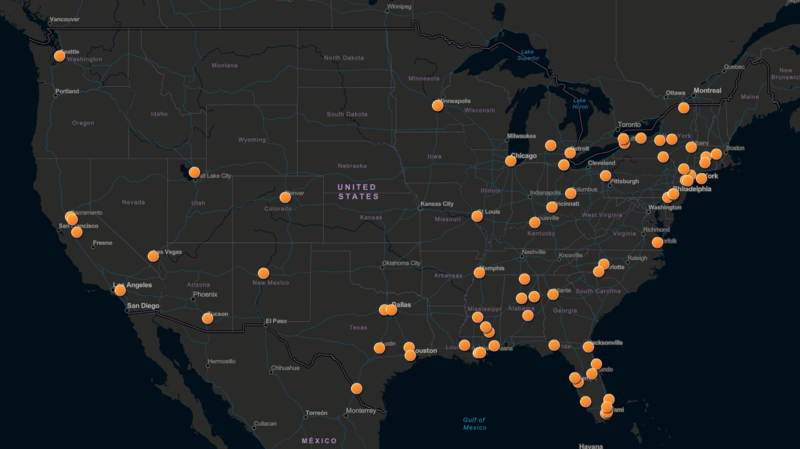
These profiles break down the costs, what technology is installed in neighborhoods, and what type of equipment and software is accessible by RTCC staff.
We also document controversies that have arisen in response to the creation of these RTCCs.
"Surveillance Compounded" is part of the Atlas of Surveillance project, an ongoing collaboration with the Reynolds School of Journalism that aims to build a central database and map of police technologies using open source intelligence.
As of November 15, 2020, the Atlas contains more than 6,100 data points related to automated license plate readers, drones, body-worn cameras, cell-site simulators, and other law enforcement technologies.
Five-Year Term Contract for the Purchase of Axon Flex On-Body Camera Equipment, Supplies and Evidence.com Storage and Controlled Electrical Weapon Equipment and Supplies for the Mesa Police Department (Replacements/Upgrades) (Sole Source) (Citywide) The Police Department began using Axon Flex On-Body Cameras (OBCs) in 2012 and using Controlled Electrical Weapon (CEW) equipment in 2011. In addition to hardware, the Police Department purchased five years of secure cloud data storage through Evidence.com. This contract includes an Axon refresh plan for OBCs and docks, which will cycle to the most current format every 2.5 years. Also, regarding CEWs, a warranty is included which covers the devices for the entirety of the contract. These provisions will ensure that program costs are evenly dispersed, the program can be sufficiently maintained, and will be financially supported for the foreseeable future without the need to purchase any replacement devices or docks which may get damaged...
It looks from all appearances just like another "Casual Tuesday" inside the Council Chambers - and what
outside Excessive High Temperatures in a series of record-breaking heat and High Ozone Pollution Alerts and Warnings and Toxic Levels of Smoke in the skies from Wild Forest Fires > first-hand evidence of Climate Change with a Decades-Old Drought that's been ignored for too long, but it's "business-as-usual" and closed off to the public but you can watch it
About 15 minutes short of two hours with half the time for today's agenda and half for Monday's agenda
THURSDAY: 2 PRESENTATIONS
1. A Climate Action Plan that is sketchy to say the least; basically "Kicking-the-Can" down the road until some time later
2. A Major Development Proposal from 2016 for a
"Smart Growth Community" Proposal is going nowhere > Jeff McVay and Kusi Appiah
MONDAY'S AGENDA IN HUGE
One item got some individual attention
Item *3-l: Contract Award for millions in multi-year contracts for the Mesa PD was removed
Hear a presentation and discuss proposed modifications to an approved Smart Growth Community Plan to allow a mixed-use transit-oriented development located east of Dobson Road and north of Main Street.
Hear a presentation, discuss, and provide direction on proposed text amendments, including but not limited to Chapters 7, 31, 86, and 87 of Title 11 of the Mesa Zoning Ordinance pertaining to marijuana facilities.
Hear a presentation, discuss, and provide direction on proposed text amendments to Title 11, the Mesa Zoning Ordinance, pertaining to Community Residences (i.e., currently known as Group Homes or Group Homes for the Handicapped in the Zoning Ordinance), Correctional Transitional Housing Facilities, and Administrative Use Permits.
Public Safety Training Facility Burn Building Project - Construction Manager at Risk (CMAR), Guaranteed Maximum Price (GMP) (District 5) This project is for the construction of a burn building for the Fire and Medical Department to be used for live fire training. The project was originally bid in 2015; however, the contractor was unable to meet the performance requirements that resulted in the demolition of the partially constructed building. The City determined to proceed with a new building, utilizing the previous design with minor adjustments. Staff recommends awarding a construction services contract to the Construction Manager at Risk (CMAR), CORE Construction, Inc.(a Mesa business), in the amount of $2,560,429.36 (GMP), and authorizing a change order allowance in the amount of $128,021.47, for a total amount of $2,688,450.83. This project is funded by the 2013 Public Safety Bonds and the General Fund.
Five-Year Term Contract for the Purchase of Axon Flex On-Body Camera Equipment, Supplies and Evidence.com Storage and Controlled Electrical Weapon Equipment and Supplies for the Mesa Police Department Five-Year Term Contract for the Purchase of Axon Flex On-Body Camera Equipment, Supplies and Evidence.com Storage and Controlled Electrical Weapon Equipment and Supplies for the Mesa Police Department
Five-Year Term Contract for the Purchase of Axon Flex On-Body Camera Equipment, Supplies and Evidence.com Storage and Controlled Electrical Weapon Equipment and Supplies for the Mesa Police Department (Replacements/Upgrades) (Sole Source) (Citywide) The Police Department began using Axon Flex On-Body Cameras (OBCs) in 2012 and using Controlled Electrical Weapon (CEW) equipment in 2011. In addition to hardware, the Police Department purchased five years of secure cloud data storage through Evidence.com. This contract includes an Axon refresh plan for OBCs and docks, which will cycle to the most current format every 2.5 years. Also, regarding CEWs, a warranty is included which covers the devices for the entirety of the contract. These provisions will ensure that program costs are evenly dispersed, the program can be sufficiently maintained, and will be financially supported for the foreseeable future without the need to purchase any replacement devices or docks which may get damaged...