Sunday, July 25, 2021

About that "Heat Dome"...No Need Anymore for A Second-Hand Source

No doubt about it - that event happened. There is no denying that - seeing is believing and the good news is that heatwaves are now on people’s radars a bit more, just a bit more. . .
One recent article said, "It’s a teachable moment in many ways for the public that climate change is here and now and dangerous. It isn’t our grandchildren’s problem, it’s our problem. But it’s been a teachable moment for climate scientists too.”
The most extensive heatwave of a scorching summer is set to descend upon much of America in the coming week, further roasting areas already gripped by severe drought, plunging reservoirs and wildfires.

Climate Prediction Center
National Weather Service Climate Prediction Center
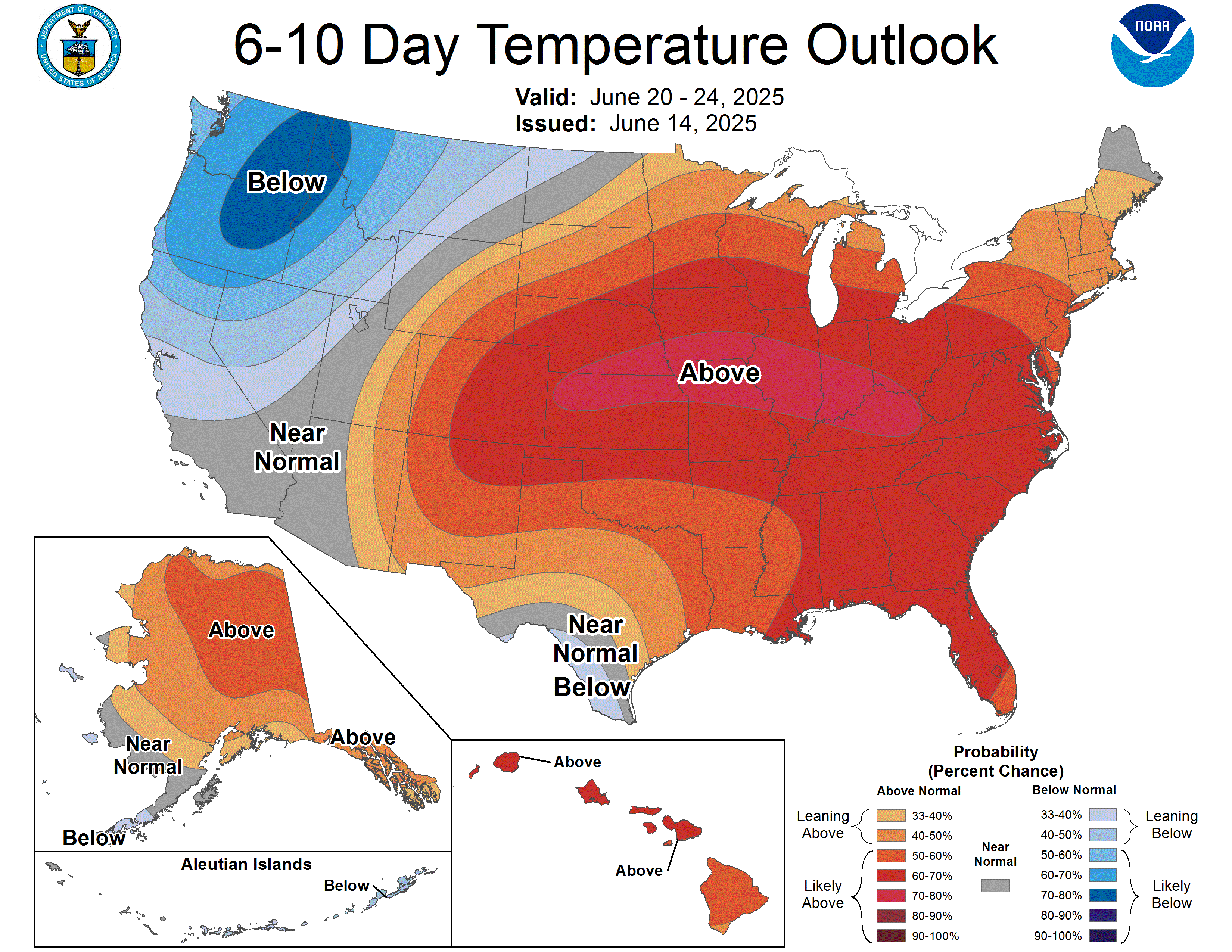
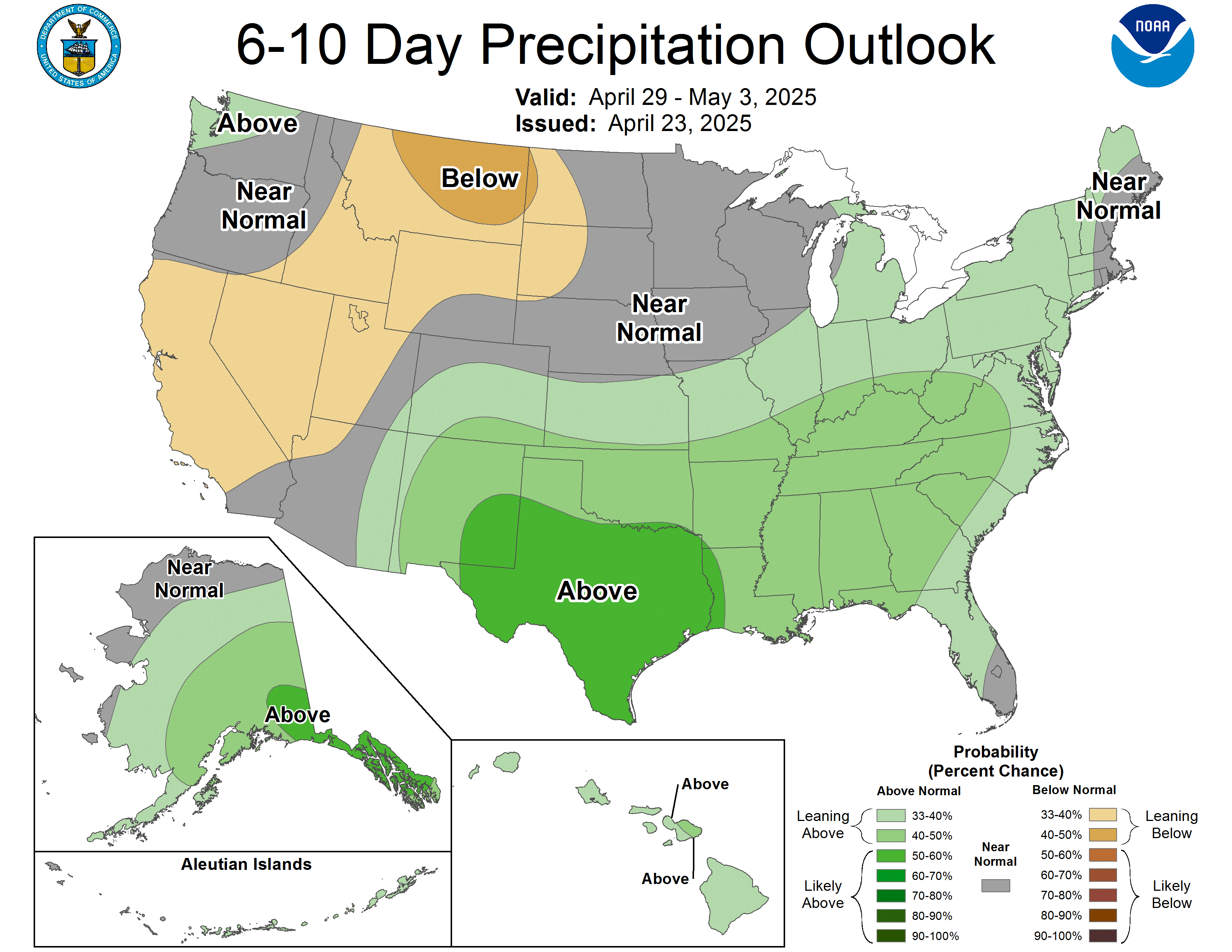
6 to 10 Day Outlooks
Valid: July 30 to August 03, 2021
Updated: 24 Jul 2021
Click below for information about how to read 6-10 day outlook maps
Temperature        Precipitation
Click below for archives of past outlooks (data & graphics), historical analogs to todays forecast, and other formats of the 6-10 day outlooks
Archives Analogs Lines-Only Format GIS Data

Temperature Probability

6 to 10 Day Outlook - Temperature Probability
Precipitation Probability

6 to 10 Day Outlook - Precipitation Probability
 
Related Topics:
Prognostic Discussion, 500mb Heights and Anomalies, Model Guidance Used, 8 to 14 Day Outlooks, Heat Index, Our Mission, Who We Are, CPC Information, CPC Web Team
 

NOAA/ National Weather Service
National Centers for Environmental Prediction
Climate Prediction Center
5830 University Research Court
College Park, Maryland 20740
Page Author: Climate Prediction Center Internet Team
Page last modified: January 25, 2021
Disclaimer
Information Quality
Credits
Glossary
Privacy Policy
Freedom of Information Act (FOIA)
About Us
Career Opportunities
 
========================================================================
NOAA logo - Click to go to the NOAA home page
 
National Weather Service

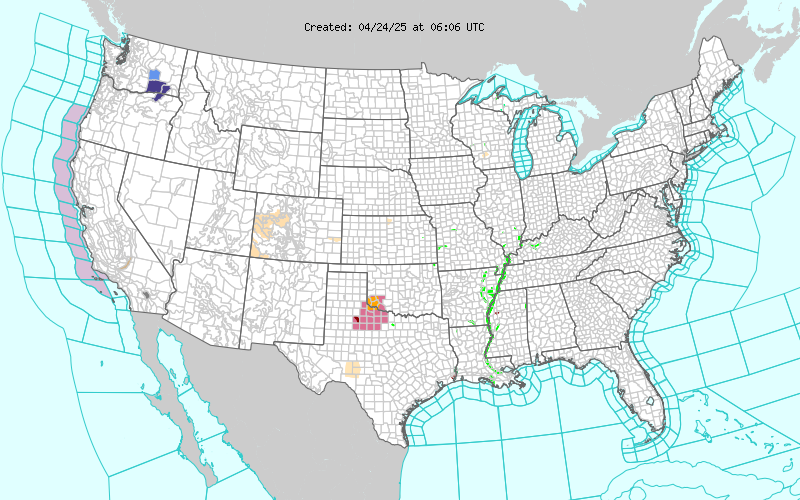
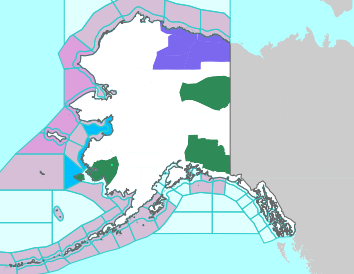
Flash Flood Threat to Persist in the 4-Corners; Heat Threat in Several Regions

The threat of flash flooding will continue to exist into Monday across the Southwest into the the central Rockies as monsoon conditions persist. Dangerous heat will be in place across the Intermountain West, northern Plains, and into the southern Plains and Lower Mississippi River Valley into early week. Read More >

Click on the map above for detailed alerts or

How Jeff Bezos Became Public Enemy Number One.....that "Mid-Life Crisis" Good Billionaire

BEYOND HYPER-LOCAL > Neighbors at The Street Level Right Outside-Your-Door /Block-by-Block: Micro-Grid "One-Minute City"

It all has to start somewhere - right outside your door on the street where you live
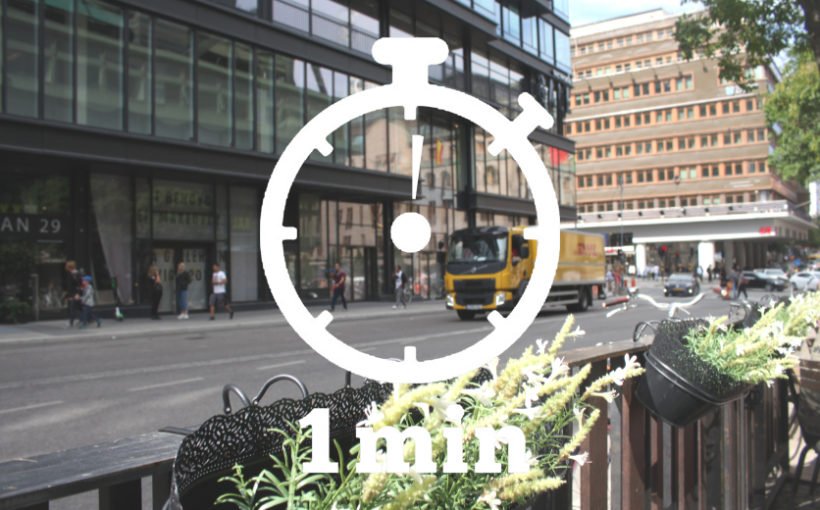
Sweden: the one-minute city - DivercityDivercity |
We frequently use the word "neighbor" to describe people who live next to us in close proximity. 
That's an old word most etymologists and lexicographers agree on taken from its origins; as a name think of the word BOWER "ready-to-grow" + "be active"

(*bheue- )

*bheuə-, also *bheu-, Proto-Indo-European root meaning "to be, exist, grow."

Nearly every language interprets that root in different ways. Here are some examples: It is the hypothetical source of/evidence for its existence is provided by: Sanskrit bhavah "becoming," bhavati "becomes, happens," bhumih "earth, world;" Greek phyein "to bring forth, make grow," phytos, phyton "a plant," physis "growth, nature," phylon "tribe, class, race," phyle "tribe, clan;" Old English beon "be, exist, come to be, become, happen;" Old Church Slavonic byti "be," Greek phu- "become," Old Irish bi'u "I am," Lithuanian būti "to be," Russian byt' "to be."

========================================================================

Here in Mesa, Arizona, city officials have a "Master Plan" - master plans for almost everything!
It's all about that TOP-DOWN THING.
Neighbors live in neighborhoods where some have more character than others. They evolve over time from what may have once been described as thriving to neglected and distressed.
We have officially designated areas for census tracts and zipcodes (all with their own data and data sub-sets), and every 10 years there's a required Census to count the number of every person and every inhabitant in each city.
Now we have something named COMMUNITIES-OF-INTEREST
========================================================================
RELATED CONTENT: Video
 
1 from November 2020 and 1 from 5 days ago
 
========================================================================
RELATED CONTENT: Dan Hill
Dan Hill on Sweden's one minute cities | City of Sydney - What's On
 

Saturday, July 24, 2021

Arizona GQPT Dis-Information Campaign Ground-Zero for Believe-Ability > HEADLINE STORY FROM AZMIRROR'S JEREMY DUDA

Here we go again!
Fact-checking the audit
Logan and Ben Cotton, the CEO of the digital forensics company CyFIR, which is a subcontractor on the election review, made a number of claims during the July 15 briefing that have since been debunked. . .

Once the bad information gets out there, people have got to hear the truth and they’ve got to hear it from a credible source.

– Gowri Ramachandran, Brennan Center for Justice


Damage done: Audit leader’s testimony sets off nationwide wave of misinformation

From the state Capitol in Phoenix to Mar-A-Lago in Florida, people are falsely claiming that the Arizona Senate’s election review showed that tens of thousands of illegitimate votes were counted in Maricopa County.

Lawmakers are saying it. Prominent statewide candidates are saying it. Former President Donald Trump is saying it. 

Who’s not saying it? The audit team leader who started it all.

Doug Logan, the leader of Senate President Karen Fann’s audit team and the CEO of the Florida-based cyber security company Cyber Ninjas, testified at a briefing in the Arizona Senate last week that his analysis found 74,243 early ballots were counted despite no evidence that they were ever mailed to voters. He also claimed to have found more than 11,000 ballots cast by people who weren’t listed as being registered to vote at the time of the election, and nearly 4,000 ballots cast by people who registered after the deadline to vote in the November election.

Logan never said the 74,000 votes were illegally cast or improperly counted. He said he didn’t know for sure. Numerous media outlets, including the Arizona Mirror, investigated the claim in the days after the hearing and found that there was nothing suspicious about the ballots at all. . .

Misinformation abounds

Trump, who is scheduled to attend a rally in Phoenix on Saturday, quickly latched onto the debunked claim, issuing several press releases after the Senate briefing in which he inaccurately described the 74,000 “magically appearing ballots” as illegitimate and falsely claiming that the hearing exposed evidence of fraud. 

“The irregularities revealed at the hearing today amount to hundreds of thousands of votes or, many times what is necessary for us to have won,” said Trump, whom President Joe Biden defeated in Arizona by 10,457 votes.

Other prominent national GOP figures touted the same discredited claims. 

“In Arizona, 74,000 ballots were counted with no record of being sent in,” tweeted U.S. Rep. Lauren Boebert, R-Colorado. “That’s not normal. That’s not right. That’s not safe nor is it secure.”

Closer to home, a number of Republican political figures in Arizona also falsely described Logan’s claim as evidence of as many as 100,000 fraudulent ballots.

Some state lawmakers even went so far as to demand that Arizona recall its 11 electoral votes for Biden, something that is not permitted by the United States Constitution. Rogers, the state senator, called for Arizona to hold a new presidential election on account of “tens of thousands of ballots mailed without being requested, the over ten thousand people who voted after registering after November 3rd,” and other dubious claims from the audit hearing.

State Rep. Mark Finchem, a Republican candidate for secretary of state, called the disproven claim “probably one of the most stunning revelations” to come out of the briefing.

Several major candidates for statewide office also ran with the bogus claims. Kari Lake, a former Fox 10 anchor who is now seeking the GOP nomination for governor, tweeted, “How do Arizonans know if their votes really counted on November 3rd? Tens of thousands of ballots are in question according to auditors — what a debacle!” 

Former U.S. Rep. Matt Salmon, another Republican contender for governor, also misstated Logan’s testimony, claiming that the audit found “real problems” with the 2020 election. “Arizonans have legitimate concerns about how the #election was handled and they deserve answers,” Salmon wrote on Twitter.

Some conservative media outlets promoted the dubious claims as well. The overtly pro-Trump One America News Network, for example, which has a history of repeating false claims about Arizona’s 2020 election and which is actively raising money to pay for the audit, called Logan’s mistaken revelation a “bombshell.”and more . . .

LISTENING TOUR: AZ Independent Redistricting Commission Public Meeting Here in Mesa August 9, 2021

The Arizona Independent Redistricting Commission is looking to find out some information to gather public input on what they would like to see in the ongoing redistricting process
Listening Tour- Round 1 | Independent Redistricting Commission

Mapping tool lets people show communities of interest to IRC

"When redistricting commissioners begin their statewide tour on Friday, Arizonans will be able to not only tell them about their communities of interest but show them as well. The Arizona Independent Redistricting Commission created a tool that’s available on its website that allows people to map out their communities of interest.

The mapping tool is part of a survey that the commission is asking people to fill out to provide public input on what they’d like to see from the redistricting process. 

Communities of interest are any grouping of people with shared interests, identities, concerns or needs. It’s a broad term that can include myriad groups — a specific neighborhood or region, a collection of people who work for the same company or industry, people who use a particular transportation corridor, people who send their children to the same school, or people who rely on a particular service. 

Respecting communities of interest is one of the six criteria in the Arizona Constitution that the IRC must follow when drawing congressional and legislative districts, and because it is such a wide-ranging term that is subject to so much interpretation, it can be one of the trickiest requirements the commission faces.

INSERT: Community of Interest Survey

Below are links to the irc's Community of Interest Survey which will be utilized to solicit public comment on The Commission's Listening tour

Whether you chose to participate at one of our public hearings or from the convience of your home, the community of interest survey is the best way to let the Commission know about what is important to your community and how you are represented.

This survey will reamin active until Tuesday, August 10th 2021 at 5:00pm MST and 6:00pm MDT.

========================================================================

The IRC created the survey for people to fill out in preparation for its upcoming listening tour, which will see the commission hold 15 meetings across the state over 17 days to receive public input before it begins drawing new districts.

HERE IN MESA AUGUST 9, 2021

Monday, August 9, 20215:00pm

Mesa Convention Center - Superstition Ballroom

263 N. Center St. 

Mesa, AZ  85201


Agenda

Presentation

Socioeconomic Report

Submit Public CommentsWatch Live


Listening Tour- Round 1

Arizona Independent Redistricting Commission Seeking Public Input

On New Legislative and Congressional District Boundaries

Arizona's Independent Redistricting Commission (IRC) invites residents to participate in its first round of statewide public hearings beginning July 23 and continuing through August 9, 2021. Information will be presented both in person and virtually about the redrawing of Arizona’s congressional and legislative districts. Public comment received during these meetings will be used by the IRC to help inform the drawing of new district boundaries. Commission Chair Erika Neuberg urges all Arizonans to attend one of these important hearings to ensure their voices will be heard.

AZLD27 on Twitter: "Call to Action!! The Arizona Independent Redistricting  Commission is holding their in-person hearing in Maricopa County.  https://t.co/gV56kxMZCy… https://t.co/RDLP8FKMPQ"

Over the next few months the Commission will be making decisions about Arizonans’ future voting districts. Voting districts determine what district a resident will vote in for representation in the United States Congress and the Arizona State Legislature. Redistricting is necessary as it takes into account any population changes from the last ten years and creates districts of equal population. 

Arizona voters passed Proposition 106 in the 2000 General Election, amending the Arizona Constitution to create a five-member commission to redraw congressional and legislative district boundaries based upon 2020 census data. The IRC is made up of two Democrats, two Republicans and an independent Chair elected by the other commissioners. The chair must not be a member of either party already represented on the Commission. Proposition 106 replaced the old process in which the State Legislature established the districts. 

One of the goals of the IRC public hearings is to solicit public input about communities of interest.  There are forms available at the public hearings, and or on the IRC website that can be used  to define an area that you feel should be considered a community of interest.

Persons with a disability may request reasonable accommodation, such as a sign language interpreter, by contacting Valerie Neumann at ircadmin@azdoa.gov (link sends e-mail). Requests should be made as early as possible to allow time to arrange the accommodation. 

Public Hearing Schedule

Satellite locations are intended to offer individuals in different parts of a region a more convenient location to participate in these public hearings. This schedule is subject to change.


========================================================================
Independent Redistricting Commission Logo
Reference: Link > https://irc.az.gov/about               INSERT: Mission     

The Independent Redistricting Commission's mission is to redraw Arizona’s congressional and legislative districts to reflect the results of the most recent census. The concept of one-person, one-vote dictates that districts should be roughly equal in population. Other factors to be considered are the federal Voting Rights Act, district shape, geographical features, respect for communities of interest and potential competitiveness. The state Constitution requires the commissioners – two Republicans, two Democrats and an independent chairperson – to start from scratch rather than redraw existing districts.

A new Arizona Independent Redistricting Commission was appointed in January 2021 to adopt new congressional and legislative districts for Arizona. This comprehensive website is being used to inform the public about its work. 

The Commission is providing this notice regarding the physical and electronic locations where all public notices regarding public meetings are posted. The Commission posts all public notices and agendas, on the Arizona Public Meetings website at https://publicmeetings.az.gov the Arizona Department of Administration, 100 N 15th Avenue, Phoenix, AZ 85007.

========================================================================
RELATED CONTENT

Competition under Arizona’s Independent Redistricting Commission

November 08, 2016

AZ_Figure1.png

One common complaint with the United States’ electoral system is that congressional elections are woefully uncompetitive. Later tonight, we’ll receive Arizona’s U.S. House results. Most of those results will not come as a surprise. Seven of Arizona’s nine congressional districts are completely safe for the party that holds them. A popular scapegoat for this problem is gerrymandering, or the deliberate drawing of district lines to benefit the party in charge of the state legislature.  Many point to independent redistricting commissions as the reform that will restore competition in Congress. Arizona adopted an independent redistricting commission in 2010.

RUSSIA DECIDED TO STOP ISRAELI STRIKES IN SYRIA || 2021

Here We Go Again, EFSQ, Mars Quakes | S0 News July.23.2021

Trump Awards Cold Open - SNL