Saturday, August 21, 2021

PUBLIC NOTE: Next MAG Air Quality Technical Advisory Committee August 26, 2021 at 1:30 pm HELD AS A VIRTUAL MEETING ONLY


Intro "This committee consists of representatives from MAG member agencies, citizens, environmental interests, health interests, construction firms, utilities, public transit, architecture, agriculture, the business community, the automobile, fuel, trucking, rock products, and housing industries, parties to the Air Quality Memorandum of Agreement, and various state and federal agencies.

Air Quality

The role of the Technical Advisory Committee is to review and comment on technical information generated during the planning process and to make recommendations to the MAG Management Committee.

Air Quality

Air Quality Technical Advisory Committee

 Air Quality Technical Advisory Committee


A meeting of the MAG Air Quality Technical Advisory Committee has been scheduled for August 26, 2021 at 1:30 pm. The meeting will be held as a virtual meeting only, with no in-person attendance options available at this time.

The agenda for the August 26, 2021, MAG Air Quality Technical Advisory Committee meeting has been posted on the MAG website at https://azmag.gov/Event/27135.

FOR COMMITTEE MEMBERS:  Committee members will receive instructions via email on how to participate in the meeting.

FOR NON-COMMITTEE MEMBERS AND THE PUBLIC:  To attend the meeting noticed above by technological means, members of the public may follow the steps below:

  1. To watch a live video stream of the meeting, go to MAG’s YouTube channel at https://www.youtube.com/channel/UCPYm3GwUIqFxbIzTabenoVA.
  2. Members of the public may submit written comments relating to this meeting to azmag.gov/comment. Comments may be sent at any time leading up to the meeting, but must be received at least one hour prior to the posted start time for the meeting.

If any member of the public has difficulty connecting to the meeting, please contact MAG at (602) 254-6300 for support.

POPTAC: What It Is > Open To The Public Through 'Technological Means' Meeting Notification: MAG Population Technical Advisory Committee

Intro: The purpose of the committee is to participate in the MAG population-related activities including the preparation of socioeconomic estimates and projections.
This committee also has responsibility for coordinating preparations for each census.
Population Technical Advisory Committee
 

The Population Technical Advisory Committee (POPTAC) comprises technical-oriented staff from either the planning department or manager's office of MAG member agencies.

Population Technical Advisory Committee 3/23/2021 Meeting Agenda Packet

The purpose of the committee is to participate in the MAG population-related activities including the preparation of socioeconomic estimates and projections. This committee also has responsibility for coordinating preparations for each census. POPTAC meetings may also include reports regarding the homeless population, housing statistics, employer data, and other topics related to the demographics of the region's population.

What does POPTAC Do?

Using the latest census as a base, the POPTAC calculates resident population in the region for July 1st each year. Member agencies assist with this process by doing the following:

  • Provides data:
    • Residential completions
    • Annexations
    • Group Quarters updates
  • Reviews final estimates
  • Recommends approval to Management Committee

The estimates are normally adopted by the Regional Council each year in December.

Click here to view current data.

POPTAC plays an integral role in the decennial and special censusus. It oversees outreach and technical efforts, and collects, organizes and distributes American Community Survey data products. POPTAC works with member agency staffs who provide the following:

  • Participates in outreach and technical meetings
  • Reviews and provides information to Census
  • Bureau for:
    • Jurisdiction boundaries
    • New streets
    • Census geography boundaries

MAG staff performs the following functions:

  • Acts as a Liaison between member agencies and Census Bureau
  • Conducts forums and workshops
  • Works with members for jurisdiction submittals to Census Bureau
  • Prepares MAG submittals to Census Bureau with member input

Important Links

Data collection and dissemination are processes that are handled by MAG who collect, purchase, and maintain the data which is later reviewed by its member agencies.

Click here to go to MAG's Maps and Data page.

MAG produces long-range projections of population and employment every three to four years. These projections are normally adopted by the MAG Regional Council in June of years ending with 3, 6, and 9, but may also be supplemented more frequently as needed. Specifically, these are projections of resident populations and employment by industry sector. POPTAC members and other member agency staff perform the following functions:

  • Provides land use data
  • Review and update ancillary databases
  • Review methods and assumptions
  • Review final projections
  • Recommend approval to MAG Management Committee and Regional Council
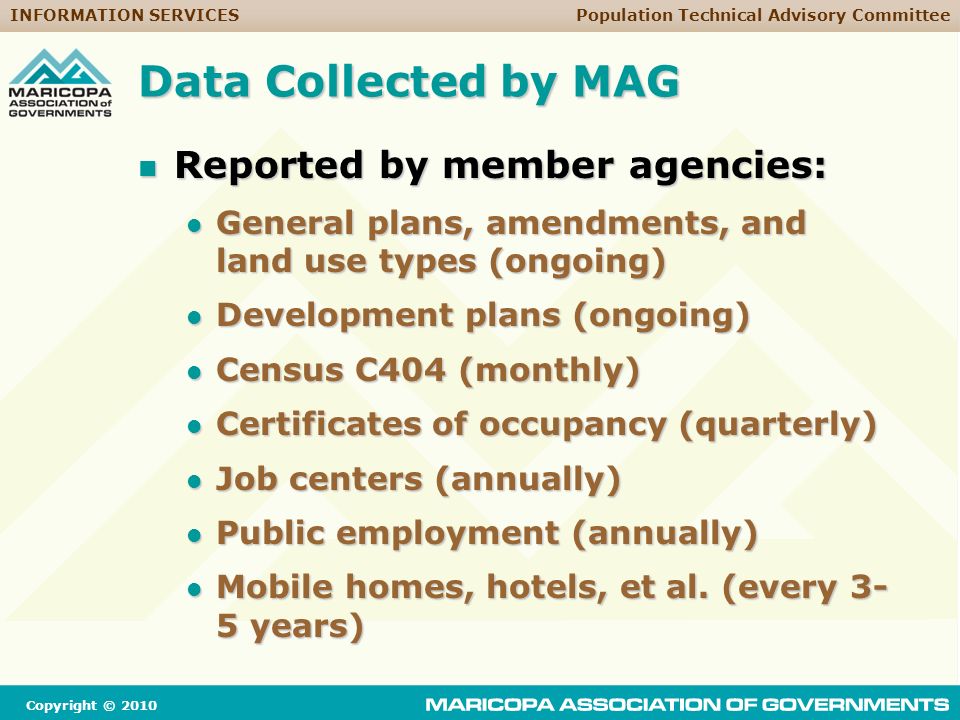
 INFORMATION SERVICESPopulation Technical Advisory Committee Copyright ©  2010 Population Technical Advisory Committee Roles and Responsibilities  January. - ppt download

MAG's tasks include:

  • Prepares composite databases for the region
  • Coordinates with State Demographer's Office for county population control total
  • Prepares employment control totals
  • Runs models and submodels
  • Reviews model results internally and with member agency staff


Current population projection data is found here


Links to Interactive Viewers


The next meeting of the MAG Population Technical Advisory Committee (POPTAC) is scheduled for:


Tuesday, August 24, 2021 at 10:00 a.m.


via MAG's MAG Meetings-Analytics and Technology YouTube Channel


Download Agenda Packet: MAG POPTAC Website


Due to the risks to public health caused by the possible spread of the COVID-19 virus at public gatherings, the Maricopa Association of Governments has determined that public meetings will be indefinitely held through technological means.

Meetings will be open to the public through technological means.


To attend the meeting by technological means, members of the public may follow the steps below:

> To watch a live video stream of the meeting, click here to go to MAG’s YouTube channel: https://www.youtube.com/channel/UChuhOXELlTs9YeBVnZD2ZDg


> Members of the public may submit written comments relating to this meeting to azmag.gov/comment.

Comments may be sent at any time leading up to the meeting, but must be received at least one hour prior to the posted start time for the meeting.


If any member of the public has difficulty connecting to the meeting, please contact MAG at (602) 254-6300 for support.


Agenda questions: Scott Wilken (602) 254-6300 swilken@azmag.gov 


=======================================================================

RELATED CONTENT

Committees

You can play a part in planning the future of our region by attending meetings of the Regional Council, Management Committee, and by contributing to MAG Committees. Committees include Policy Committees established to provide specific policy recommendations to the Management Committee and Regional Council, and Technical Advisory Committees consisting of professional experts to assist in program development.

Population Technical Advisory Committee 3/23/2021 Meeting Agenda Packet

About MAG

The Maricopa Association of Governments (MAG) is a Council of Governments (COG) that serves as the regional planning agency for the metropolitan Phoenix area.

Title VI

Title VI requires that no person in the United States of America shall, on the grounds of race, color, or national origin, be excluded from the participation in, be denied the benefits of, or be otherwise subjected to discrimination under any program or activity for which MAG receives federal financial assistance.

Get In Touch

  • Address: 302 N. First Ave., Suite 300
    Phoenix, Arizona 85003

  • Phone: 602-254-6300

  • FAX: 602-254-6490

  • Email: mag@azmag.gov

Web Accessibility

The Maricopa Association of Governments is committed to providing the best web experience possible for all users. We continue to make changes to improve the user experience for everyone and apply the relevant accessibility standards as stated in the MAG Web Accessibility Statement.


Dicey on Demands for Arizona Public School Instructions: Teach It 2X Between 7th-to-12th Grades

Splitting hairs and micro-managing

FOR IMMEDIATE RELEASE
August 19, 2021

Governor Ducey Signs Bill To Strengthen Holocaust Education In K-12 Schools 

PHOENIX — Holocaust survivors, students, lawmakers and educators joined Governor Doug Ducey today as he signed legislation strengthening instruction about the Holocaust and other genocides in Arizona’s schools.

The legislation requires young Arizonans to learn the enduring lessons of the Holocaust and the tragic consequences of religious and racial intolerance.

“Arizona has long been a leader on civics education, but it’s clear we need to extend our curriculum to more closely cover the horrors of the Holocaust,” said Governor Ducey. “This bill is a step in the right direction but our work is far from over. Antisemitism and other forms of hate are real, and we must do more to make sure this never, ever happens again. My thanks to Representative Alma Hernandez for leading this effort, along with Speaker Bowers and all of the survivors who have dedicated their lives to spreading awareness."

Governor Ducey was joined by House Speaker Rusty Bowers, Senate Minority Leader Rebecca Rios, House Minority Leader Reginald Bolding, legislators, Holocaust survivors, members of Arizona’s Jewish community, Holocaust education advocates and students at the Arizona State Capitol for the ceremonial signing. 

House Bill 2241 will require the State Board of Education to adopt requirements for students to be taught about the Holocaust and other genocides at least twice between 7th and 12th grades. Representative Alma Hernandez, an unwavering advocate for Holocaust survivors and Arizona’s Jewish community, sponsored the legislation.

“I can’t begin to express how proud I am to see this important legislation get signed,” said Representative Hernandez. “Thank you to the Holocaust survivors, advocates, students and community leaders who supported House Bill 2241. This is a big win for not only Arizona’s Jewish community, but for the future of our state. My thanks also goes to Governor Ducey for his continued support in our efforts to reject antisemitism and expand Holocaust education.” 

According to a Pew Research Center study conducted in 2019, fewer than half of respondents could correctly answer multiple-choice questions about the number of Jewish individuals who were murdered during the Holocaust or the way that Adolf Hitler came to power.

“This important bill will strengthen our youth’s understanding of a dark time in history,” said Speaker of the House Rusty Bowers. “I’m grateful to Representative Hernandez for her effort in leading this bill in the legislature. It was an honor to work with my colleagues to get this done, and I’m grateful to Governor Ducey for signing this bill into law.”

Antisemitism has been on the rise in recent years with 18 incidents in Arizona already this year. Last year there were more than 2,000 incidents of antisemitism around the country and 23 incidents in Arizona, according to the Anti-Defamation League.

“These antisemitic acts are disgraceful and unacceptable, and we’re going to do everything we can to ensure Arizonans of the Jewish faith are treated with respect, dignity and humanity,” the Governor said during the signing ceremony.

For education resources on the Holocaust and other genocides, visit the Phoenix Holocaust Association and Arizona Department of Education websites. 

Additional Bill Signings
The Governor ceremonially signed other bills to further protect Arizona’s children and to make Navajo Code Talkers Day an official state holiday before the signing of House Bill 2241.

With the signings of Senate Bills 1391 and 1660 and House Bill 2410, Arizona is taking steps to ensure more children across the state are safe. Senate Bill 1391 protects a child’s right to be represented by legal counsel in dependency cases, Senate Bill 1660 helps protect vulnerable children from sexual abuse and sex trafficking, and House Bill 2410 increases the age of a newborn which can be delivered into the safe haven program from 72 hours to 30 days old.

The signing of Senate Bill 1802 makes National Navajo Code Talkers Day, which fell on last Saturday, an official state holiday every year on August 14. The legislation honors the 400 Navajo men who developed an unbreakable code during World War II.

2nd Successful Mid-Air Refueling for Boeing's Unmanned MQ-25 StingrayTM Drone

Intro  

MQ-25™ Stingray

Description:

The MQ-25™ Stingray will be the world’s first operational, carrier-based unmanned aircraft and provide aerial refueling and intelligence, surveillance and reconnaissance (ISR) capabilities that enhance capability and versatility for the Carrier Air Wing (CVW) and Carrier Strike Group (CSG). Integration of a persistent, sea-based tanker into the CVW will make better use of our combat strike fighters and extend the range of our aircraft carriers. The system will be a critical part of the future CVW and is central to the Navy’s strategic Unmanned Campaign Framework, laying the foundation for all future carrier-based unmanned systems and pioneering the cutting-edge manned-unmanned teaming (MUM-T) operational concept

MQ-25 StingrayTM drone completes second unmanned refueling mission with  Navy E-2D Hawkeye - YouTube

The Navy plans for all NIMITZ and FORD-class carriers to eventually be MQ-25 capable.

MQ-25 is comprised of two major segments: The MQ-25 Air System (air vehicle), and the Unmanned Carrier Aviation Mission Control System (UMCS), the system required for carrier integration and command and control of the MQ-25 air vehicle and payload. PMA-268 manages these segments as the government Lead Systems Integrator (LSI).

MQ-25 is currently in flight test, gaining valuable early insight from the contractor-owned MQ-25 predecessor, T1. In 2019, the government/industry team conducted its first flight with the MQ-25 T1 test asset. Data from early T1 testing allows for learning and discovery to advance the development of major systems and software, and supports a rapid developmental test program. 

The Navy awarded an Engineering and Manufacturing Development (EMD) contract to The Boeing Company in August 2018 for the design, development, fabrication, test, delivery, and support of four MQ-25A Engineering Development Models (EDMs). In 2020, the Navy executed a contract option to purchase three additional test aircraft.

Over the next few years, Boeing will deliver the EDM aircraft and testing will occur at its facility in St. Louis, Missouri before transiting to NAS Patuxent River for the duration of the flight test program, with additional testing taking place in Lakehurst, New Jersey, and Eglin Air Force Base, Florida. 

U.S. Navy, Boeing Score Another MQ-25 First with E-2D Refueling

  • MQ-25 T1 unmanned test asset refuels a Navy E-2D command and control aircraft, the second carrier-based aircraft it has refueled to date.

The U.S. Navy and Boeing [NYSE: BA] have completed a second carrier-based aircraft unmanned refueling mission with the Boeing-owned MQ-25TM T1 test asset, this time refueling a Navy E-2D Hawkeye command and control aircraft.

During a test flight from MidAmerica St. Louis Airport on Aug. 18, pilots from the Navy’s Air Test and Evaluation Squadron VX-20 conducted a successful wake survey behind MQ-25 T1 to ensure performance and stability before making contact with T1’s aerial refueling drogue. The E-2D received fuel from T1’s aerial refueling store during the flight.

“Once operational the MQ-25 will refuel every receiver-capable platform, including E-2,” said Capt. Chad Reed, the Navy’s Unmanned Carrier Aviation program manager. “This flight keeps us on a fast track to getting the Stingray out to the fleet where its refueling capability will greatly increase the range and operational flexibility of the carrier air wing and strike group.”

flynavy on Twitter: "Another milestone for the E-2D Advanced Hawkeye  program, as VAW-120's "Greyhawks," the Airborne Early Warning Fleet  Replacement Squadron (FRS) received its first aerial-refueling capable  Hawkeye to the flightline. #FlyNavy #

The MQ-25 StingrayTM will be assigned to the carrier airborne early warning squadron within the carrier air wing, which currently operates the E-2 C/D aircraft – known as the “digital quarterback” of the fleet for its role in joint battle management and command and control.

“It was another great flight showing that our MQ-25 design is performing to plan,” said Dave Bujold, Boeing’s MQ-25 program director. “These historic refueling flights provide an incredible amount of data we feed back into the MQ-25 digital models to ensure the aircraft we’re producing will be the Navy’s game-changer for the carrier air wing.”

This is the second aerial refueling mission the MQ-25 team has conducted this summer. On June 4, the MQ-25 T1 test asset became the first unmanned aircraft to refuel another aircraft, a U.S. Navy Super Hornet. Both flights were conducted at operationally relevant speeds and altitudes, with the E-2D and F/A-18 performing maneuvers in close proximity to T1.

Boeing is currently manufacturing the first two of seven MQ-25 test aircraft and two ground test articles currently under contract. The Boeing-owned MQ-25 T1 test asset is a predecessor to these aircraft. The MQ-25 is leveraging advancements in model-based digital engineering and design, and ongoing flights are intended to test aircraft design and performance much earlier than traditional programs.

Source: Boeing
Date: Aug 18, 2021


WHY THIS + WHY NOW: Arizona ADEQ Groundwater Protection Issues Changes for Permitting Programs

Water resources are scarce in a Stage 1 Drought Emergency
This Week's Drought Summary
Monsoonal moisture, and associated heavy rainfall, returned to Arizona and New Mexico after a brief hiatus last week, leading to widespread improvements in drought conditions, as well as some flash flooding.
In most of Arizona and New Mexico, long-term drought remains, but recent conditions have been wet enough for a green-up in vegetation. . .widespread improvements in drought conditions occurred in Arizona and New Mexico this week, as heavy monsoonal rains made their return after a one-week hiatus. Two-inch rainfall totals were commonplace, particularly in the southern halves of both states, and localized higher amounts also occurred.
> Most of the remaining drought in these states, while still extreme or exceptional in some locales, is confined to long-term impacts, as conditions are wet in many places on the short-term. While heavy monsoonal rain occurred in Arizona and New Mexico, moderate to heavy amounts were mostly confined to these two states. In central and southern Arizona and New Mexico, temperatures were cooler than normal, in some areas by 3 to 9 degrees. 

Map released: August 19, 2021

Data valid: August 17, 2021

United States and Puerto Rico Author(s):
Curtis Riganti, National Drought Mitigation Center
Pacific Islands and Virgin Islands Author(s):
Brad Rippey, U.S. Department of Agriculture

View grayscale version of the map

Groundwater Protection

Updates to Aquifer Protection and Recycled Water Permitting Programs

To continuously improve our permitting processes, ADEQ has made several changes to the process for obtaining Aquifer Protection and Water Reuse Permits. These changes have been made to continuously improve our permitting process.  Please see below for a summary of these changes.

Recycled Water Permits

  • Type 2 Recycled Water General Permits and Type 3 Recycled Water Agent General Permits are now issued through the myDEQ online portal.  To register for a myDEQ account, visit https://www.azdeq.gov/myDEQ/register
  • Applications for Individual Recycled Water Permits should be emailed to waterreuse@azdeq.gov.
  • If you have any questions about Recycled Water Permits, please email waterreuse@azdeq.gov.

Aquifer Protection Permits

  • Applications for Individual Aquifer Protection Permits should be emailed directly to the Project Manager if one has already been assigned or to groundwaterpermits@azdeq.gov.
  • Type 2.1 and 2.4 General Permits for Drywell are now issued through the myDEQ online portal. To register for a myDEQ account, visit https://www.azdeq.gov/myDEQ/register

General

  • For emailed applications, if the attachment is large (over 25 MB) please email us and we will make arrangements for uploading your application through an ftp site.  ADEQ can not accept USB drives with applications on them.
  • For permits that are available in myDEQ, mailed or paper applications will not be accepted.
  • For permits that are not yet available in myDEQ, we recommend submitting applications electronically via email. We also accept mailed applications, however, this may result in a delay processing your application.
  • Before filling out an application, check azdeq.gov/forms to ensure you are using the latest version of the application form. Please note that using an old form may result in a delay processing your permit.
  • ADEQ also strongly encourages those needing an APP to contact us about scheduling a pre-application meeting before filling out the application. ADEQ provides an hour of no-cost consultation to help identify information needed for the final application. The meeting request form can be found at: https://azdeq.gov/app-pre-application-meeting-request-form
  • For applications with missing or incomplete information or are otherwise not approvable, we may request a withdrawal of the application and resubmittal once the application is revised, in lieu of denying the permit. 
  • Similarly, major changes to an application will not be accepted after the application is submitted. The current application must be withdrawn and a new application submitted.
  • To withdraw an application, email the project manager requesting the withdrawl. A final bill will be generated based on the time spent on the application up until withdrawl. If a similar application is submitted in the future, the same project team may be assigned to minimize rework.

About ADEQ

Under the Environmental Quality Act of 1986, the Arizona State Legislature established the Arizona Department of Environmental Quality in 1987 as the state agency for protecting and enhancing public health and the environment of Arizona. For more information, visit azdeq.gov.

ADEQ will take reasonable measures to provide access to department services to individuals with limited ability to speak, write or understand English and/or to those with disabilities. Requests for language translation, ASL interpretation, CART captioning services or disability accommodations must be made at least 48 hours in advance by contacting the Title VI Nondiscrimination Coordinator at 602-771-2215 or Communications@azdeq.gov. For a TTY or other device, Telecommunications Relay Services are available by calling 711.

ADEQ tomará las medidas razonables para proveer acceso a los servicios del departamento a personas con capacidad limitada para hablar, escribir o entender inglés y/o para personas con discapacidades. Las solicitudes de servicios de traducción de idiomas, interpretación ASL (lengua de signos americano), subtitulado de CART, o adaptaciones por discapacidad deben realizarse con al menos 48 horas de anticipación comunicándose con el Coordinador de Anti-Discriminación del
Título VI al 602-771-2215 o Communications@azdeq.gov. Para un TTY u otro dispositivo, los servicios de retransmisión de telecomunicaciones están disponible llamando al 711. 


 AZDEQ Logo QUESTIONS?
Contact Us


An exclusive look into how Space Force is defending America

Imperialst Rhetoric, Tom Horn to Defuse Tensions, Gold Tops $5,000 in Demand Frenzy, . . .Japan Bond Crash

         Stephen Maturen/Getty Images Trump, Democrats Hurtle Toward Shutdown After Minnesota Killing A fatal shooting by Border Patrol agen...