Tuesday, August 24, 2021

'Only in New York, Kids' : The Genuine Genius Cindy Adams & The New York Post Page Six Icon Extraordinaire Who Turned Tabloid Trash Into The Culture Matrix

She's been on-the-job more than nine decades on now - and still working fivehours a day six days a week in her Park Avenue Penthouse apartment where she's turned former owner Doris Dukes bathroom into her home-office.
The Verge reporter Adrian Horton calls Cindy Adams "the resident maven of dish" in this one recent article to promote a new 4-part docuseries streaming now on SHOWTIME.
There's also another recent article published in New York Magazine that has a lot more local flavor - excerpts are extracted farther down. It's way more than "gossip". . .


Ben Widdicombe, a former columnist for the New York Daily News, perhaps puts it best: “Gossip is frequently disparaged, . .And I understand the reasons why. But the trashy stuff connects to the bigger picture, and we ignore it at our peril.”

Cindy Adams in Gossip, a four-part series concerned with the brash, throaty New York tabloids at the intersection of wealth, politics and Hollywood. Photograph: Courtesy of SHOWTIME

<div class=__reading__mode__extracted__imagecaption>Cindy Adams in Gossip, a four-part series concerned with the brash, throaty New York tabloids at the intersection of wealth, politics and Hollywood. Photograph: Courtesy of SHOWTIME<br>Cindy Adams in Gossip, a four-part series concerned with the brash, throaty New York tabloids at the intersection of wealth, politics and Hollywood. Photograph: Courtesy of SHOWTIME</div>

‘The trashy stuff connects to the bigger picture’: the gossip-ification of America

Gossip, a four-part docuseries, traces the culture-shaping influence of the New York Post, Cindy Adams, and Rupert Murdoch’s transformation of American media

 
The docuseries Gossip opens with a needle drop on the media timeline: “In the early 90s, gossip became very hot.”. . .and then veers off keeping the focus on Cindy Adams by to bring up the name of Donald Trump (who was only one would-be celebrity of thousands featured on Page Six) . . .

Gossip, the series, proceeds on two intertwined chronological tracks: the first, Murdoch’s steering of the Post, which he purchased in 1976, into a biting bully pulpit with a conservative bent and a knack for courting readership through sensationalism and fault lines of race, class and political belief. Murdoch pioneered a slicker, seemlier gossip page by committee in the Post – Page Six, which launched in January 1977. Circulation shot upwards. Lurid scandal, sex, crime, shame – as numerous tabloid authors such as Michael Musto, AJ Benza, former Page Six editor Paula Froelich, the New York Daily News’s George Rush and former New York Post editor-in-chief and Murdoch confidante Col Allan testify, Murdoch knew that gossip sold.

The second is Adams’ journey from pageant queen and commercial model to commenter on the rich, powerful and influential. . .Throughout the 60s and 70s, Adams built a career as a news anchor-cum-performer representing New York’s who’s-who. . .She became a regular columnist in 1981, where she continued relaying the sides of disreputable figures: Panamanian dictator Manuel Noriega; Philippines first lady Imelda Marcos, convicted of stealing billions before she and her husband Ferdinand Marcos were deposed in 1986; New York hotelier and convicted tax evader Leona Helmsley (that Cindy Adams called "The Queen of Mean") . . .

Throughout the series, Adams defends her relationships with figures who have inflicted an incalculable toll on other lives as both a matter of fiercely cherished, reciprocal personal loyalty and the potential for an exclusive. If everyone hates someone, she says in a later episode, then their side is the one story not being told . .

A CAUTIONARY TALE OF SORTS BUT THAT IS WAY-TOO-SIMPLE A CONCLUSION: “Who are we giving so much time, so much print, so much television coverage, so much internet coverage to?”

=========================================================================

NEXT: From New York Magazine via The Cut

Insert

"The penthouse that gossip built looms above Park Avenue guarded by a one-and-a-half-year-old Yorkie, Jellybean, who was sososososososoexcited to have a guest, and a 91-year-old New York Post columnist, Cindy Adams, who was not.

“What is it you’re looking for?” she asked me. “What do you want?!”

The occasion for my visit was Gossip, the four-part Showtime documentary series, out August 22, in which director Jenny Carchman tells the story of the New York Post and the Murdochization of American media through the newspaper’s most enduring star, who has for almost 40 years devoted five hours a day, six days a week, to crafting her column.

“I would never leave the Post,Adams told me, “because I’m very loyal and because the New York Post is the flavor of New York. If you go to the Hamptons — I sold my house there, I don’t want to go to the Hamptons — they say that you can’t go to dinner unless you first go to the newsstand and pick up the Post. I don’t know about Colorado. I don’t care about Arkansas; I don’t even know where they are — but if you’re in New York, it’s the New York Post.

. . .Adams has a term for the distinct manner in which she communicates: “I write smartmouth, she said.

“I write like a city person. My English is perfect, but I don’t write that way. I write the way a New Yorker sounds.” New York’s city editor, Christopher Bonanos, assessed the Adams style this way: “She’s the last known survivor of the art she practices, and the last person on the island who speaks the language of a lost population — that rat-a-tat thing of Walter Winchell and Leonard Lyons — and she’s got to write it down to pass it on.”

It’s all very simple to Adams, who views the world as divided between “somebodies” and “nobodies.” And, as she explained it to me, “I’m not gonna write about nobody!” I guess I wanted to understand why. . ."

=========================================================================

Next UP space of the week

Where Gossip Never Sleeps

Cindy Adams bought Doris Duke’s Park Avenue apartment 22 years ago, and even today the phone doesn’t stop ringing.
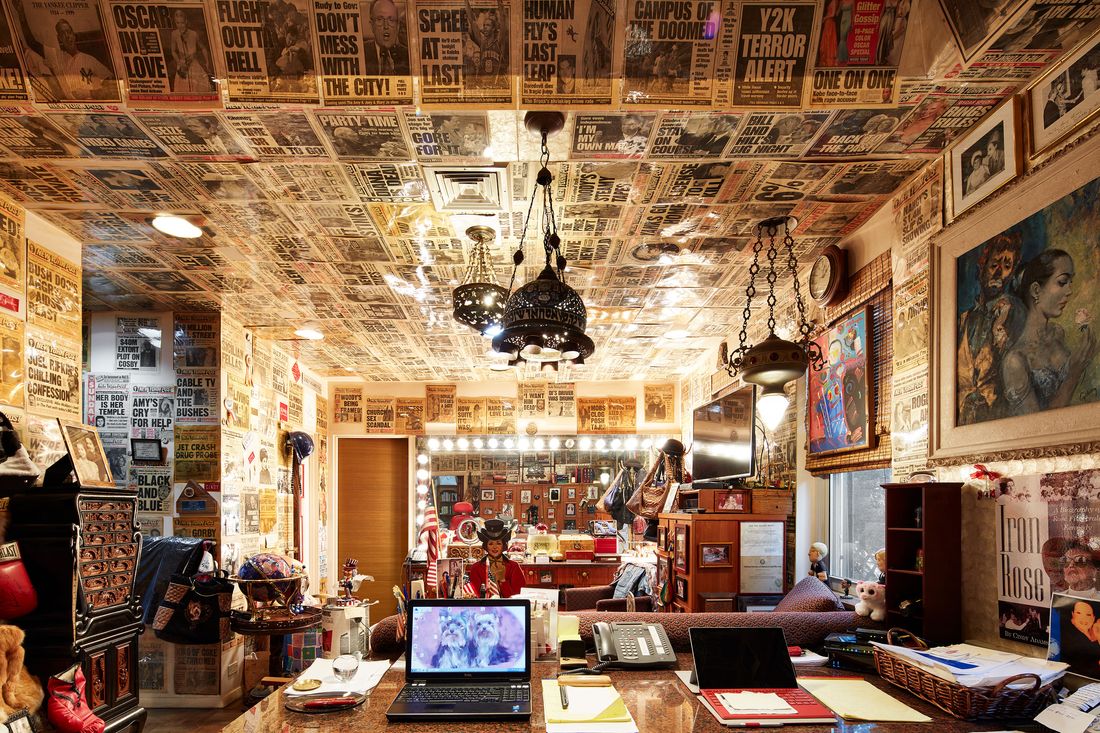
"I thought if it was good enough for Doris Duke, it’s good enough for me,” Cindy Adams says, striding through the foyer of the Park Avenue penthouse she purchased in 1997 — with her own money, she wants you to know — and today shares with her 17-year-old Yorkshire terrier, Juicy. “Three and a half pounds of pure selfish,” she calls her. (Translation: the most beloved thing in her life.)

They live in theatrical splendor, with the phone ringing off the hook as if it were the pre-texting era and people still knew that the best stories are whispered directly into an understanding ear...She moved into the place with her husband, the comedian Joey Adams, at a time when he was ailing and having difficulty navigating their previous “much nicer” apartment on Fifth Avenue. Adams is a New York girl, born in 1930, who grew up on the Upper West Side. She dropped out of high school over a requirement that she take a sewing class, she says, and was working as a photographer’s model when she met Joey on a radio program (they married in 1952). He was her mother’s age. “I would have loved to have been a six-foot-tall blonde model and married a brainy man,” Adams says. She was pretty and charismatic — a pageant queen, the onetime Miss Bagel — but six feet tall and blonde she was not. . .

After joking (I think) to our photographer that she’ll ruin him if she doesn’t like his picture of her, Adams has to go. The phone hasn’t stopped ringing, and she has to get back to her office, surrounded by her front-page scoops. . ."

========================================================================


DON'T OVERTHINK IT: Elon Musk's 'Technoking' Says A Helluva Lot About Media Culture

With no regrets at all, your MesaZona blogger went Boing-Boing push-button publishing a number of posts about THE TESLA BOT.
To be honest it was a welcome eye-opening event staged by Elon Musk, basically to say after the opening sequence that "This is not real"
. . ."Even by Musk’s standards, it was a bizarre and brilliant bit of tomfoolery: a multipurpose sideshow that trolled Tesla skeptics, fed the fans, ginned up the share price, and created some eye-catching headlines."

Don’t overthink it: Elon Musk’s Tesla Bot is a joke

A distraction and an empty promise      James Vincent Aug 20, 2021, 11:46am EDT        

The Verge

Insert After a dense presentation about the undeniably impressive work Tesla is doing with AI, the company’s self-anointed Technoking, Elon Musk, capped the evening by bringing out a dancer in a spandex suit. Behold, said Musk: my Tesla Bot.
. . .Do you believe him?
Should you believe him?
I won’t answer that for you, but I want to restate the facts.
> Elon Musk got up on stage last night and promised that Tesla, a company whose driver assist software is unable to reliably avoid parked ambulances, would soon build a fully functioning humanoid robot.
> Musk said that the machine would be able to follow human instructions intuitively, responding correctly to commands like “please go to a store and get me the following groceries.” He outlined these scenarios and then said: “Yeah, I think we can do that.”
> This was minutes after he’d ushered away the best demo of the Tesla Bot available:a dancer in a spandex suit.
> If nothing else, you have to admire the chutzpah.
 
. . .Once he’s got it to walk out onstage he can even send it to space, just for the headlines. But if he does, it will be just another distraction. Robotics are having a huge effect on manufacturing, no doubt about that, but there’s no need to pretend that machines need to look human to do so.
 
. . .Carl Berry, a lecturer in robotics engineering at the UK’s University of Central Lancashire, put things to me in less uncertain terms: “[Calling it] horse shit sounds generous, frankly. I’m not saying that he shouldn’t be doing research like this, but it’s the usual overblown hype.” Berry stressed that deploying robotics and AI in manufacturing usually required making the simplest machine possible: not the most complex. . .
 
. . .What the Tesla Bot really reminded me of is Sophia: the mechanical chatbot that’s appeared on chat shows and magazine covers. Sophia relies on misdirection to fool audiences and is a regular target of AI experts’ scorn. But it also has a job to do. As one of the robot’s creators, Ben Goertzel, told me in 2017, Sophia works by priming our imagination, encouraging us to fool ourselves into thinking the future is closer than the evidence suggests. In the process, the robot generates funding and news coverage for its makers. . .
 

“If I tell people I’m using probabilistic logic to do reasoning on how best to prune the backward chaining inference trees that arise in our logic engine, they have no idea what I’m talking about,” said Goertzel. “But if I show them a beautiful smiling robot face, then they get the feeling that AGI may indeed be nearby and viable.”

That feeling is what Musk wants to inculcate in his audience, be they investors or otherwise.

> His twist on the Sophia strategy is that he doesn’t even need a simulacrum of a robot to sell the dream.

All he needs is a dancer in a spandex suit. Now that’s innovation."

Monday, August 23, 2021

Happy Monday Techdirt! > This, That + Some Other Things

Let's have a go at it - The Week is off to a good start!
Legal issues, Defamation, Journalism, (Mis) Uses of Technology, and Wireless
 
1 First up at 05:39 a.m.
Insert To be clear, there's absolutely no evidence that 5G wireless technology poses a meaningful impact to human health. Most of the conspiracy theorists that claim otherwise have a head full of pebbles, and are uniformly basing those claims on misinterpreted evidence or absolute gibberish. That doesn't mean that you don't want to continue studying cellular technology's impact on the human body, or adjust your safety standards when the scientific evidence warrants.

In December of 2019 the Ajit Pai FCC announced it would not be updating its radiofrequency (RF) emission guidelines, which determine "safe" levels of exposure. The decision, Pai said, was based on a comprehensive six year review of the available evidence.

Yeah, about that.

Several groups that lean toward the... conspiratorial... had challenged the FCC's decision, forcing a court review. And when the Court of Appeals for the DC Circuit actually reviewed the FCC's decision making process, they found that the FCC didn't really do its due diligence in reviewing the evidence. The court stated in its order (pdf) that while there very well might be good evidence to not change the standards, the FCC under Ajit Pai didn't actually provide it:

......................................................................Granted this whole "making a decision without looking at the actual evidence" thing was a bit of a pattern for the Ajit Pai FCC, whether it was its attempts to kill broadband subsidies for tribal lands, its attacks on media consolidation rules, its rulings on cell tower placements that largely favored industry, or its attempt to ban states from protecting broadband consumers. In every example Pai's decisions were shot down by the courts after they found they weren't based on much in the way of legally-supportable fact. Pai's disregard for factual reality was also well represented during the net neutrality repeal. . .

It's true that the FCC is historically a captured agency (especially under Trump). It's also true that some of the Pai FCC's laziness could be attributed to not wanting to upset the cellular industry. But that doesn't automatically mean that 5G harms human health. That still needs to be proven by actual evidence. But because Pai didn't do his job properly, that's going to all get lost in translation.

Filed Under: 5g, ajit pai, arbitrary, capricious, evidence, fcc, robert f. kennedy jr., safety

2 Second up at 09:37 a.m.
Insert Jonathan Mayer, a Princeton University professor and former chief technologist at the FTC, is one of the smartest people I know. Every time I've spoken with him I feel like I learn something. He's now written a quite interesting article for the Washington Post noting how he, and a graduate researcher at Princeton, Anunay Kulshrestha, actually built a CSAM scanning system similar to the one that Apple recently announced, which has security experts up in arms over the risks inherent to the approach.

Mayer and Kulshretha note that while Apple is saying that people worried about their system are misunderstanding it, they are not. They know what they're talking about -- and they still say the system is dangerous . . .The potential dangers that Mayer and Kulshretha are exactly what many had warned about when Apple announced its plans: ...........................................................

. . .As we noted in our earlier posts (and as Mayer and Kulshretha noted in their research), the risk of false positives is extremely high. And late last week, the hypothetical became a lot more real. Someone reverse engineered the NeuralHash algorithm that Apple is using and put it on Github.

. . .This is part of the reason that we highlighted earlier that security researchers are so up in arms about this. Apple seemingly ignored so much of the research and conversations that were happening about these approaches, and just barged right in announcing that it had a solution without exploring the tradeoffs and difficulties associated with it -- leaving that for security experts to point out afterwards.

Apple is trying to downplay these findings, saying that it expected the collisions at least, and that it's system would also do a separate server side hashing comparison which would stop the false collisions. Though, as Bruce Schneier points out, if this was "expected," then why wasn't it discussed in the initial details that were released? Similarly, I have yet to see a response to the flip side issue of changing the images in a way that fool NeuralHash while still looking the same.

I know Apple keeps wanting to insist that it's thought through all of this, but it doesn't seem to have thought through any of how the security community would see all of this, and it's after-the-fact scrambling is not exactly reassuring.

Filed Under: backdoors, client side scanning, csam, encryption, hash clash, jonathan mayer, surveillance
Companies: apple

 
3 Third up at 10:53 a.m.
Insert Earlier this month, another courtroom challenge of evidence exposed another questionable alteration of a gunshot report by law enforcement tech supplier, ShotSpotter. In 2018, a man shot by police officers claimed in his lawsuit that ShotSpotter altered gunshot detection records at the request of law enforcement to back up the officers' narrative -- one that claimed he had shot at them first. No gun was ever recovered and the number of shots originally detected by ShotSpotter matched the number fired by officers, leaving them at least one shot short of their "he shot first" story.

This appears to have happened again. A man, apparently falsely arrested for a murder he didn't commit, was put in jail for eleven months based almost solely on ShotSpotter reports. The problem with the ShotSpotter report is that it kept changing. And again, the alterations made the report align with the presuppositions of law enforcement. The original detection didn't classify the "percussive noise" as a gunshot. This non-determination was manually overridden by a ShotSpotter "analyst" to be classified as a gunshot.

Months later, ShotSpotter relocated the detected noise from where it was originally "heard" to the intersection where the wrongfully-arrested man's car was captured by a nearby surveillance camera, allowing prosecutors to tie together their theory that the person they had already pinned the crime on had actually committed the crime. But, as soon as the wrongfully-arrested man challenged this evidence, prosecutors dropped the case, citing a lack of evidence.

This reporting on ShotSpotter's apparent alteration of reports to better fit law enforcement claims and theories angered ShotSpotter. The company issued an angry statement claiming Motherboard's article on its latest evidentiary… oddities… was bogus and possibly capable of "confusing" readers. . .

The Associated Press has taken a long, detailed look at this case and uncovered plenty of information that casts doubt on the company's assertions about its practices and the value of its sole product: sensors that detect gunshots and provide their locations to law enforcement. In the middle of it all is 65-year-old Michael Williams who spent 11 months in jail, arrested for a homicide he didn't commit. In fact, Williams drove the gunshot victim to the ER after he was shot by someone in an adjacent car.

The AP report says everything Motherboard said (and more) -- the same things ShotSpotter publicly denied in its angry statement. . .As for the claim the company never alters reports, especially at the request of law enforcement, the AP found that claim is complete bullshit.

. . .The company remains unrepentant, even in the face of mounting evidence the tech is faulty and its detections can be set to manual override at the whim of "analysts" or law enforcement officers. . .

ShotSpotter can keep being angry about how it's portrayed in the press. But it can't blame anyone else for its own missteps and failures. Not only does the company seem to overstate the reliability of its sensors, but admissions made in court make it clear the evidentiary value of its reports is, at best, extremely questionable.

Filed Under: evidence, police, shotspotter
Companies: shotspotter

4 Fourth up at 12:06 p.m.
Insert I'm going to try, once again, to do that stupid thing where I try to express a nuanced point on the internet, where there's a high likelihood of it being misunderstood. So, consider this opening a warning that you should read this entire article to try to get at the larger point.

And, along those lines, there are two parts to this story, and while much of it is going to point some fingers at the NY Times and Washington Post in how they presented a story that suggested blaming Facebook for something that isn't actually a Facebook issue, that shouldn't be seen as letting Facebook off the hook, because it doesn't come out of this story looking very good either. Basically, this is a story that shows how much more complex and complicated our information ecosystem is when it comes to misinformation, and simple blame games aren't necessarily that effective. . .

But, first, some background: for a long time, NY Times reporter Kevin Roose has used Facebook's own CrowdTangle tool to highlight what content on Facebook was getting the most engagement. It is a consistently useful tool in showing how claims that Facebook has an "anti-conservative bias" is bullshit. It constantly shows top "conservative" personalities like Ben Shapiro, Don Bongino, and others as having the most engagement on the site.

For reasons I don't fully understand, Facebook has always hated this, and has spent so much wasted effort repeatedly insisting that Roose's tracking of the numbers is not telling an accurate picture of what's happening on the site (even though he's using Facebook's own tool). Last week, Facebook launched a new offering which it seemed to hope would change the narrative on this. It's called the "Widely Viewed Content Report" (catchy!). And, obviously, it is true that "engagement" (what CrowdTangle shows) is not the be-all, end-all of what's happening on the site, but it is kinda weird how annoyed Facebook gets about the lists.................................................................................................................................................

And, to be fair, there is a bunch of interesting stuff in this report. It shows that, despite all the focus on Facebook links to outside sources, apparently 87% of content viewed in Facebook's News Feed doesn't even link to an outside source. And much of the rest of the report really leans hard on the fact that for most people, politics and news (and disinformation) are not a huge part of their Facebook experience. That's certainly very interesting, though it would be nicer if Facebook exposed the raw data, rather than doing this as quarterly reports. . .Anyway, a couple days after Facebook released all this, the NY Times came out with what is a legitimate scoop: Facebook had actually planned to release a version of this report earlier this year, but (according to the article) shelved it when the most-viewed link didn't look very good for Facebook. From the article:

.........................................................................................................................................................

Now, the fact that Facebook would shelve the report because of the possible optics is bad. Flat out. No question about it at all. It also demonstrates why having to sit around and rely on Facebook to release this report every quarter rather than just sharing the data is always going to be questionable and not engender much trust.

But... (and this is important), the NY Times piece kinda buries something rather important here

................................................To be honest, the NY Times article and framing is more defensible. It focuses on Facebook's (highly questionable) decision to shelve the report until there was a better link in the top slot. The reporters on the Times piece -- Davey Alba and Ryan Mac, both of whom, I should note, I think are generally top notch reporters on the tech beat -- have taken issue with people calling out this aspect of their reporting. . .Mac pointed out that the real issue wasn't so much the problems of the original Tribune/Sentinel story (which the NY Times also had a version of), but rather the users on Facebook sensationalizing the story to imply something about the vaccine. Alba, similarly, points out that the real news is the fact that the reason this article was so popular was that it was shared widely by anti-vax groups.

And... I can see that. But, somewhat ironically, all weekend on Twitter, I kept seeing Facebook haters sharing those NY Times and Washington Post articles in the exact same way that Alba and Mac are complaining about -- by misrepresenting the key newsworthy points, and instead using it to reinforce their prior beliefs (that Facebook was somehow bad).

Very, very, very few people were noting that this is all a lot more complex. It reminds me, yet again, of the research from Yochai Benkler that showed that disinformation really only goes viral on social media after more mainstream media presents a story. . .The fact is the ecosystem is a lot more complex, and the ways to deal with it are a lot more nuanced than many people seem to want to discuss or admit. . .

We're not going to solve the problems associated with a bunch of people believing in nonsense if we ignore the underlying parties responsible for the content itself, and focus just on the intermediaries. That doesn't mean to ignore Facebook, but it's a reminder to view the overall ecosystem.

Filed Under: blame, disinformation, engagement, journalism, reporting, vaccines
Companies: facebook, ny times, washington post


5 Fifth up at 1:39 p.m.

Ninth Circuit Affirms MSNBC's Anti-SLAPP Motion Against OAN Network's Bullshit Defamation Lawsuit

from the opinion,-facts-still-protected-speech-because-duh dept

Insert One America News (OAN) -- a "news" network apparently more "fair and balanced" than the extremely right-leaning Fox News -- sued MSNBC commentator Rachel Maddow for (factually) insinuating one of OAN's reporters had a side gig working for the Russian government. The OAN reporter, Kristian Rouz, also worked for Sputnik, the government-controlled Russian news outlet.

This report by Maddow came with the usual Maddow commentary, which included (protected!) opinions and the statement that Rouz was "literally paid Russian propaganda." This referred to Rouz's Sputnik work and cast serious shade on OAN's decision to bring the reporter on board with its network. A defamation lawsuit followed. And OAN lost.

The district court said the assertions were based on fact and everything else was protected opinion. The court signed off on MSNBC's anti-SLAPP motion, handing it a win. And with a the anti-SLAPP win came some fee-shifting, which led to OAN being ordered to pay more than $250,000 in legal fees.

OAN appealed. And it has lost again. The Ninth Circuit Court of Appeals says the lower court was right about everything. . ...................................................................................Undisputed.

And yet, OAN wants to dispute. Too bad, says the Ninth Circuit. . ............................................And that ends this case unless OAN thinks the Supreme Court is going to be more receptive to its arguments. Those arguments are, basically, opinion OAN doesn't like shouldn't be protected speech, and people shouldn't be allowed to report on undisputed facts that make OAN look bad. Hardly the sort of thing that's likely to upset Supreme Court precedent and long-held First Amendment protections for both opinions and factual statements.

Filed Under: 1st amendment, anti-slapp, california, defamation, free speech, kristian rouz, opinion, rachel maddow
Companies: msnbc, oan, sputnik

 
6 Sixth up at 3:45 p.m.
Insert Opponents of Uber et al. have been cheering the recent California court decision declaring Proposition 22 unconstitutional. Proposition 22 was a ballot measure passed to override significant parts of the legislature's AB 5 bill, which affected all sorts of untraditional employment arrangements, including those of "gig workers." Some people unhappy with the policy effects of Proposition 22 then sued to challenge its validity under the California Constitution. And, at least initially, have won.

Whether it actually is a victory for labor is debatable but also somewhat besides the point. The relative merits of any of these things (Uber, Prop. 22, AB 5) is not what's at issue. Instead, the question is whether the decision correctly interprets the California Constitution.

The California Constitution is, let's face it, kind of weird. Many state constitutions mirror the US Constitution with the way they are articulated. Not so the California Constitution, which reads much more like a laundry list of specific policies. As a result, it is more changeable than other constitutions, although given all the specific policies that can get baked into it, perhaps not always changeable enough.

Ultimately the court found two aspects of Prop. 22 (but only two aspects, despite the challengers' arguments) to be unconstitutional given the current incarnation of the California Constitution: the language in Section 7451 about Workman's Compensation, and the language in Section 7465(c)(4) about amending the law put on the books by the proposition. Each had a different constitutional problem. . .

To the court, the problem was that propositions were limited to being only about a single "subject":.......................................................................................................And to the court, the collective bargaining had nothing to do with the subject of the proposition.................................. For better or for worse, the ballot initiative process exists for cases like these where the legislature gets policy wrong and then doesn't fix it (although, to be fair, it did mitigate a few of the problems with AB 5, but not all). Overturning a legislative decision via direct democracy is exactly the political process the California Constitution envisions and invites with the ballot initiative process. Whether, however, it's a process the California Constitution should invite may be something worth reconsidering, particularly in its current, overly-permanent form. But not on the backs of a single initiative on a single issue of political contention. Because even if you hate the policy that resulted from it, it's the result of the system working as designed.

To change that result you have to first change the system.

Filed Under: ab5, california, california constitution, constitution, gig workers, prop 22

ALL ABOUT WATER in Mesa: What or Who Can We Trust For Real Facts > Definitely NOT The City of Mesa Newsroom

Let's take a look and first take notice that with all these data centers in-the-works, there was one more announced last week on August 17, 2021 - even bigger and another water-grab
(Scroll down farther for Related Content)
 
First:
Press Release from the City of Mesa Newsroom dated August 16, 2021

Mesa’s water supply is secure despite Stage One Colorado River shortage declaration

August 16, 2021 at 1:45 pm
The United States Bureau of Reclamation declared a Stage One Water Shortage on the Colorado River as part of the release of their August 24-month study. The City of Mesa has anticipated this declaration based on current hydrology and months of speculation. Stage One shortage on the river does not affect supply to Mesa water customers.
Drought and shortage are not short-term problems, but a reality of living in the desert. Long-term planning has always been a priority in Mesa.

"Mesa has a diverse water portfolio that not only includes the Colorado River, but also the Salt and Verde Rivers, and groundwater," said Jake West, Mesa Water Resources Director.

"Mesa also has creative strategies for acquiring additional water supplies. For example, Mesa provides treated wastewater (effluent) to farms in exchange for vital surface water."

Each valley city has their own water outlook, and Mesa has long prepared for shortage by investing in our infrastructure, water supplies, underground water storage and demand management programs.

Water allocations to Colorado River Basin states were made decades ago based on times of higher precipitation and lower demands. Drought conditions and rapid growth have put unprecedented demands on water supplies.

In anticipation of shortages and as one of many sustainable water management strategies, about two years ago the Mesa City Council approved the Large Customer Sustainable Water Allowance ordinance. This policy creates a water "budget" for large water users who project their demand to be a half-million gallons or more of water per day. The ordinance requires these large users to stay within their water budgets and in some cases, they must bring their own water to the table - for example, in the form of long-term storage credits. These credits are used over time to meet the large water demands of their business operations.

"We take water conservation and the shortage on the Colorado River very seriously--it is our responsibility to be good stewards of these resources," said Mayor John Giles. "The Large Customer Sustainable Water Allowance ordinance is one of many ways Mesa is actively protecting our water supplies from being compromised, while balancing economic development opportunity for our city."   The City of Mesa will continue to plan for further shortage and carefully manage water supplies. To learn more about Mesa's water stewardship strategy, visit www.mesaaz.gov/water. For tools and tips to save water, visit www.mesaaz.gov/conservation

Contact: Weston Brown

(480) 644-5713

Weston.Brown@mesaaz.gov 

You Need A Reality Check | Revolutionary Paideia

PLEASE NOTE THIS FROM THE SECOND REPORT BY TOM SCANLON

But, when the Tribune asked the names of the companies that will use a half-million gallons or more of water per day, a water department spokesman said he could not answer.

“Due to customer privacy protocol we cannot give out any information about our customers,” Weston Brown said.

When asked to provide the number of gallons consumed by Mesa’s biggest users, without providing the name, Brown again declined to answer. 

“We are not able to disclose individual customer utility information including customer usage,” he said. He said an Arizona law makes it “unlawful for a person to procure a public utility record in Arizona without the authorization of the customer to whom the record pertains.” 

============================================================================

Second:
Managing Editor Tom Scanlon's Piece in The East Valley Tribune dated August 22, 2021
top story

Water cuts won’t hit Mesa but some worry


Insert "The topic of water made quite a splash this week.

While monsoon storms pummeled Mesa, the federal government announced drought conditions at Lake Mead and the Colorado River will lead to significant cuts of Arizona water allocation.

Mesa officials stressed the cuts will not directly impact the city.

Mayor John Giles said the city saw this coming long ago.

“Mesa has long prepared for this reality, with careful planning, an ongoing educational campaign for our residents and a robust Water Shortage Management Plan,” Giles said.

_____________________________________________________________________________

INSERT FROM AN EARLIER POST ON THIS BLOG

THIS BUDGET PIE CHART WAS THREE YEARS AGO
Readers might want to take note that water is a precious resource here in the desert and the East Valley.
On top of the $150,000,000 for SBWTP and the $200,000,000 for the GWTP, take a look>
As you can see in the infographic to the right, the taxpayer burden for costs in the City of Mesa's FY17/18 Wastewater Treatment Bond Projects in this fiscal year's budget amount to $45,3000,000 23.9%.
Together with the costs of water at $80,9000,000 (42.5%) they consume 2/3 or 66.3% of the entire Budget Pie.
Wastewater costs more than 2X as much as the total amount spent on Parks and 5x as much as money spent on Electric.
_____________________________________________________________________________

Even so, some are wondering how a growing city that has been rolling out the welcome mat to water-guzzling data centers will deal with the potential of a dwindling water supply. . .

When City Council approved a development deal for a massive Facebook data center, Vice Mayor Jenn Duff was the lone voice of opposition. 

“I cannot in good conscience approve this mega-data center using 1.4 million gallons per day,” Duff said, her voice cracking in emotion. “We already have seven or eight data centers in this area. Data Centers are not a responsible use of water and it’s time to stop and allow other forms of manufacturing and technology to infill.”

That was about two months before this week’s stunning declaration of the first-ever water shortage at Lake Mead, a reservoir on the Colorado River. After years of drought conditions, the Bureau of Reclamation said this week it will cut Arizona’s annual water from Lake Mead by 18 percent.

Hours before the announcement, the Mesa Water Department fired off its own press release about the water shortage and cuts to Arizona. . .

“The city of Mesa has anticipated this declaration based on current hydrology and months of speculation. Stage One shortage on the (Colorado) river does not affect supply to Mesa water customers,” it stated.

About 55 percent of Mesa’s water comes from the Colorado River/Lake Mead, delivered to the city via the Central Arizona Project. Salt River Project provides about 31 percent of Mesa’s water.

As water supplies are challenged

by droughts, Mesa’s demand for water has increased.

The current water use in Mesa is regularly published, but the city has not provided projected use figures to the Tribune. Asked for projections of commercial water use for the years 2022, 2023 and 2024, Weston Brown, a Mesa Water Department spokesman, referred to the 2018 Water Master Plan Update.

However, those years are not listed in the report – which was prepared before the development of the Elliot Tech Corridor in booming southeast Mesa. . .

Apple is the only data center in operation, with Google’s plans remaining a mystery. The others have started construction. Duff told the Tribune last week, “I have since learned we only have three of the data centers that use water. The others are air cooled.”

Even so, she added, “I still have concerns about data centers that use water for cooling in the desert. It is the most valuable resource we have in the desert.”

One big question: How much water will these huge data centers use?

. . .She is far from anti-data centers, noting, “Practically everything that is economic activity uses water. It’s not necessarily a question, ‘Is this a big water user or not? 'It's more what are the various benefits this commitment of water resources brings to the community.

“Every city should think about how it wants to use its water resources. That’s really what city councils are supposed to be doing,” Porter said.


“The thing people don’t like about data centers is they use a lot of water, but they don’t tend to provide a huge number of jobs and the jobs they have don’t tend to be super high-paying.”

> According to Melanie Roe, a Facebook spokeswoman, the Facebook data center in Eastmark will be a boon for Mesa.

“This data center will represent an $800 million investment, support 100-plus jobs in the data center and approximately 1,500 construction jobs at peak,” she said. . .

According to Roe, “We do not have an estimated water use number for this data center.” . . ..

 “Arizona is drier and hotter, so we do anticipate it will likely require more water,” Roe said of the Mesa operation.

> Mesa has a “bring your own water” ordinance governing high-water users, though it involves credits, as opposed to actual water. . .As such, Mesa’s city code requires “the transfer of long-term storage credits to the city in order to maintain the water allowance….”

> The “high water mark,” so to speak, in Mesa was August 2020, when commercial users went through 1.3 million kilogallons and residents 1.6 million kilogallons (both were just a few sips higher than August 2017).  . ."

___________________________________________________________________________

RELATED CONTENT


25 August 2019

Take-Me-Out To The Mesa Council's Ball Game & Photo Opp: Paid In Full
Throw in some peanuts and Cracker Jacks inside the Upper Chamber for last Monday's public meeting and it's hard to beat City Manager Chris Brady's off-season extravaganza with all the boys of a hot summertime all lined up to show a big graphic. This opening image was taken from Twitter.
If you missed the show on Monday, there's a post on this blog to view it.
There are 15 people in the image: a crowd. Some of that is explained below in an article from AZ Big Media.


16 November 2020

Now....About that 42"-Inch Water STUB

A pipeline to where - was that ever an unpublished mystery?

DUH? Hard to believe city officials are using that same old play-book

"This is just an illustration.
We have no idea where the alignment is,’’
----- Jake West, Mesa’s water resources director, said
“We’re just in the beginning of an alignment study to make it as successful and economically done as possible.’’
_________________________________________________________
The West Is Trading Water for Cash. The Water Is Running Out
Desert farmers along the Colorado River are striking lucrative deals with big cities. But not everyone comes out a winner. 
For the big deal to spend $200,000,000 of Mesa taxpayers' money in a Field of Schemes to finance Sloan Park,  a stadium here in Mesa for the Billionaire-Ricketts Family, owners of the Chicago Cub's sport franchise, City Manager Chris Brady held up a defiant fist when questioned over the terms of pay-off of the public debt obligations. He was joined by former mayor Scott Smith . . . city assets would be sold-off:
Water-Rights on 11,444 acres of land.
Brady justified that by stating that the city had 'plenty of water' in August 2019
 
Now the story has changed
Let's crack open this latter-day charade
City envisions a $66M pipe as a lifeline to SE Mesa 
DUH? Hard to believe city officials are using that same old play-book
"This is just an illustration. We have no idea where the alignment is,’’
----- Jake West, Mesa’s water resources director, said
“We’re just in the beginning of an alignment study to make it as successful and economically done as possible.’’


19 August 2021

Japanese Government-Owned NTT Ltd Plans a 7-Data Center Campus Here on The Edge of Mesa's Dry Desert Sprawl

Add seven more data centers in one 'campus' to the City of Mesa's Data Center Alley

NTT announces LEED-certified, seventh US campus


10 August 2016
City of Mesa: Know Your H20?? Industrial Contamination Clean-Up?
Researchers find unsafe levels of industrial chemicals in drinking water of 6 million Americans

As part of the study, which was published Tuesday in Environmental Science & Technology Letters, the researchers examined concentrations of six types of PFAS chemicals in drinking water supplies around the country. The data came from more than 36,000 samples collected by the Environmental Protection Agency between 2013 and 2015

Key Factors Driving Rally Moving Out of Picture: BofA’s Raedler

Ted Johnson: Racial Inequality At the Heart of All U.S. Problems | Amanp...

ICE Barbie and Alleged Lover Face Ax as Trump Purges Goons

The Daily Beast: The Latest in Politics, Media & Entertainment News   ICE Barbie and Alleged Lover Face Ax as Trump Purges Goons CLEANIN...