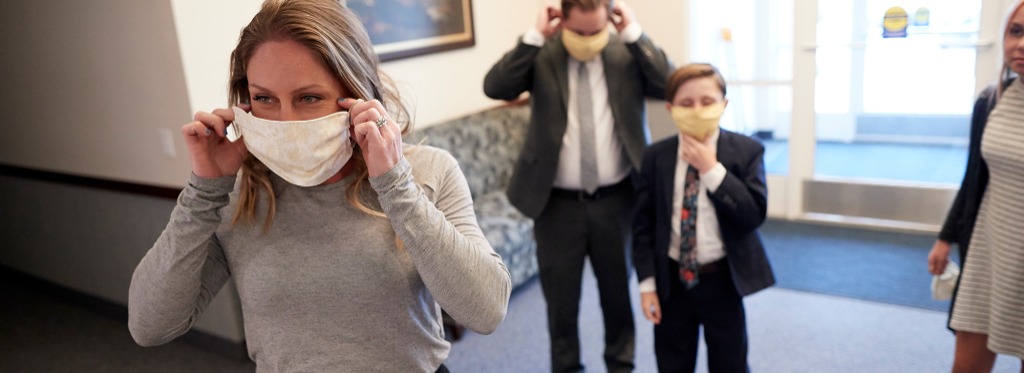
Mormon Church To Require Masks In Temple To Limit COVID-19 Spread
Related...
It insists that these bills don't regulate speech -- when they very, very clearly do.The subject of a report in Techdirt: Unconstitutional restrictions on the free exercise of editorial discretion And, now, the same two organizations that sued to strike down Florida's law, NetChoice and CCIA, have similarly sued to strike down Texas' law.
At bottom, H.B. 20 imposes impermissible content- and viewpoint-based classifications to compel a select few platforms to publish speech and speakers that violate the platforms’ policies—and to present that speech the same way the platforms present other speech that does not violate their policies. Furthermore, H.B. 20 prohibits the platforms from engaging in their own expression to label or comment on the expression they are now compelled to disseminate. And in light of the statute’s vague operating provisions, every single editorial and operational choice platforms make could subject those companies to myriad lawsuits.
These restrictions—by striking at the heart of protected expression and editorial judgment—will prohibit platforms from taking action to protect themselves, their users, advertisers, and the public more generally from harmful and objectionable matter. At a minimum, H.B. 20 would unconstitutionally require platforms like YouTube and Facebook to disseminate, for example, pro-Nazi speech, terrorist propaganda, foreign government disinformation, and medical misinformation. In fact, legislators rejected amendments that would explicitly allow platforms to exclude vaccine misinformation, terrorist content, and Holocaust denial.
Additional H.B. 20 provisions will work to chill the exercise of platforms’ First Amendment rights to exercise their own editorial discretion and to be free from state-compelled speech. H.B. 20 will impose operational mandates and disclosure requirements designed to prescriptively manage—and therefore interfere with and chill—platforms’ exercise of editorial discretion. In a series of intrusive provisions, H.B. 20 requires “social media platforms” to publish how they intend to exercise their discretion, document in excruciating detail how they exercise their editorial discretion over potentially billions of pieces of content, and operate inherently burdensome and unworkable individualized complaint mechanisms—all of which together work to compel or otherwise challenge the platforms’ countless daily uses of editorial discretion.
Notably, the lawsuit does not challenge the email filter provisions in the law, which effectively means that on December 2nd, if no one else tries to stop it, spam filters may be in violation of Texas' law. As Prof. Eric Goldman has noted, any spammer whose email is caught in a spam filter will then be able to sue the filter provider and seek statutory damages. Fun stuff!
Meanwhile, also this week, just to show how totally committed Texas Attorney General Ken Paxton is to unconstitutional restrictions on the free exercise of editorial discretion, he also filed an amicus brief in the appeal of the Florida ruling. A bunch of other states (Alabama, Alaska, Arizona, Arkansas, Kentucky, Mississippi, Missouri, Montana, and South Carolina) all signed on, but this is a Texas product. Also, it's hot garbage. It insists that these bills don't regulate speech -- when they very, very clearly do.
. . .The entire amicus brief tries to claim that editorial discretion is "conduct" and not speech -- and that would upend basically all 1st Amendment precedent. And if Texas actually got its way with this, then that would enable the government to regulate who could appear on Fox News and other media organizations, claiming that those demands are "conduct, not speech."
Nothing in S.B. 7072’s neutrality and disclosure provisions regulates the speech of Plaintiffs or the members of their trade associations—they “neither limit[] what [Plaintiffs or their members] may say nor require[] them to say anything.” FAIR, 547 U.S. at 60. Instead, at most these provisions regulate the conduct of Plaintiffs and their members: their arbitrary and blunderbuss content-moderation policies
This is... wrong. Requiring them not to moderate certain content (as the Florida bill does for political speech) is absolutely requiring them to associate with speech they may disagree with -- and such compelled association is a violation of the 1st Amendment. Did Ken Paxton actually graduate law school without learning this?
Like Florida did in its case, the Texas Amicus brief relies heavily on Rumsfeld v. FAIR. The district court in Florida rightly pointed out that FAIR does not apply here and is easily distinguished: The Florida statutes now at issue, unlike the state actions in FAIR and PruneYard, explicitly forbid social media platforms from appending their own statements to posts by some users. And the statutes compel the platforms to change their own speech in other respects, including, for example, by dictating how the platforms may arrange speech on their sites. This is a far greater burden on the platforms’ own speech than was involved in FAIR or PruneYard.
But, Texas insists otherwise -- and now we have to hope that the panel of Judges on the 11th Circuit recognizes the absolute garbage that is Texas' brief.
Filed Under: censorship, content moderation, florida, social media, texas
Companies: ccia, netchoice
“License and registration, please." It's what we expect to hear when law enforcement stops us for a moving violation.
But today, many motorists ask themselves when the appropriate time is to reach into their glove box, purse or back pocket for the information.
The Minnesota State Patrol, along with several law enforcement agencies across the state, want to make it easier for drivers to store the information and for law enforcement to see when motorists are reaching for documents.
It's called a “Not-Reaching Pouch." Its intent is to store a person's driver's license, and insurance card in a pouch that's kept in plain sight in the vehicle on an air vent or other visible location.
The Department of Public Safety (DPS) recently purchased some Not-Reaching Pouches, which were created by Valerie Castile in partnership with Jacquelyn Carter, to help reduce deadly force encounters between law enforcement and citizens during traffic stops.
This isn't a new product or one the DPS came up with. Another person whose son was killed by police in Virginia came up with the idea and it was championed by Philando Castile's mother after her own son was shot and killed during a traffic stop. If you don't want to get the pouch from a cop, anyone can purchase one directly from the creator's website.
But the DPS's rollout leaves a lot to be desired. As does the product itself when it's being handed out by government employees, as it implies the solution to easily scared officers isn't better training and less reliance on deadly force, but rather asking citizens to defuse the walking bombs that have pulled them over.
> The press release is also written in an exonerative tone, distancing these public servants from the public servants who have killed residents of the state. The problem isn't "people" having trouble figuring out when it's "appropriate" to reach for their IDs and insurance information. They do it when they are asked or instructed to. The problem is that they sometimes get shot while attempting to comply with officers' instructions.
> But the most problematic aspect of this partnership between people whose loved ones have been killed by cops and the agency that oversees the Minnesota State Police is the statement that accompanies this tricky rollout:
“We are continually looking for ways to reduce deadly force encounters as these instances can be catastrophic for police officers, and community members ," said DPS Assistant Commissioner Booker Hodges. “By working together with Ms. Castile, who has tirelessly advocated for these since her son was killed in a deadly force encounter with law enforcement, we are hoping these pouches help in some way reduce these instances, even if it's just one."
Appreciate the sentiment, Booker, but these "encounters" always seem to go one way: officer "fears," officer fires.
These are routine traffic stops that ended with the killing of someone by police officers -- killings that were done in response to movements made by drivers and passengers attempting to comply with officers' requests and orders.
This statement attempts to spread the blame around, as though deadly force is inherent to the "encounter," rather than deployed by officers who seem to believe anytime someone moves while sitting in a vehicle, it's to retrieve a weapon.
It's a well-meaning effort but it's undercut by the agency that's performing it -- one that has already exonerated officers by (1) referring to the killing of drivers by cops as "deadly force encounters," (2) robbing the dead of their agency and (3) understating the severity of officers' actions and overreactions.
Despite those drawbacks, it's a huge step forward for any government agency to hand something like this out.
The DPS's decision to buy these and hand them out is an implicit admission it knows there's something wrong with policing in the state, if not the nation. If it is willing to give drivers something that might prevent "even just one" senseless killing, it is making it clear police officers cannot be trusted to remain calm (and nonviolent) during traffic stops without the assistance of those they're interacting with.
Sure, in a perfect world, the government would already be on top of this, (1) firing bad cops, (2)engaging in more prosecutions of violent cops, (3) refusing to indemnify officers being sued over rights violations, and (4) stocking agencies with employees who understand and respect the fact their real employers are the people they serve. . .But if this was a perfect world, no one would have come up with this idea. So, you do the best with what you have and keep pushing to make it better.
Filed Under: dps, minnesota, minnesota dept. of public safety, minnesota state patrol, not reaching bag, philando castile, police, police shooting
The Best and Worst Places to Work in America
Connecting state and local government leaders
Oregon is the best state to work in while North Carolina checks in last, according to rankings from the nonprofit group Oxfam America.
The index is based on state policies in three areas: wages, worker protections and labor organizing rights. It’s the latest edition of the annual rankings put out by Oxfam. All the data used for the report is based on laws and policies in effect as of July 1 2021.
After Oregon, the report says the other best states to work in are:
One of the more notable changes in this year’s ranking is Virginia’s leap to the top. In 2018 and 2019 the state was at the bottom of the list, in the 51st spot. In 2020, it improved somewhat, checking in at 37. Now, the state has jumped to the top half of the list, ranking at 23.
Following North Carolina, the other worst states to work in, according to the report, are:
The report credits a variety of policy changes for Virginia’s upgrade, such as strengthening protections for domestic workers, raising the minimum wage and adopting Covid-19 safety standards
The authors of the report say that more robust worker protections are needed at the state and federal levels. Although most states have passed basic laws on equal pay and sexual harassment, few have enacted polices like paid sick leave, paid family leave and fair scheduling laws.
For the full report click here.
Wyoming is the most “tax-friendly” state for middle-class families while Illinois checks in last, according to rankings from business forecast and personal finance publisher Kiplinger.
Kiplinger’s index is based on a calculation of each state’s tax burden, taking into account the sum of income, sales and property tax paid by a hypothetical married couple, with two kids, an annual earned income of $77,000 a home with an assessed value of $300,000.
After Wyoming, the report says the other most tax-friendly states for middle-class families are:
Nevada