Friday, November 26, 2021
Double Asteroid Redirection Test (DART) Mission
Why NASA Really, Really Wants to Slam a Spacecraft Into an Asteroid
The DART mission is scheduled to launch early Wednesday. It will crash into an asteroid to see if it's possible to deflect one.
NASA is about to launch a craft designed to crash itself directly into a hurtling space rock at 15,000 mph
[...] "If a hazardous asteroid is ever actually bearing toward Earth, slamming a spacecraft—or a “kinetic impactor”—into it is just one tool at humanity’s disposal. NASA, ESA, and other space agencies have also been exploring other approaches, like positioning a spacecraft close by as a “gravity tractor” to pull it onto a different course, or detonating a nuclear explosion nearby to force it away. . .The advantage of having an early warning if an asteroid is on a collision course is that only a tiny shift in trajectory would be needed to save the day—and the DART mission is a dry run at doing that. It will be perhaps the only time NASA scientists will celebrate the destruction of one of their spacecraft. DART will continually stream images back to Earth, showing the tiny dot representing Didymos and Dimorphos as it grows in size and brightness, with the last image of the asteroids being sent back a few seconds before the crash. . ."
ACADEMIC AESTHETICS FOR YOU
Get A Beautiful Open Syllabus Poster To Support Techdirt And The Open Syllabus Project
from the academic-aesthetics dept
Get your poster from the Open Syllabus Print Shop »
Open Syllabus is a very cool non-profit research organization, spun out of the American Assembly at Columbia University, that collects and analyzes millions of syllabi to better understand what materials are being used to educate people in classes around the world. It currently has a corpus of nine million English-language syllabi from 140 countries and has done a bunch of research based on this data. Most of these syllabi are collected by scouring the open web (though some are submitted directly), and the end result is a very handy Open Syllabus explorer that allows you to take deep dives into what's being taught in various subjects, at various schools and more. Want to know what are the top titles taught for computer science? Or Economics? Or Political Science? They've got the details and more.
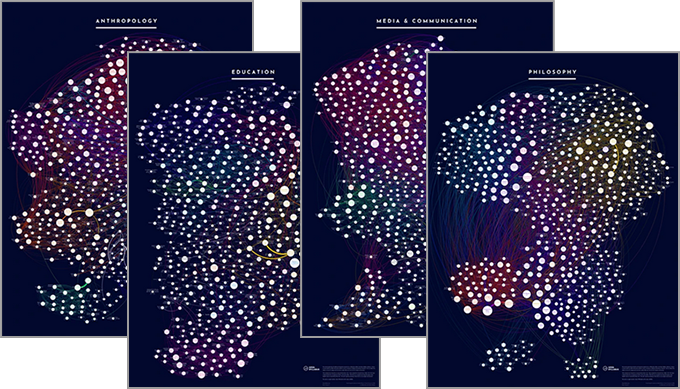
And, recently, Open Syllabus used a bunch of that data to make amazing, beautiful posters, taking the top 600 or so assigned titles in certain fields, and creating "galaxy maps" highlighting the clusters of works and how often certain works are assigned together with one another. They're educational and stunning to look at.

We're now teaming up with Open Syllabus to sell these posters. Buying the posters helps supports both Techdirt and Open Syllabus -- and gets you an amazing looking poster for topics of your choosing from Political Science to Media and Communication to Sociology to Philosophy. There are a bunch more, so check them out, and order one for yourself... and maybe get another as a gift for someone in those academic fields.
Filed Under: open syllabus
"THE UNTOUCHABLES" : New Approaches To Change Entrenched Political Patronage
Using Federal Relief Funds to Invest in Non-Police Approaches to Public Safety
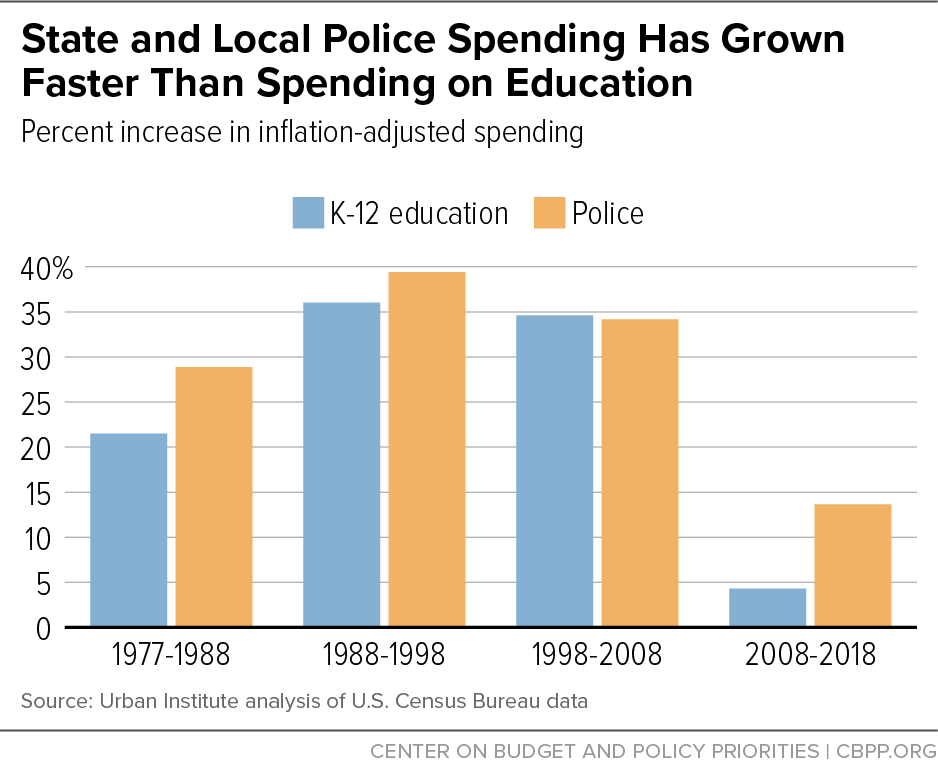
Cities and States Should Consider Non-Police Approaches to Public Safety
Many communities across the U.S. are engaged in debates about the best ways to keep residents safe amid broader awareness of the problems of policing, but also in response to concerns about recent increases in violent crime. These communities are evaluating the proper role of policing, possible reforms to hold police more accountable, and non-police approaches to some aspects of public safety.
American Rescue Plan Can Be Used to Support New Public Safety Approaches
Creating new approaches to public safety that go beyond traditional policing will require new resources. Transferring responsibilities from police to other entities requires money to plan and start those efforts. Community investments to create more stable and safer communities, such as affordable housing, require substantial funding to address these problems on a meaningful scale.
The American Rescue Plan, enacted in March 2021 to alleviate COVID-19-related hardship and support an equitable recovery, creates a historic opportunity for states and localities to implement new approaches to public safety. It includes several targeted funds — in behavioral health, education, and housing, for example — as well as $350 billion in State and Local Fiscal Recovery Funds (FRF) that can be used flexibly. Interim guidance from the U.S. Treasury Department, which is administering the Fiscal Recovery Funds, encourages states to spend the funds in ways that help residents hit especially hard by the pandemic and to reduce long-standing economic and racial inequities. For instance, the guidance clarifies that FRF can be used to reduce health inequities across racial and economic lines, and any spending in a low-income Census tract is assumed allowable. Finally, states and localities can use FRF to replace revenues that fell as a result of the pandemic and can spend these dollars on any program or service.
These efforts will likely require greater state government involvement, even though policing is mostly a local responsibility. State governments can provide support, including Rescue Plan funds, to enable and encourage localities to fund police alternatives. State leaders have an interest in public safety reform because it could positively impact state policy, such as through improving state economies and reducing state prison costs.
States have three years or more to spend Rescue Plan funds, depending on the source, and they can use the time during which federal funds are available to plan to maintain those investments with their own resources.
Affordable Housing
The Rescue Plan provides several sources of funds that can be used to create affordable housing in ways that provide stability and that can reduce interactions with the criminal legal system. Targeted affordable housing can address one of the main challenges to stability that people returning from jail or prison face; a lack of housing options contributes to recidivism rates.
- The Rescue Plan provides $5 billion for housing vouchers for people experiencing homelessness or at risk of homelessness, including survivors of domestic violence. These vouchers are distributed to and controlled by local housing agencies. Use of these vouchers will contribute to more stable communities and therefore support public safety. Housing agencies could further connect these vouchers to public safety by designating a share for people returning from jail or prison who were formerly homeless or are at risk of being homeless upon release.
- The Rescue Plan provides an additional $5 billion to states and localities to build affordable housing, provide tenant-based rental assistance, acquire buildings to use as non-congregate homeless shelters, and provide supportive services.
- State and local governments can use their Fiscal Recovery Funds for affordable housing, as noted in Treasury’s interim guidance.
- States and localities also can use their FRF to invest in homeless-outreach services, as an alternative to having police respond to homelessness-related calls. This would help connect residents experiencing homelessness to services and reduce their risk of arrest and incarceration.
States and localities also can create sustainable solutions to homelessness by reducing reliance on law enforcement to respond to homelessness.Some communities effectively criminalize homelessness by outlawing activities such as sleeping outside, sitting in public, living in cars, or panhandling, and by relying on law enforcement to respond to homelessness. This subjects people to fines or jail time for not being able to afford a place to live. It also makes it harder for people to access housing, in part because public housing agencies and landlords often screen out applicants for criminal records.
Shifting Responsibilities From Police to Other Entities
The State and Local Fiscal Recovery Funds create opportunities for states to fund new entities to take over certain responsibilities from police or provide services that can reduce violence and interventions by police. For example, states can fund new non-police traffic management entities and violence interrupter services.
Non-police traffic management
Violence interruption services.
Other Investments in Stable Families and Communities
Investments in basic services that support family and community stability, such as affordable housing and job training, contribute to greater public safety, research confirms. These investments support strong communities and reduce stressors that can contribute to community strife and violence. Communities with strong institutions to address violence and promote community well-being have lower rates of violent crime. Increased spending on social services is correlated with substantially lower homicide rates.
More specifically, states that spend more on housing generally have lower incarceration rates, perhaps because affordable and supportive housing programs offer a stable foundation for education, employment, and access to services.
[...] Stronger communities, stronger economies. Investments in affordable housing, high-quality schools, and job training have tremendous benefits. Affordable housing that reduces the likelihood of frequent moves, eviction, or overcrowding helps adults find and keep jobs and supports children’s educational success. These and other investments to address poverty can improve educational and economic outcomes for children and improve health outcomes for children and adults. Stable affordable housing reduces incarceration rates among children when they become adults.
==========================================================================
States Should Use Federal Relief Funds to Jumpstart Long-Term Investments in a Better, More Equitable Future
DELIVERING MORE PAYLOAD - FASTER, FARTHER AND SMARTER
Boeing to Deliver Additional Chinook Helicopters to US Army Special Operations
- $246.48 million contract is for six MH-47G Block II Chinooks plus spares

Boeing will build six more MH-47G Block II Chinooks for the U.S. Army Special Operations Aviation Command as part of a $246.48 million contract.
Delivery of these aircraft are scheduled to start in 2023. With this additional order, Boeing is now under contract for 30 MH-47G Block II Chinooks, four of which have been delivered to date.
These aircraft will be the first to include the new Active Parallel Actuator Subsystem (APAS), a mission system that helps pilots execute more difficult maneuvers while improving safety and reliability of flight.

Global Military Helicopter - Market and Technology Forecast to 2027
Market forecasts by Region, by Platform, and by Component. Country analysis, Market Overview, Opportunity Analysis, and Leading Companies
Published: August 2019 - Pages: 222 pages
“APAS is one of many next-level capabilities that allows the Chinook to deliver more payload – faster, farther and smarter,” said Andy Builta, Boeing vice president and H-47 program manager.
The MH-47G Block II Chinook also features improved structure and weight reduction initiatives like new lighter weight fuel pods that increase performance and efficiency.
Boeing has more than 4,600 Boeing employees in Pennsylvania supporting H-47 Chinook, V-22 Osprey, MH-139A Grey Wolf and a number of services and engineering efforts. Boeing’s presence, including suppliers and vendors, supports an estimated 16,000 total jobs in Pennsylvania.
Source: Boeing
Date: Nov 24, 2021
View original News release
Thursday, November 25, 2021

Imperialst Rhetoric, Tom Horn to Defuse Tensions, Gold Tops $5,000 in Demand Frenzy, . . .Japan Bond Crash
Stephen Maturen/Getty Images Trump, Democrats Hurtle Toward Shutdown After Minnesota Killing A fatal shooting by Border Patrol agen...

-
 Flash News: Ukraine Intercepts Russian Kh-59 Cruise Missile Using US VAMPIRE Air Defense System Mounted on Boat. Ukrainian forces have made ...

