Friday, December 24, 2021

FAST-FORWARD ON PAST PANDEMIC MISTAKES | The Atlantic

By all means, please take the time to read more important details . . .there are more than a few
 
 
"Omicron is dangerous not just in itself, but also because it adds to the damage done by all the previous variants—and at speed. And the U.S. has consistently underestimated the cumulative toll of the pandemic, lowering its guard at the first hint of calm instead of using those moments to prepare for the future. That is why it keeps making the same mistakes. American immune systems are holding on to their memories for dear life, but American minds seem bent on forgetting the past years’ lessons."
 

Omicron Is Our Past Pandemic Mistakes on Fast-Forward

We’ve been making the same errors for nearly two years now.

<div class=__reading__mode__extracted__imagecaption>Ben Hickey

"With Omicron, everything is sped up. The new variant is spreading fast and far. At a time when Delta was already sprinting around the country, Omicron not only caught up but overtook it, jumping from an estimated 13 to 73 percent of U.S. cases in a single week. We have less time to make decisions and less room to course-correct when they are wrong. Whereas we had months to prepare for Delta in the U.S., we’ve had only weeks for Omicron. Every mistake gets amplified; every consequence hits us sooner. We should have learned after living through multiple waves and multiple variants of COVID, but we haven’t, at least not enough. We keep making the same pandemic mistakes over and over again.

This is not March 2020. We have masks. We have better treatments. Our immune systems are much more prepared to fight off the virus, thanks to vaccines. But as a society, we are still not prepared.

Here are the six traps that we keep falling into, each consequence made all the more acute because of Omicron’s speed.

> We rush to dismiss it as “mild.”

> We treat vaccines as all-or-nothing shields against infection.

> We still try to use testing as a one-stop solution.

> We pretend the virus won’t be everywhere soon.

> We fail to prioritize the most vulnerable groups.

> We let health-care workers bear the pandemic’s brunt.


BETTER WATCH OUT: Blister Kicks Into Action! (for at least 3 months since September 15) | Bleeping Computer

Stealthy BLISTER malware slips in unnoticed on Windows systems

Security researchers have uncovered a malicious campaign that relies on a valid code-signing certificate to disguise malicious code as legitimate executables.

One of the payloads that the researchers called Blister, acts as a loader for other malware and appears to be a novel threat that enjoys a low detection rate.

The threat actor behind Blister has been relying on multiple techniques to keep their attacks under the radar, the use of code-signing certificates being only one of their tricks.

Signed, sealed, delivered

Whoever is behind Blister malware has been running campaigns for at least three months, since at least September 15, security researchers from Elastic search company found.

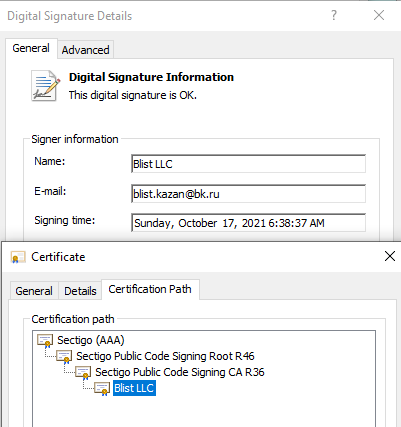
The threat actor used a code-signing certificate that is valid from August 23, though. It was issued by digital identity provider Sectigo for a company called Blist LLC with an email address from a Russian provider Mail.Ru.

source: Elastic

Using valid certificates to sign malware is an old trick that threat actors learned years ago. Back then, they used to steal certificates from legitimate companies. These days, threat actors request a valid cert using details of a firm they compromised or of a front business.

In a blog post this week, Elastic says that they responsibly reported the abused certificate to Sectigo so it could be revoked.

The researchers say that the threat actor relied on multiple techniques to keep the attack undetected. One method was to embed Blister malware into a legitimate library (e.g. colorui.dll).

The malware is then executed with elevated privileges via the rundll32 command. Being signed with a valid certificate and deployed with administrator privileges makes Blister slip past security solutions.

In the next step, Blister decodes from the resource section bootstrapping code that is “heavily obfuscated,” Elastic researchers say. For ten minutes, the code stays dormant, likely in an attempt to evade sandbox analysis.

It then kicks into action by decrypting embedded payloads that provide remote access and allow lateral movement: Cobalt Strike and BitRAT - both have been used by multiple threat actors in the past.

The malware achieves persistence with a copy in the ProgramData folder and another posing as rundll32.exe. It is also added to the startup location, so it launches at every boot, as a child of explorer.exe.

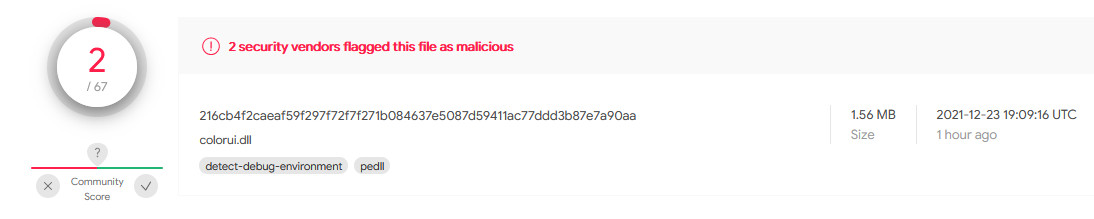
Elastic’s researchers found signed and unsigned versions of the Blister loader, and both enjoyed a low detection rate with antivirus engines on VirusTotal scanning service.

detection rate of unsigned Blister malware sample

While the objective of these attacks of the initial infection vector remain unclear, by combining valid code-signing certs, malware embedded in legitimate libraries, and execution of payloads in memory the threat actors increased their chances for a successful attack.

Elastic has created a Yara rule to identify Blister activity and provides indicators of compromise to help organizations defend against the threat.


USA FACTS . . .7 charts a-learnin'

Workforces before and after the holidays

'Tis the season for holiday hiring. And, according to a new report at USAFacts, January is a time for trimming the workforce. After the end-of-the-year shopping is done, many retailers shed not just their seasonal help, but workers hired before the holidays.

  • Bureau of Labor Statistics data from 2011 to 2021 shows that retailers in the eight retail categories most reliant on holiday sales lose an annual average of 686,000 jobs in the first two months of the year.
     
  • Holiday retail hiring reached a peak of 761,000 employees in 2013.

Learn more about holiday retail hiring in this new report. 


Seven charts a-learnin'

Want more retail numbers? Here's a stocking stuffed with charts on holiday shopping, the Consumer Price Index, COVID-19, travel, and more.

Shoppers are finding higher prices for presents in all different categories this year. The prices for many gifts are up, from 0.6% for wine to 6.7% for jewelry.
 
The holiday shopping season is clearly a big deal for retailers, but this chart explains just how important December is to clothing retailers — both pre-pandemic and during the pandemic.
 
Now onto another kind of spending. Federal spending grew by less than 1% in fiscal year 2021. Track the history of spending back to 1980 with this graphic.
 
The federal government collected $3.5 trillion in revenue in fiscal year 2020 — or $10,457 per person. Ninety-one percent came from individual income, payroll, and corporate income taxes.
 
At least 20% of children ages 5 to 11 in the US have received their first COVID-19 vaccination since November 2. 
 
Here's what that vaccination rate looks like nationwide: Maine, Rhode Island, Massachusetts, and Vermont all have rates at 35% or above for children 5–11.
 
Are you traveling for the holidays? It might cost you more than in years past, with vehicle and hotel rentals up over a year ago. Gasoline is up over 58%. However, airline travel costs are down.

BEA News: Gross Domestic Product by State, 3rd Quarter 2021

BEA logo and link to website

BEA News: Gross Domestic Product by State, 3rd Quarter 2021


The U.S. Bureau of Economic Analysis (BEA) has issued the following news release today:
Real gross domestic product (GDP) increased in 37 states and the District of Columbia in the third quarter of 2021, as real GDP for the nation increased at an annual rate of 2.3 percent. The percent change in real GDP in the third quarter ranged from 6.0 percent in Hawaii to -3.3 percent in New Hampshire and North Dakota. GDP estimates reflect the continued economic impacts related to the COVID-19 pandemic. Government pandemic assistance payments to households and business decreased. The full economic effects of the COVID-19 pandemic cannot be quantified in the state GDP estimates because the impacts are generally embedded in source data and cannot be separately identified.
The full text of the release on BEA's website can be found at: www.bea.gov/news/2021/gross-domestic-product-state-3rd-quarter-2021              


Public Notice & 30-Day Public Comment Period | Significant Amendment to Aquifer Protection Permit for ASARCO Ray Operations in Pinal County

Public Notice

Why Time-Sensitive Decisions Can Trigger Our FOMO [Advertiser Content Fr...

Alibaba Admits Slow to Report Software Bug