Sunday, July 03, 2022

BEWARE THE REDUX...

/

Uncovering untold secrets of NATO --- monstrous remnant from Cold War days
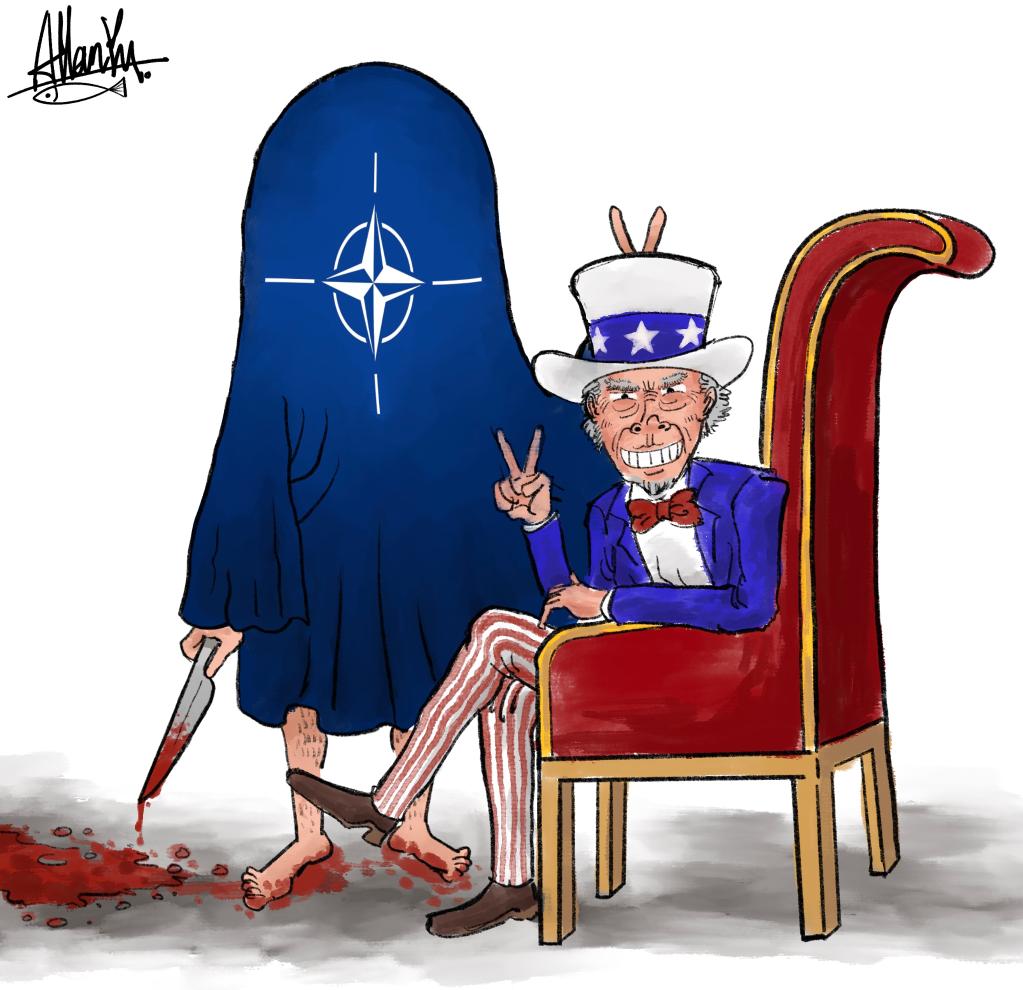
Source: Xinhua

Editor: huaxia

2022-04-26 19:33:00

Source: Xinhua

Editor: huaxia

2022-04-26 19:33:00


0:00:00
/2:07

* Both history and military alliance theory seem to predict that once the Cold

* Both history and military alliance theory seem to predict that once the Cold War had ended, NATO would have disintegrated. Unfortunately this has not been the case. Far from being fully disbanded, NATO has been bent on expansion.

* The relationship between the United States and its European allies within NATO is fundamentally unequal. NATO contributes to the United States' hegemonic position in Western Europe by allowing U.S. military bases and troops to be stationed in the region.

* Since 1999, NATO has expanded eastward five times, advancing more than 1,000 km all the way to the Russian border, gradually pushing Russia into a corner.

* NATO forces launched 78 days of bombardment against Yugoslavia in 1999, killing or injuring over 8,000 civilians and displacing approximately 1 million people. Other countries, including Afghanistan, Iraq and Libya, have also fallen victim to the U.S.-led NATO's belligerence and violations of human rights.

BEIJING, April 26 (Xinhua) -- As the Russia-Ukraine conflict rages on, tensions between NATO and Russia have verged on downright hostilities.

The gloomy reality on the ground brings up a question as to why, more than 30 years after the end of the Cold War, the world appears to have regressed to where it ever was.

Thanks to their intentionally neglected nuance in depicting the Russia-Ukraine conflict, Western media have framed Russia as the lone villain. Close scrutiny of regional geopolitics, however, makes clear that NATO, a remnant from Cold War days, bears responsibility for precipitating the current crisis, not least for its relentless expansion at the expense of Russia's security concerns...

GLOBAL PEACE DISRUPTOR

Russia has long been accused by the U.S.-led NATO of violating basic international rules and norms and stoking global instability. Ironically, it is precisely what people in many parts of the world believe Washington and NATO have been doing.

Speaking in March at a ceremony marking the Remembrance Day of victims of the 1999 NATO aggression against the Federal Republic of Yugoslavia, President of the Republic of Serbia Aleksandar Vucic condemned the NATO attack as "brutal, horrible, criminal, (and) inhuman."

Though that small country "hardly did anything wrong to anyone... that small country and great people just wanted to be on their own, to guard their hearths, and nothing more," Vucic said, "some others, 19 big ones, wanted to show all their courage, arrogance and brutality on a small unconquered people like the Serbs."

NATO forces launched 78 days of bombardment against Yugoslavia in 1999, killing or injuring over 8,000 civilians and displacing approximately 1 million people.

Other countries, including Afghanistan, Iraq and Libya, have also fallen victim to the U.S.-led NATO's belligerence and violations of human rights.

In the two-decade-long Afghanistan war fought nominally to protect civilians, NATO's airstrikes have killed thousands of civilians.

Din Mohammad, a 73-year-old Afghan man from the hamlet of Lakani in the Panjwayi district of Kandahar province in south Afghanistan, still remembered the night ten years ago when the U.S. military unleashed airstrikes on his hometown, killing 63 civilians and injuring dozens more.

"The bodies of men, women and children were lying in blood and the crying of the injured was heard from every corner of the house," he told Xinhua.

"Innocent people were killed in their beds without committing any crime," said Mohammad, who lost 17 family members, including five children, that night.
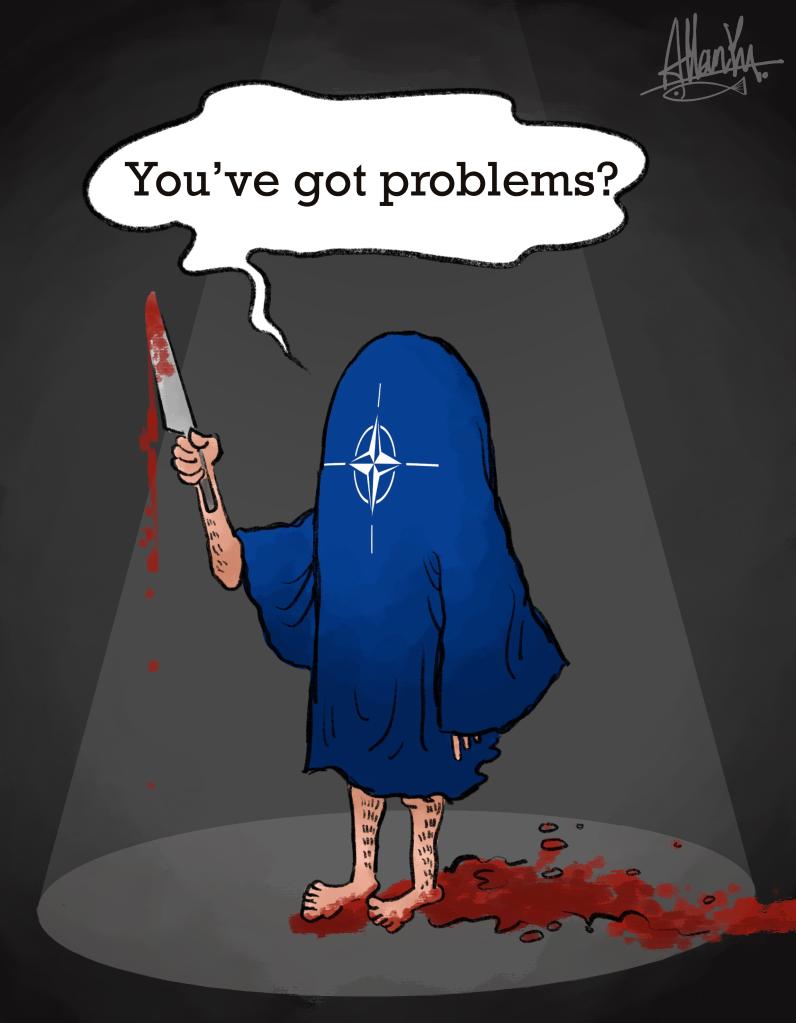

After the U.S.-led NATO intervention in 2011, Libya sank into civil war and became a breeding ground for instability and terrorism.

As Alan Kuperman, associate professor of public affairs at the University of Texas at Austin, has noted, "Libya has not only failed to evolve into a democracy; it has devolved into a failed state. Violent deaths and other human rights abuses have increased severalfold" after the NATO military attacks.

In Iraq, between 184,382 and 207,156 civilians have died from "direct war-related violence caused by the United States, its allies, the Iraqi military and police, and opposition forces" from the time of the invasion through October 2019, according to the Costs of War project at the U.S. Brown University.

The death toll is "likely much higher," as not all war-related deaths were accurately recorded, it said.

(Video reporter: Lu Jiafei, Feng Yasong, Shu Chang, He Fei; Video editors: Lin Lin, Cao Ying, Zhu

>

Video for NATO war interventions, animated timeline
May 30, 2022 · The history of NATO on maps, from the end of World War II, until the invasion of Ukraine by ...
Duration: 15:55
Posted: May 30, 2022

Home/Articles/Realism & Restraint/The War for Globalism in Ukraine

Washington’s proxy war in Ukraine is the globalist scheme to transcend the continuity of history, culture, and geography embodied in the nation-state.


Beware the redux: America’s violent Cold War history

Hollywood loves a sequel, but the Russia-Ukraine crisis has made the possibility real, and no one should want to see it.

A growing chorus of pundits and policymakers has suggested that Russia’s invasion of Ukraine marks the beginning of a new Cold War. If so, that means trillions of additional dollars for the Pentagon in the years to come coupled with a more aggressive military posture in every corner of the world.

Before this country succumbs to calls for a return to Cold War-style Pentagon spending, it’s important to note that the United States is already spending substantially more than it did at the height of the Korean and Vietnam Wars or, in fact, any other moment in that first Cold War. Even before the invasion of Ukraine began, the Biden administration’s proposed Pentagon budget (as well as related work like nuclear-warhead development at the Department of Energy) was already guaranteed to soar even higher than that, perhaps to $800 billion or more for 2023.

Here’s the irony: going back to Cold War levels of Pentagon funding would mean reducing, not increasing spending. Of course, that’s anything but what the advocates of such military outlays had in mind, even before the present crisis

> REFERENCES AND RESOURCES

Grand Illusions: The Impact of Misperceptions About Russia on U.S. Policy

Getting Russia right—assessing its capabilities and intentions, the long-term drivers of its policy and threat perceptions, as well as its accomplishments—is essential because the alternative of misreading them is a recipe for wasted resources, distorted national priorities, and increased risk of confrontation.


GLOBAL CONFLICT TRACKER Link >> https://www.cfr.org/global-conflict-tracker

HISTORY OF NATO

America’s Longest Foreign Wars                      


>

Afghanistan

Visualising the impact of 20 years of war


Here's what 20 years of war has done to the Afghan people. As the US withdraws its troops, we look at the latest figures on human suffering.

The human cost of war An estimated 241,000 people have died as a direct result of the war since the US invaded Afghanistan to topple the Taliban in the wake of the September 11, 2001 attacks in the US, according to the most recent figures from Brown University’s Costs of War. Hundreds of thousands more, mostly civilians, have died due to hunger, disease and injury caused by the devastating war. . .

The US and NATO's longest war

The US under President George W Bush invaded Afghanistan on October 7, 2001, less than a month after the September 11 attacks in the US. The coalition he led accused the ruling Taliban regime of harbouring Osama bin Laden, the al-Qaeda leader who claimed responsibility for the attacks.

The war in Afghanistan spanned nearly 20 years and four US presidents.        

Over the 20-year war, 50 NATO and partner nations contributed forces to the missions in Afghanistan. At its peak in 2011, nearly 140,000 US and allied forces were in the country.

The economic cost of war

The war in Afghanistan is estimated to have cost the US $2.26 trillion to date, according to the Cost of War project. The bulk of the spending, $933bn, was allocated to the US Department of Defense war budget, later supplemented by another $443bn.

The rest of the money includes $296bn for veterans’ medical and disability care and $59bn towards the Department of State’s war budget. The US has also paid some $530bn in interest for its heavy borrowing throughout the war. The US has spent $144bn on Afghanistan reconstruction initiatives.

These figures do not include the lifetime care for veterans nor future interest payments, which means even after the US leaves Afghanistan it will continue to pay for the war.

====================================================

The US military presence in Europe has been declining for 30 years – the current crisis in Ukraine may reverse that trend

Up to 8,500 U.S. troops could soon be heading to Eastern Europe – bolstering an American military presence in the continent that has been in decline since the end of the Cold War.

News of the possible deployment, announced on Jan. 24, 2022, by the Pentagon, comes as Russia and the United States continue to maneuver in the face of an escalating crisis in Ukraine.

We are a team of researchers who study U.S. troop deployments and how they affect the security, perceptions, economy, social sphere and environment of host countries. Understanding the changing U.S. military commitment to European countries helps us understand what is at stake in Europe and U.S. credibility in the region.

US troop numbers in Europe have fallen since Cold War's end 

A significant drop in America's military presence in Europe coincided with the end of the Soviet Union in 1991, and then again as the US got bogged down in conflicts in Iraq and Afghanistan.

Europe


>


OFFICAL INFORMATION

Operations and missions: past and present

Last updated: 14 Jun. 2022 13:11

NATO is an active and leading contributor to peace and security on the international stage. It promotes democratic values and is committed to the peaceful resolution of disputes. However, if diplomatic efforts fail, it has the military capacity to undertake crisis management operations alone or in cooperation with other countries and international organisations.

Current operations and missions

Terminated operations and missions

From 1949 to the early 1990s

NATO in Afghanistan - Following the 9/11 terrorist attacks against the United States, the International Security Assistance Force (ISAF) was established under the request of the Afghan authorities and a UN mandate in 2001. ISAF was led by NATO from August 2003 to December 2014 and was succeeded on 1 January 2015 by the Resolute Support Mission (RSM), which was terminated early September 2021.

Operation Active Endeavor - Operation Active Endeavour (OAE) was initiated in the immediate aftermath of the 9/11 terrorist attacks to deter, defend, disrupt and protect against terrorist activity in the Mediterranean. It helped to secure one of the busiest trade routes in the world and was among eight initiatives launched by the Alliance in 2001, in solidarity with the United States. It was an Article 5 operation, i.e., a collective defence operation that, initially only involved NATO member countries until it started accepting non-NATO countries' participation in 2004.

NATO and Iraq - NATO conducted a relatively small but important support operation in Iraq from 2004 to 2011 that consisted of training, mentoring and assisting the Iraqi Security Forces. At the Istanbul Summit in June 2004, the Allies rose above their differences and agreed to be part of the international effort to help Iraq establish effective and accountable security forces. The outcome was the creation of the NATO Training Mission in Iraq (NTM-I). The NTM-I delivered its training, advice and mentoring support in a number of different settings. All NATO member countries contributed to the training effort either in or outside of Iraq, through financial contributions or donations of equipment. In parallel and reinforcing this initiative, NATO also worked with the Iraqi government on a structured cooperation framework to develop the Alliance's long-term relationship with Iraq.

NATO and Libya -

Following the popular uprising against the Gadhafi regime in Benghazi, Libya, in February 2011, the UN Security Council adopted Resolutions 1970 and 1973 in support of the Libyan people, "condemning the gross and systematic violation of human rights". The resolutions introduced active measures including a no-fly zone, an arms embargo and the authorisation for member countries, acting as appropriate through regional organisations, to take "all necessary measures" to protect Libyan civilians.

Initially, NATO enforced the no-fly zone and then, on 31 March 2011, NATO took over sole command and control of all military operations for Libya. The NATO-led Operation Unified Protector had three distinct components:

  • the enforcement of an arms embargo on the high seas of the Mediterranean to prevent the transfer of arms, related material and mercenaries to Libya;
  • the enforcement of a no-fly-zone in order to prevent any aircraft from bombing civilian targets; and
  • air and naval strikes against those military forces involved in attacks or threats to attack Libyan civilians and civilian-populated areas.

The UN mandate was carried out to the letter and the operation was terminated on 31 October 2011 after having fulfilled its objectives.

Assisting the African Union in Darfur, Sudan - The African Union Mission in Sudan (AMIS) aimed to end violence and improve the humanitarian situation in a region that has been suffering from conflict since 2003. From June 2005 to 31 December 2007, NATO provided air transport for some 37,000 AMIS personnel, as well as trained and mentored over 250 AMIS officials. While NATO's support to this mission ended when AMIS was succeeded by the UN-AU Mission in Darfur (UNAMID), the Alliance immediately expressed its readiness to consider any request for support to the new peacekeeping mission.

Second Gulf Conflict - During the second Gulf Conflict, NATO deployed NATO AWACS radar aircraft and air defence batteries to enhance the defence of Türkiye in an operation called Display Deterrence. This operation started on 20 February 2003 and lasted until 16 April 2003. The AWACS aircraft flew 100 missions with a total of 950 flying hours.


Saturday, July 02, 2022

COUNTER-NARRATIVES TO WESTERN MEDIA: Keeping NATO Madrid Summit in Perspective (Russia and China)

Stories in the media: including one about oil prices rising even more in Q3 2022 to $135/barrel

Press review: Russia’s gesture of goodwill and takeaways from NATO’s Madrid summit

Top stories from the Russian press on Friday, July 1st

Nezavisimaya Gazeta: NATO’s Madrid summit launches new standoff

The Madrid-hosted NATO summit, which has concluded, may be considered a turning point in the alliance’s history. Not only will it accept new members, with the process of the Euro-Atlantic integration of Sweden and Finland being launched, but also the statements and documents approved in Madrid, including NATO’s new Strategic Concept, indicate that the US-led military bloc adopted a stance opposing the West’s geopolitical rivals chiefly Russia and, to the lesser extent, so far, China.

> NATO members agreed on an arms race, the expansion of its ranks and its beefed-up military presence in certain countries, that is, to all the steps that previously had been problematic for the military alliance.

Associate Professor of the Department of Integration Processes at MGIMO Alexander Tevdoy-Burmuli told the newspaper that, although increasing defense spending requires substantial budget policy adjustments in many NATO countries, they will gradually achieve it. "The necessity of doing so up to a certain point did not seem obvious to them. Now it does. Evidently, the countries of the alliance won’t move towards this at the same rate. This trend is absolutely clear," the expert thinks. According to him, the largest member states will be in the lead. The expenses of smaller countries will depend on how much the leaders are ready to spend. . .

========================================================================

SEE ALSO:

China calls NATO ‘systemic challenge’ to global peace and stability

"We want to state openly that NATO is exaggerating and inflating the so-called Chinese threat and this is an absolutely futile endeavor," Chinese Foreign Ministry Spokesperson Zhao Lijian remarked
Chinese Foreign Ministry Spokesman Zhao Lijian EPA-EFE/WU HONG
Chinese Foreign Ministry Spokesman Zhao Lijian
© EPA-EFE/WU HONG

BEIJING, June 30. /TASS/. NATO itself is a systematic challenge to global peace and stability, Chinese Foreign Ministry Spokesperson Zhao Lijian said on Thursday, commenting on the alliance’s new strategic concept.

"NATO itself is a systemic challenge to global peace and stability," the Chinese diplomat said at a regular news conference. The US-led organization, while positioning itself as a defensive bloc, has sought to advance into new areas and domains, he added. He also said "NATO has the blood of the global population on its hands."

"We want to state openly that NATO is exaggerating and inflating the so-called Chinese threat and this is an absolutely futile endeavor," Zhao Lijian remarked. He urged the military bloc to immediately stop its baseless criticism and provocative statements against China and refrain from Cold War ideology and the zero-sum game concept.

At Wednesday’s summit in Madrid, NATO leaders agreed on a new strategic concept in which Russia was identified as "the most significant and direct threat to the alliance’s security." NATO addressed China for the first time, pointing to the systemic challenges posed by the country."

========================================================================

Izvestia: Moscow embarks on goodwill gesture to ease global food dilemma

Russia has pulled out its garrison from Snake Island in the Black Sea. Moscow embarked on this goodwill gesture and demonstrated to the global community that it is not preventing the exports of agricultural products from Ukraine, the Russian Defense Ministry said on June 30. Experts note that it didn’t make much sense to hold on to the island from a military point of view. The Russian Navy has complete superiority over its adversary in the Black Sea and if needed, Russia’s forces can be swiftly redeployed to the island.

Once Ukraine gets MLRS and SPGs from the West, the island will be shelled constantly, according to military expert Dmitry Boltenkov. In his opinion, the Ukrainian army will definitely attempt an amphibious assault on the island because in the absence of real victories they need a media triumph. "They won’t miss a chance to show off on Snake Island," the expert said, noting that Russia is capable of completely eliminating any assault troops or of retaking the island at any time.

"The entire narrative that Russia is preventing grain exports from Odessa and fueling world hunger is artificial and contrived," says former UN Deputy Secretary General Sergey Ordzhonikidze, stressing that the situation was created to pressure Russia.

> "Ukraine provides about 1% of the world’s grain. The figure looks significant in tonnes but in the global format it is absolutely unsubstantial. Additionally, Snake Island did not pose any threat to maritime traffic in that area of the Black Sea, but mines laid by Ukraine in those waters do. They’ve been told over and over again to demine the Odessa port yet they haven’t done that," the diplomat said, adding that the vessels carrying grain should be inspected for weapons. According to him, Ukraine smuggles arms using passenger trains and civilian trucks and will attempt to do the same at sea.

Nezavisimaya Gazeta: Takeaways from the Sixth Caspian Summit

The Caspian Summit of heads of state has concluded in Ashgabat with the signing of a communique. The presidents of Russia, Kazakhstan, Azerbaijan, Turkmenistan and Iran gave high marks to the level of cooperation, expressed concern over the shallowing Caspian and agreed upon maintaining the necessary level of security in the region. Moscow managed to resolve an important issue of preventing joint naval drills in the Caspian with participants from extra-regional countries.

Despite preliminary statements by Russian Foreign Minister Sergey Lavrov on the importance of the Sixth Caspian Summit, no significant documents have been signed upon its completion. Moreover, the 2018 Convention on the Legal Status of the Caspian Sea remains suspended since Iran still has not ratified it.

"It is precisely the incomplete nature of this document that allowed, for example, Azerbaijan to hold military drills on the Caspian coast and in its waters, with the participation of non-coastal countries, primarily, Turkey and Pakistan. And the military of NATO member states from time to time indicate their presence within the framework of various joint programs, and on the Caspian coast as well," expert on Central Asia Serdar Aytakov told the newspaper.

The summit, even without signing any new important documents, was extremely essential to Russia for several reasons, according to Senior Researcher at the IMEMO Center for Post-Soviet Studies Stanislav Pritchin. Among them he lists the failure of Western countries to isolate Russia on the international stage and the readiness of Russia’s neighbors and partners to continue political dialogue and cooperation despite all the sanctions and Western pressure. Additionally, the summit confirmed the basic principles of regional security and the absence of any third-party military presence. According to the expert, the summit made it possible to discuss specific economic projects, new transportation routes and opened new horizons for cooperation in the absence of any prospects of interaction with EU countries. "The Russian president noted that in 2021 the trade volume with the region’s countries grew 35%, totaling $34 bln, while by April 2022 it increased by another 12%," the expert told the newspaper.

Vedomosti: Indonesian leader tries to settle issue with Putin’s participation in G20 summit

On June 30, Russian President Vladimir Putin began a meeting with his Indonesian counterpart Joko Widodo with a reminder that in a phone conversation the latter was interested in the issue of settling the Donbass crisis and promised to inform him about "our vision of this problem." In the open part of the conversation, Widodo focused on problems with grain and fertilizer exports.

Indonesia ranks fourth worldwide in terms of population, thus, it carries certain obligations in the global community and wants to increase its status to become a global power, according to Leading Researcher of the Center for Southeast Asia at the Russian Academy of Sciences’ Institute of Oriental Studies Alexey Drugov.

The expert noted that currently Indonesia is chairing G20 with the group’s summit scheduled to take place in Bali on November 15-16. Due to this, Indonesia has to regulate the issues related to the Russian-Ukrainian conflict and Putin’s participation. According to him, Indonesian elites see the Ukrainian situation not as a bilateral conflict but as a struggle between NATO along with the West against Russia, with Indonesia being the first possible Asian mediator in the conflict. Widodo was the first Asian leader to visit Kiev after the onset of Russia’s special military operation, Drugov noted.

The choice of participation format at the G20 summit is now up to Putin and depends on his intentions. The invitation from Indonesia has been received and it hardly involves remote participation, according to Russian International Affairs Council Director General Andrey Kortunov. Yet a face-to-face format, even though it establishes Russia's presence more explicitly, also involves a possible escalation and is fraught with a display of unfriendly attitudes by about 50% of the G20 leaders, the expert noted.

Kommersant: OPEC+ deal’s fate hangs in the balance

As expected, the biggest oil producers agreed to boost production in August by 648,000 barrels per day within the framework of the OPEC+ deal. Despite the current sanctions which entailed difficulties with raw materials exports, in the summer, Russia hopes to go from the current 9.9 mln barrels per day to 11 mln barrels according to its quota. The critical issue is whether the coordination of efforts by OPEC+ participants will continue after September when the deal is formally over.

According to Director of the ACRA corporate rating group Vasily Tanurkov, Russia and Saudi Arabia will stop closely coordinating their efforts on the market but this is not particularly important since the vast majority of OPEC+ countries already do not have free capacities to significantly increase production. He thinks that oil prices may stabilize but this is rather due to the global economy slowing down and not because of the growing market supply.

According to Anton Usov of Kept, the OPEC+ countries will continue to adhere to the deal’s parameters even after it is formally over. He even does not rule out the possibility of a formal extension of the agreements in order to maintain an acceptable price "while there is an opportunity to make money." The analyst stresses that the alliance participants are interested in maintaining a high price in order to increase their earnings."

TASS is not responsible for the material quoted in these press reviews.

Mission StraightUp: VIRGIN ORBIT COSMIC GIRL LAUNCHES 7 RESEARCH SATELLITES INTO LOW-EARTH ORBIT

‘Straight Up’ success!

Virgin Orbit successfully launches satellites during first night mission

img_86-1.jpg

1 comment

‘Straight Up’ success

"Virgin Orbit launched a rocket carrying seven satellites from California’s Mojave Air and Space Port early Saturday morning at 1:49 AM ET (10:49PM local), marking the small satellite launcher’s first successful night mission. The company brought the satellites into low Earth orbit with the help of its Boeing 747 carrier aircraft called Cosmic Girl, which had the LauncherOne rocket attached beneath one of its wings.

img_89-2.jpg

The mission called Straight Up after the chart-topping song from Paula Abdul's 1988 album "Forever Your Girl." That album was released by Virgin Records, another member of the Virgin Group  -   involved seven research satellites as part of NASA’s Space Test Program. Like its previous missions, Virgin Orbit propelled the satellites into space by having Cosmic Girl carry the LauncherOne rocket 35,000 feet above the ground, giving it a headstart before the rocket detaches and launches its payload into orbit. Virgin Orbit initially postponed the mission on Thursday after finding that its rocket propellant temperature was “slightly out of bounds.”

Virgin Orbit has made five launch attempts in total, but only failed once during its first test flight in May 2020. It has been on a roll since first reaching orbit in January 2021, deploying a set of satellites into orbit in June 2021 and completing yet another mission earlier this year. Virgin Orbit’s Straight Up mission is the company’s fourth successful flight to date.

Virgin Orbit is owned by the British billionaire Richard Branson, and isn’t to be confused with Virgin Galactic, the company’s separate branch for commercial spaceflight. The company went public via a SPAC (special purpose acquisition company) merger last year. While it has completed all its launches from Southern California so far, Virgin Orbit plans on taking off from Cornwall, England later this year."

ADDITIONAL FLIGHT INFORMATION

". . .All five of Virgin Orbit's liftoffs to date have originated from the Mojave Air and Space Port, but, as that comment suggests, the company plans to start launching from other locales soon. Indeed, Virgin Orbit is gearing up for a launch from Spaceport Cornwall in England. That mission, which will be the first-ever orbital effort from the United Kingdom, is on track to lift off in September or thereabouts, Hart said.

The seven satellites that went up on Saturday morning were a diverse lot.

> One of them, the shoebox-sized Adler-1, will study the space debris environment to help improve researchers' models. This little satellite will be operated by Virginia-based company Spire Global.

> The Polish company SatRevolution provided two spacecraft, called Stork-3 and SteamSat-2.

Stork-3 will join SatRevolution's Stork constellation of Earth-imaging satellites, while SteamSat-2 will test water-fueled thrusters developed by the U.K. company SteamJet Space Systems.

> Two other spacecraft are tiny cubesats manifested via NASA's Educational Launch of Nanosatellites program, or ELaNa.

One was developed by NASA's Langley Research Center in Virginia and the other by researchers at the University of Colorado, Boulder.

The final payloads that flew on Saturday were research and development satellites sponsored by the U.S. Department of Defense. They will conduct experiments in space-based communication and in-space navigation, Virgin Orbit representatives said. . .

Virgin Orbit launches 7 satellites in 1st night mission

"Virgin Orbit just aced its fourth mission in a row, launching seven small satellites in the company's first-ever night flight.

Virgin Orbit's carrier plane, a modified Boeing 747 called Cosmic Girl, lifted off from the Mojave Air and Space Port in Southern California on Saturday (July 2) at 1:49 a.m. EDT (0549 GMT; 10:49 p.m. local time) with the company's LauncherOne rocket tucked under one wing.

Cosmic Girl headed west and then southwest, eventually reaching a targeted zone west of the Channel Islands. The plane dropped LauncherOne at 2:53 a.m. EDT (0653 GMT),at an altitude of about 35,000 feet (10,700 meters). A few seconds later, the 70-foot-long (21 m) rocket fired up its first-stage NewtonThree engine, beginning to power its way to orbit.

That burn lasted three minutes. Shortly thereafter, the rocket's two stages separated, and the upper stage's NewtonFour engine lit up. The NewtonFour blazed for a total of six minutes over two separate burns, taking the seven payloads to their desired orbit, a circular path 310 miles (500 kilometers) above Earth. All seven satellites were successfully deployed there as planned, Virgin Orbit representatives said via Twitter (opens in new tab) at 3:56 a.m. EDT (0756 GMT).

It was the fourth consecutive successful launch for Virgin Orbit, following satellite-lofting missions in January 2021, June 2021 and January of this year . . "

RELATED

Cosmic carrier: Inside Virgin Orbit's Boeing 747

You are viewing premium content from a subscription product

Subscribe today to gain access to a vast online library of articles just like this.

It is January 17, 2021. A Boeing 747-400 with a strangely familiar livery crosses the Pacific coast north of Los Angeles. Aboard are a special crew and a single VIP, but this was no president. Instead, the aircraft pulls off an unusual trick. Pitching to an angle no airliner would normally achieve, Cosmic Girl makes the first successful air launch of an orbital class, liquid-fuelled rocket. . .

Satellites used to cost millions and be car-sized, now cubesats can be closer in price to a brandnew car and can be toaster-sized. They use increasingly powerful, standardised microelectronics, constellations offering a dilution of risk and increased coverage. Civilian or military, the fields of positioning, timing, communications and observation are all underpinned by data and satellites.

This renaissance is now matched politically, the UK not alone in having a recently founded Space Command, the domain now considered akin to land, sea or air. There is an immense drive to create, use and sell orbital data services, hampered by a bottleneck in affordable, flexible launching. With NASA passing the baton to the private sector, there is no major incumbent and the market is considered wide open. The democratising effect of New Space represents ideas, not ideologies .

The 70ft LauncherOne rocket in place beneath Cosmic Girl's port wing 
VIRGIN ORBIT/ GREG ROBINSON

LINK: https://www.key.aero/article/cosmic-carrier-inside-virgin-orbits-boeing-747


Video for Boeing 747 carrier aircraft called Cosmic Girl
Jun 30, 2021 · In their first commercial mission, Virgin Orbit launched seven satellites into orbit using their ...
Duration: 1:39
Posted: Jun 30, 2021

Next Up In Science


CORONAL MASS EJECTIONS...from MesaZona Archives

Here are a few... there are many more

Solar CME Shockwave Hits Magnetosphere | S0 News July.16.2017

For your information there's a short video upload from YouTube about geomagnetic impacts
Published on Jul 16, 2017
 
July 16, 2017: CME STRIKE SPARKS GEOMAGNETIC STORMS: Geomagnetic storms are underway on July 16th following a CME strike at 0545 UT. Auroras have been sighted in New Zealand as well as US states such as Washington and Wyoming. The storms are intensifying as Earth moves into the CME's magnetized wake. They are currently category G2 (moderately strong). Arrived on schedule.
 

19 May 2021

CORONAL MASS EJECTIONS

Coronal mass ejections are lively bursts of plasma that send geomagnetic shockwaves across the solar system. The bigger ones that cross paths with Earth can wreak havoc on satellites in space, potentially disrupting radio transmissions or (for really rare and massive ones) knocking power grids offline. The plasma emitted from these ejections pummel Earth’s protective magnetosphere and slide around into its polar regions, clashing with the atmosphere . . .
OK Here's "a happy accident" reported yesterday

One of NASA’s Solar Orbiter tools caught its first video of a coronal mass ejection

An instrument aboard NASA and ESA’s Solar Orbiter had a “happy accident”


CORONAL MASS EJECTIONS: Cosmetic Geo-Magnetic Radiation, Pole Shifts, Plasma Bombs, Disruptions Impacting Planet Earth

Parts of that story are told here in a very long-and-detailed report by Matt Ribel that appeared in Wired's  Backchannel

[Illustration inserted below by Mike Pernice] PERNICE

Every so often, our star fires off a plasma bomb in a random direction. Our best hope the next time Earth is in the crosshairs? Capacitors.

<div class=__reading__mode__extracted__imagecaption>ILLUSTRATION: MARK PERNICE