Tuesday, July 12, 2022
Sunday, July 10, 2022
Thursday, July 07, 2022
G20 FOREIGN MINISTERS MEETING JULY 7-8 2022 IN BALI INDONESIA
The G20 Foreign Ministers’ Meeting (FMM) will be held in Bali on July 7-8, 2022. The Ministry of Foreign Affairs of the Republic of Indonesia is organizing the meeting within the framework of Indonesia G20 Presidency.
Guided by the theme “Recover Together, Recover Stronger”, The G20 FMM 2022 aims to enhance further collaboration through dialogue to revive multilateralism in addressing global challenges

Analysts question how much can be achieved by the G20, which is fraught with rifts over how to manage the war in Ukraine and its global impacts. While western members have accused Moscow of war crimes and imposed unprecedented sanctions, others – such as China, Indonesia, India and South Africa – have not adopted the same critical stance.
Ukraine tensions run high as Lavrov flies into Bali for G20 foreign ministers summit
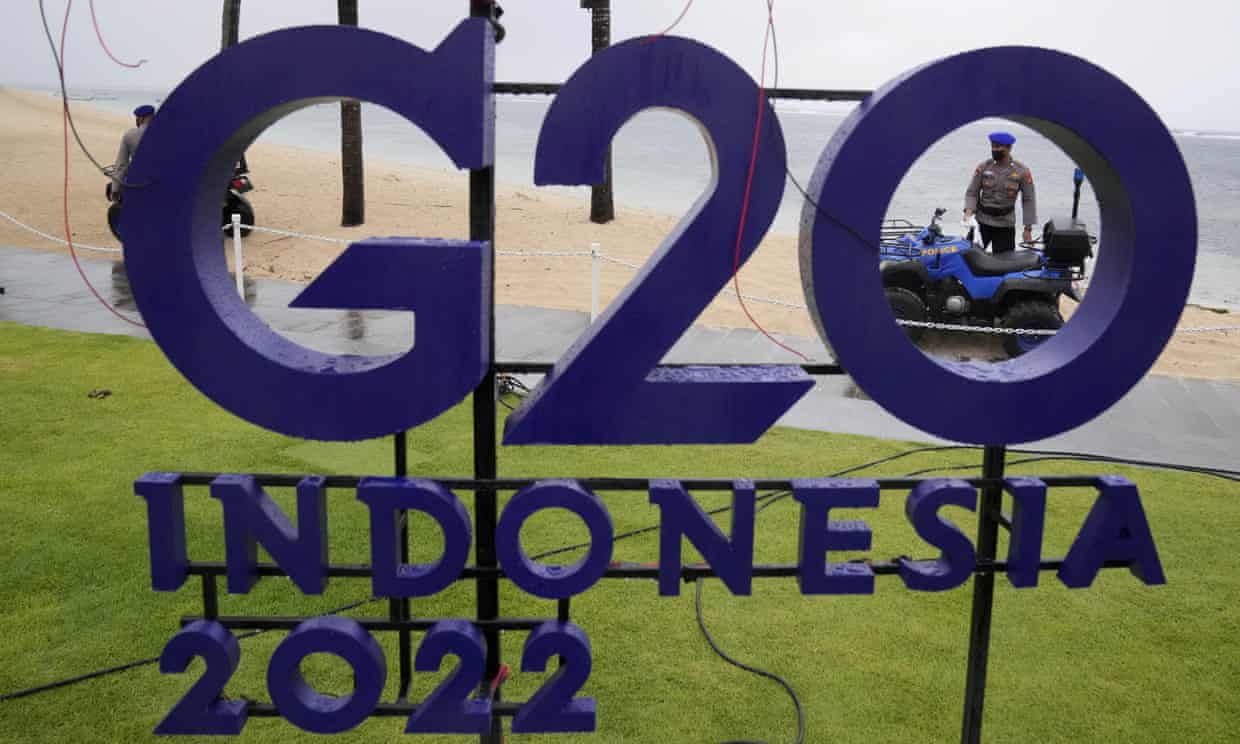
Meeting in Indonesia will be the first with the Russian envoy since the Kremlin invaded its neighbour, triggering global food and energy crises
"Russian foreign minister Sergei Lavrov has flown into the Indonesian island of Bali for a gathering of G20 foreign ministers, which is likely to be overshadowed by Moscow’s war in Ukraine and deep divisions within the bloc over how to respond to the crisis.
US secretary of state Antony Blinken, Lavrov and Chinese foreign minister Wang Yi are all due to attend the gathering as concern among western governments mounts about the war’s impact on the cost of food and fuel, which has prompted the UN to warn of an “unprecedented wave of hunger and destitution”.
The gathering will mark the first time that Lavrov has met counterparts from nations that are strongly critical of the war. . .
On Wednesday, Lavrov called on all parties in the world to make efforts to protect international laws, saying: “The world is evolving in a complicated manner.”
Earlier in the week, China attacked the US and Nato, stating that Washington “observes international rules only as it sees fit”. Chinese foreign ministry spokesperson Zhao Lijian told reporters in Beijing that the “so-called rules-based international order is actually a family rule made by a handful of countries to serve the US self-interest”.

Speaking ahead of Thursday’s meeting, German foreign ministry spokesperson Christian Wagner said it would not be a “normal summit” nor “business as usual”.
Joshua Kurlantzick, senior fellow for south-east Asia at the Council on Foreign Relations, said that Indonesia’s president, Joko Widodo, who is hosting the meeting, is likely hoping to avoid a “disastrous meeting”.
There is such a diverse range of countries and viewpoints around the table, that it is “almost unmanageable”, said Kurlantzick. “The divides are too big between some of the G20 countries to come to any conclusions really about almost anything. It’ll be miraculous simply if no one walks out, as happened during the finance ministers meeting.”
In April the UK, US and Canada staged a coordinated walkout of a G20 meeting in protest against Russia’s invasion.
Some western countries had threatened to boycott G20 meetings, but the US state department said on Tuesday that Blinken would be a “full and active participant”.
> There would not be a formal meeting between the US and Lavrov, it said, adding that Russian was not “serious about diplomacy”. . .
Blinken will hold separate talks with Wang “to discuss having guardrails” on US-China relations so that competition “does not spill over into miscalculation or confrontation”, said US assistant secretary of state Daniel Kritenbrink.
“This will be another opportunity ... to convey our expectations about what we would expect China to do and not to do in the context of Ukraine,” he said. . .
> Indonesia maintains an “independent and active” approach to foreign policy, and has sought to appear as a neutral actor that could aid negotiations. . .
Jokowi is likely hoping “to show himself as a world leader and to simply avoid a disastrous meeting”, said Kurlantzick.
“He probably hopes for some kind of situation in which no one walks out of the meeting, he avoids a complete disaster, and he helps keep dialogue going between all the various actors, perhaps with one goal being to get Russia to begin exporting grain again to many countries, maybe they can achieve some other minor goal as well,” Kurlantzick added."
Reuters and Associated Press contributed to this report
How Putin will participate in G20 summit will depend on state of global affairs — MFA
It is stated that the G20 was created to counter the global financial and economic crises, promote the inclusive achievement of sustainable development and economic growth

MOSCOW, July 6. /TASS/. Exactly how Russian President Vladimir Putin will take part in the G20 summit in November will depend on the situation in the world and the sanitary and epidemiological situation in Southeast Asia, the Russian Foreign Ministry said on Wednesday.
"Regarding the November G20 summit, an official invitation from Indonesian President Joko Widodo addressed to the Russian leader has been received. Jakarta was tentatively informed of President Vladimir Putin's intention to take part. The format of participation is subject to clarification depending on the development of the situation in the world and taking into account the sanitary and epidemiological situation in Southeast Asia," the ministry said in a statement.
Russian Foreign Minister Sergey Lavrov will lead a Russian delegation at a face-to-face foreign ministers meeting of the G20 on the Indonesian island of Bali on July 7-8.
"Russia regards the G20 as the leading forum for international economic cooperation and as an effective mechanism for multilateral governance, on the basis of which well-considered decisions should be made in the interests of the whole world," the statement said.
The ministry said the G20 was created to counter the global financial and economic crises, promote the inclusive achievement of sustainable development and economic growth, and in response to the growing role of large emerging markets in the world economy."
According to the statement, Moscow highly appreciates the activities of the current Indonesian chairmanship, impartiality in leadership, and a focus on practical results.
"We share the relevance of the priority issues declared by Jakarta: healthcare, energy security and digitalization. We are ready to make a significant contribution to making progress in all these areas by the time of the Bali summit on November 15-16 of this year. Indonesia's course towards multilateralism, consideration of the interests of all participants in the group sets the right vector of work," the ministry said."
>
>
PEACE, WAR & FREEDOM: The Ionic Original disc of ‘Blowin’ in the Wind’
"Blowin' in the Wind" is a song written by Bob Dylan in 1962. It was released as a single and included on his album The Freewheelin' Bob Dylan in 1963. It has been described as a protest song and poses a series of rhetorical questions about peace, war, and freedom. Six decades after Dylan wrote it, ‘Blowin’ in the Wind’ is making musical history once again.

Ionic Original combines the tonal depth for which analogue sound has always been renowned with the durability of a digital recording. Dylan and his long-time collaborator T Bone Burnett have used it to produce a single copy of the classic folk song.
For a song reportedly written in just 10 minutes, it has had remarkable longevity. Bob Dylan penned ‘Blowin’ in the Wind’ in double-quick time in a Greenwich Village café in 1962. In the decades since, it has come to be regarded as an out-and-out classic — and been covered by dozens of artists, from Stevie Wonder and Sam Cooke to Dolly Parton.
In the 1990s, the song was inducted into the Grammy Hall of Fame.
Dylan himself recorded it on 9 July 1962, for his second album, The Freewheelin’ Bob Dylan.
Almost exactly 60 years later, a special re-recorded version of the song is being offered in The Exceptional Sale at Christie’s in London on 7 July, as part of Classic Week.
In 2021, Dylan took to the studio for a special session with his friend and long-time collaborator T Bone Burnett, the multiple Grammy award-winning producer. The result was the first new studio recording of ‘Blowin’ in the Wind’ since 1962.
That wasn’t all, however: Burnett produced it using groundbreaking technology that he has newly patented. Known as Ionic Original, it is a high-fidelity analogue format in which a one-off aluminium disc is painted with lacquer and etched with the sound recording.
The Ionic Original disc of ‘Blowin’ in the Wind’ by Burnett’s company NeoFidelity, Inc. — presented in a custom-made walnut and white oak cabinet —is unique. It is the only copy of the new recording. . .Dylan fans, audiophiles, musicologists and others have recently had the chance to experience the technology and hear the Ionic Original version of ‘Blowin’ in the Wind’ at exclusive listening sessions in Los Angeles and New York. The same experience will be offered at Christie’s in London, from 2 July, in the run-up to the auction.
Bob Dylan was still an aspiring folk singer, aged just 20, when he wrote ‘Blowin’ in the Wind’. He debuted it at Gerde’s Folk City, a music venue in Greenwich Village, that same evening.

>Its melody was adapted from a 19th-century African-American spiritual called ‘No More Auction Block for Me’. Its lyrics consist of a series of questions — ‘How many roads must a man walk down, before you call him a man?’ and ‘How many times must the cannonballs fly, before they’re forever banned?’ — followed by the repeated response that the answer is blowing in the wind.
The song soon became an anthem for the US Civil Rights movement in the 1960s and has been sung by myriad members of other social movements since. The serial questions in Dylan’s lyrics have widely been understood as anti-establishment in nature.
However, part of the song’s success may be down to the multiple interpretations it leaves open. . .
The 2021 recording was made in Los Angeles and Nashville, with Dylan joined by Greg Leisz on mandolin, Stuart Duncan on violin, Dennis Crouch on bass, Don Was on bass, and Burnett himself on electric guitar. It was recorded by Michael Piersante and Rachael Moore and mixed by Michael Piersante."
=================================
Top stories
The Nobel Award Ceremony Speech
Dec 12, 2016 Here is the Presentation Speech by Professor Horace Engdahl, Member of the Swedish Academy, Member of the Nobel Committee for Literature, 10 December 2016.
Here is the Presentation Speech by Professor Horace Engdahl, Member of the Swedish Academy, Member of the Nobel Committee for Literature, 10 December 2016.
27 May 2022

Wednesday, July 06, 2022
DRONES ON THE BATTLEFIELD
/
DJI drones, Ukraine, and Russia — what we know about AeroScope
Why DJI’s drones are a hot-button issue in the Ukraine-Russia war
/cdn.vox-cdn.com/uploads/chorus_image/image/70660440/acastro_220322_5097_0001.0.jpg)
How are Ukrainians using their DJI drones in wartime, anyhow?
“Civilians have been using the aerial cameras to track Russian convoys and then relay the images and GPS coordinates to Ukrainian troops,” according to the Associated Press. While there have also been reports on a drone that can drop Molotov cocktails, the pictures only show it dropping a beer bottle. “I think it’s mostly aspirational,” says Kovar, while adding how ISIS and others have indeed used DJI products to drop 40mm grenades in the past.
Nevertheless, Ukraine does have some history with makeshift drone weaponry. In 2018, Smithsonian Magazine reported on the custom-made “fighting drones of Ukraine,” and the Ukrainian National Guard was reportedly using DJI Mavic 2 drones to direct airstrikes and drop homemade bombs in 2020, according to Coffee or Die.
DJI drones aside, Ukraine has reportedly also been using inexpensive military-grade drones from Turkey that drop laser-guided bombs. The US is sending 100 “Switchblade” kamikaze drones to Ukraine as well.
Has DJI stopped sales in either Russia or Ukraine?
No. “We’ve always told our distributors and our dealers, you have to follow any applicable export control laws of any country where you’re operating and the US... we’ve reemphasized that guidance since this began,” says Lisberg.
Stopping sales of AeroScope receivers wouldn’t necessarily deter the Russian military from tracking down these drones, anyhow. Troiak believes Russia already has hundreds of them in the country. And, “state-level militaries have probably figured out how to decrypt that information as well,” says Kovar. . .
What kind of oversight keeps an AeroScope station owner from, say, logging all nearby flights and selling that data?
Nothing, it seems.
“[A]s with all DJI products, your data is your data,” writes Lisberg. “We’re not a data company. We don’t want to be the repository for our customers’ data. Just like with our drones, we offer data hosting as a convenience for customers who want to use it and who have no security concerns about it. And once you generate data with our products, it’s yours to use and control and keep.”
In hindsight, is the AeroScope system a good idea?
In hindsight, is the AeroScope system a good idea?
DJI has said publicly that the situation in Ukraine goes to show that the company’s drones don’t belong in a warzone, and it’s hard to disagree. AeroScope clearly wasn’t designed for that.
“In this situation, no, it’s clearly a bad idea,” says Kovar. “[AeroScope] is exposing people fighting for democracy, whose nation is under attack, who are trying to use a powerful, very commercially available drone to defend their country, to being identified and located by opposing forces. In that regard, it’s a horrible, horrible idea. But for law enforcement purposes, to protect our critical infrastructure and such, it was an excellent idea.”
He likens it to other unforeseen uses of technology that have unfortunate implications for their owners. . ."
READ MORE >> https://www.theverge.com/22985101/dji-aeroscope-ukraine-russia-drone-tracking
TECHDIRT TRENDING STORY: Drone Mission Creep Without Meaningful Restrictions or Oversight
Getting some traction now - more than four months after the original report in Phoenix New Times by Katya Schwenk February 17, 2022 1:04PM...Since it’s apparently a matter of life and death, the request made by the council for the police to develop a drone policy and deployment plan before seeking funding and permission to acquire them has been abandoned. It’s apparently now far too urgent a problem to be slowed down by accountability and transparency.
> The committee agreed to allow Phoenix Fire to go ahead with its drone purchases — so it could roll the tech out by the summer — but asked Phoenix police to come back for approval separately, with a more fleshed-out plan
> Assistant City Manager Lori Bays said it would likely take around six months for the police department to buy the drones and begin using them. The city plans to develop its policies and hold community engagement sessions during that time.
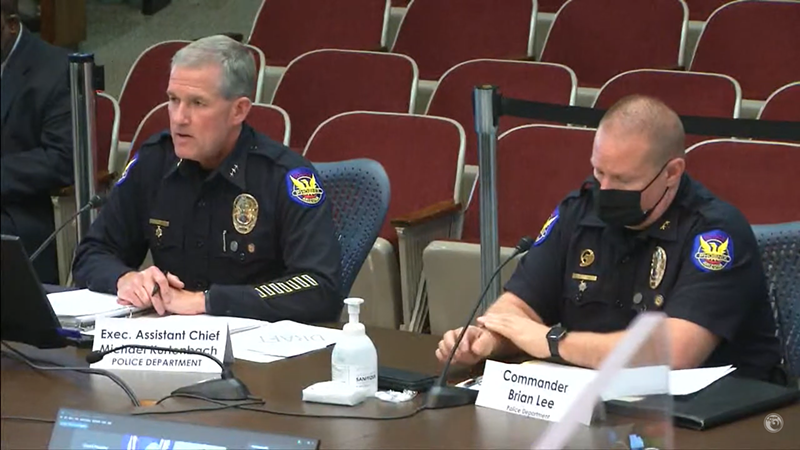
News reports about the ambush shooting make no mention of a deployed drone or describe what difference it made in resolving the deadly situation. But that shooting that happened to have a late-arriving drone is being used to justify the sudden acquisition of drones by the PD, which will presumably be deployed as soon as they’re obtained.
from the I-guess-there-will-always-be-time-to-regret-things-later dept
Phoenix City Council Says PD Can Have Surveillance Drones Without Any Policy In Place Because Some Officers Recently Got Shot
The Phoenix Police Department wants drones and it wants them now. And, according to this report by the Phoenix New Times, it’s going to get them.
After several hours of debate and spirited public response during the Phoenix City Council meeting this week, local officials agreed to authorize the police department to purchase public safety drones right away.
Late Wednesday night the Phoenix City Council voted 6-3 after a lengthy, and at times heated, discussion.
The request was submitted to the city council at the last minute, fast-tracking the agency’s plans to implement the technology.
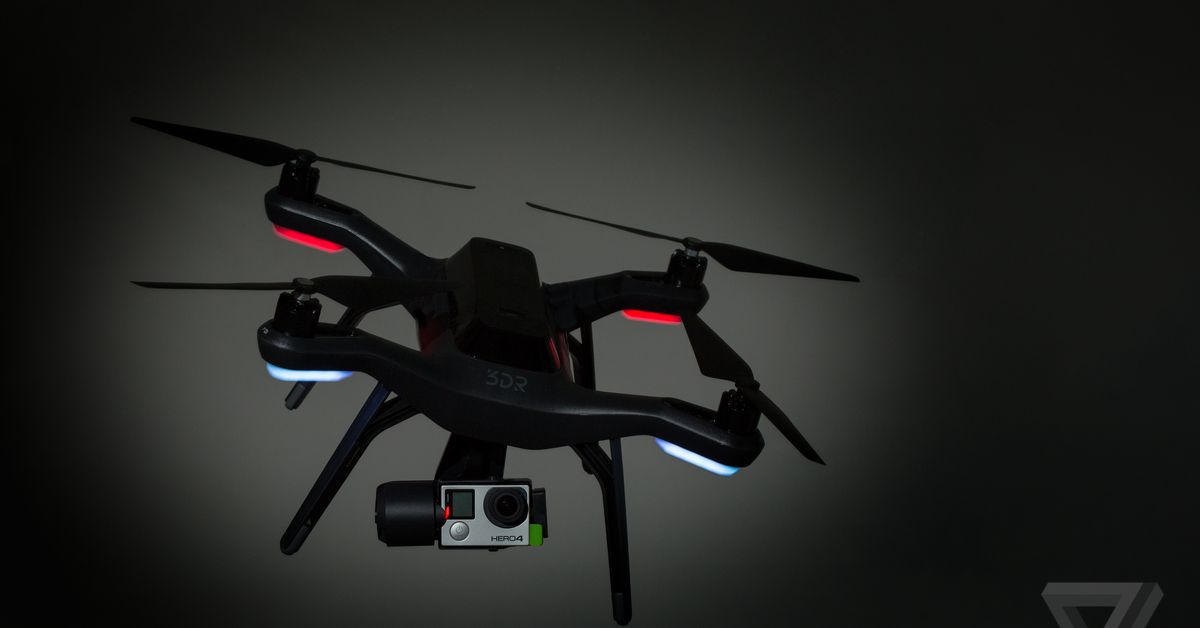 Why the rush? Well, according to a letter [PDF] signed by Mayor Kate Gallego and two council members, having a drone in the air would have… not changed anything at all about a recent incident where officers were shot
In the early morning hours of February 11, our officers were ambushed when responding to a call for service at a two-story home in Southwest Phoenix near 54th Avenue and Broadway. Nine of our police officers were injured but thankfully all of them are recovering.
During this incident was determined for the safety of our officers drone would need to be utilized to neutralize the situation. Currently, Phoenix does not own any drones for use by our Police Department, therefore we had to rely on the grace of our neighbor, the City of Glendale, to provide our department with a drone.
That gives the Phoenix PD permission to send eyes into the skies without meaningful restrictions or oversight.
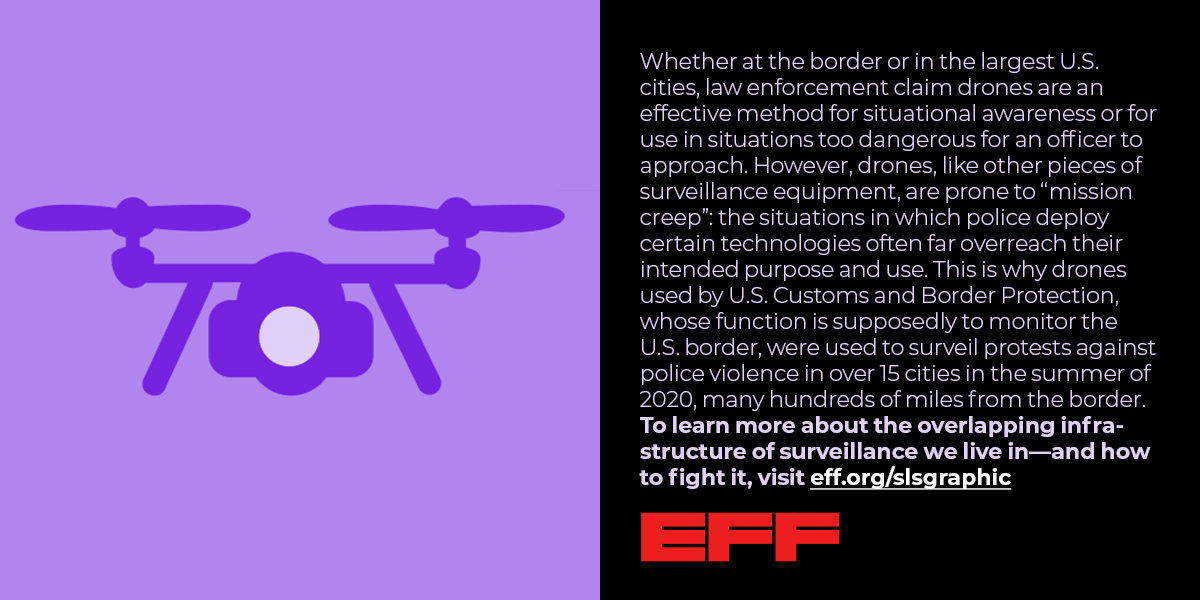
Drones flying over your city could be at the behest of local police or federal agencies, but as of this moment, there are very few laws restricting when and where police can use drones or how they can acquire them. Community Control Over Police Surveillance, or CCOPS ordinances, are one such way residents of a city can prevent their police from acquiring drones or restrict how and when police can use them. The Fourth Circuit court of appeals has also called warrantless use of aerial surveillance a violation of the Fourth Amendment.
Far too much slack is being cut for a police department that is currently being investigated by the Department of Justice following years of abusive behavior by its officers. Here’s what the DOJ — which announced this investigation last August — will be digging into:
This investigation will assess all types of use of force by PhxPD officers, including deadly force. The investigation will also seek to determine whether PhxPD engages in retaliatory activity against people for conduct protected by the First Amendment; whether PhxPD engages in discriminatory policing; and whether PhxPD unlawfully seizes or disposes of the belongings of individuals experiencing homelessness. In addition, the investigation will assess the City and PhxPD’s systems and practices for responding to people with disabilities. The investigation will include a comprehensive review of PhxPD policies, training, supervision, and force investigations, as well as PhxPD’s systems of accountability, including misconduct complaint intake, investigation, review, disposition, and discipline.
Not exactly the sort of thing that inspires trust. And certainly not the sort of thing that warrants a free pass on surveillance policies until long after new surveillance tech has been deployed. The Phoenix PD may have recently been involved in an unexpected burst of violence (I mean, committed by someone else against police officers), but that hardly justifies a careless rush into an expansion of the department’s surveillance capabilities."
Filed Under: drones, phoenix, phoenix pd, surveillance
- Yet Another EU Data Protection Authority Says Google Analytics Violates The Law
- The Future Of Policing In China Is Pervasive, Surveillance-Driven Law Enforcement Crystal Balls
- FCC's Carr Once Again Heads To The Fainting Couch Over TikTok
- NSO Lawyer Tells Lawmakers Company Can Count To Five, Will Need More Time To Count Higher Than That
- U.S. Companies Don't Much Want To Talk About Abortion Data Collection And Protection

The Overlapping Infrastructure of Urban Surveillance
A Re-Post from last year
N THE PUBLIC INTEREST: Crossing-Over The Electronic Frontier Into The 'Brave New World' of Total Surveillance
[VISUAL] The Overlapping Infrastructure of Urban Surveillance, and How to Fix It
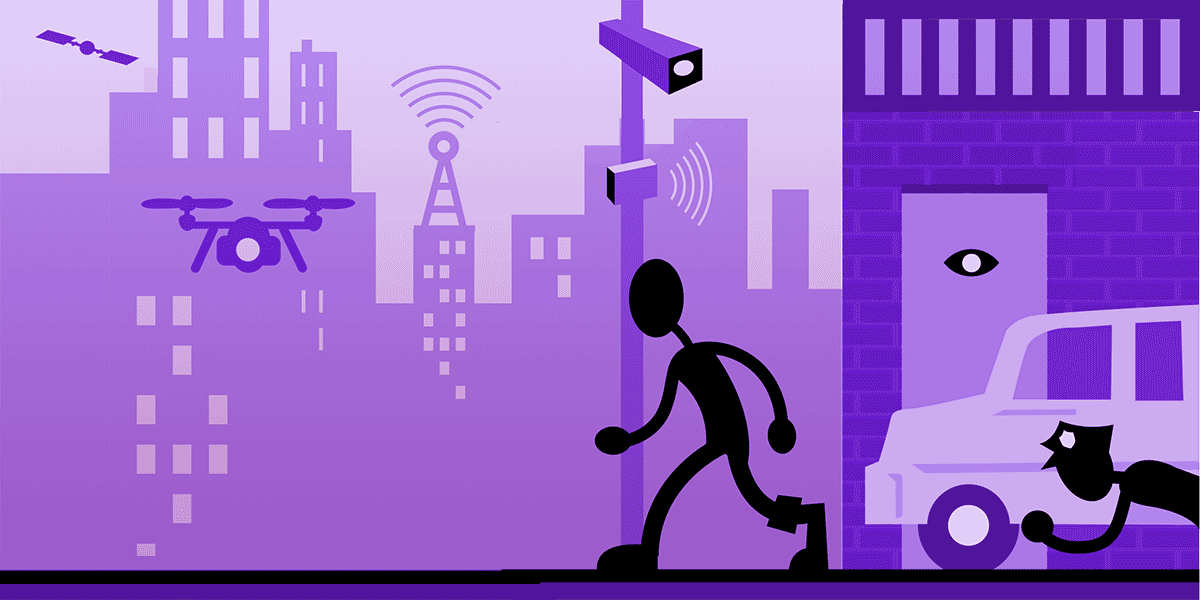
Between the increasing capabilities of local and state police, the creep of federal law enforcement into domestic policing, the use of aerial surveillance such as spy planes and drones, and mounting cooperation between private technology companies and the government, it can be hard to understand and visualize what all this overlapping surveillance can mean for your daily life. We often think of these problems as siloed issues. Local police deploy automated license plate readers or acoustic gunshot detection. Federal authorities monitor you when you travel internationally.
But if you could take a cross-section of the average city block, you would see the ways that the built environment of surveillance—its physical presence in, over, and under our cities—makes this an entwined problem that must be combatted through entwined solutions.
Thus, we decided to create a graphic to show how—from overhead to underground—these technologies and legal authorities overlap, how they disproportionately impact the lives of marginalized communities, and the tools we have at our disposal to halt or mitigate their harms.
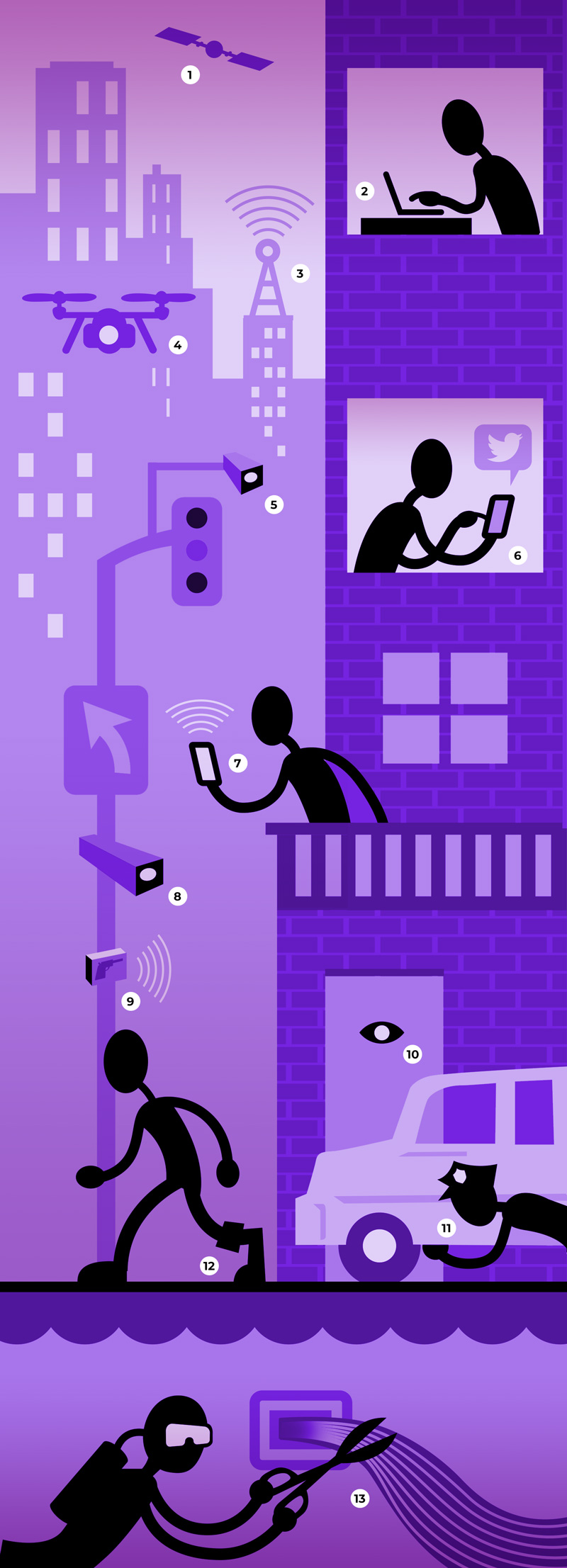
Going from Top to Bottom:

1. Satellite Surveillance:
Satellite photography has been a reality since the 1950s, and at any given moment there are over 5,000 satellites in orbit over the Earth—some of which have advanced photographic capabilities. While many are intended for scientific purposes, some satellites are used for reconnaissance by intelligence agencies and militaries. There are certainly some satellites that may identify a building or a car from its roof, but it’s unlikely that we could ever reach the point where pictures taken from a satellite would be clear enough or could even be the correct angle to run through face recognition technology or through an automated license plate reader.
Satellites can also enable surveillance by allowing governments to intercept or listen in on data transmitted internationally.
2. Internet Traffic Surveillance
Government surveillance of internet traffic can happen in many ways. Through programs like PRISM and XKEYSCORE, the U.S. National Security Agency (NSA) can monitor emails as they move across the internet, browser and search history, and even keystrokes as they happen in real time. Much of this information can come directly from the internet and telecommunications companies that consumers use, through agreements between these companies and government agencies (like the one the NSA shares with AT&T) or through warrants or orders granted by a judge, including those that preside over the Foriegn Intelligence Surveillance Court (FISC).
Internet surveillance isn’t just the domain of the NSA and international intelligence organizations; local law enforcement are just as likely to approach big companies in an attempt to get information about how some people use the internet. In one 2020 case, police sent a search warrant to Google to see who had searched the address of an arson victim to try to identify a suspect. Using the IP addresses Google furnished of users who conducted that search, police identified a suspect and arrested him for the arson.
How can we protect our internet use? FISA reform is one big one. Part of the problem is also transparency: in many instances it's hard to even know what is happening behind the veil of secrecy that shrouds the American surveillance system.
3. Cellular Communications (Tower) Surveillance
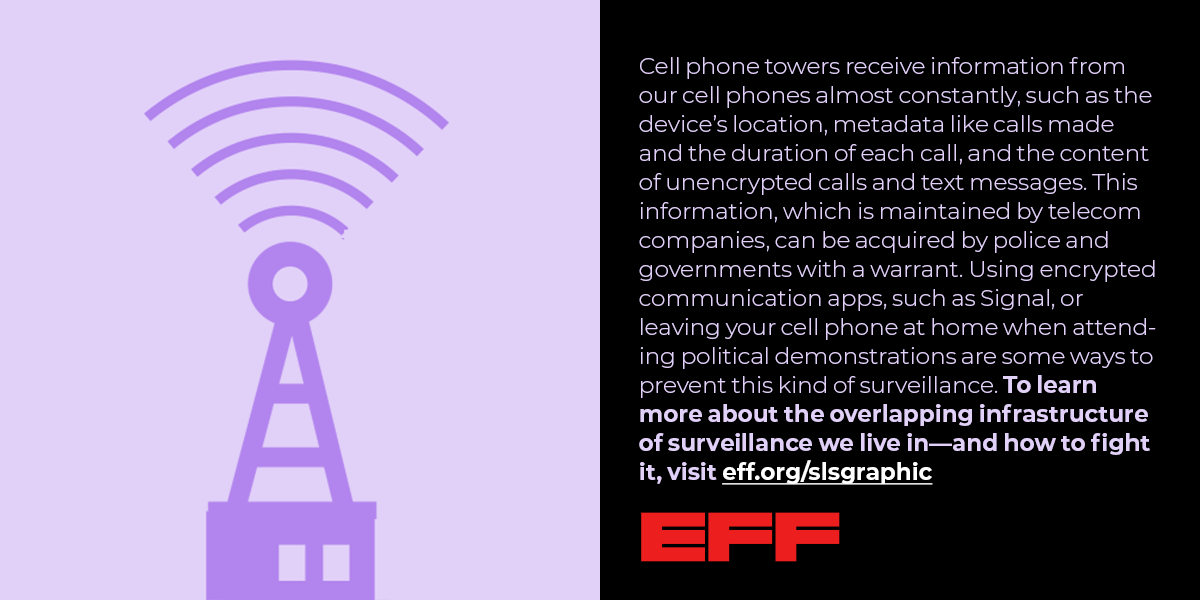
Cell phone towers receive information from our cell phones almost constantly, such as the device’s location, metadata like calls made and the duration of each call, and the content of unencrypted calls and text messages. This information, which is maintained by telecom companies, can be acquired by police and governments with a warrant. Using encrypted communication apps, such as Signal, or leaving your cell phone at home when attending political demonstrations are some ways to prevent this kind of surveillance.
4. Drones
Police departments and other local public safety agencies have been acquiring and deploying drones at a rapid rate. This is in addition to federal drones used both overseas and at home for surveillance and offensive purposes. Whether at the border or in the largest U.S. cities, law enforcement claim drones are an effective method for situational awareness or for use in situations too dangerous for an officer to approach. The ability for officers to use a drone in order to keep their distance was one of the major reasons police departments around the country justified the purchase of drones as a method of fighting the COVID-19 pandemic.
However, drones, like other pieces of surveillance equipment, are prone to “mission creep”: the situations in which police deploy certain technologies often far overreach their intended purpose and use. This is why drones used by U.S. Customs and Border Protection, whose function is supposedly to monitor the U.S. border, were used to surveil protests against police violence in over 15 cities in the summer of 2020, many hundreds of miles from the border.
It’s not only drones that are in the skies above you spying on protests and people as they go about their daily lives. Spy planes, like those provided by the company Persistent Surveillance Systems, can be seen buzzing above cities in the United States. Some cities, however, like Baltimore and St. Louis, have recently pulled the plug on these invasive programs.
Drones flying over your city could be at the behest of local police or federal agencies, but as of this moment, there are very few laws restricting when and where police can use drones or how they can acquire them. Community Control Over Police Surveillance, or CCOPS ordinances, are one such way residents of a city can prevent their police from acquiring drones or restrict how and when police can use them. The Fourth Circuit court of appeals has also called warrantless use of aerial surveillance a violation of the Fourth Amendment.
5. Social Media Surveillance
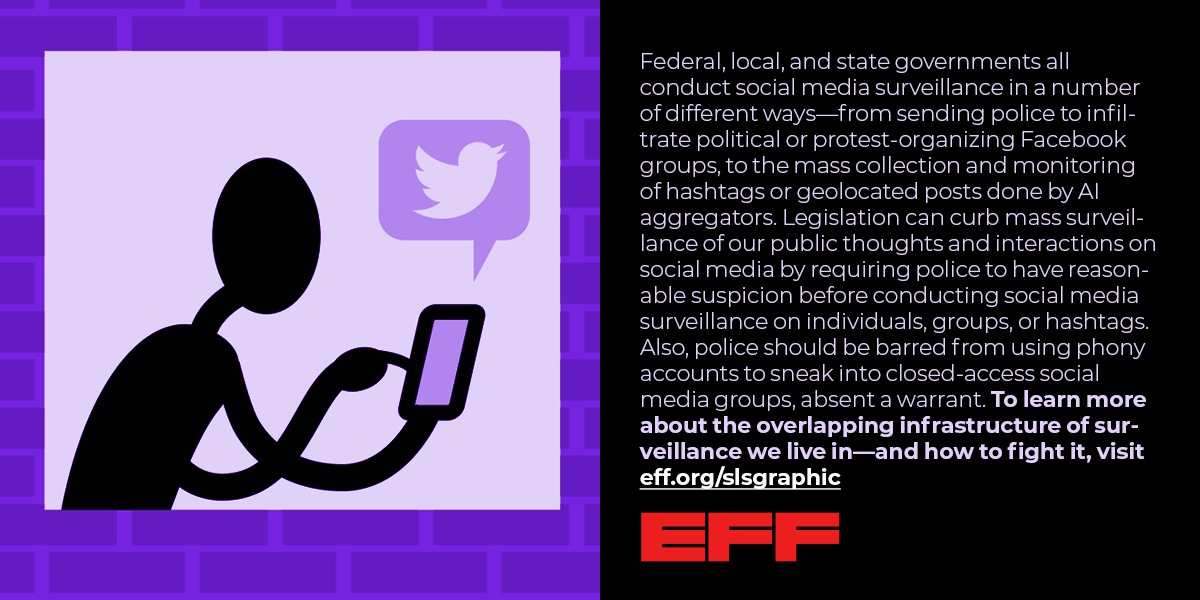
Federal, local, and state governments all conduct social media surveillance in a number of different ways—from sending police to infiltrate political or protest-organizing Facebook groups, to the mass collection and monitoring of hashtags or geolocated posts done by AI aggregators.
There are few laws governing law enforcement use of social media monitoring. Legislation can curb mass surveillance of our public thoughts and interactions on social media by requiring police to have reasonable suspicion before conducting social media surveillance on individuals, groups, or hashtags. Also, police should be barred from using phony accounts to sneak into closed-access social media groups, absent a warrant.
6. Cameras
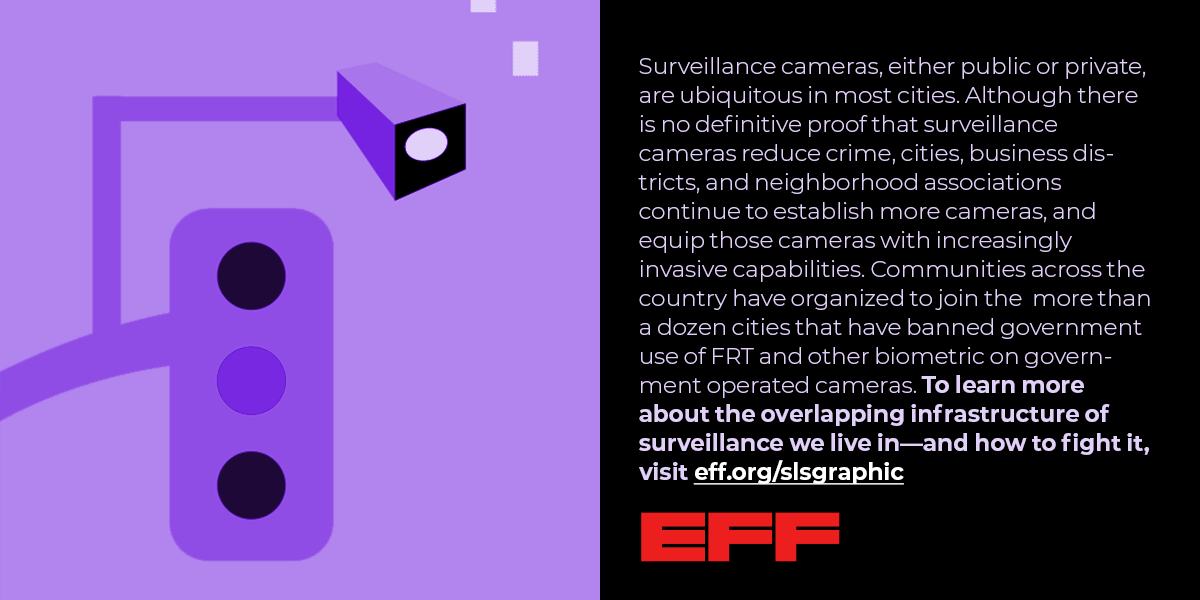
Surveillance cameras, either public or private, are ubiquitous in most cities. Although there is no definitive proof that surveillance cameras reduce crime, cities, business districts, and neighborhood associations continue to establish more cameras, and equip those cameras with increasingly invasive capabilities.
Face recognition technology (FRT), which over a dozen cities across the United States have banned government agencies from using, is one such invasive technology. FRT can use any image—taken in real-time or after-the-fact—and compare it to pre-existing databases that contain driver’s license photos, mugshots, or pre-existing CCTV camera footage. FRT has a long history of misidentifying people of color and trans* and nonbinary people, even leading to wrongful arrests and police harassment. Other developing technology, such as more advanced video analytics, can allow users to search footage accumulated from hundreds of cameras by things as specific as “pink backpack” or “green hair.”
Networked surveillance cameras can harm communities by allowing police, or quasi-governmental entities like business improvement districts, by recording how people live their lives, who they communicate with, what protests they attend, and what doctors or lawyers they visit. One way to lessen the harm surveillance cameras can cause in local neighborhoods is through CCOPS measures that can regulate their use. Communities can also band together to join more than a dozen cities around the country that have banned government use of FRT and other biometrics.
TELL congress: END federal use of face surveillance
7. Surveillance of Cell Phones
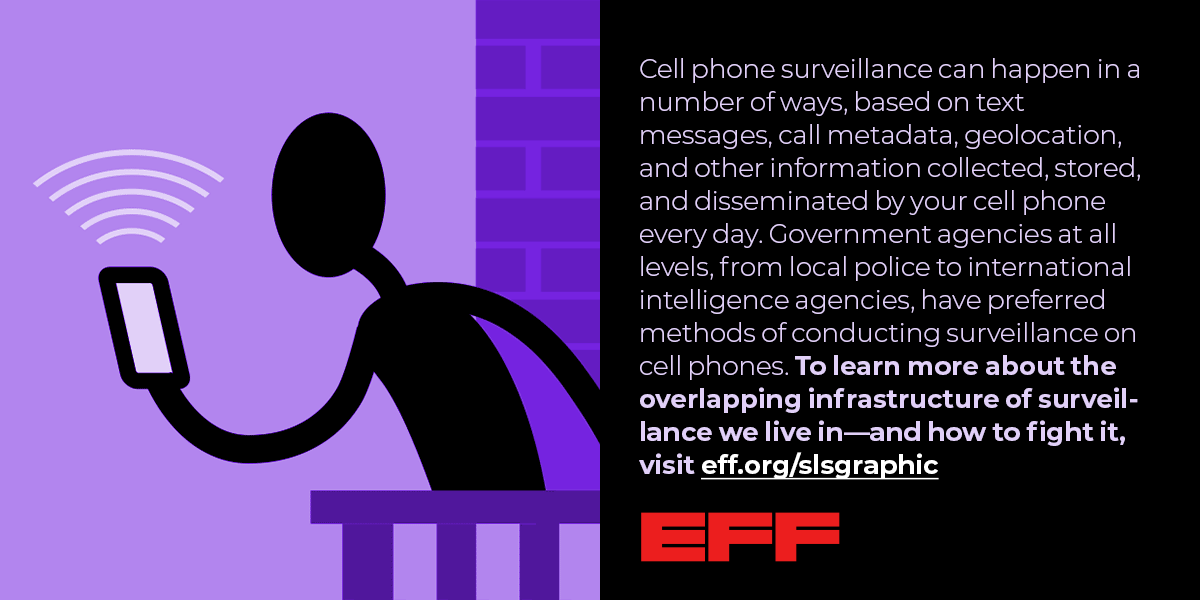
Cell phone surveillance can happen in a number of ways, based on text messages, call metadata, geolocation, and other information collected, stored, and disseminated by your cell phone every day. Government agencies at all levels, from local police to international intelligence agencies, have preferred methods of conducting surveillance on cell phones.
For instance, local and federal law enforcement have been known to deploy devices known as Cell-Site Simulators or “stingrays,” which mimic cell phone towers your phone automatically connects to in order to harvest information from your phone like identifying numbers, call metadata, the content of unencrypted text messages, and internet usage.
Several recent reports revealed that the U.S. government purchases commercially available data obtained from apps people downloaded to their phones. One report identified the Department of Defense’s purchase of sensitive user data, including location data, from a third-party databroker of information obtained through apps targeted at Muslims, including a prayer app with nearly 100 million downloads. Although the government would normally need a warrant to acquire this type of sensitive data, purchasing the data commercially allows them to evade constitutional constraints.
One way to prevent this kind of surveillance from continuing would be to pass the Fourth is Not For Sale Act, which would ban the government from purchasing personal data that would otherwise require a warrant. Indiscriminate and warrantless government use of stingrays is also currently being contested in several cities and states and a group of U.S. Senators and Representatives have also introduced legislation to ban their use without a warrant. CCOPS ordinances have proven a useful way to prevent police from acquiring or using Cell-Site Simulators.

8. Automated License Plate Readers
Automated license plate readers (ALPRs) are high-speed, computer-controlled camera systems that are typically mounted on street poles, streetlights, highway overpasses, mobile trailers, or attached to police squad cars. ALPRs automatically capture all license plate numbers that come into view, along with the location, date, and time of the scan. The data, which includes photographs of the vehicle and sometimes its driver and passengers, is then uploaded to a central server.
Taken in the aggregate, ALPR data can paint an intimate portrait of a driver’s life and even chill First Amendment protected activity. ALPR technology can be used to target drivers who visit sensitive places such as health centers, immigration clinics, gun shops, union halls, protests, or centers of worship.
ALPRs can also be inaccurate. In Colorado, police recently pulled a Black family out of their car at gunpoint after an ALPR misidentified their vehicle as one that had been reported stolen. Too often, technologies like ALPRs and face recognition are used not as an investigative lead to be followed up and corroborated, but as something police rely on as a definitive accounting of who should be arrested.
Lawmakers should better regulate this technology by limiting “hotlists” to only cars that have been confirmed stolen, rather than vehicles labeled as “suspicious”, and to limit retention of ALPR scans of cars that are not hotlisted.
9. Acoustic Gunshot Detection
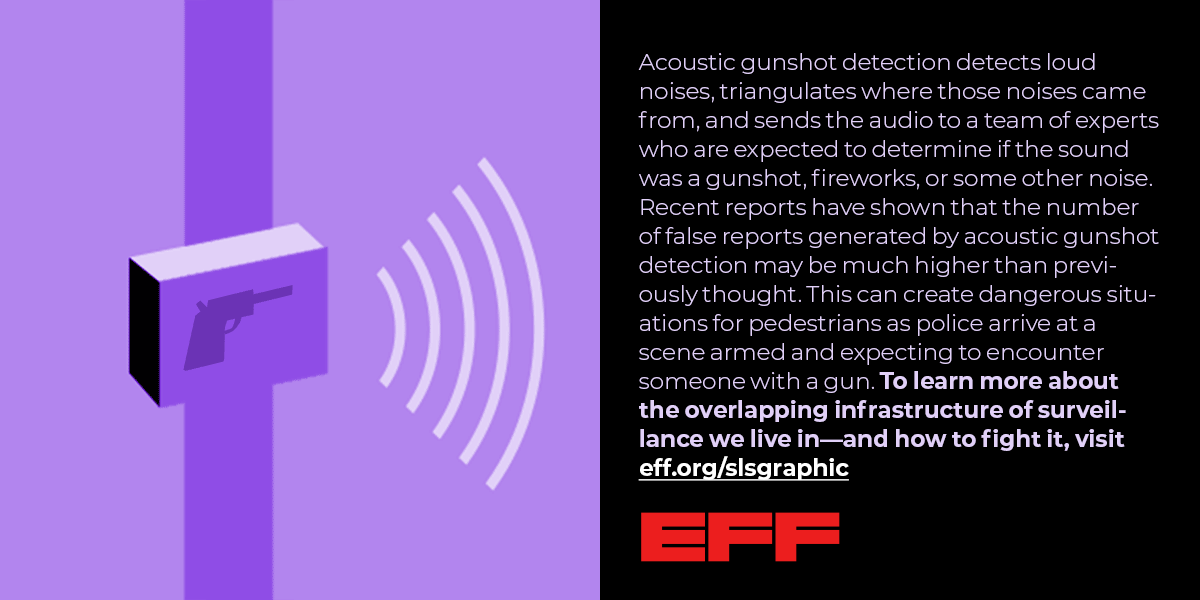
Cities across the country are increasingly installing sophisticated listening devices on street lights and the sides of buildings intended to detect the sound of gunshots. Acoustic gunshot detection, like the technology sold by popular company ShotSpotter, detects loud noises, triangulates where those noises came from, and sends the audio to a team of experts who are expected to determine if the sound was a gunshot, fireworks, or some other noise.
Recent reports have shown that the number of false reports generated by acoustic gunshot detection may be much higher than previously thought. This can create dangerous situations for pedestrians as police arrive at a scene armed and expecting to encounter someone with a gun.
Even though aimed at picking up gunshots, this technology also captures human voices, at least some of the time. In at least two criminal cases, the People v. Johnson (CA) and Commonwealth v. Denison (MA), prosecutors sought to introduce as evidence audio of voices recorded on an acoustic gunshot detection system. In Johnson, the court allowed this. In Denison, the court did not, ruling that a recording of “oral communication” is prohibited “interception” under the Massachusetts Wiretap Act.
While the accuracy of the technology remains a problem, one way to mitigate its harm is for activists and policymakers to work to ban police and prosecutors from using voice recordings collected by gunshot detection technology as evidence in court.
10. Internet-Connected Security Cameras
Popular consumer surveillance cameras like Amazon’s Ring doorbell camera are slowly becoming omnipresent surveillance networks in the country. Unlike traditional surveillance cameras which may back up to a local drive in the possession of the user, the fact that users of internet connected security cameras do not store their own footage makes that footage more easily accessible to police. Often police can bypass users altogether by presenting a warrant directly to the company.
These cameras are ubiquitous but there are ways we can help blunt their impact on our society. Opting in to encrypt your Amazon Ring footage and opting out of seeing police footage requests on the Neighbors app are two ways to ensure police have to bring a warrant to you, rather than Amazon, if they think your camera may have witnessed a crime.
11. Electronic Monitoring
Electronic monitoring is a form of digital incarceration, often in the form of a wrist bracelet or ankle “shackle” that can monitor a subject’s location, and sometimes their blood alcohol level.
Monitors are commonly used as a condition of pretrial release, or post-conviction supervision, like probation or parole. They are sometimes used as a mechanism for reducing jail and prison populations. Electronic monitoring has also been used to track juveniles, immigrants awaiting civil immigration proceedings, and adults in drug rehabilitation programs.
Not only does electronic monitoring impose excessive surveillance on people returning home from incarceration, but it also hinders their ability to successfully transition back into the community. Additionally, there is no concrete evidence that electronic monitoring reduces crime rates or recidivism.
12. Police GPS Tracking
One common method that police attempt to track people suspected of criminal activity is GPS monitors placed underneath a person’s vehicle. Before the 2012 U.S. Supreme Court decision in United States v Jones, which ruled that a GPS monitor on a car constituted a search under the Fourth Amendment, and the 2013 Katzin decision in the Third Circuit which ruled, once and for all, that police need a warrant in order to install a GPS device, police often used these devices with few restrictions.
However, recent court filings indicate that law enforcement believes that warrantless use of GPS tracking devices at the border is fair game. EFF currently has a pending Freedom of Information Act lawsuit to uncover CBP’s and U.S. Immigration and Customs Enforcement’s (ICE) policies, procedures, and training materials on the use of GPS tracking devices.
13. International Internet Traffic Surveillance
Running under ground and under the oceans are thousands of miles of fiber optic cable that transmit online communications between countries. Originating as telegraph wires running under the ocean, these highways for international digital communication are now a hotbed of surveillance by state actors looking to surveil chatter abroad and at home. The Associated Press reported in 2005 that the U.S. Navy had sent submarines with technicians to help tap into the “backbone of the internet.” These cables make landfall at coastal cities and towns called “landing areas” like Jacksonville, Florida and Myrtle Beach, South Carolina and towns just outside of major cities like New York, Los Angeles, San Diego, Boston, and Miami.
How do we stop the United States government from tapping into the internet’s main arteries? Section 702 of the Foreign Intelligence Surveillance Act allows for the collection and use of digital communications of people abroad, but often scoops up communications of U.S. persons when they talk to friends or family in other countries. EFF continues to fight Section 702 in the court in hopes of securing communications that travel through these essential cables.
TELL congress: END federal use of face surveillance
BEA News: U.S. International Transactions and Investment Position, 4th Quarter and Year 2025
BEA News: U.S. International Transactions and Investment Position, ...

-
 Flash News: Ukraine Intercepts Russian Kh-59 Cruise Missile Using US VAMPIRE Air Defense System Mounted on Boat. Ukrainian forces have made ...

