Sunday, July 24, 2022

SWING STATE ARIZONA: Gotcha-Girl Karrin Taylor Robson is The Chosen GOP Stand-In

 External national politics were in play here in red-state-turning-blue on Friday

Trump and Pence squared off in Arizona the day after the congressional committee investigating the attempted coup on January 6 said that the then president’s refusal to call off the violent mob for over three hours amounted to a dereliction of duty. The duel signals a proxy war for the future of the Republican party, and follows revelations that Trump approved – or was at least nonchalant about – the mob chanting “hang Mike Pence”.


The duelling appearances underlines the importance of Arizona on the national stage, with the 2 August primaries likely to serve as a litmus test for Trump’s endorsement prowess ahead of the midterms, where the Republicans hope to win key state races and regain control of the Senate and House.

How much it means is the big question.

In Arizona’s gubernatorial race, candidate Kari Lake’s consistent and combative false claims about election fraud were rewarded with an endorsement from Trump back in January, which helped the former local Fox news anchor and Barack Obama supporter surge ahead in the race for the Republican nomination.

But Trump’s visit on Friday also took place as his former wingman Mike Pence spoke at two campaign events for Karrin Taylor Robson, Lake’s main rival in the key battleground state, who has stopped short of calling the election corrupt.

Trump and Pence squared off in Arizona the day after the congressional committee investigating the attempted coup on January 6 said that the then president’s refusal to call off the violent mob for over three hours amounted to a dereliction of duty. The duel signals a proxy war for the future of the Republican party, and follows revelations that Trump approved – or was at least nonchalant about – the mob chanting “hang Mike Pence”.

Trump and Pence duel in Arizona in fight for Republican future

Donald Trump speaks at the Save America rally in Prescott on Friday.
Donald Trump speaks at the Save America rally in Prescott on Friday. Photograph: Ross D Franklin/AP

Former president and his one-time wingman appear at rival events – and it’s all to play for as the US midterms approach

in Prescott and Peoria
Sat 23 Jul 2022 09.04 EDT

“Trump continues to have a tight hold over the Republican party in the state, but we’ll see whether the January 6 hearings have made enough of them decide that they want something less bombastic,” said Julie Erfle, a Phoenix-based communications consultant and political commentator.

The Trump-Lake event on Friday evening took place about 90 miles north of Phoenix in the Prescott valley, one of the reddest parts of the state, with deep seated undercurrents of racism, including the presence of white supremacy groups such as the Proud Boys, the Three Percenters and the Oath Keepers.

Friday was the hottest day of the year so far, and several people passed out and needed medical attention. Once inside, the mood was festive as exhausted supporters refueled on popcorn, cheesy nachos and small bottles of water that cost $4.50.

It was very much the Trump show, with appearances by several far-right conspiracy theorists, including the MyPillow boss Mike Lindell, former sheriff Joseph Arpaio, Trump’s attorney general candidate Abe Hamadeh, and Mark Finchem, a member of the militia group the Oath Keepers running for secretary of state. All of Trump’s endorsements have repeated the false claims about the stolen 2020 election.

Trump came on stage to rapturous applause, and repeated his usual baseless complaints about rampant election fraud by the so-called radical left. But the crowd seemed to hang on to every word.

arlier in the day, Pence appeared at Taylor’s relatively small but spirited campaign event in Peoria, a Phoenix suburb, alongside the outgoing Republican governor Doug Ducey. Taylor, a pro-gun, anti-choice, anti-immigration developer, is catching up fast in the polls after spending least $13.5m of her own wealth on the race.

It’s not the first time Pence has pitted himself against his former boss. In May, he backed Georgia governor Brian Kemp, who like Ducey has been repeatedly attacked by Trump for his refusal to overturn the 2020 results in his state. On that occasion, Kemp crushed Trump’s candidate David Perdue by more than 50 points.

It’s unclear whether Pence, who has been campaigning for candidates nationwide, plans to launch a 2024 presidential bid but as polls stand now, only Ron DeSantis, the hardline Florida governor, looks capable of challenging Trump.Next week, the former allies will take the fight to Washington with speeches about the post-2024 Republican agenda at rival conservative think tanks on Tuesday. It will be Trump’s first public appearance in the capitol since he left the White House on Biden’s inauguration day on 20 January 2021.

“Nationally, this signals what we’re going to see in the Republican presidential primary for 2024 – a contest between the Trump and Pence factions of the party,” said Erfle.

“The two sides are not all that different on misogyny, racism and far-right nationalism. It’s more about choosing a cult of personality that revolves around Trump or continuing democracy in some form.”

… we have a small favour to ask. Tens of millions have placed their trust in the Guardian’s fearless journalism since we started publishing 200 years ago, turning to us in moments of crisis, uncertainty, solidarity and hope. More than 1.5 million supporters, from 180 countries, now power us financially – keeping us open to all, and fiercely independent.

Unlike many others, the Guardian has no shareholders and no billionaire owner. Just the determination and passion to deliver high-impact global reporting, always free from commercial or political influence. Reporting like this is vital for democracy, for fairness and to demand better from the powerful.

And we provide all this for free, for everyone to read. We do this because we believe in information equality. Greater numbers of people can keep track of the events shaping our world, understand their impact on people and communities, and become inspired to take meaningful action. Millions can benefit from open access to quality, truthful news, regardless of their ability to pay for it.

Every contribution, however big or small, powers our journalism and sustains our future. Support the Guardian from as little as $1 – it only takes a minute. If you can, please consider supporting us with a regular amount each month. Thank you.


Contribution frequency

Contribution amount
Last modified on Sat 23 Jul 2022 10.24 EDT

OBSESSED WITH GROWTH: The Be All + End All Here in Mesa AZ


Talk

This Pioneering Economist Says Our Obsession With Growth Must End

Growth is the be-all and end-all of mainstream economic and political thinking. Without a continually rising G.D.P., we’re told, we risk social instability, declining standards of living and pretty much any hope of progress. But what about the counterintuitive possibility that our current pursuit of growth, rabid as it is and causing such great ecological harm, might be incurring more costs than gains? That possibility — that prioritizing growth is ultimately a losing game — is one that the lauded economist Herman Daly has been exploring for more than 50 years. In so doing, he has developed arguments in favor of a steady-state economy, one that forgoes the insatiable and environmentally destructive hunger for growth, recognizes the physical limitations of our planet and instead seeks a sustainable economic and ecological equilibrium. “Growth is an idol of our present system,” says Daly, emeritus professor at the University of Maryland School of Public Policy, a former senior economist for the World Bank and, along with the likes of Greta Thunberg and Edward Snowden, a recipient of the prestigious Right Livelihood Award (often called the “alternative Nobel”). “Every politician is in favor of growth,” Daly, who is 84, continues, “and no one speaks against growth or in favor of steady state or leveling off. But I think it’s an elementary question to ask: Does growth ever become uneconomic?”

There’s an obvious logic to your fundamental argument in favor of

which is that the economy, like everything else on the planet, is subject to physical limitations and the laws of thermodynamics and as such can’t be expected to grow forever. What’s less obvious is how our society would function in a world where the economic pie stops growing. I’ve seen people like Peter Thiel, for example, To me that suggests a fairly limited and grim view of human possibility. Is your view of human nature and our willingness to peacefully share the pie just more hopeful than his? First, I’m not against growth of wealth. I think it’s better to be richer than to be poorer. The question is, Does growth, as currently practiced and measured, really increase wealth? Is it making us richer in any aggregate sense, or might it be increasing costs faster than benefits and making us poorer? Mainstream economists don’t have any answer to that. The reason they don’t have any answer to that is that they don’t measure costs. They only measure benefits. That’s There’s nothing subtracted from G.D.P. But the libertarian notion is logical. If you’re going to be a libertarian, then you can’t accept limits to growth. But limits to growth are there. I recall that said there are two kinds of ethics. There’s a heroic ethic and then there’s an economic ethic. The economic ethic says: Wait a minute, there’s benefits and costs. Let’s weigh the two. We don’t want to charge right over the cliff. Let’s look at the margin. Are we getting better off or worse? The heroic ethic says: Hang the cost! Full speed ahead! Death or victory right now! Forward into growth! I guess that shows a faith that if we create too many problems in the present, the future will learn how to deal with it.

Do you have that faith? [Laughs.] No, I don’t.

Historically we think that economic growth leads to higher standards of living, lower death rates and so on. So don’t we have a moral obligation to pursue it? In ecological economics, we’ve tried to make a distinction between development and growth. When something grows, it gets bigger physically by accretion or assimilation of material. When something develops, it gets better in a qualitative sense. It doesn’t have to get bigger. An example of that is computers. You can do fantastic computations now with a small material base in the computer. That’s real development. And the art of living is not synonymous with “more stuff.” People occasionally glimpse this, and then we fall back into more, more, more.

But how would a country continue to raise its standard of living without growing its G.D.P.? It’s a false assumption to say that growth is increasing the standard of living in the present world because

If it goes up, does that mean we’re increasing standard of living? We’ve said that it does, but we’ve left out all the costs of increasing G.D.P. We really don’t know that the standard is going up. If you subtract for the deaths and injuries caused by automobile accidents, chemical pollution, wildfires and many other costs induced by excessive growth, it’s not clear at all. Now what I just said is most true for richer countries. Certainly for some other country that’s struggling for subsistence then, by all means, G.D.P. growth increases welfare. They need economic growth. That means that the wealthy part of the world has to make ecological room for the poor to catch up to an acceptable standard of living. That means cutting back on per capita consumption, that we don’t hog all the resources for trivial consumption.

Herman Daly teaching at Vanderbilt University in 1969. From Herman Daly

You said “make ecological room,” which brings to mind the arguments you’ve made about how we’ve moved from

But how do we know that our world is full and that we’re operating near the limits of the planet’s ecological capacity? What I call the empty world was full of natural resources that had not been exploited. What I call the full world is now full of people that exploit those resources, and it is empty of the resources that have been depleted and the spaces that have been polluted. So it’s a question of empty of what and full of what. Is it empty of benefits and full of cost? Or full of benefits and empty of cost? That gets to that point of paying attention to the costs of growth.

Aren’t the serious difficulties that we’ve seen during past recessions or periods of stagnant growth indicative of what would happen in a steady-state economy? The failure of a growth economy to grow is a disaster. The success of a steady-state economy not to grow is not a disaster. It’s like the difference between an airplane and a helicopter. An airplane is designed for forward motion. If an airplane has to stand still, it’ll crash. A helicopter is designed to stand still, like a hummingbird. So it’s a comparison between two different designs, and the failure of one does not imply the failure or success of the other. But in order to move from our present growth economy to a steady-state economy, that’s going to imply some important design principles — some changes in the fundamental design.

Let’s say that tomorrow the United States government says it recognizes the need for ecological balance and is going to

Wouldn’t every other country have to make the same decision for it to have the desired ecological effect? That’s a very difficult question. If you try to enact laws for counting the ecological costs of your production in the United States and then you enter into trading relations with another country that does not count the costs, they have a competitive advantage. They may ruin themselves in the long run, but in the short run they’re going to undersell you. This creates huge problems for the free traders because the answer to the problem is to have a tariff to protect the U.S. industry. At one time I would have tended to favor moving toward a global government. I don’t know what changed my mind. Perhaps spending six years at the World Bank made me think that global governance looks like a chimera. I think you’re stuck with nation-states. But this is globalism versus internationalism. Globalism says to erase national boundaries. Let’s have one global system that we manage globally. Internationalism says national boundaries are important, but they’re not the ultimate thing. This was the philosophy behind the We said we have a world of interdependent nations, which are fundamentally separate but try to be cooperative. That’s the model that we’re stuck with. So the best road forward is for nations to try to move toward a steady state and accept the fact that you’re going to need to have some tariffs and hope that the resulting benefits are sufficient to convince other nations to follow suit.

A lot of what you’re talking about has to do with getting humanity — from individuals to corporations to governments — to accept the idea of having “enough” and that constraining the ability to pursue “more” is a good thing. Those ideas are basically anathema to modern Western society and, especially, certain notions of liberty. So what would the inflection point or mechanism be that might move people away from that mind-set of “more”? So, how do you envision a successful steady-state economy? First, back up and say, How do you envision a successful steady-state Earth? That question is easier because we live in one. Earth is not expanding. We don’t get new materials, and we don’t export stuff to space. So you have a steady-state Earth, and if you don’t recognize that, well, there’s an education problem. But again, there’s this heroic ethic and economic ethic. Maybe the heroic ethic is the right one, but religion’s counsel is to pay attention to the cost. Don’t make people worse off.

Daly (third from left) with fellow recipients of the Right Livelihood Award in Stockholm in 1996. Eric Roxfelt/Associated Press

Do your religious beliefs influence your economic ideas? I’ll start with the second part of that question. When you study economics, you’re looking at the relationship between ends and means. You want to allocate your means so as to maximally satisfy your ends. But traditionally economics has begun with what I would call intermediate means and intermediate ends. Our intermediate ends might be a good diet, education, a certain amount of leisure, health — the benefits of wealth. We dedicate our means toward these intermediate ends. Our intermediate means are commodities that we’re able to produce: food and industrial goods, education. Economics is going from intermediate means, which are limited, to intermediate ends, which economics says are unlimited. I say, let’s not just talk about intermediate means. Let’s ask what our ultimate means are. What is necessary to satisfy our ends and which we ourselves cannot make but must take as given? Is there an answer to such a big question? I think there is. I learned from my old professor

that it’s matter and low-entropy energy. You need matter and energy to accomplish your physical ends. But the first law of thermodynamics says that matter and energy can never be destroyed or created. You can change its form, and all processes change that form from low-entropy, useful energy to high-entropy, useless energy. Our ultimate means are constrained by the entropy law. But is there an ultimate end? That’s harder to answer.

Can you give it a shot for me? I think we’re all in the position where we have to try to answer it for ourselves. But I can rule out the current answer, which is that growth is the ultimate end. Now, instead of that you could say spiritual improvement is the ultimate end. That gets you into fundamental religious questions: What is the meaning of life? Where did I come from? What’s going to happen when I die? These are questions people used to think of as fundamental. Now they’re marginal, unscientific. My critique of economics as it exists today would be that it is too materialistic because it does not consider the relationship between the ultimate ends and the intermediate ends. At the same time, economics is not materialistic enough because it also refuses to deal with the ultimate means. It doesn’t ask questions about the fundamental limits of the entropic nature of the world, of matter and energy and adapting to these physical limits.

Let me stick with ultimate ends for a second. What do you think the meaning of life is? Everyone has an answer to that, even if it’s just to punt, but I’m a Christian. I do think there’s a creator. I don’t think that you can say life is an accident, which is really what scientific materialism says. Neo-Darwinism has gotten a free ride philosophically for a long time. When you calculate the compound probability of all these infinitesimally probable events happening at once to generate life, it becomes quite absurd. The Neo-Darwinist types say, “Yes, we accept that, that’s mathematics.” It’s totally improbable that life should have originated by chance in our universe. “But we have infinitely many unobserved universes!” Infinitely many universes, unobserved? “Mathematically it could have happened!” And our universe is the lucky one? They look down their noses at religious people who say there’s a creator: That’s unscientific. What’s the scientific view? We won the cosmic lottery. Come on.

You’ve spent a lifetime arguing rationally and diligently for your ideas, and

But growth is still king. Is that at all disappointing? My duty is to do the best I can and put out some ideas. Whether the seed that I plant is going to grow is not up to me. It’s just up to me to plant it and water it. Of course, I don’t think burning the world is ethically mandated by the ultimate end, so I like to see the ideas of ecological and steady-state economics move forward. But you’re asking about disappointment. I get a lot of criticism in the sense of “I don’t like that; that’s unrealistic.” I don’t get criticism in the more rational sense of “Your presuppositions are wrong” or “The logic which you reason from is wrong.” That is a disappointment. Georgescu-Roegen made many of the same arguments, and he was also completely ignored. In his case he had made other contributions to mathematical economics, which should have given credibility to his more radical ideas but didn’t. I lacked that independent thing, so it’s even more unlikely I would be taken seriously. But unlikely things do happen.


This interview has been edited and condensed from two conversations.

Opening illustration: Source photograph from University of Maryland

David Marchese is a staff writer for the magazine and the columnist for Talk. Recently he interviewed Neal Stephenson about portraying a utopian future, Laurie Santos about happiness and Christopher Walken about acting.


Special offer. Subscribe for
$4.25 $1 a week.
Thanks for reading The Times.
  • LAUNCH: China Space Station Module Wentian "Quest for The Heavens"

     Here are two different narratives - one from China's official news source CGTN https://www.cgtn.com/tech-sci and one from today's NY Times that's more concerned about space debris

    Heads Up, Again: China Launches Space Station Module With Giant Rocket

    Another Long March 5B rocket is traveling through space. When its 23-ton booster comes back down, no one knows where the debris will land.


  • Another big Chinese rocket launched to space on Sunday at 2:22 p.m. Beijing time, and once again, no one knows where or when it will come down.

    It will be a replay of two earlier launches of the same rocket, the Long March 5B, which is one of the largest currently in use. For about a week after launch, the world’s watchers of space debris will be tracking the 10-story, 23-ton rocket booster as wisps of air friction slowly pull back it back down.

    China launches Wentian lab module to its space station
    Updated 19:36, 24-Jul-2022
    Guo Meiping, Cao Qingqing

    China successfully launched its space station lab module Wentian, the largest spacecraft ever developed by the country, into orbit on Sunday afternoon.

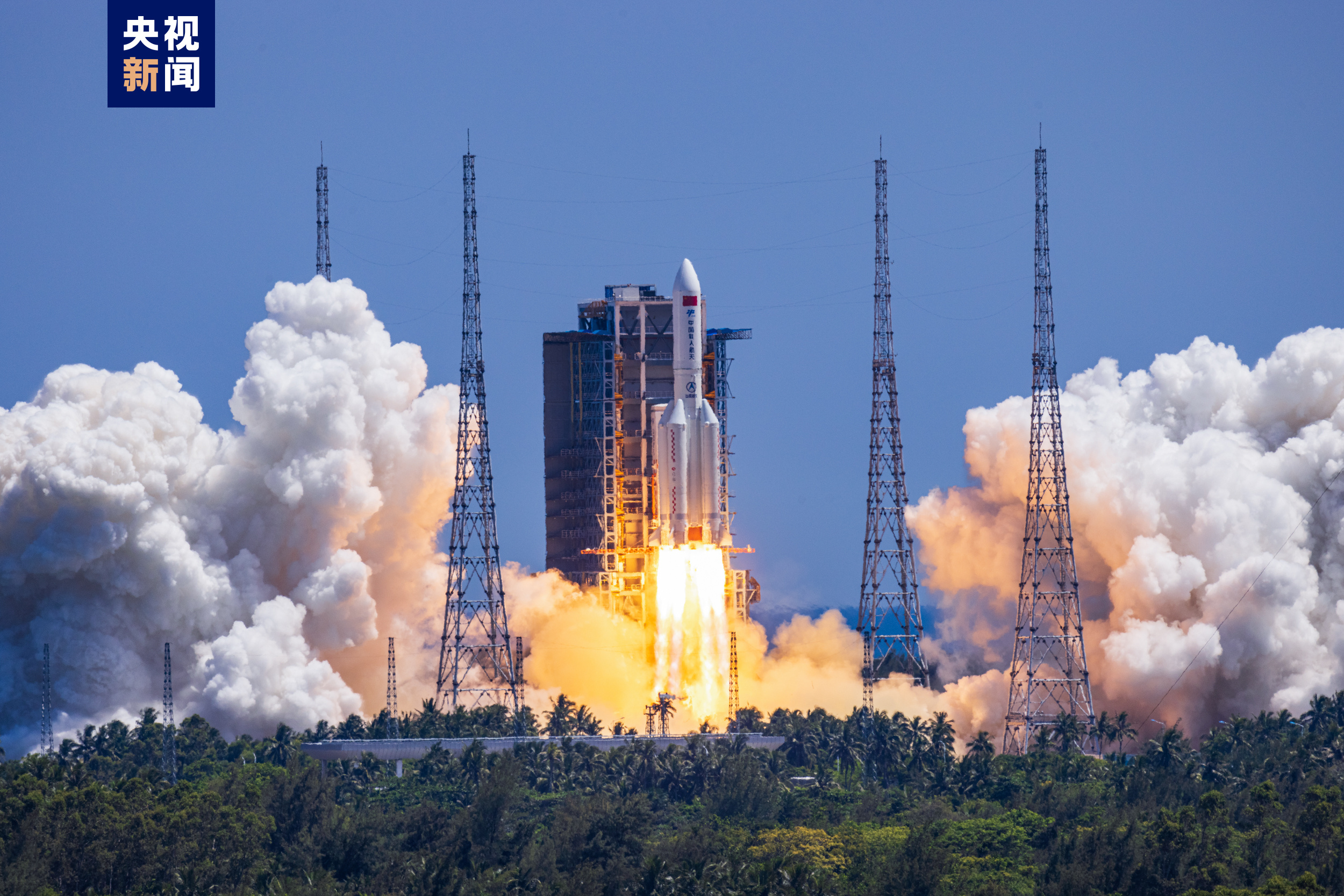
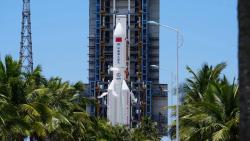
    The Long March-5B Y3 rocket, carrying Wentian (which means "quest for the heavens"), blasted off at 2:22 p.m. Beijing Time from the Wenchang Spacecraft Launch Site in south China's Hainan Province.

    Click here for CGTN's live coverage of the event.

    About eight minutes later, the lab module separated from the carrier rocket and entered its preset orbit. The China Manned Space Engineering Office (CMSEO) declared the launch mission a complete success.

    In the next few hours, the Wentian will rendezvous and dock with the Tianhe core module in orbit, forming the second part of China's three-module space station.

    On July 17, the Tianzhou-3 cargo craft undocked from Tianhe, leaving its front docking port for the upcoming Wentian lab module.

    The Shenzhou-14 crew currently in the core module will then enter the Wentian cabin. They will become the first Chinese astronauts to witness the docking of two large space station modules in orbit.

    The Long March-5B Y3 carrier rocket, carrying the Wentian lab module, blasts off from the Wenchang Spacecraft Launch Site in south China's Hainan Province, July 24, 2022. /CMG

    About the Wentian lab module

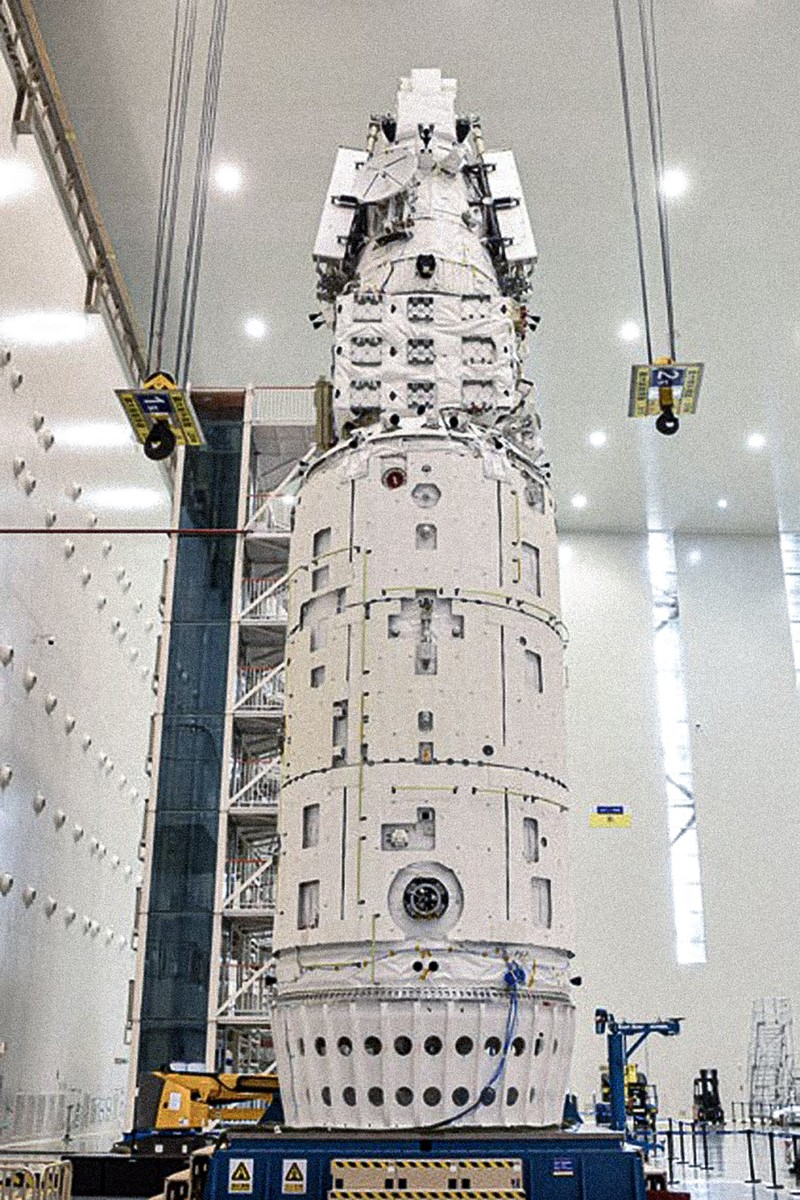
    With a length of 17.9 meters, a maximum diameter of 4.2 meters and a takeoff weight of 23 tonnes, the Wentian module is the largest and heaviest spacecraft China has developed.

    It has the same astronaut living facilities as the Tianhe core module, including three sleeping areas, a toilet and a kitchen.

    The lab module will provide a bigger platform for scientific experiments in space. It is mainly for space life science research. The module is equipped with laboratory cabinets for life ecology, biotechnology and variable gravity science.

    A small robotic arm half the weight and length of the existing robotic arm on the space station's core module is aboard the Wentian module. The robotic arm has a load capacity of about one-eighth of its predecessor, and its end positional accuracy is five times higher than its predecessor, allowing it to conduct more elaborate operations.

    The small robotic arm will have similar missions to its predecessor, including assisting astronauts during extravehicular activities and carrying out inspections of extravehicular conditions.

    The Wentian lab module. /Xinhua

    What's next?

    The Mengtian lab module, the final component of the space station, will be launched in October.

    By that time, China's space station will be expanded from the foundational core module into a basic T-shaped three-module structure, with the core module Tianhe in the center and the two lab modules, Wentian and Mengtian, on each side of it.

    Read more: What will China's space station be like once completed?

    The Mengtian module is for microgravity science research and is equipped with multi-disciplinary laboratory cabinets for fluid physics, materials science, combustion science, basic physics and aerospace technology experiments.

    Nearly 100 experiments are planned during the construction phase of the space station, said Lin Xiqiang, deputy director of the CMSEO, at a press conference before the launch of the Shenzhou-14 crewed mission in June.

    He said large-scale scientific research will be carried out after the operation is normalized. The research is expected to effectively promote breakthroughs in major frontier scientific fields, such as dark matter and dark energy, galaxy formation and evolution, the laws of nature and the sustainable development of the Earth.

    (CGTN's Bu Shi also contributed to the story.)

    Taking a Break with this animated 'finger roll'...Ever explore The Archives here? Go right >>

    Carly Simon - Nobody Does It Better - The Spy Who Loved Me

    Saturday, July 23, 2022

    KTR's High-Flying Arizona Strategies: Flashing Her Pearls in Ducey-Pence Road Show

     Gotcha-Girl Gubernatorial candidate Mesa-born millionaire real estate developer Katrin Taylor Robson


    Robson campaign denies she flew from Scottsdale to Glendale to campaign with Mike Pence

    By: - July 22, 2022 7:20 pm

    Karrin Taylor Robson’s campaign says the Republican candidate for governor didn’t hop on a private plane for an 11-minute flight from one Valley suburb to another to attend a campaign event Friday, despite claims from Democrats that she did exactly that. 

    “Neither Karrin nor any other participants in today’s campaign event in Peoria were on the plane that traveled from Scottsdale to Glendale,” Robson campaign spokesman Matthew Benson said in an emailed statement to the Arizona Mirror. Benson would not comment on the aircraft or answer questions about Robson’s travel to and from the campaign events.

    GET THE MORNING HEADLINES DELIVERED TO YOUR INBOX

    Democratic operatives on Twitter criticized Robson for the use of the private jet, which is registered to the address of her husband’s company. They compared it to the recent controversy over celebrity Kylie Jenner’s use of a private jet to fly 17 minutes from Van Nuys, a Los Angeles suburb, to the nearby town of Camarillo. 

    “Accelerated climate change sponsored by the ultra-rich,” said Lauren Kuby, a Democratic candidate for Corporation Commission. 

    One of the many criticisms of the use of private jets is the environmental impact private jets have on climate change. One private jet can emit two tons of CO2 in just one hour, and a 2016 study found that private jets alone produce 33.7 million metric tons of carbon dioxide.   

    Robson, a former university regent, is married to wealthy 92-year-old developer Ed Robson, whose company has built many popular active-adult communities across the state. 

    On Friday, she held two campaign events with former Vice President Mike Pence and Gov. Doug Ducey. The first was at TYR Tactical in Peoria at 11:45 a.m., while the second was at the National Border Patrol Council’s Office in Tucson at 2 p.m. 

    The aircraft in question left Scottsdale Municipal Airport at 10:33 a.m. and landed at Glendale Municipal Airport — a nine-minute drive from TYR Tactical — at 10:44 a.m.  Shortly before 1 p.m., the plane took off from Glendale and flew to Marana Regional Airport — a 19-minute drive from the National Border Patrol Council’s Office — and landed at 2:10 p.m. . 

    The jet Robson flew on usually costs at least $11 million costs on average around $600,000 a year to maintain, according to Guardian Jet.

    SUPPORT NEWS YOU TRUST.

    Our stories may be republished online or in print under Creative Commons license CC BY-NC-ND 4.0. We ask that you edit only for style or to shorten, provide proper attribution and link to our web site. Please see our republishing guidelines for use of photos and graphics.

    Jerod MacDonald-Evoy
    Jerod MacDonald-Evoy

    Reporter Jerod MacDonald-Evoy joins the Arizona Mirror from the Arizona Republic, where he spent 4 years covering everything from dark money in politics to Catholic priest sexual abuse scandals. Jerod has also won awards for his documentary films which have covered issues such as religious tolerance and surveillance technology used by police. He brings strong watchdog sensibilities and creative storytelling skills to the Arizona Mirror.

    MORE FROM AUTHOR

    ICE Barbie and Alleged Lover Face Ax as Trump Purges Goons

    The Daily Beast: The Latest in Politics, Media & Entertainment News   ICE Barbie and Alleged Lover Face Ax as Trump Purges Goons CLEANIN...