Wednesday, July 27, 2022

WORLD ECONOMIC OUTLOOK July 2022: International Monetary Fund

 A “The risks to the outlook are overwhelmingly tilted to the downside,” the I.M.F. said


According to the report, the likelihood of a global recession is rising. It said the probability of a recession starting in one of the Group of 7 advanced economies was now nearly 15 percent, four times its usual level. And it said some indicators suggested that the United States was already in a “technical” recession, which the I.M.F. defines as two consecutive quarters of negative growth.

Data set for release on Thursday is expected to show that the U.S. economy grew little or perhaps shrank in the second quarter of 2022.

At a news conference following the release of the report, Mr. Gourinchas added that the I.M.F. was not currently projecting that the United States was in a recession and that even if its economy contracted in the second quarter, defining a recession can be complicated.

“The recession in the way it is defined typically is looking at more than just output, you want to take into account the strength of the labor market,” Mr. Gourinchas said. “The general assessment as to whether the economy is in a recession overall is a little bit more complex.”

Mr. Gourinchas also suggested that the kind of “soft landing” that the Fed was trying to engineer — where it cools the economy just enough without setting off a recession — would be difficult to achieve.


The I.M.F. warns that a global recession could soon be at hand.

The International Monetary Fund downgraded its growth forecasts and projected higher inflation around the world

The world could soon be on the brink of a global recession as the economies of the United States, China and Europe slow more sharply than anticipated amid a collision of crises, the International Monetary Fund warned on Tuesday.

In an update of the World Economic Outlook, the I.M.F. said economic prospects had darkened significantly in recent months as war in Ukraine, inflation and a resurgent pandemic inflicted pain on every continent. If the thicket of threats continues to intensify, the world economy faces one of its weakest years since 1970, a period of intense stagflation across the globe.

“The world may soon be teetering on the edge of a global recession, only two years after the last one,” Pierre-Olivier Gourinchas, the I.M.F.’s chief economist, wrote in a blog post accompanying the report. Put simply, the outlook for the global economy is “increasingly gloomy,” he wrote.

The I.M.F. downgraded its global growth forecasts from its April projections, predicting that output will fall to 3.2 percent in 2022, from 6.1 percent last year. Growth is expected to slow even further next year as central banks around the world raise interest rates in an effort to tame inflation by cooling their economies.


Inflation is also rising more rapidly and broadly than the I.M.F. anticipated earlier this year. It now expects prices to rise 6.6 percent in rich countries and 9.5 percent in emerging markets and developing economies.

The international group also warned of another problem that could emerge as the Fed raises interest rates. Higher rates are expected to further strengthen the U.S. dollar as investors plow into Treasury bonds that offer lucrative returns. The I.M.F. said inflation in emerging markets could be amplified as the appreciation of the dollar made the imports that they bought with their local currencies more expensive.

imf world economic outlook july 2022 from m.youtube.com
Duration: 56:20
Posted: 20 hours ago
Global growth is projected to slow from an estimated 6.1 percent in 2021 to 3.6 percent in 2022 and 2023. This is 0.8 and 0.2 percentage points lower for 2022 ...
20 hours ago · The IMF announced on Tuesday (July 26, 2022) a 3.2% revised downward forecast to global growth in 2022 and 2.9% in 2023. · “The global economy is ...
Latest from imf.org
World Economic Outlook Update, July 2022: Gloomy and More Uncertain
International Monetary Fund 11 mins ago
Global Economic Growth Slows Amid Gloomy and More Uncertain Outlook
IMF Blog 19 hours ago

Tuesday, July 26, 2022

Time matters...yes it does

 Report today just now

Hackers scan for vulnerabilities within 15 minutes of disclosure

  • July 26, 2022
  • 03:44 PM

    Hackers scan for vulnerabilities within 15 minutes of disclosure

    • July 26, 2022
    • 03:44 PM
    • 0

    stopwatch

    System administrators have even less time to patch disclosed security vulnerabilities than previously thought, as a new report shows threat actors scanning for vulnerable endpoints within 15 minutes of a new CVE being publicly disclosed.

    According to Palo Alto's 2022 Unit 42 Incident Response Report, hackers are constantly monitoring software vendor bulletin boards for new vulnerability announcements they can leverage for initial access to a corporate network or to perform remote code execution.

    However, the speed at which threat actors begin scanning for vulnerabilities puts system administrators in the crosshairs as they race to patch the bugs before they are exploited.

    "The 2022 Attack Surface Management Threat Report found that attackers typically start scanning for vulnerabilities within 15 minutes of a CVE being announced," reads a companion blog post.

    Since scanning isn't particularly demanding, even low-skilled attackers can scan the internet for vulnerable endpoints and sell their findings on dark web markets where more capable hackers know how to exploit them.

    Then, within hours, the first active exploitation attempts are observed, often hitting systems that never had the chance to patch.

    Unit 42 presents CVE-2022-1388 as an example, a critical unauthenticated remote command execution vulnerability impacting F5 BIG-IP products.

    The flaw was disclosed on May 4, 2022, and according to Unit 42, by the time ten hours had passed since the announcement of the CVE, they had recorded 2,552 scanning and exploitation attempts.

    This is a race between defenders and malicious actors, and the margins for delays on either side are dwindling with every year that passes.

    Most exploited flaws in 2022

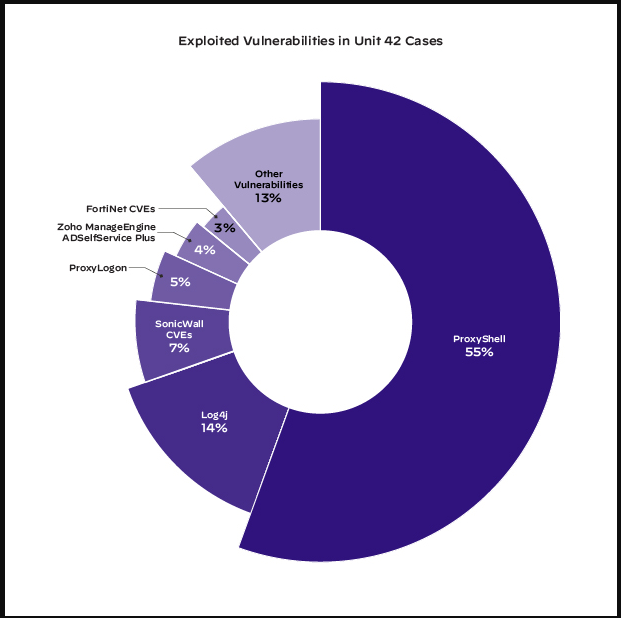
    Based on the data collected by Palo Alto, the most exploited vulnerabilities for network access in H1 2022 are the “ProxyShell” exploit chain, accounting for 55% of the total recorded exploitation incidents. ProxyShell is an attack exploited by chaining together three vulnerabilities tracked as CVE-2021-34473, CVE-2021-34523, and CVE-2021-31207.

    Log4Shell follows at second place with 14%, various SonicWall CVEs accounted for 7%, ProxyLogon had 5%, while the RCE in Zoho ManageEngine ADSelfService Plus was exploited in 3% of the cases.

    Most exploited flaws in H1 2022
    Most exploited flaws in H1 2022 (Unit 42)

    As it becomes evident from these stats, the lion’s share in the exploitation volume is captured by semi-old flaws and not the most recent ones.

    This happens for various reasons, including the attack surface size, exploitation complexity, and practical impact.

    More valuable and better-protected systems whose admins are quick to apply security updates are targeted with zero-days or attacks that unfold immediately after the disclosure of flaws.

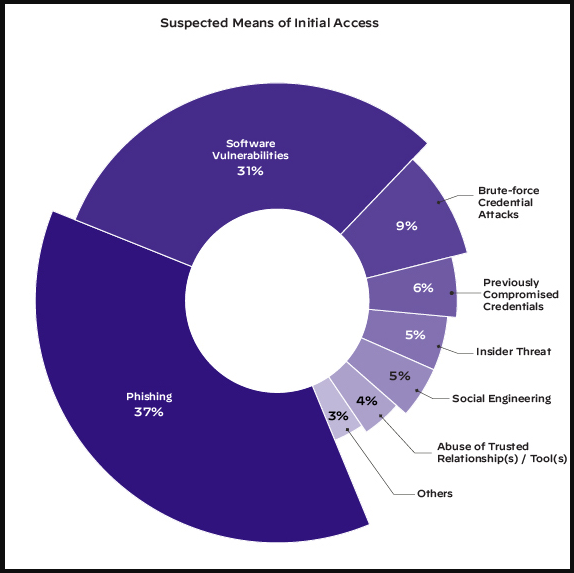
    It is also worth noting that according to Unit 42, exploiting software vulnerabilities for initial network breaches accounts for roughly one-third of the method used.

    In 37% of the cases, phishing was the preferable means for achieving initial access. Brute-forcing or using compromised credentials is how hackers penetrated networks in 15% of the cases.

    How attackers achieved initial access in H1 2022
    How attackers achieved initial access in H1 2022 (Unit 42)

    Finally, using social engineering tricks against privileged employees or bribing a rogue insider to aid in network access corresponds to 10% of the incidents.

    A race against the clock

    With system administrators, network admins, and security professionals already under significant stress as they try to keep up with the latest security threats and OS issues, the speed at which threat actors target their devices only adds additional pressure.

    Therefore, it is extremely important to keep devices off the Internet if possible, and only expose them through VPNs or other security gateways. By restricting access to servers, admins not only reduce the risk of exploits, but provide additional time to apply security updates before the vulnerabilities could be targeted internally.

    Unfortunately, some servives must be publicly exposed, requiring admins to tighten security as much as possible through access lists, exposing only the necessary ports and services, and applying updates as quickly as possible.

    While quickly applying a critical update may lead to downtime, this is much better than the ramifications of a full-blown cyberattack.

    Related Articles:

    Microsoft June 2022 Patch Tuesday fixes 1 zero-day, 55 flaws

    Metasploit 6.2.0 improves credential theft, SMB support features, more

    Android June 2022 updates bring fix for critical RCE vulnerability

    Exploit released for Atlassian Confluence RCE bug, patch now

    Hackers exploited PrestaShop zero-day to breach online stores

In Uvalde: Irrational Fear + A Systemic Failure

 327 first-responders - Federal and local - showed up...waited and waited

Irrational Fear Of Undocumented Immigrants May Have Contributed To Botched Response To Uvalde School Shooting

from the public-safety-efforts-that-make-the-public-less-safe dept

The bad news keeps pouring in. No doubt, the United States (and US law enforcement) will ultimately walk this debacle off, but it’s going to take just a bit longer this time.

The school shooting in Uvalde has undermined law enforcement’s self-portrayal as the thin line between the public and the criminal element. Hundreds of officers were on the scene, but after a brief exchange of gunfire, the officers retreated for more than an hour as the shooter fired dozens of shots into students and teachers at Robb Elementary.

Since then, law enforcement has been on the defensive. State agencies are still working to prevent the release of recordings captured by officers, under the theory it might show future shooters how inadequate first responder responses actually are. Despite being specifically instructed that sacrificing their safety is a prerequisite in situations where members of the public are in danger, nearly 400 officers remained out of harm’s way, allowing children and teachers to soak up the bullets they were unwilling to risk taking themselves.

There’s no single thing that was done wrong. Instead, there’s a long list of failures that cover everything from an inexplicable search for a room key (ridiculous, considering officers routinely destroy entire houses to gain access when they want to) to the simple fact that quality matters more than quantity when no one seems willing (or even capable) of responding efficiently to an active shooter situation.

One uniquely local contributing factor may have made this worse. Uvalde schools are apparently in lockdown mode frequently. When lockdowns are common, lockdowns just become another annoyance — a thing treated as an inconvenience, rather than a necessity.

When a majority of school lockdowns address no real threat to school safety, the tendency to view the procedure as an annoyance (if not possibly optional) increases. That’s what appears to be the case in Uvalde, Texas, which is about an hour north of the Mexican border. (That would also explain the overabundance of Border Patrol and state police officers at the scene of the shooting.)

Even though it’s an undeniable fact that immigrants are far less likely to commit crimes than natural born citizens, this is the standard m.o. in much of the state of Texas.

An entire generation of students in America has grown up simulating lockdowns for active shooters, or worse, experiencing the real thing. But in South Texas, another unique kind of classroom lockdown occurs along the state’s 1,200-mile southern border: hunkering down because Border Patrol agents or state police are chasing migrants who are trying to evade apprehension.

Uvalde is uniquely positioned to become a victim of complacency. Not only is it only an hour from the border, it is within minutes of several large immigrant detention centers. When immigrants escape facilities or avoid capture when spotted by border enforcement officers, lockdowns are triggered at nearby schools.

Even the first officers on scene at Robb Elementary wondered whether the threat was a so-called “bailout” — the term used by law enforcement along the border to describe suspected migrants or drug traffickers who have fled. Pete Arrendondo, the embattled Uvalde school police chief who has become the target of angry demands by parents to resign or be fired, told the House committee the thought crossed his mind since it happens so often.

This is apparently standard procedure despite there being no evidence migrants on the run have ever sought to use schools as hideouts or committed any violence on school campuses.

Making things even worse is that school alert systems do not specify the reason for a lockdown. That may have led teachers and administrators to believe the Robb Elementary lockdown was just another “migrant in the area” reaction, further delaying police response and/or making officers believe they were looking for a (non-dangerous) person simply trying to avoid being deported.

And it’s apparently not going to get any better or any less stupid. This irrational fear of undocumented immigrants may have contributed to the botched response to this shooting. That this form of tragic lightning rarely strikes twice doesn’t justify the city’s mayor deciding — even after reviewing this report — that local schools need more lockdowns in response to non-threats, rather than fewer.

Uvalde Mayor Don McLaughlin, who said he has not spoken to (Governor) Abbott for nearly a month, has called on the governor to do even more on the border to curb migrant crossings. With classes set to re-start in less than two months, he worries about “the bailouts by the schools and so forth” and said “it needs to stop.”

The problem isn’t the “bailouts.” It’s the response. An alert system that generates panic without info isn’t helping. Pretending every mobile brown person without proper papers poses a threat to schools despite there being no evidence of this ever happening just stokes irrational fears and makes actual threats tougher to detect and even tougher to respond to.

Filed Under: , , , , ,

ARIZONA 'Medical Marijuana' Law in International News...Concealed Carry-On

 An amazing combination of real life circumstances when a WNBA All-Star "packed too fast and got caught at a Russian airport security check 

ADVERTISEMENT
Click to copy

Russian expert at Griner’s trial discusses medical cannabis

today

KHIMKI, Russia (AP) — The drug trial of American basketball star Brittney Griner in a Russian court focused Tuesday on testimony that cannabis, while illegal in Russia, is regarded in other countries as having legitimate medicinal use.

Griner acknowledged in court earlier this month that she was carrying vape canisters containing cannabis oil when she was arrested in February at a Moscow airport. But she contends she had no criminal intent and that the canisters ended up in her luggage inadvertently because of hasty packing.

“We are not arguing that Brittney took it here as a medicine. We are still saying that she involuntarily brought it here because she was in a rush,” defense attorney Alexander Boykov said after the hearing.

Another member of Griner’s defense team previously submitted a U.S. doctor’s letter recommending the basketball player use medical cannabis to treat pain. During Tuesday’s court session, a Russian neuropsychologist testified about worldwide use of medicinal cannabis. “The Russian public has to know, and the Russian court in the first place has to know, that it was not used for recreational purposes in the United States. It was prescribed by a doctor,” lawyer Boykov said."

Top stories

 https://www.theguardian.com/sport/2022/jul/26/brittney-griners-legal-team-argue-cannabis-has-legitimate-medical-use

2 of Mesa's 'Hometown Non-Partisan' Politicians Got Censored by AZ GOP

 This might be some hyperlocal breaking-bad news Meanwhile, the LD 10 Republican Committee in Mesa censure Mayor John Giles for endosring an unnamed Democratic candidate in the Aug. 2 primary, calling on local GOP memners to "cease recognition" of him as a Republican an


d to cease supporting him in any future election. Giles could not be reached for comment.....

top story

GOP censures Mesa lawmaker, Mayor Giles


Bowers

State House Majority Leader Rusty Bowers is in a primary fight with former Sen. David Farnsworth for the Republican nomination for the Senate in the east Mesa Legislative District 10. (Cronkite News)

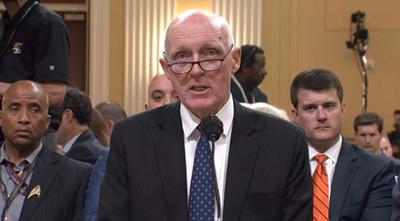
The Arizona Republican Party formally censured House Speaker Rusty Bowers July 19 as “unfit to serve” the party, less than one month after he testified to the committee investigating the Jan. 6 Capitol attack.

The move came as Bowers is locked in a primary election fight with former state Sen. David Farnsworth for the Republican nomination for the state Senate seat in Legislative District 10 covering part of east Mesa. 

Meanwhile, the LD 10 Republican Committee in Mesa censure Mayor John Giles for endosring an unnamed Democratic candidate in the Aug. 2 primary, calling on local GOP memners to "cease recognition" of him as a Republican and to cease supporting him in any future election. Giles could not be reached for comment.

The state GOP censure resolution makes no mention of the congressional testimony by Bowers, who detailed former President Donald Trump’s efforts to overturn the 2020 election in what Bowers called a “tragic parody” that would have forced him to violate his oath of office.

Instead, the two-page resolution cites a litany of issues where it said Bowers worked with Democrats on issues ranging from election reform to school funding to LGBTQ rights. 

As a result, the resolution said, Bowers has “lost the confidence of a majority of Republican Party leaders” and it ended “any and all recognition and support of him as a member of” the party.

Despite the stated justifications, most analysts said they have little doubt about what was behind the censure.


Silicon Valley Mastermind - Who’s behind Palantir's "Gotham" surveillanc...

   Jan 2, 2026 #documentary #dwdocumentary #dwdocs   Palantir is considered one of the most opaque companies in the field of big data...